
WATER BALANCE DISORDERS Fluid deficiency l Volume depletion
WATER BALANCE DISORDERS Fluid deficiency l Volume depletion (hypovolemia) l ** Dehydration Fluid excess l Volume excess (hypervolemia) l ** Hypotonic hydration (water intoxication)

WATER BALANCE DISORDERS FLUID DEFICIENCY: DEHYDRATION l Caused by loss of more water than Na+ l Total body water decreases l Tissue fluid osmolarity increases l Causes Lack of drinking water l Diabetes mellitus l Anti-Diuretic hormone hyposecretion l Profuse sweating l Overuse of diuretics l
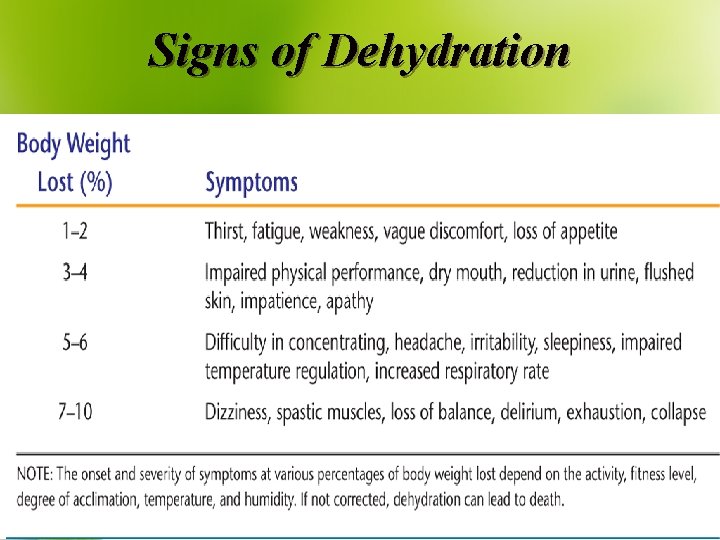
Signs of Dehydration
EFFECTS OF FLUID DEFICIENCY l Circulatory shock l Due to loss of blood volume l Neurological dysfunction l Due to dehydration of brain cells
WATER BALANCE DISORDERS: FLUID EXCESS l Arises when water input exceeds output l Less common since kidneys effective at compensating for excess body water by increasing urine output; however, in cases of renal failure or aldosterone hypersecretion excess fluid retention
WATER BALANCE DISORDERS: FLUID EXCESS Hypotonic Hydration “Water intoxication” or “Positive water Balance” l It occurs when more water than Na+ retained or ingested body fluids become hypotonic cells swell, possibly burst , Total body water increased, Tissue fluid osmolarity decreases Causes l Excessive water intake, esp. after profuse sweating l Replacement of water and salt with water l Lack of proportionate intake of electrolytes l Anti-Diuretic hormone hypersecretion excessive water reabsorption
EFFECTS OF FLUID EXCESS l Pulmonary edema l Cerebral edema
Why it is desirable avoiding drinking water while eating ? • Water dilutes the digestive juices in the stomach thus leading to indigestion. • Water leaves the stomach within five to ten • minutes of drinking and therefore some of the food is also likely to be adversely affected It is desirable that you drink water on empty stomach or three hours after food or one to one and half hours before meals
How should you drink water ? • At-Tirmidhi narrated that the Prophet said : “Do not drink in one breath just as the camel does. Rather, drink twice and thrice, and mention (Allah's) Name before drinking and thank (Him) upon finishing” ﺍﺷﺮﺑﻮﺍ ﻣﺜﻨﻰ : ﻛﺸﺮﺏ ﺍﻟﺒﻌﻴﺮ ﻭﻟﻜﻦ : ﻻ ﺗﺸﺮﺑﻮﺍ ﻧﻔﺴﺎ ﻭﺍﺣﺪﺍ ) ( ﻭﺍﺣﻤﺪﻭﺍ ﺇﺫﺍ ﺃﻨﺘﻢ ﻓﺮﻏﺘﻢ ، ﻭﺳﻤﻮﺍ ﺇﺫﺍ ﺃﻨﺘﻢ ﺷﺮﺑﺘﻢ ، ﻭﺛﻼﺙ • Muslim narrated that Anas ﺭﺿﻲ ﺍﻟﻠﻪ ﻋﻨﻪ said the Messenger of Allah used to sip the water in three separate breathes and would say “This method quenches the thirst better and is more palatable and sanitary” ( )ﺇﻧﻪ ﺃﺮﻭﻱ ﻭ ﺃﻤﺮﺃ ﻭ ﺃﺒﺮﺃ
How should you drink water ? Most people tend to drink water in large gulps. l You need to drink water sip by sip and chew it in the mouth in order to mix it with the saliva. l Avoid regular use of straws for drinking water and or fluids l
Can water be substituted with other drinks ? No, there is no fitting substitute for water. l Drinking tea , coffee, aerated drinks are not desirable substitutes for water. Although these fluids contain water , they also contain substances that cause dehydration l As a result , the body not only excretes the water in these beverages but also some water that is reserved in the body l Regular intake of aerated drinks and juices automatically reduces the urge to drink water l
What is the best type of water for drinking ? l The best type of water to drink is the pure , soft one to which no minerals are added. This is because the minerals may either be rejected or deposited in some parts of the body , thus causing heath problems. l It is necessary to purify water which will be used for drinking and for therapy
Does temperature of the drinking water affect health? Cold water from natural sources ( which is not cooled in a refrigerator or with ice ) is fit for drinking for the following reasons: Lowers the body temperature Dilute the blood to the required consistency Promotes excretion of poisons from the skin in the form of evaporation Stimulates the normal functions of the kidneys and therefore increase the rate of removal of poisons from the body through the urine Increase the movements of intestines thus facilitating formation and passing of soft stools
Does temperature of the drinking water affect health? Hot water benefits are : Stimulation of the inner lining of the stomach and contraction of its blood vessels. As a result there is less blood circulation in the lining of the stomach. This lead to reduced activity of the glands that secrete acids in the stomach. Thus you are less likely to suffer from increased acids secretions in the stomach. Hot water cleans the stomach , relieves heartburn, flatulence acute indigestion , vomiting and cramps in the abdomen. Drinking hot water is not recommended for those who suffer from ulcers in the stomach. It is important to remember that hot water should be sipped and not gulped.
What is hydrotherapy ? l l i. iii. Is a branch of healing systems that deals with the management of some diseases by using water , either by as an external application or taken internally or both. Water is used for hydrotherapy because of the following reasons : It has immense power for absorbing and communicating heat Water is a universal solvent. This means that majority of the substances can dissolve in water Water can be easily frozen to a solid state as ice or heat to gaseous form as vapour.
How is water used in management of diseases ? l Water is used in various forms for maintaining health and management of several diseases which include : Temperature : different temperatures of water used for different health problems. For example , cold water , warm or neutral water and hot water Packs : water is used as cold packs , hot packs and partial body packs. Water packs are prepared by soaking several layers of cotton or muslin in either hot or cold water. Water packs relieve congestion of the internal organs , pain , swelling and spasm. There are several types of packs like throat pack, chest pack , abdominal pack and joint pack.
How is water used in management of diseases ? Baths: There are four main types of baths. These include : l Immersion bath in which the entire body is immersed in water l Size bath , in which only the buttock or hips are immersed in water or salt solution l Sweating bath such as vapour bath or hot air bath l Medicated baths such as brine bath, sulphur bath foam bath , etc Douches : water is also used as jet sprays and douches. Douche is a procedure in which medicine or cleansing agent mixed with warm water is introduced into the vagina under low pressure
How is water used in management of diseases ? Drinking: l it plays an important role in management of health and disease l Drinking naturally cold water has tonic effect while application of ice cold water used to reduce fever. l Drinking water is like having a bath for the internal organs of the body. l It helps purify and dilute the blood l It also increase output of urine by activating the kidneys to remove waste products from the body. l Drinking large quantities of water helps the blood to carry the energy and nutritive parts of the digested food to the relevant parts of the body l It increases the blood and lymph circulation l It helps maintain normal functions of most glands of the body.
How is water used in management of diseases ? Irrigations : Is the term used when running water is used for cleaning different parts of the body and it include: Enema : it is a procedure in which water is introduced in the lower part of the large intestine and it also called (colon irrigation). The main purpose of the enema is to cleanse the lower part of the large intestine. There are warm , neutral and cold enema which are used for many conditions like chronic constipation , improvement of normal movements of the intestine Nasal irrigation : irrigation of the nose with warm water is usually recommended for sinusitis. Irrigation of the ears : used for infected ear , especially if there is discharge of pus or other liquid Vaginal irrigation : It is recommended in case of white discharge or after menstruation to remove the remaining blood clots from the vagina
Example of health hazards due to chronic deprivation of water to specific organs of the body DYSPEPSIA l It is the term used for a vague feeling of discomfort like fullness , l heartburn, or nausea in the stomach region soon after eating food
Why inadequate water can lead to dyspepsia ? There are two main reasons i. Increased acids in the stomach : the water forms a protective layer on the inner lining of the stomach so when the water content in the protective layer decreases , the acid comes in contact with the inner layer of the stomach and causes pain ii. Changes in the normal functions of the pancreas: when the pancreas does not get adequate water from blood circulation , there is inadequate secretion of watery bicarbonate solution. As a result , the intestine is not able to send effective messages to the pyloric valve to allow food to enter (Fig. 3 ) l
How does drinking more water prevent dyspepsia ? l Drinking a glass of water especially on empty stomach , passes into the intestine immediately and absorbed into the body. After one to one and half hours the absorbed water is secreted into the stomach through its inner layer and as a result removes the excess salt deposits on it. Thus the protective layer of water remain intact and therefore the acid cannot penetrate the layer. This is why nature cure recommends drinking water at least an hour before meal.
- Slides: 22