
Water and the Fitness of the Environment for
- Slides: 16
Water and the Fitness of the Environment (for life) Chapter 2
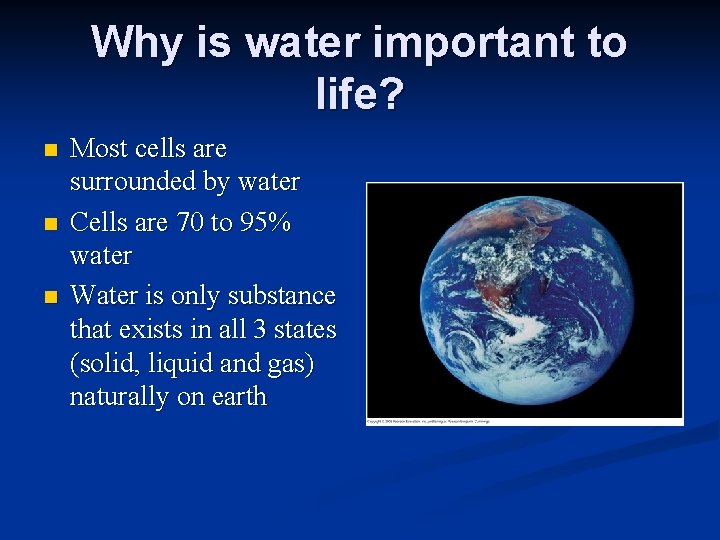
Why is water important to life? n n n Most cells are surrounded by water Cells are 70 to 95% water Water is only substance that exists in all 3 states (solid, liquid and gas) naturally on earth
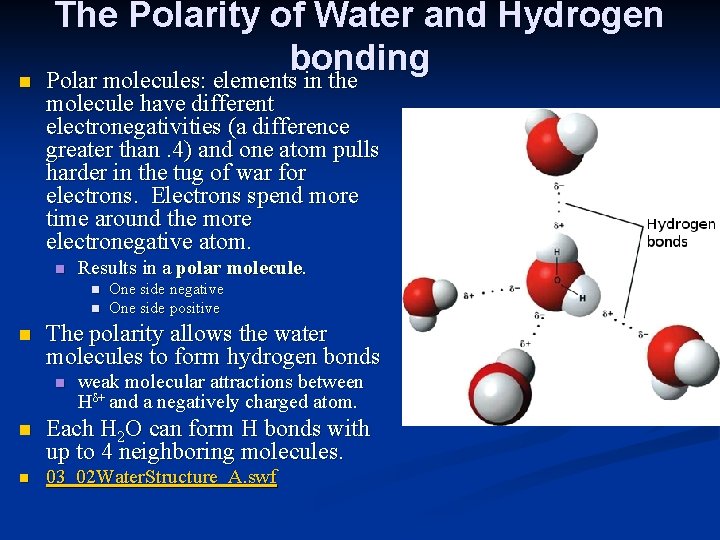
n The Polarity of Water and Hydrogen bonding Polar molecules: elements in the molecule have different electronegativities (a difference greater than. 4) and one atom pulls harder in the tug of war for electrons. Electrons spend more time around the more electronegative atom. n Results in a polar molecule. n n n One side negative One side positive The polarity allows the water molecules to form hydrogen bonds n weak molecular attractions between Hδ+ and a negatively charged atom. n Each H 2 O can form H bonds with up to 4 neighboring molecules. n 03_02 Water. Structure_A. swf
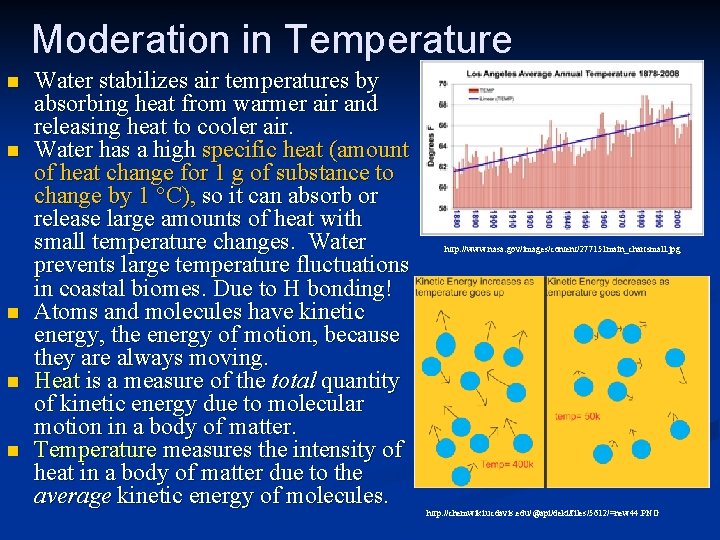
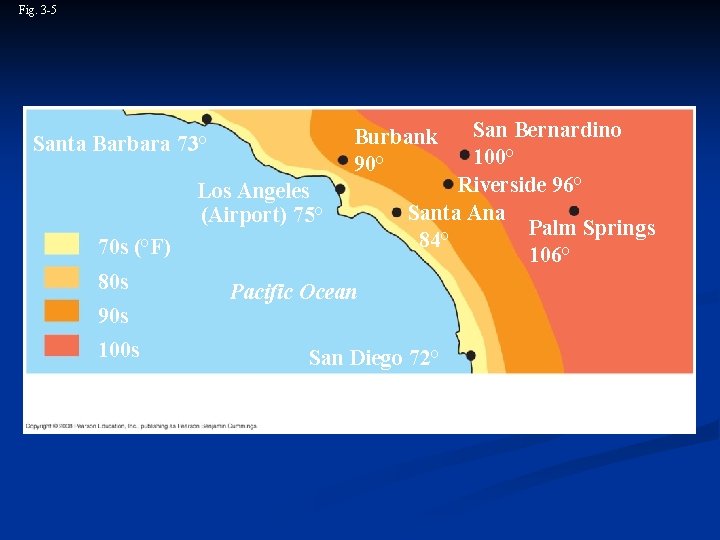
Moderation in Temperature n n n Water stabilizes air temperatures by absorbing heat from warmer air and releasing heat to cooler air. Water has a high specific heat (amount of heat change for 1 g of substance to change by 1 °C), so it can absorb or release large amounts of heat with small temperature changes. Water prevents large temperature fluctuations in coastal biomes. Due to H bonding! Atoms and molecules have kinetic energy, the energy of motion, because they are always moving. Heat is a measure of the total quantity of kinetic energy due to molecular motion in a body of matter. Temperature measures the intensity of heat in a body of matter due to the average kinetic energy of molecules. http: //www. nasa. gov/images/content/277151 main_chartsmall. jpg http: //chemwiki. ucdavis. edu/@api/deki/files/5612/=new 44. PNG
Fig. 3 -5 Los Angeles (Airport) 75° 70 s (°F) 80 s 90 s 100 s San Bernardino 100° Riverside 96° Santa Ana Palm Springs 84° 106° Burbank 90° Santa Barbara 73° Pacific Ocean San Diego 72° 40 miles
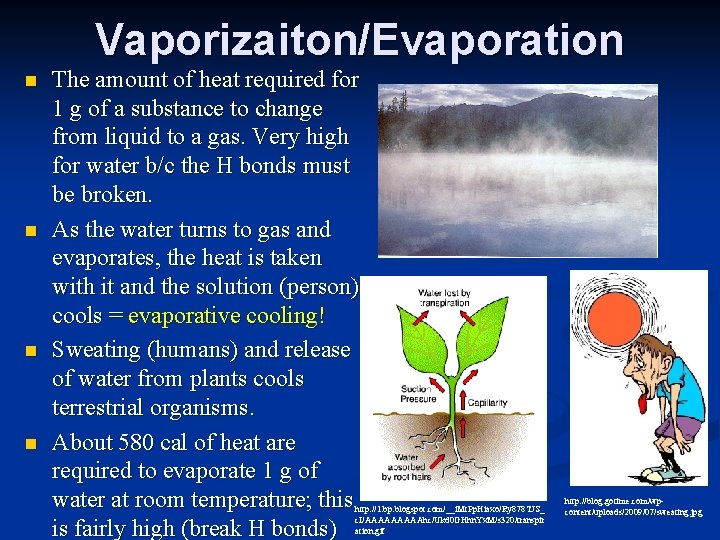
Vaporizaiton/Evaporation n n The amount of heat required for 1 g of a substance to change from liquid to a gas. Very high for water b/c the H bonds must be broken. As the water turns to gas and evaporates, the heat is taken with it and the solution (person) cools = evaporative cooling! Sweating (humans) and release of water from plants cools terrestrial organisms. About 580 cal of heat are required to evaporate 1 g of water at room temperature; this is fairly high (break H bonds) http: //1. bp. blogspot. com/__i. Mt. Pp. Hiaxo/Ry 878 TJS_ c. I/AAAAAhc/Ukd 0 GHhn. Yx. M/s 320/transpir ation. gif http: //blog. gotime. com/wpcontent/uploads/2009/07/sweating. jpg
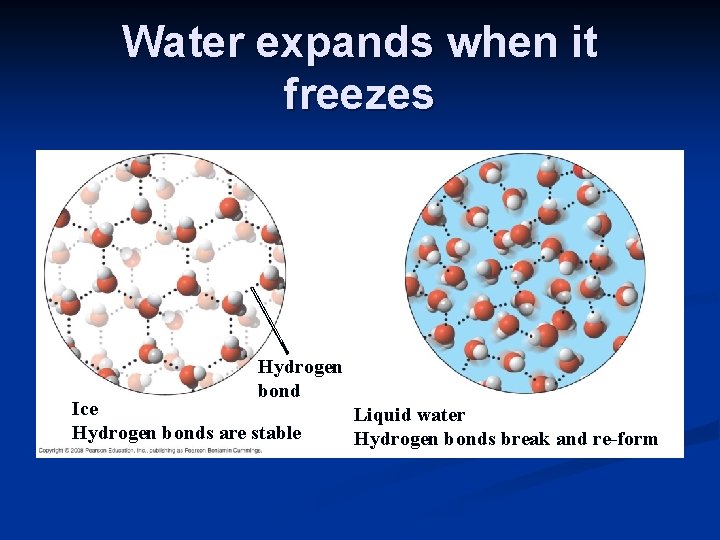
Water expands when it freezes Hydrogen bond Ice Hydrogen bonds are stable Liquid water Hydrogen bonds break and re-form
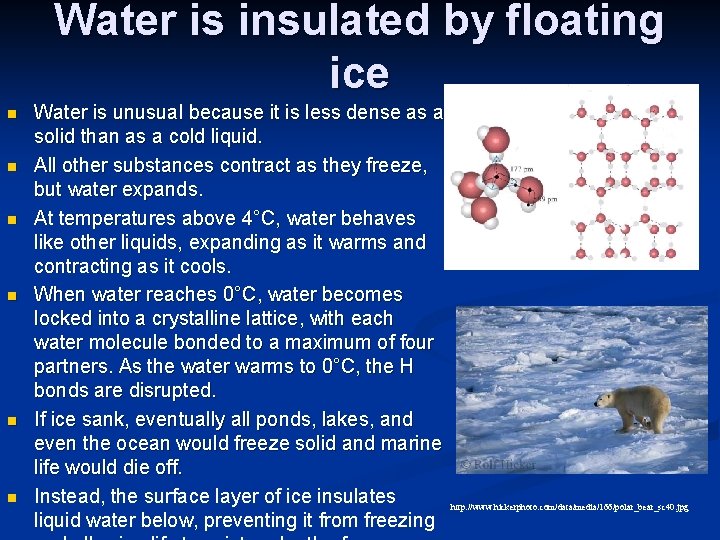
Water is insulated by floating ice n n n Water is unusual because it is less dense as a solid than as a cold liquid. All other substances contract as they freeze, but water expands. At temperatures above 4°C, water behaves like other liquids, expanding as it warms and contracting as it cools. When water reaches 0°C, water becomes locked into a crystalline lattice, with each water molecule bonded to a maximum of four partners. As the water warms to 0°C, the H bonds are disrupted. If ice sank, eventually all ponds, lakes, and even the ocean would freeze solid and marine life would die off. Instead, the surface layer of ice insulates liquid water below, preventing it from freezing http: //www. hickerphoto. com/data/media/166/polar_bear_sc 40. jpg
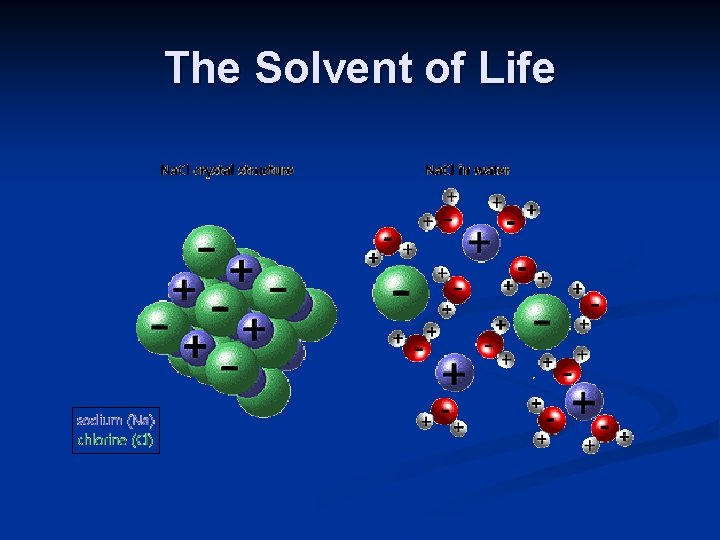
The Solvent of Life
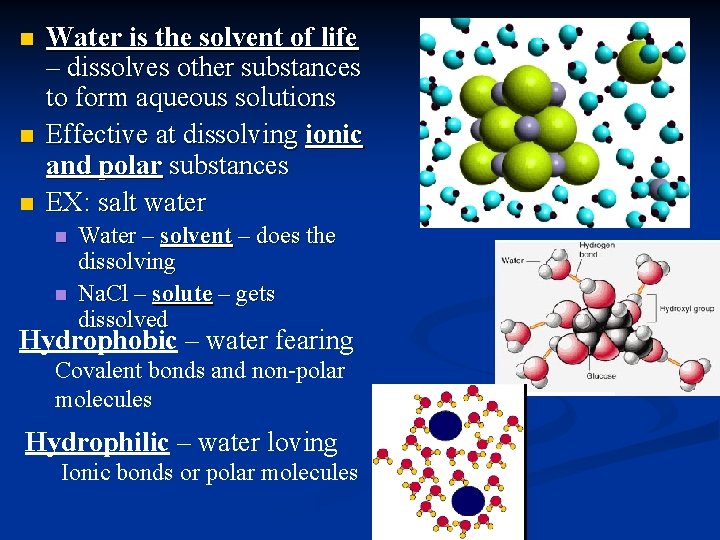
n n n Water is the solvent of life – dissolves other substances to form aqueous solutions Effective at dissolving ionic and polar substances EX: salt water n n Water – solvent – does the dissolving Na. Cl – solute – gets dissolved Hydrophobic – water fearing Covalent bonds and non-polar molecules Hydrophilic – water loving Ionic bonds or polar molecules
Biology and the Mole. n n n Remember that the amount of a substance in chemical reaction is measured in moles. One mole is 6. 02 x 1023 of any substance. The mass of the substance off the periodic table in grams is equal to one mole. We measure concentration with Molarity M= Moles of solute/Liters of solution To make a 1 molar (1 M) solution of sucrose (C 12 H 22 O 11), we would slowly add water to 342 g (molar mass) of sucrose until the total volume was 1 liter and all the sugar was dissolved. Sometimes it is necessary to heat a solution to dissolve all of the solute.
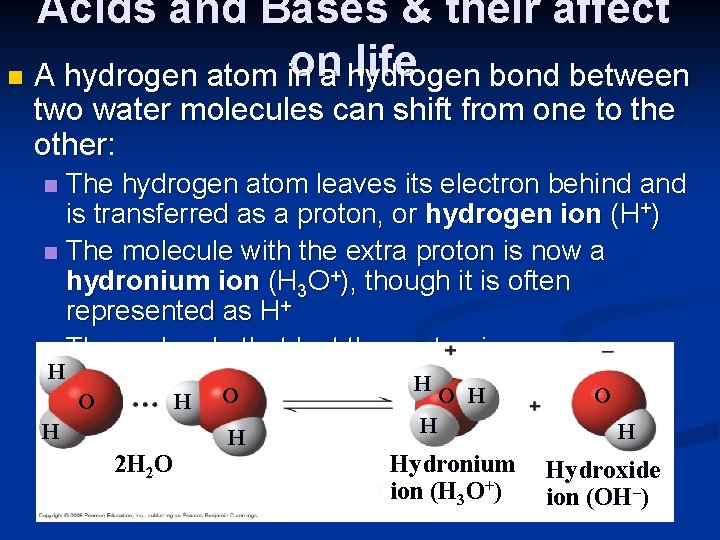
Acids and Bases & their affect on life n A hydrogen atom in a hydrogen bond between two water molecules can shift from one to the other: The hydrogen atom leaves its electron behind and is transferred as a proton, or hydrogen ion (H+) n The molecule with the extra proton is now a hydronium ion (H 3 O+), though it is often represented as H+ n The molecule that lost the proton is now a Hhydroxide ion (OH–) H n O H H 2 H 2 O O H H Hydronium ion (H 3 O+) O H Hydroxide ion (OH–)
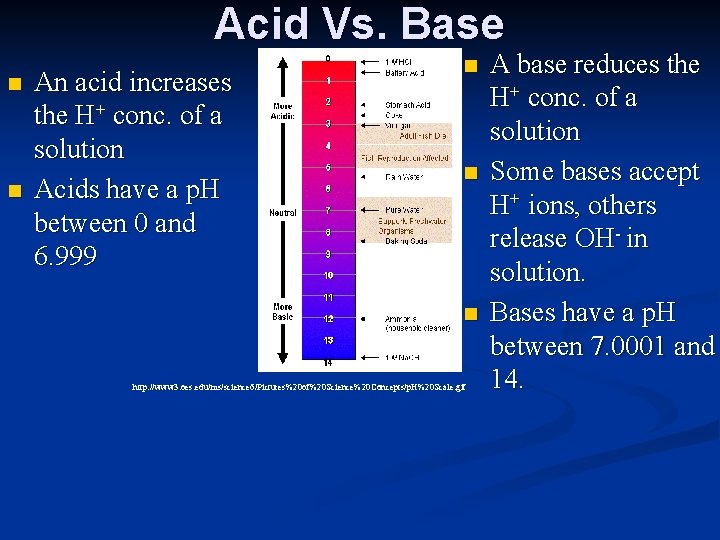
Acid Vs. Base n n An acid increases the H+ conc. of a solution Acids have a p. H between 0 and 6. 999 n n n http: //www 3. oes. edu/ms/science 6/Pictures%20 of%20 Science%20 Concepts/p. H%20 Scale. gif A base reduces the H+ conc. of a solution Some bases accept H+ ions, others release OH- in solution. Bases have a p. H between 7. 0001 and 14.
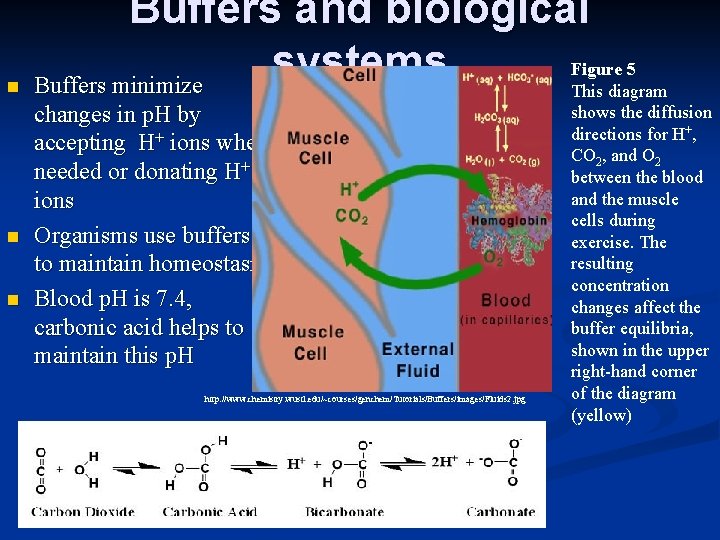
n n n Buffers and biological Figure 5 systems Buffers minimize This diagram changes in p. H by accepting H+ ions when needed or donating H+ ions Organisms use buffers to maintain homeostasis. Blood p. H is 7. 4, carbonic acid helps to maintain this p. H http: //www. chemistry. wustl. edu/~courses/genchem/Tutorials/Buffers/images/Fluids 2. jpg shows the diffusion directions for H+, CO 2, and O 2 between the blood and the muscle cells during exercise. The resulting concentration changes affect the buffer equilibria, shown in the upper right-hand corner of the diagram (yellow)
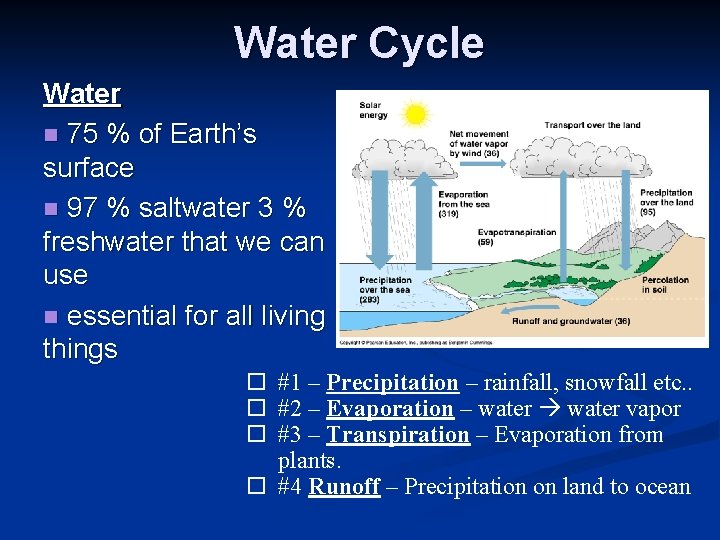
Water Cycle Water n 75 % of Earth’s surface n 97 % saltwater 3 % freshwater that we can use n essential for all living things #1 – Precipitation – rainfall, snowfall etc. . #2 – Evaporation – water vapor #3 – Transpiration – Evaporation from plants. #4 Runoff – Precipitation on land to ocean
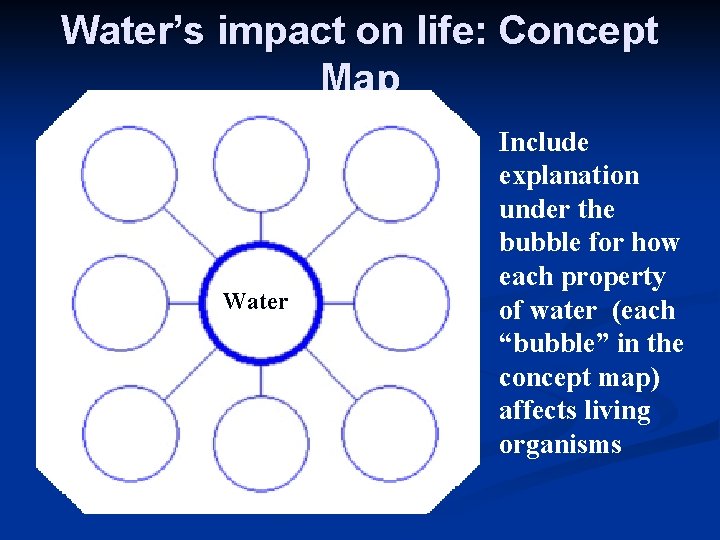
Water’s impact on life: Concept Map Water Include explanation under the bubble for how each property of water (each “bubble” in the concept map) affects living organisms