
Water Analysis Protocol Marine Chemistry Lab Practical Parameters
Water Analysis Protocol Marine Chemistry Lab Practical
Parameters to Measure. . . Water Sampling Collection p. H Temperature & Salinity Dissolved Oxygen (D. O. ) Carbon Dioxide (CO 2) Nitrates (NO 3 -) Plankton Turbidity n Phosphates (PO 4 -3) n n n n
Water Sampling & Analysis RULE OF THREE n Rinse container and discard with sample water twice n Keep the third sample
Dissolved Oxygen Test Winkler Titration Method Two Parts n 1. Fixation Procedure (“Pickling”) n 2. Titration n
Fixation Procedure (“Pickling”) n 1. Add 2 m. L of manganeese sulfate (Mn. SO 4) about 1 cm below the surface of the water. Mix and let precipitate settle. n 2. Add 2 m. L of alkaline iodide (Na. I) reagent about 1 cm below the surface of the water. Re-stopper BOD bottle and rock back and forth to mix thoroughly and let precipitate settle.
Fixation cont. n 3. Add 2 m. L of concentrated sulfuric acid (H 2 SO 4) allowing acid to run down the inside of the neck of bottle. Restopper and rock back and forth to mix. Precipitate will disappear and an orangish-brown solution will remain.
Dissolved Oxygen (O 2) “Pickling” Summary n Add 2 m. L of manganesse solution n Add 2 m. L of iodine solution n Add 2 m. L of conc. Sulfuric acid
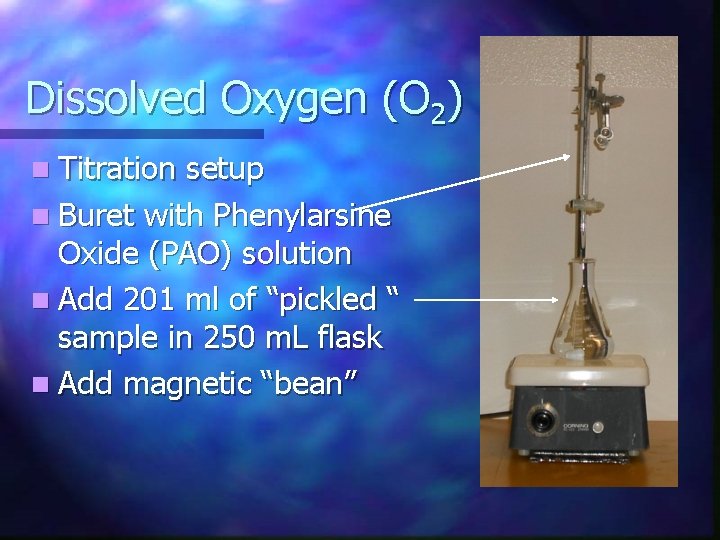
Dissolved Oxygen (O 2) n Titration setup n Buret with Phenylarsine Oxide (PAO) solution n Add 201 ml of “pickled “ sample in 250 m. L flask n Add magnetic “bean”
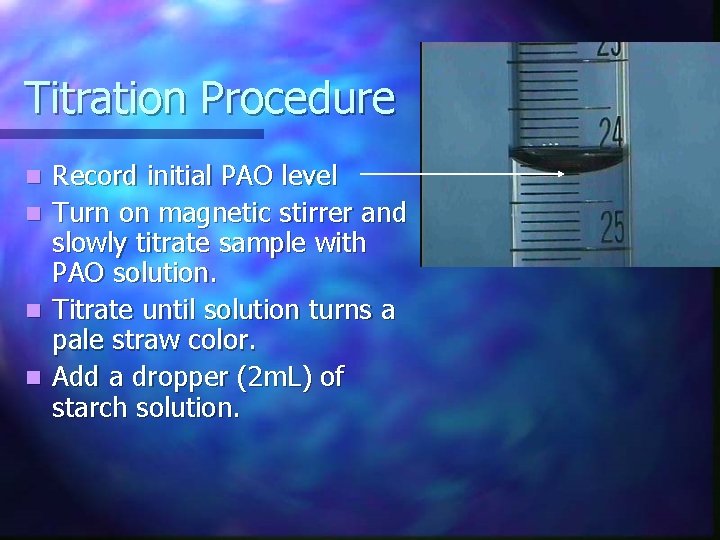
Titration Procedure Record initial PAO level n Turn on magnetic stirrer and slowly titrate sample with PAO solution. n Titrate until solution turns a pale straw color. n Add a dropper (2 m. L) of starch solution. n
O 2 Titration Procedure (cont. ) n Titrate drop by drop until the blue indicator first disappears (end point). n Record the final level of PAO solution. n The amount of dissolved oxygen is equal to the amount of PAO used and measured in mg/L or ppm.
Determining the % Oxygen Saturation n Locate your temperature and salinity values on the nomogram n Use a straight edge to connect the two values n Record the O 2 solubility to the nearest tenth n Find the quotient of D. O. /O 2 solubility n Multiply by 100 to put into %
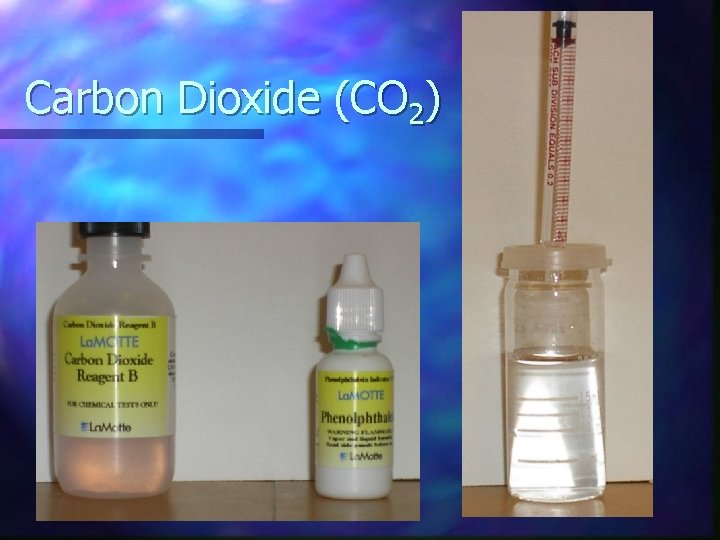
Carbon Dioxide (CO 2)
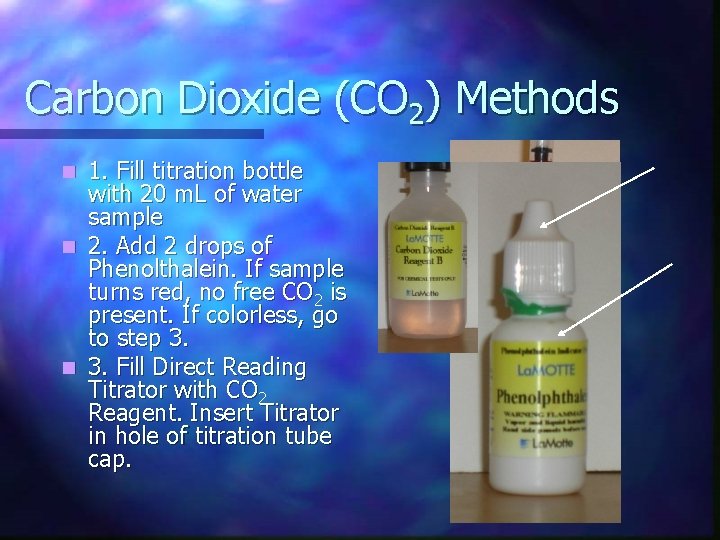
Carbon Dioxide (CO 2) Methods 1. Fill titration bottle with 20 m. L of water sample n 2. Add 2 drops of Phenolthalein. If sample turns red, no free CO 2 is present. If colorless, go to step 3. n 3. Fill Direct Reading Titrator with CO 2 Reagent. Insert Titrator in hole of titration tube cap. n
Carbon Dioxide Methods (cont) n 4. While gently swirling, add reagent drop by drop until a faint pink color develops (must persist at least 30 seconds) n 5. Read where plunger tip meets Titrator scale. Record as ppm.
Plankton
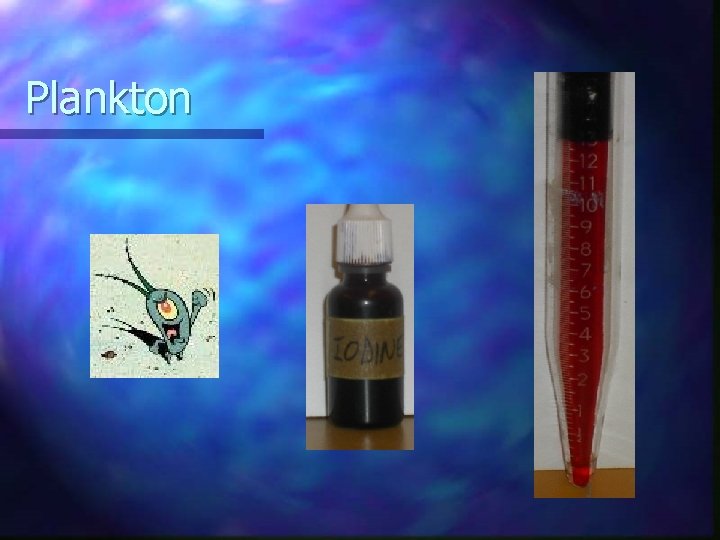
Plankton “Pickling” n 1. Draw 3 m. L of sample water into graduated test tube using pipette n 2. Add 2 drops of iodine solution n 3. Let stand overnight or centrifuge for 3: 00 minutes.
Plankton Analysis n 1. Pipette off the top 2 m. L of pickled sample and discard n 2. Place one drop of sample onto depression slide and examine n 3. Examine drop by drop to completion
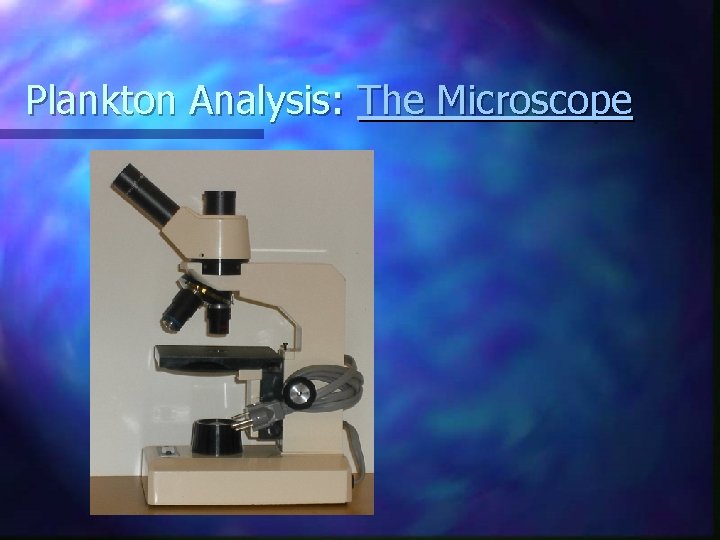
Plankton Analysis: The Microscope
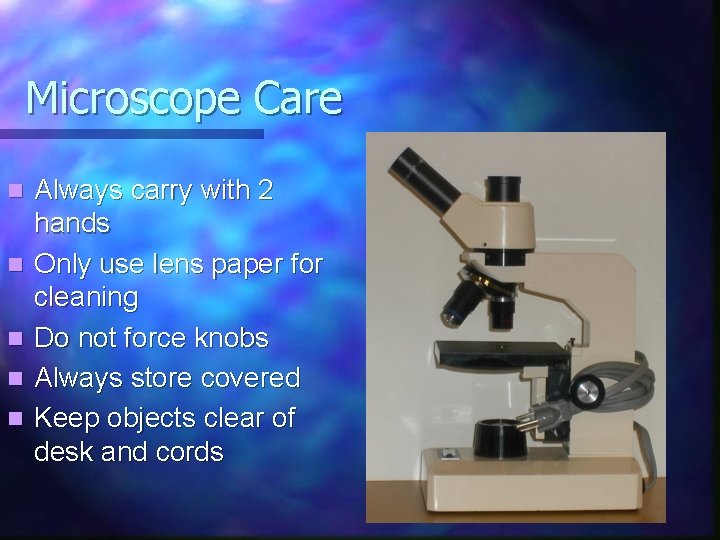
Microscope Care n n n Always carry with 2 hands Only use lens paper for cleaning Do not force knobs Always store covered Keep objects clear of desk and cords
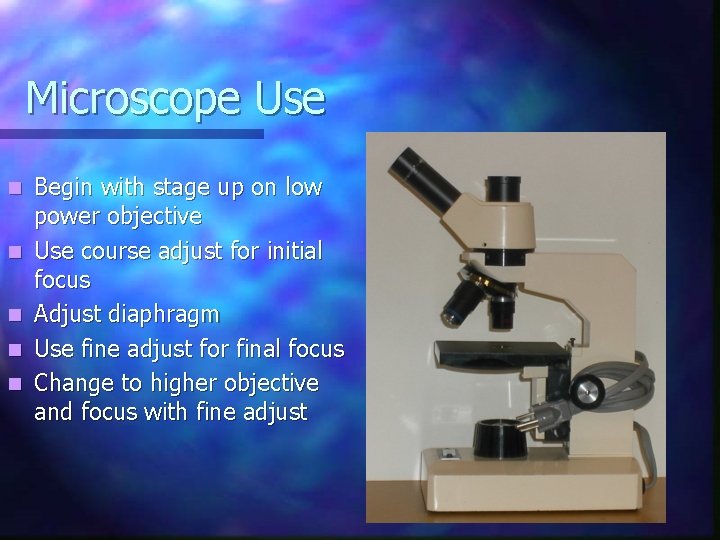
Microscope Use n n n Begin with stage up on low power objective Use course adjust for initial focus Adjust diaphragm Use fine adjust for final focus Change to higher objective and focus with fine adjust
Plankton n Labeled drawings of each organism (determine type if possible) n Total magnification n Diaphragm setting n Plankton Shape n Occurrence (count # of times seen)
Plankton Shapes n Circles n Rectangles/boxes n Spirals n Chains (circle or box) n Spheres (maybe it’s spears!) n Animal n Other

Nitrate (NO 3 -) Test Methods 1. Fill tube to 2. 5 m. L mark with sample. n 2. Add 2. 5 m. L of Mixed Acid Reagent, cap and mix. Wait two minutes. n 3. Add 0. 1 grams (1 level spoonful) of Nitrate Reducing Reagent. Cap and invert 50 -60 times in a minute. Wait ten minutes. n
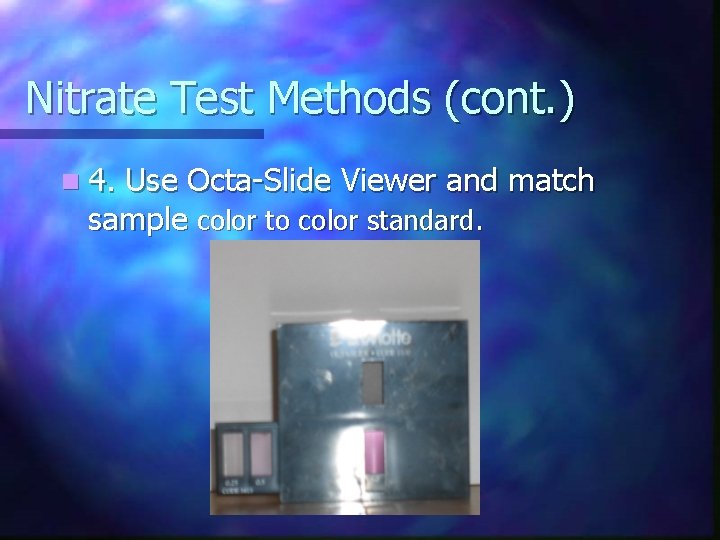
Nitrate Test Methods (cont. ) n 4. Use Octa-Slide Viewer and match sample color to color standard.
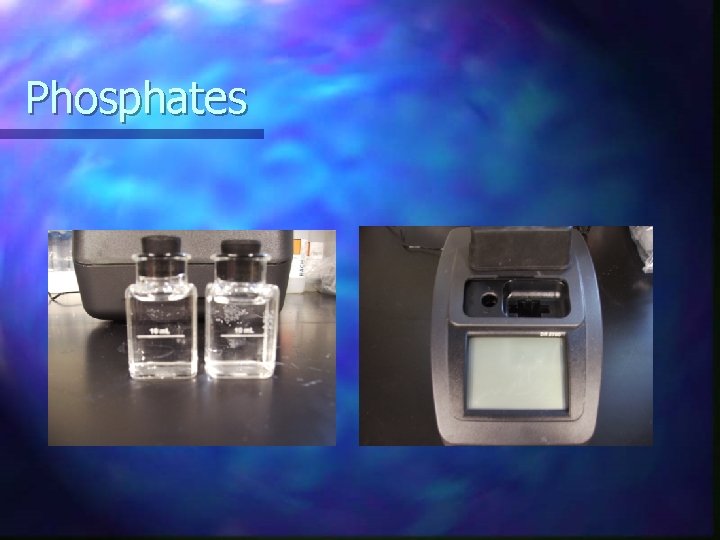
Phosphates
Phosphates (PO 4 -3) – Solution Prep n n Fill sample cell with 10 m. L of sample Add the contents of one Phos. Ver 3 phosphate Powder Pillow to the cell. Stopper and shake vigorously for 30 seconds. Start the instrument timer and let sample react for 2 minutes Meanwhile, prepare the blank by filling a 2 nd sample cell with 10 m. L of sample.

Phosphate Test n n When the timer expires, wipe the blank with a Kimex and insert into the cell holder ZERO the instrument (0. 00 mg/L PO 43 - will show) Wipe the prepared sample and insert Read the results in mg/L PO 43 - (or ppm)
- Slides: 28