
WATER ACTIVITY AND MASS TRANSFER Food Engineering DTE321

- Slides: 11
WATER ACTIVITY AND MASS TRANSFER Food Engineering (DTE-321) Dr. J. Badshah SGIDT, Patna
Effects of Water Activity in microbial Activity in Foods � Water activity (aw) is measured as the equilibrium relative humidity (ERH), the percent relative humidity (RH) of an atmosphere in contact with a product at the equilibrium water content. aw is also ratio of the partial pressure of water in the headspace of a product (P) to the vapour pressure of pure water (P 0) at the same temperature � aw = ERH = P/P 0 � Bacterial growth is also affected at fairly high water activity levels. If water activity is maintained at a value below 0. 90, most bacteria remain dormant. Most yeasts and molds, however, can grow and multiply at water activity levels as low as 0. 80. � The relationship between aw and the rate of deteriorative reactions is very important to design dehydration systems. Reducing aw below 0. 7 prevents microbiological spoilage. However, although microbiological spoilage does not occur at aw = 0. 7, prevention of other deteriorative reactions needed to preserve a dried food product successfully reduction of aw to
Effects of Water Activity on Chemical and Physical Changes � Chemical changes that are enhanced by water activity include enzymatic reactions, nonenzymatic browning, and microbial activity. In foods. When water is present, carboxyl and amino compounds are involved as reactants, products, or catalysts in the browning process. � Physical changes such as texture and aroma can depend greatly on water activity. Textural changes are most often seen in freeze drying and subsequent storing of foods, particularly meats and fish. The water activity in dried foods can also affect the retention of aroma. Different foods that are stored together will be altered if their individual relative humidities (water activities) are different. Under the action of a driving force created by a difference in water activities changes in the moisture and water activities of these foods will follow their own isotherm curve until an equilibrium water activity is achieved. � When the moisture content of a substrate is reduced below 10 %, microorganisms are no longer active. It is necessary however to reduce the moisture content to below 5 % in order to preserve nutrition and flavour. �
Dehydration of Foods and Mechanisms � Dehydration involves the simultaneous transfer of heat, mass and momentum in which heat penetrates into the product and moisture is removed by evaporation into an unsaturated gas phase. � In the pores of solids with rigid structure, capillary forces are responsible for the retention of water, whereas in solids formed by aggregates of fine powders, the osmotic pressure is responsible for water retention within the solids as well as in the surface. � In the case of capillary-porous materials such as fruits and vegetables, interstitial spaces, capillaries and gas -filled cavities exist within the food matrix and water transport takes place via several possible mechanisms acting in various combinations.
Dehydration of Foods and Mechanisms � The possible mechanisms include: � liquid diffusion caused by concentration gradients, � liquid transport due to capillary forces, � vapour diffusion due to shrinkage and partial vapour-pressure gradients (Stefan’s law), � liquid or vapour transport due to the difference in total pressure caused by external pressure and temperature (Poiseuille’s law), � evaporation and condensation effects caused by differences in temperature, � surface diffusion in liquid layers at the solid interface due to surface concentration gradient, � liquid transport due to gravity.
Effects of Hygroscoic nature with capillary porous Rigid structure • A hygroscopic material is one that contains bound water that exerts a vapor pressure lower than the vapor pressure of liquid water at the same temperature. It is expected that products made mainly of carbohydrates will behave as hygroscopic materials, since the hydroxyl groups around the sugar molecules allow formation of hydrogen bonds with water molecules. The interaction between the water molecules and the hydroxyl groups causes solvation or solubilization of sugars. • In water soluble proteins, the polar amino acids are uniformly distributed in the surface, while the hydrophobic groups are located towards the inside of the molecule. This arrangement allows formation of hydrogen bonds with water, which explains the solubility of this type of proteins. � Most foods are classified as capillary porous rigid or capillary porous colloids. Therefore, it is often proposed that a combination of capillary flow and vapour diffusion mechanisms should be used to describe internal mass transfer. � Water activity, rather than moisture content, influences biological reactions. In the regions of water adsorption on polar sites or when a mono-molecular layer exists, there is little enzyme activity. Enzyme activity begins only above the region of mono-molecular adsorption.
Mechanism of Water Transfer during Drying �Water movement due to capillary forces �Diffusion of liquid due to concentration gradients �Surface diffusion �Water vapor diffusion in pores filled with air �Flow due to pressure gradients �Flow due to water vaporization– condensation
Mass Transfer � During dehydration, water is vapourized only from the surface. The transfer of water vapour from the wet surface to a stream of moving air is analogous to convection heat transfer, therefore, a mass transfer coefficient is used. � Moisture flux is proportional to the driving force which is the difference in vapour pressure on the surface and the vapour pressure of water in air surrounding the surface. At the same time that water is removed from the surface, water diffuses from the interior of a solid towards the surface. The later is a general form of diffusion which is analogous to conduction heat transfer. � The differential equations for conduction also apply to diffusion, but mass diffusivity is used in place of thermal diffusivity. � Flux of mass Transfer i. e mass transfer per unit area per unit time = - D (dc/dx), where D = Diffusion coefficient
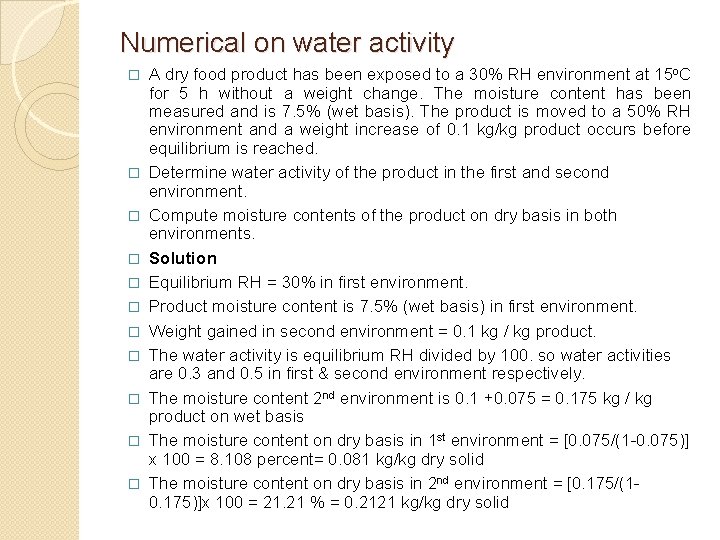
Numerical on water activity � � � A dry food product has been exposed to a 30% RH environment at 15 o. C for 5 h without a weight change. The moisture content has been measured and is 7. 5% (wet basis). The product is moved to a 50% RH environment and a weight increase of 0. 1 kg/kg product occurs before equilibrium is reached. Determine water activity of the product in the first and second environment. Compute moisture contents of the product on dry basis in both environments. Solution Equilibrium RH = 30% in first environment. Product moisture content is 7. 5% (wet basis) in first environment. Weight gained in second environment = 0. 1 kg / kg product. The water activity is equilibrium RH divided by 100. so water activities are 0. 3 and 0. 5 in first & second environment respectively. The moisture content 2 nd environment is 0. 1 +0. 075 = 0. 175 kg / kg product on wet basis The moisture content on dry basis in 1 st environment = [0. 075/(1 -0. 075)] x 100 = 8. 108 percent= 0. 081 kg/kg dry solid The moisture content on dry basis in 2 nd environment = [0. 175/(10. 175)]x 100 = 21. 21 % = 0. 2121 kg/kg dry solid
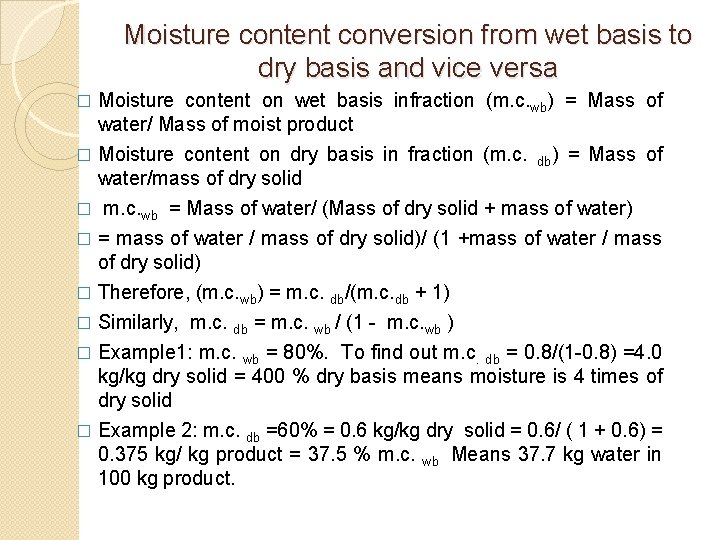
Moisture content conversion from wet basis to dry basis and vice versa � Moisture content on wet basis infraction (m. c. wb) = Mass of water/ Mass of moist product Moisture content on dry basis in fraction (m. c. db) = Mass of water/mass of dry solid � m. c. wb = Mass of water/ (Mass of dry solid + mass of water) � = mass of water / mass of dry solid)/ (1 +mass of water / mass of dry solid) � Therefore, (m. c. wb) = m. c. db/(m. c. db + 1) � Similarly, m. c. db = m. c. wb / (1 - m. c. wb ) � Example 1: m. c. wb = 80%. To find out m. c. db = 0. 8/(1 -0. 8) =4. 0 kg/kg dry solid = 400 % dry basis means moisture is 4 times of dry solid � Example 2: m. c. db =60% = 0. 6 kg/kg dry solid = 0. 6/ ( 1 + 0. 6) = 0. 375 kg/ kg product = 37. 5 % m. c. wb Means 37. 7 kg water in 100 kg product. �
THANK YOU