
WASTEWATER DISPOSAL SYSTEM INTRODUCTION SEWAGE Means any liquids

- Slides: 48
WASTEWATER DISPOSAL SYSTEM
INTRODUCTION SEWAGE Means any liquids waste/wastewater discharge containing human, animal, vegetable matter in suspension/ solution and includes liquids containing chemicals in solution but does not include industrial effluent. (Sewerage Service Act 1993)
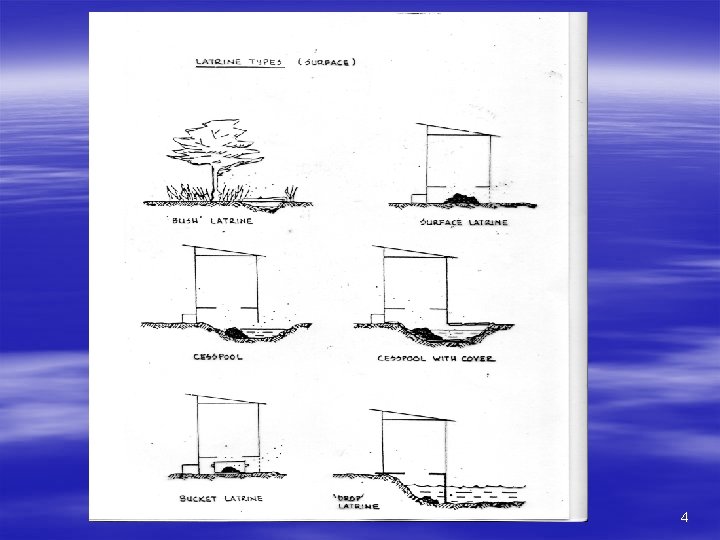
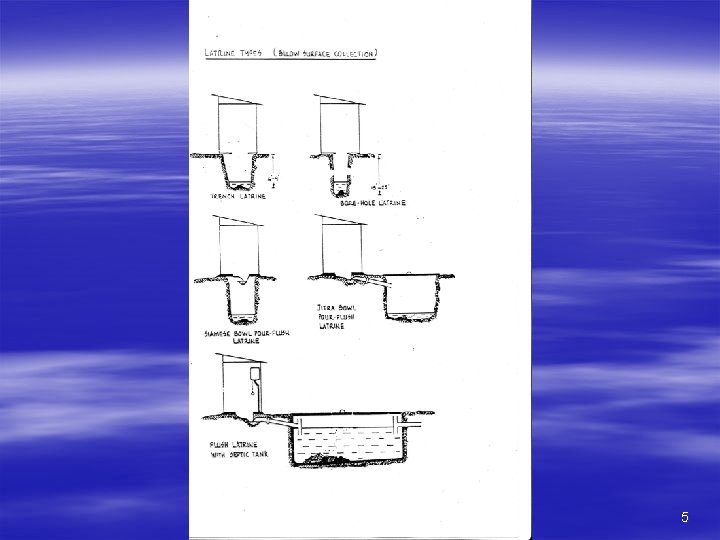
TRADITIONAL METHOD OF SEWAGE DISPOSAL (EXCRETA) § Sewage disposal in the traditional ways are include surface and below surface of various types of latrines. § Two types of latrines which is controllable latrines and uncontrollable latrines.
4
5
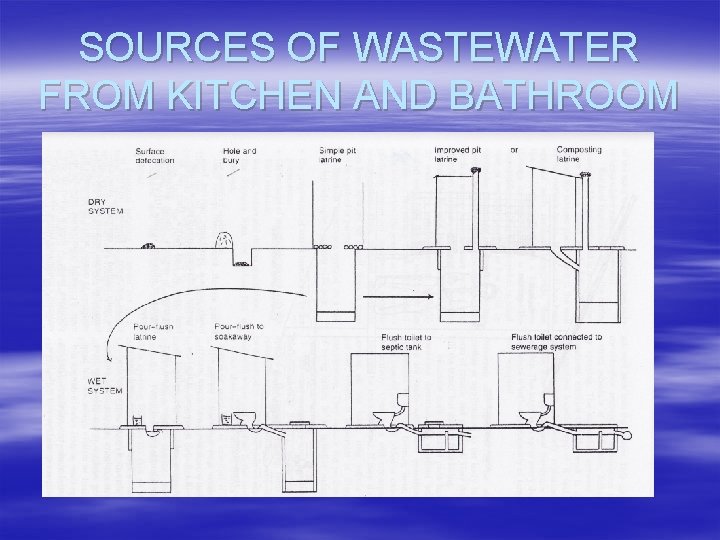
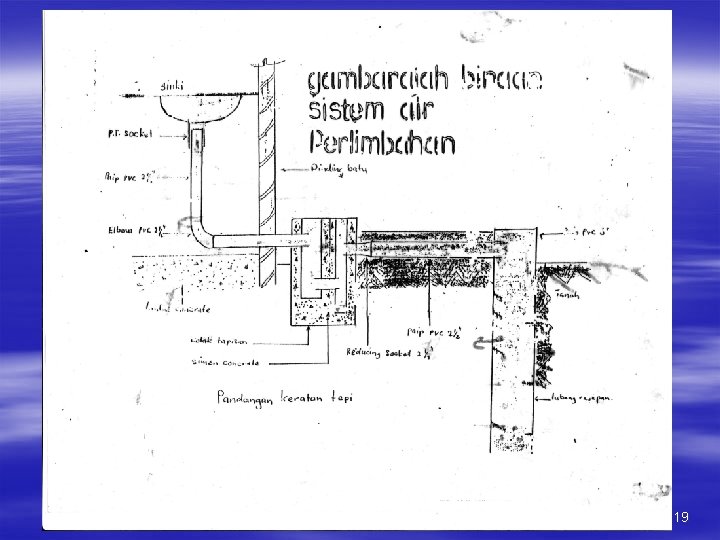
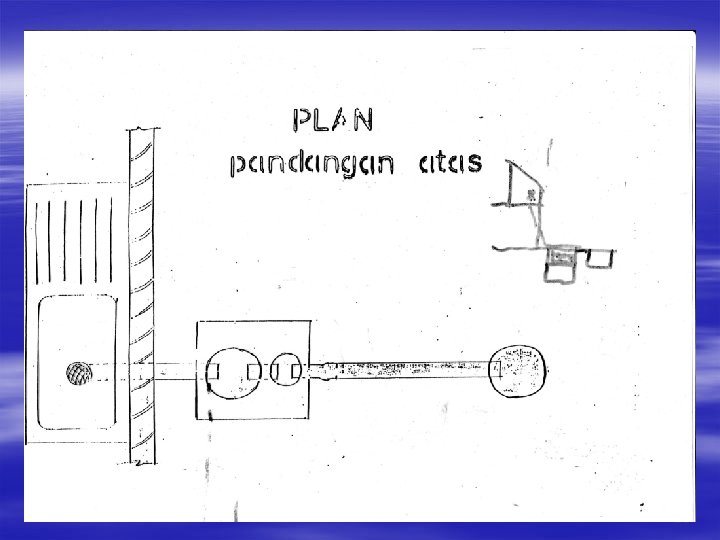
SOURCES OF WASTEWATER FROM KITCHEN AND BATHROOM § A great deal of household waste is produced in the kitchen. § Kitchen waste: - Food waste - water-washed (dish) - hand wash basin § Bathroom waste: - soaps - laundry water
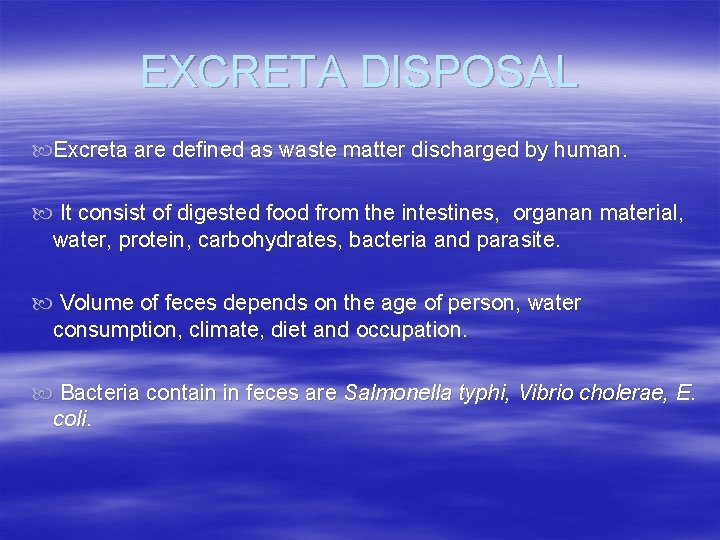
EXCRETA DISPOSAL Excreta are defined as waste matter discharged by human. It consist of digested food from the intestines, organan material, water, protein, carbohydrates, bacteria and parasite. Volume of feces depends on the age of person, water consumption, climate, diet and occupation. Bacteria contain in feces are Salmonella typhi, Vibrio cholerae, E. coli.
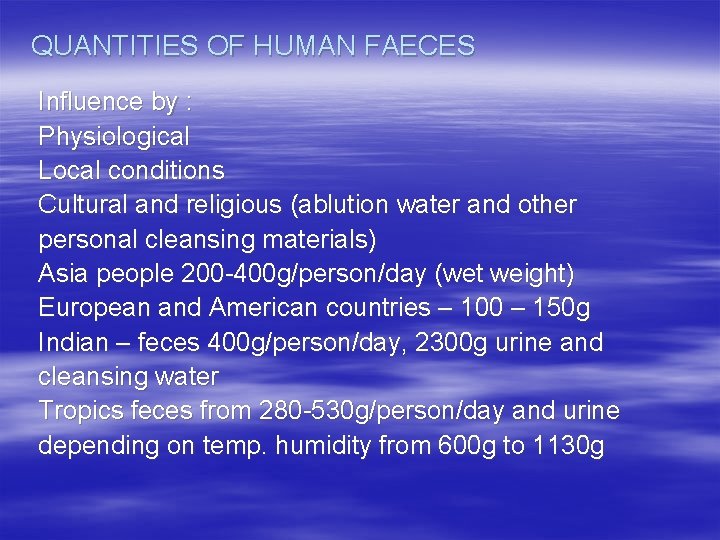
QUANTITIES OF HUMAN FAECES Influence by : Physiological Local conditions Cultural and religious (ablution water and other personal cleansing materials) Asia people 200 -400 g/person/day (wet weight) European and American countries – 100 – 150 g Indian – feces 400 g/person/day, 2300 g urine and cleansing water Tropics feces from 280 -530 g/person/day and urine depending on temp. humidity from 600 g to 1130 g
PUBLIC HEALTH IMPORTANCE OF EXCRETA • Important part of environmental sanitation • Assuring a safe environment in rural areas and small communities • Inadequate and insanitary disposal of infected feces leads to ground and sources of water supplies • Attracts domestic vermin • Nuisance • Breeding places for vectors
RELATIONSHIP TO HEALTH Poor excreta disposal associated with : q lack of water supplies q low economic status q sanitation facilities - equipments
DIRECT AND INDIRECT RELATIONSHIP • DIRECT EFFECT § Reduce incident of certain diseases when proper disposal of excreta is practice § Group of diseases : cholera, typhoid, paratyphoid fevers, dysenteries, hookworm disease, ascariasis, parasitic and intestinal infections
cont……. INDIRECT EFFECT The improvement of hygienic conditions and sanitation programs : § § § Promotes population social development Decrease in mortality from diseases An increase in life expectancy due to implementation of sanitation programs § Healthy persons - Employment
§ Hazard from traditional sewage disposal system
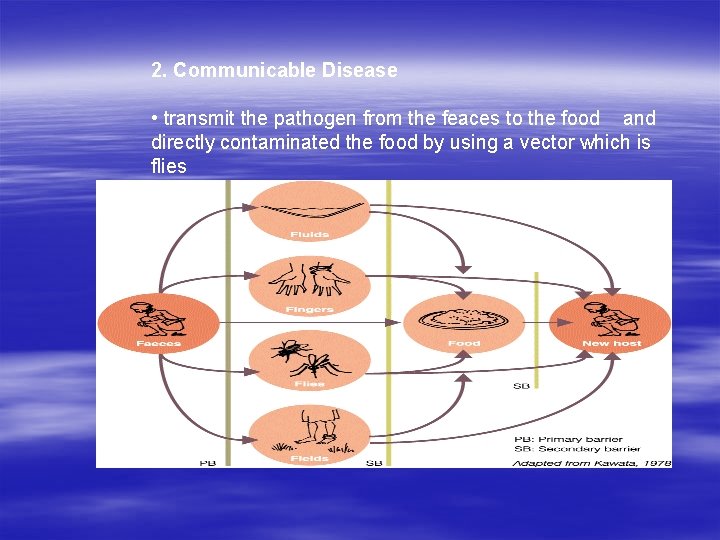
2. Communicable Disease • transmit the pathogen from the feaces to the food and directly contaminated the food by using a vector which is flies
Nuisances v. Transmission disease 1) Flies infestation: to - Flies can carry disease from the latrine to food. Diarrhoeal disease may easily be spread from human excreta food. Cholera and food poisoning also can be spread by the flies infestation. Example : pit latrine, trench latrine, bucket latrine, bush latrine. 2)Hookworm infection: - The absence of a squatting slab increase the risk of hookworm infection by larvae migrating from the pit through the soil surface and penetrating the soles of the feet trench users. Example: trench latrine
Odour - Some of the latrine produce bad odour. The residences will be uncomfortable with the bad odour. It also make nuisance to the people around the place. The absence of a water seal also promotes odours. Example: bucket latrine, pit latrine and trench latrine. Aesthetic value - Excreta can be seen through the hole in the squatting plate. The excreta can be unsightly and nauseating scenes, thus its becomes an aesthetic pollution because its spoiling the visual beauty of nature. This filthy surrounding attracting flies. Example: pit latrine,
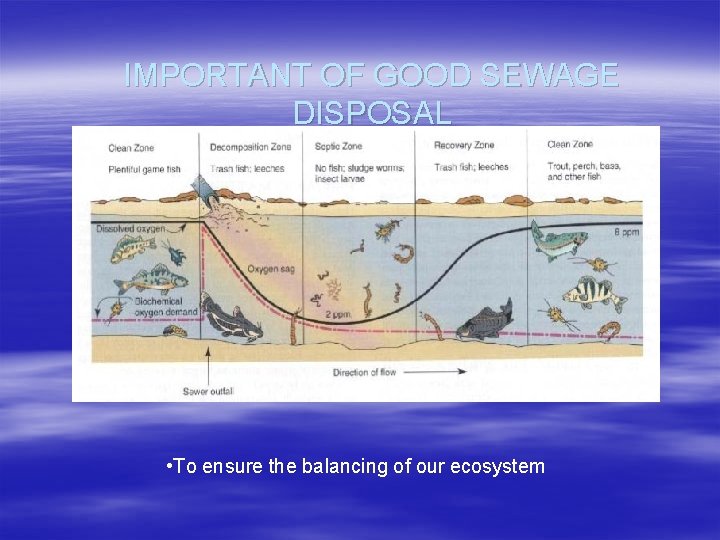
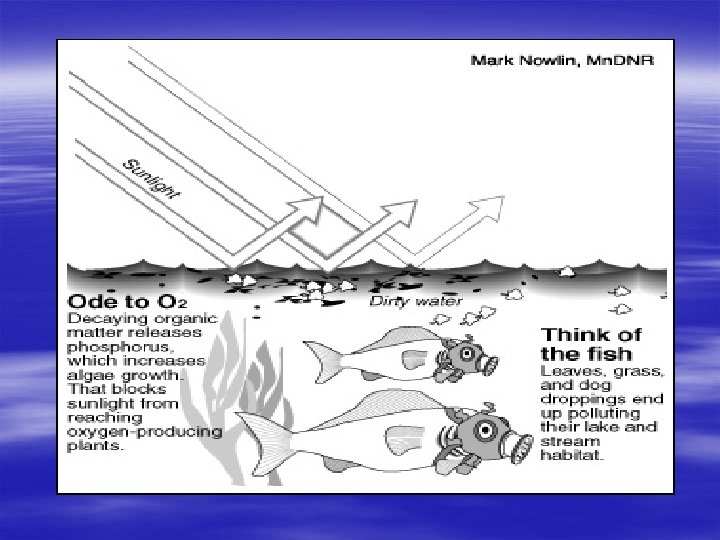
IMPORTANT OF GOOD SEWAGE DISPOSAL • To ensure the balancing of our ecosystem
19
20
• Part III Drains, Section 55 Penalty for making unauthorized drains into public canal or stream. Water closets and trade effluent not to communicate with river, etc. , without approval. (2) No water-closet or privy shall be allowed to communicate with any river, canal, stream, pond, lake, sea or with any public surface or storm water drain without the prior written permission of the local authority responsible for such drain or sewer or, in any other case, without the consent of the State Authority. (3) No trade effluent shall be discharged into or allowed to communicate with any river, canal, stream, pond, lake, sea or with any public surface or storm water drain without the prior written permission of the local authority responsible for such drain or sewer or, in any other case, without the consent of the State Authority and the local authority or the State Authority may impose conditions to such permission. (Local Government Act 1976 Act 171)
TYPES OF LATRINE 1) Open Defecation 2) Hole and Bury 3) Trench Latrine 4) Overhung Latrines 5) Simple Pit Latrine 6) The Bucket Latrine / Conservancy System / Earth Closet 7) Borehole Latrine 8) Pour-flush Latrine 9) Septic Tank
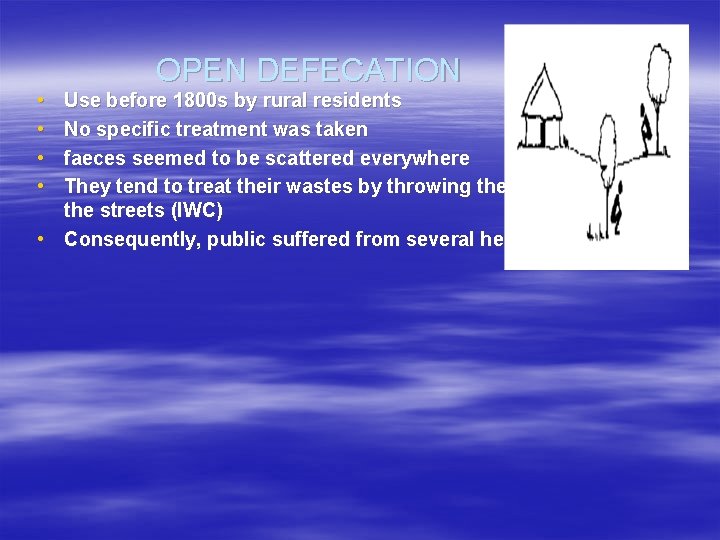
• • OPEN DEFECATION Use before 1800 s by rural residents No specific treatment was taken faeces seemed to be scattered everywhere They tend to treat their wastes by throwing them freely into the streets (IWC) • Consequently, public suffered from several health effects.
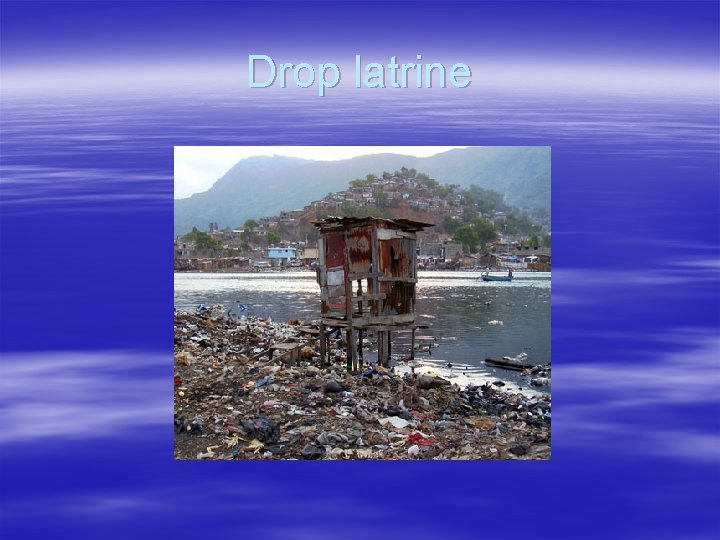
Uncontrolled method 1) Bush Latrine - Person hide in the bush and disposed the feces on the grass or ground surface. - unclean, decayed and dried by natural process. 2) Drop latrine - closed hut and inside was only a hole to defecate. - built on the river bank and hole is above water surface. - feces were drop in the water causes sedimentation
Drop latrine
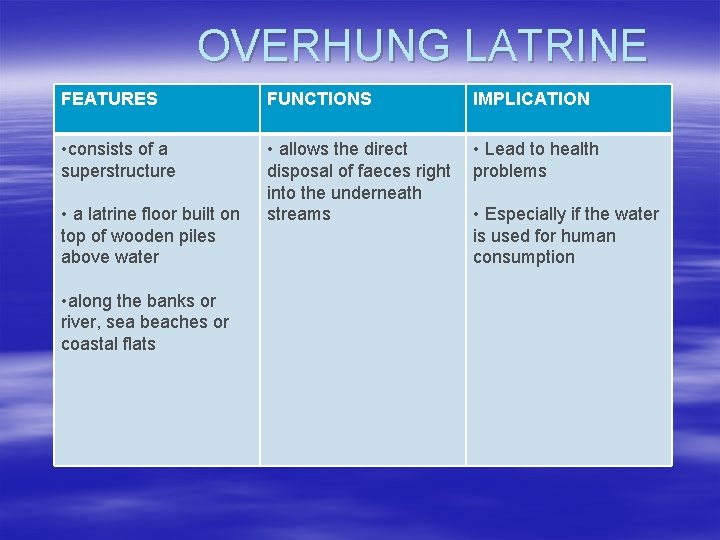
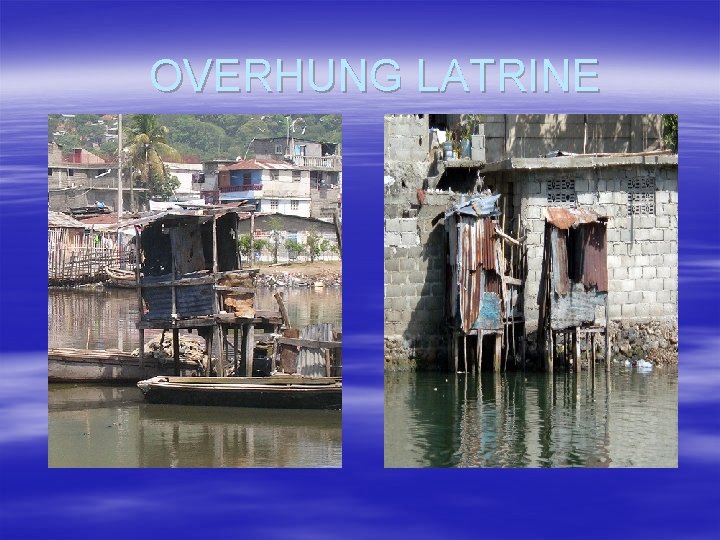
OVERHUNG LATRINE FEATURES FUNCTIONS IMPLICATION • consists of a superstructure • allows the direct disposal of faeces right into the underneath streams • Lead to health problems • a latrine floor built on top of wooden piles above water • along the banks or river, sea beaches or coastal flats • Especially if the water is used for human consumption
OVERHUNG LATRINE
HOLE AND BURY • • Villagers dig a small hole for defecation Then, cover the excreta with the earth (Pathak B. ) Decomposition is rapid But flies breed in large number and also hookworm larvae
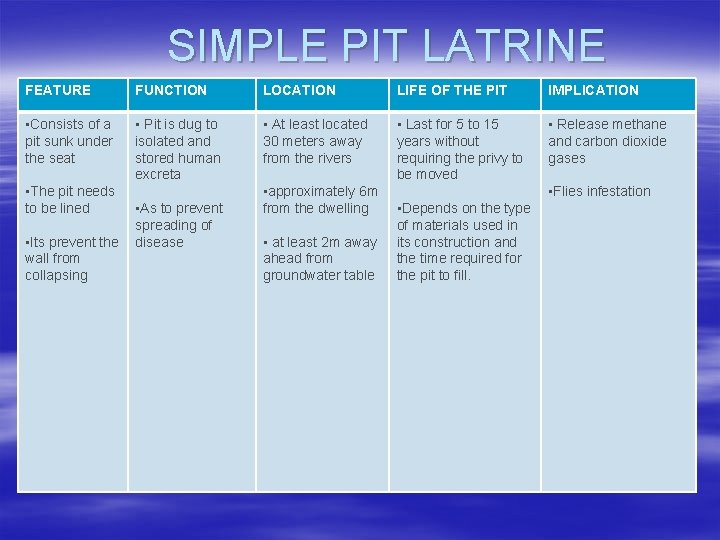
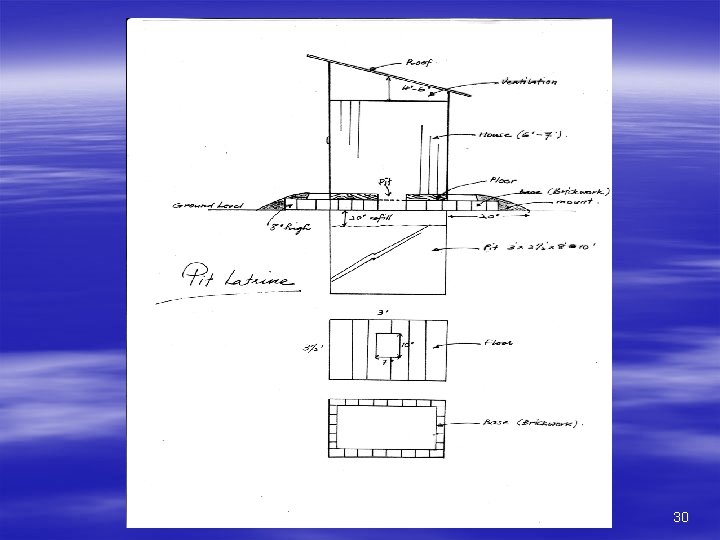
SIMPLE PIT LATRINE FEATURE FUNCTION LOCATION LIFE OF THE PIT IMPLICATION • Consists of a pit sunk under the seat • Pit is dug to isolated and stored human excreta • At least located 30 meters away from the rivers • Last for 5 to 15 years without requiring the privy to be moved • Release methane and carbon dioxide gases • The pit needs to be lined • Its prevent the wall from collapsing • As to prevent spreading of disease • approximately 6 m from the dwelling • at least 2 m away ahead from groundwater table • Flies infestation • Depends on the type of materials used in its construction and the time required for the pit to fill.
30
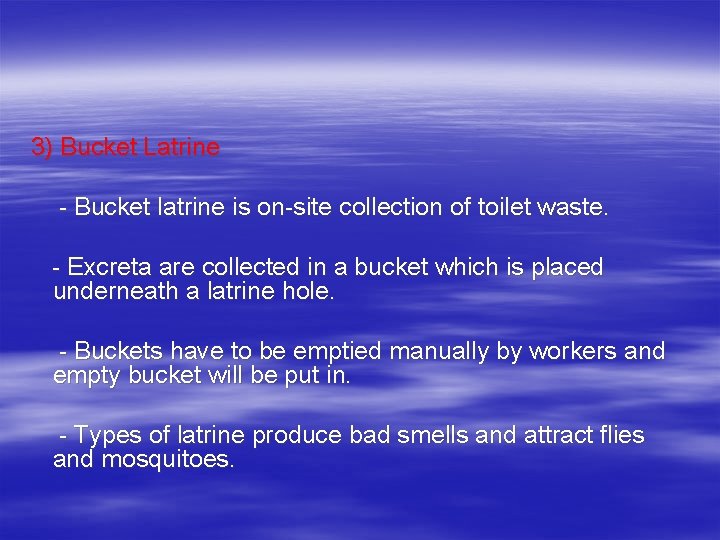
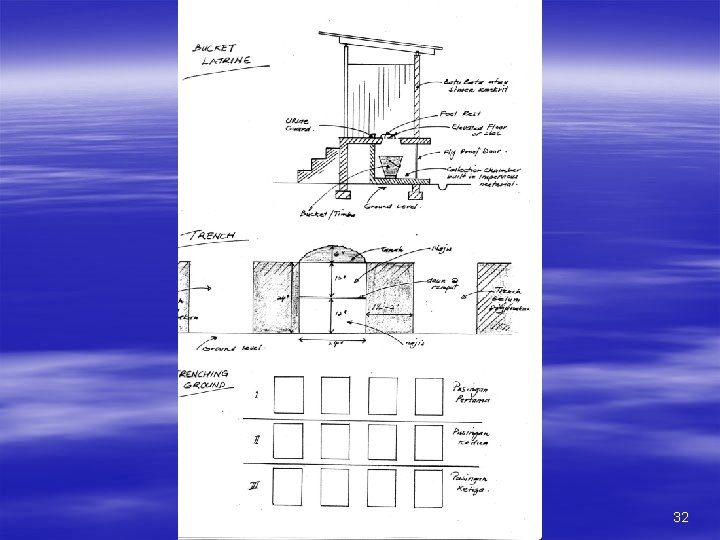
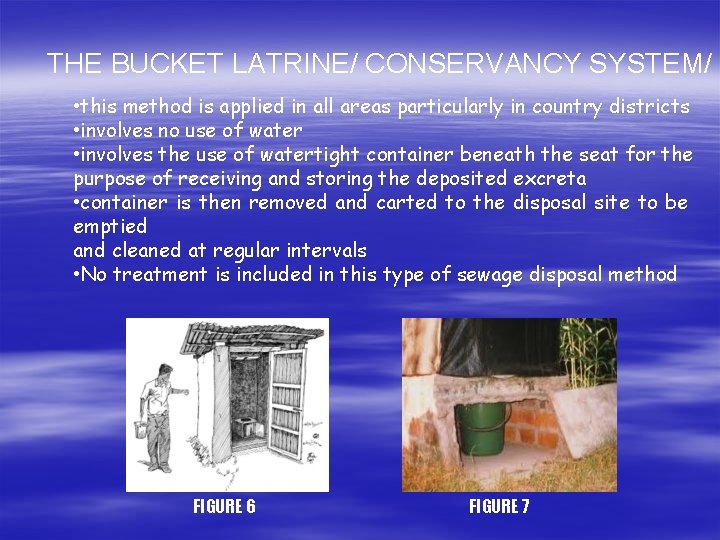
3) Bucket Latrine - Bucket latrine is on-site collection of toilet waste. - Excreta are collected in a bucket which is placed underneath a latrine hole. - Buckets have to be emptied manually by workers and empty bucket will be put in. - Types of latrine produce bad smells and attract flies and mosquitoes.
32
THE BUCKET LATRINE/ CONSERVANCY SYSTEM/ E • this method is applied in all areas particularly in country districts • involves no use of water • involves the use of watertight container beneath the seat for the purpose of receiving and storing the deposited excreta • container is then removed and carted to the disposal site to be emptied and cleaned at regular intervals • No treatment is included in this type of sewage disposal method FIGURE 6 FIGURE 7
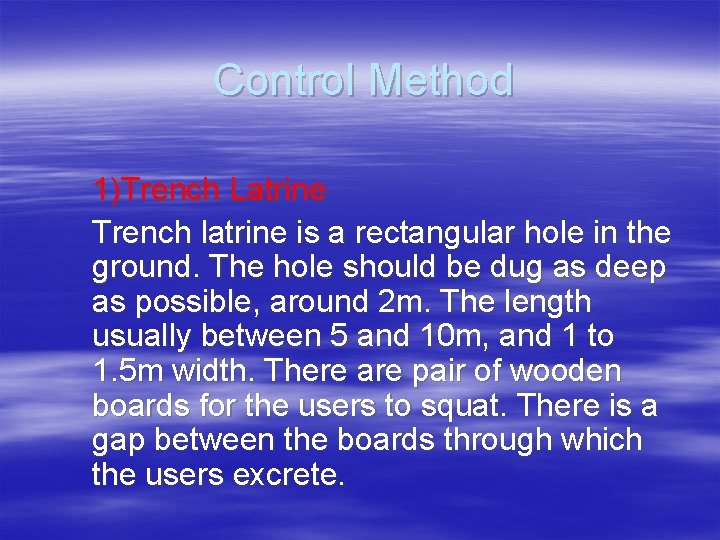
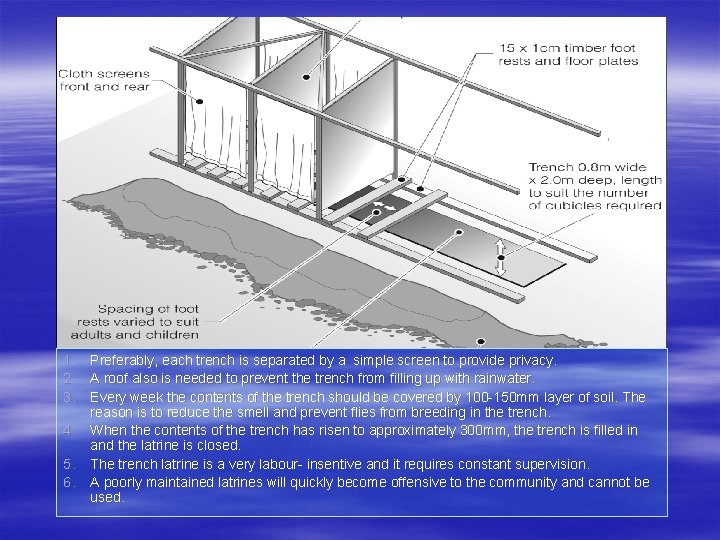
Control Method 1)Trench Latrine Trench latrine is a rectangular hole in the ground. The hole should be dug as deep as possible, around 2 m. The length usually between 5 and 10 m, and 1 to 1. 5 m width. There are pair of wooden boards for the users to squat. There is a gap between the boards through which the users excrete.
1. Preferably, each trench is separated by a simple screen to provide privacy. 2. A roof also is needed to prevent the trench from filling up with rainwater. 3. Every week the contents of the trench should be covered by 100 -150 mm layer of soil. The reason is to reduce the smell and prevent flies from breeding in the trench. 4. When the contents of the trench has risen to approximately 300 mm, the trench is filled in and the latrine is closed. 5. The trench latrine is a very labour- insentive and it requires constant supervision. 6. A poorly maintained latrines will quickly become offensive to the community and cannot be used.
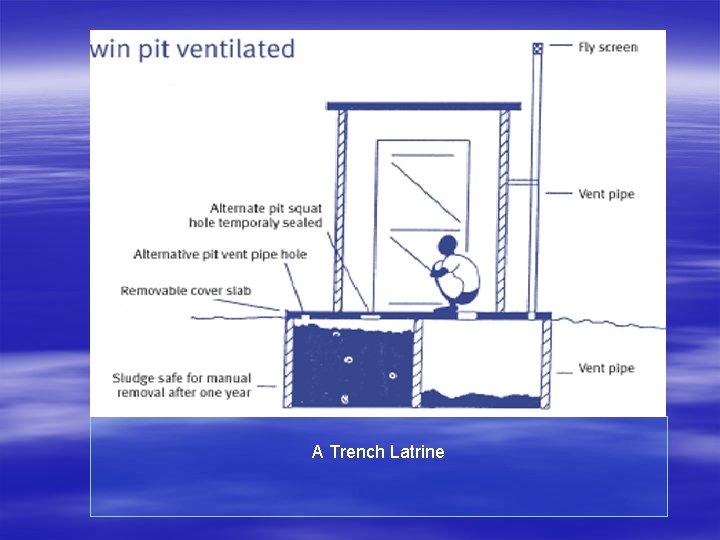
A Trench Latrine
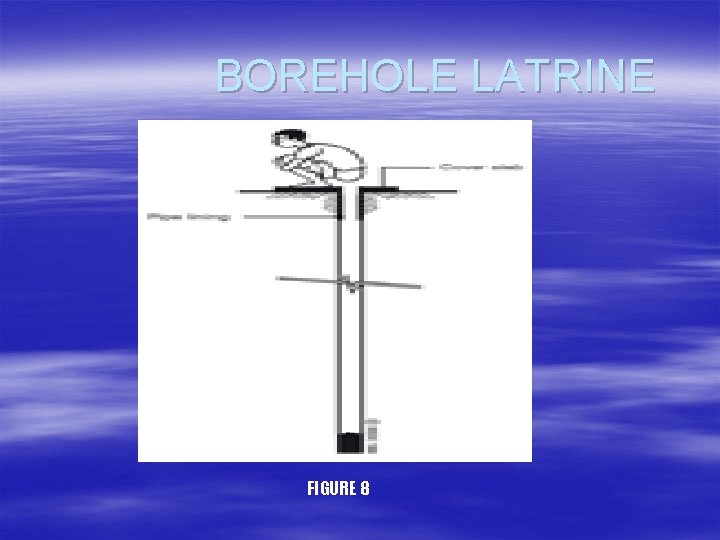
2)Bore Hole Latrine A bore hole latrine is a latrine where a hole is drilled in the ground to receive and store waste. A floor slab of wood or concrete is placed on top. A recommended borehole diameter is at least 0. 4 m and the pit is 4 -10 m deep. A bore hole latrine is suitable for stable, permeable soils, free of stones and where the groundwater is deep below the surface. It is also mainly used in emergency situations.
BOREHOLE LATRINE FIGURE 8
A Bore Hole Latrine
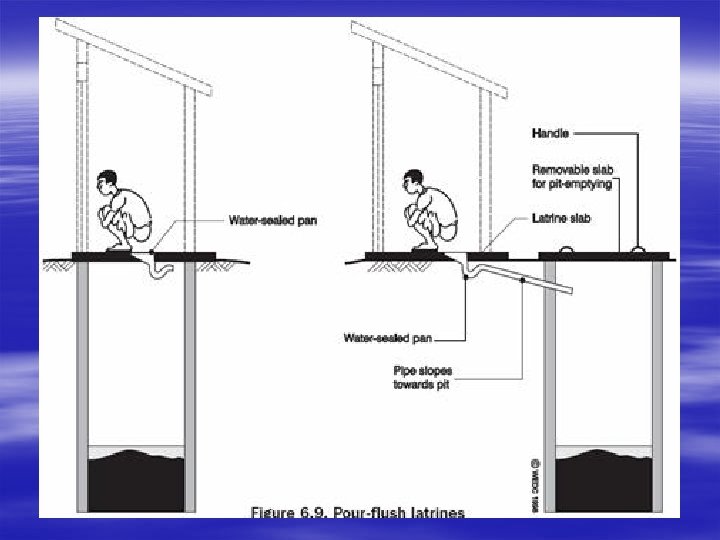
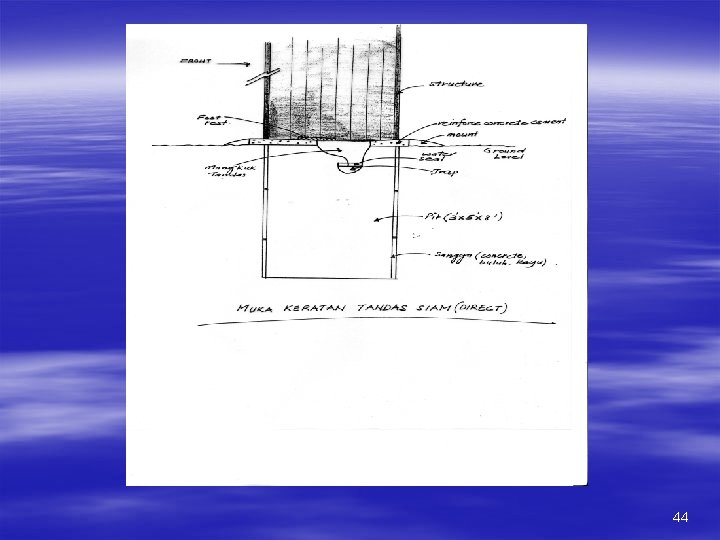
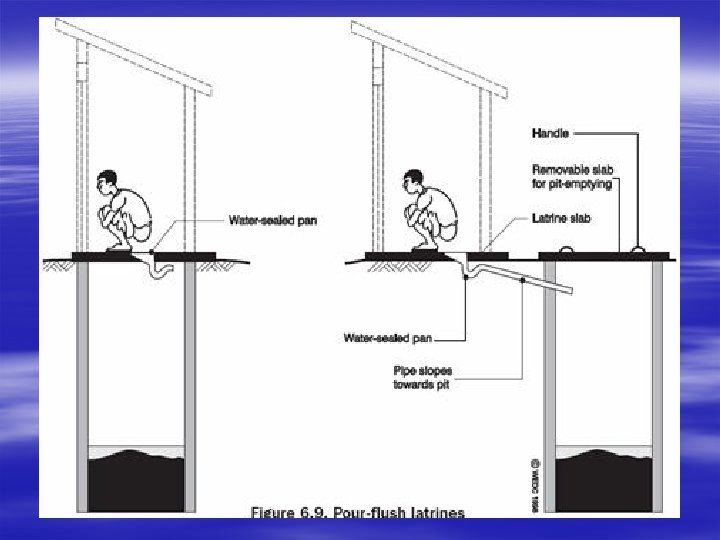
3. Pour Flush Latrine There have 2 types of pour flush latrine that is Siamese bowl pour flush latrine and Jitra bowl pour flush latrine. a) Siamese Bowl Pour Flush Latrine - Siamese Bowl Pour Flush Latrine is like a flush toilet except that instead of the water coming from the cistern above but Siamese Bowl is poured in by the user. - Siamese bowl have water seal that prevents odour and flies from coming back up the pipe. - Water is poured into the bowl to flush the toilet of excreta; approximately 2 to 3 Liter is usually sufficient. - This latrine can be made from plastic and ceramic, or from galvanized sheet metal.
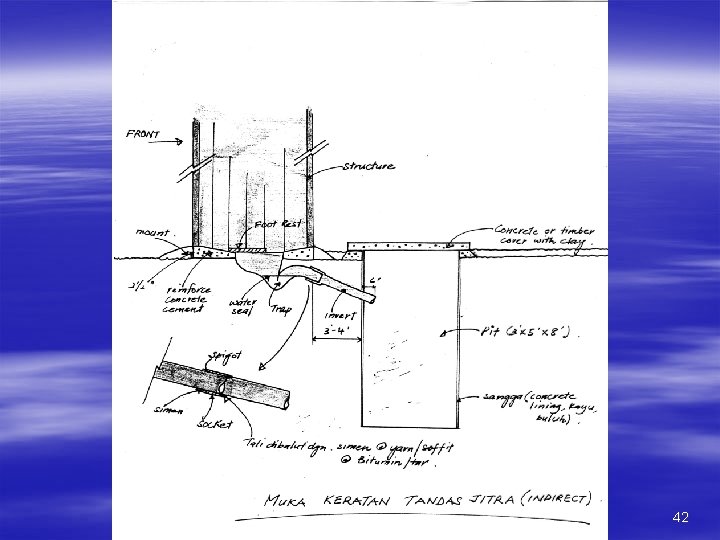
b) Jitra Bowl Pour Flush Latrine - Jitra Bowl Pour Flush Latrine is same like Siamese Bowl Pour Flush Latrine except it more safe that Siamese Bowl because the latrine far from pit. - There have pipe slopes towards the pit. So, it effectively prevents odours and the excreta of one user are flushed away before the next user arrives. - It has removable slab for emptying pit, so if the pit are fully, the removable slab can be open and transfer the excreta into the lorry.
42
44
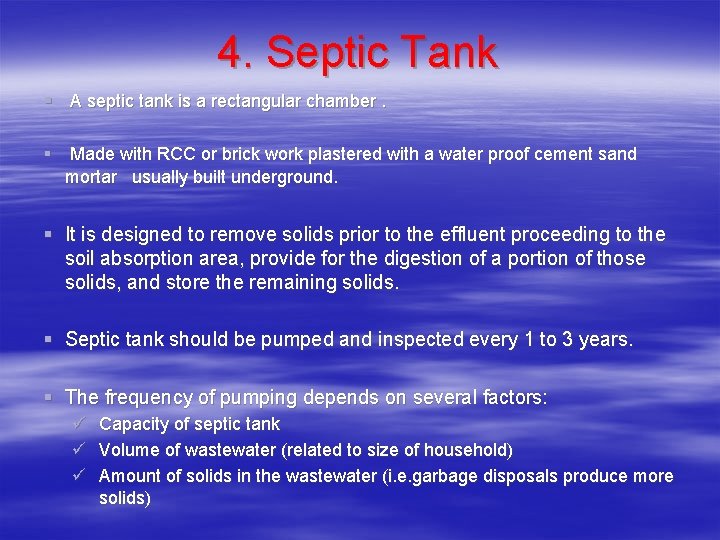
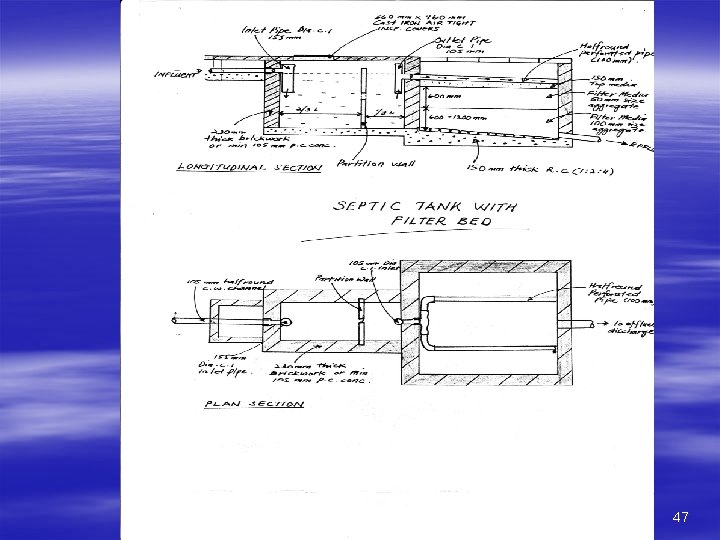
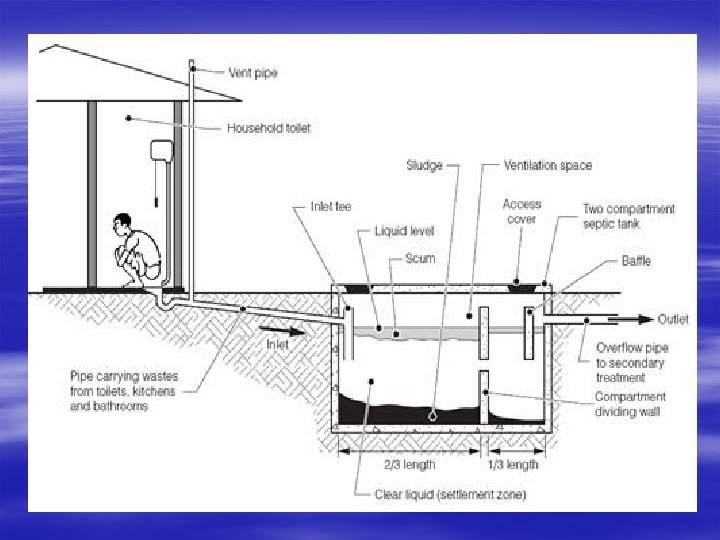
4. Septic Tank § A septic tank is a rectangular chamber. § Made with RCC or brick work plastered with a water proof cement sand mortar usually built underground. § It is designed to remove solids prior to the effluent proceeding to the soil absorption area, provide for the digestion of a portion of those solids, and store the remaining solids. § Septic tank should be pumped and inspected every 1 to 3 years. § The frequency of pumping depends on several factors: ü Capacity of septic tank ü Volume of wastewater (related to size of household) ü Amount of solids in the wastewater (i. e. garbage disposals produce more solids)
47