
Wastes Associated with Automotive Painting Waste paint old
- Slides: 20
Wastes Associated with Automotive Painting Waste paint (old, leftover, dried etc. ) n Solvent (various types) n All materials contaminated with paint including: n – Used paint booth arrestors (also called exhaust filters) – Disposable rags Collision Repair - Solvent and Paint-contaminated Waste 11 -1 (a)
Wastes Associated with Automotive Painting – Masking tape and paper – Floor sweepings – Disposable mixing cups and sticks – Disposable paint strainers Collision Repair - Solvent and Paint-contaminated Waste 11 -1 (b)
Minimize the Amount of Painting Waste n Use reusable mixing cups and sticks – Clean them in a mechanical gun wash system. Use cloth rags that are cleaned by a laundry service and returned. n Improve transfer efficiency of coating operations. n Recycle solvent on-site with a solvent distillation unit. n Collision Repair - Solvent and Paint-contaminated Waste 11 -2 (a)
Minimize the Amount of Painting Waste Recycle solvent off-site - recycling service. n Prevent solvent evaporation - close lids. n Use a mechanical gun wash system to reduce solvent waste. n Keep records of the types and quantities of materials used to better estimate future jobs. n Use a material usage tracking form. n Collision Repair - Solvent and Paint-contaminated Waste 11 -1 (b)
Minimize the Hazardous Nature of Paint-Related Waste n Use undercoats and topcoats that contain no heavy metals. – Arsenic, barium, cadmium, chromium, lead, mercury, selenium, and silver. Use low-VOC paint and solvent products. n Use water-based coatings when practical. n Collision Repair - Solvent and Paint-contaminated Waste 11 -3
Disposal of Paint-Related Wastes n Liquid paint and solvent waste – Managed as a hazardous waste. – Stored in sealed containers labeled “Hazardous Waste ”. – Disposal by a hazardous waste management company. Collision Repair - Solvent and Paint-contaminated Waste 11 -4 (a)
Disposal of Paint-Related Wastes n Dry paint-related wastes: paint booth arrestors, rags, floor sweepings, masking tape etc. . . – Potentially hazardous due to metals, solvents and must be laboratory tested. – If hazardous, must be managed same as liquid paint and solvent wastes – If nonhazardous may landfill with approval and permits. Collision Repair - Solvent and Paint-contaminated Waste 11 -4 (b)
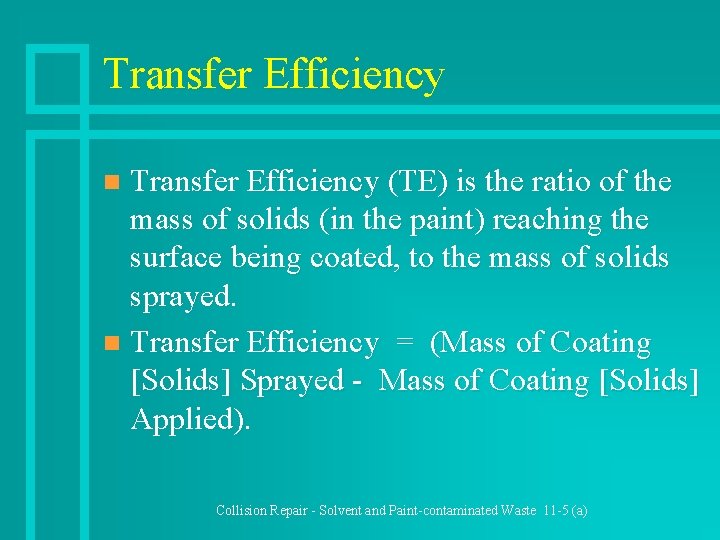
Transfer Efficiency (TE) is the ratio of the mass of solids (in the paint) reaching the surface being coated, to the mass of solids sprayed. n Transfer Efficiency = (Mass of Coating [Solids] Sprayed - Mass of Coating [Solids] Applied). n Collision Repair - Solvent and Paint-contaminated Waste 11 -5 (a)
Transfer Efficiency High transfer efficiency means less paint is wasted in overspray. n Poor transfer efficiency causes excessive paint and solvent waste. n Collision Repair - Solvent and Paint-contaminated Waste 11 -5 (b)
Factors Affecting Transfer Efficiency n Factors that cannot be controlled by the spray operator. – Size and shape of the parts sprayed. – Atmospheric conditions – Finish quality requirements. Collision Repair - Solvent and Paint-contaminated Waste 11 -6 (a)
Factors Affecting Transfer Efficiency n Factors that can be controlled by the spray operator: – Spray equipment type – Gun set up – Spray angle – Spray distance – Spray techniques – Spray equipment maintenance and practices Collision Repair - Solvent and Paint-contaminated Waste 11 -6 (b)
Improving Spray Technique Operator spray technique is the most important element in achieving a good transfer efficiency. n Spray Angle n – Gun perpendicular to the surface being sprayed – Use parallel strokes. – Never arc the gun » except when performing blending operations or panel spotting. Collision Repair - Solvent and Paint-contaminated Waste 11 -7 (a)
Improving Spray Technique n Spray Pattern. – Uniform pattern – Coating must be atomized properly. n Spray Distance – Appropriate distance from the surface being sprayed. » 6 to 8 inches (as close as 4 in. with some gun/coating combinations) » Distance constant throughout the coating operation. Collision Repair - Solvent and Paint-contaminated Waste 11 -7 (b)
Improving Spray Technique n Spray Overlap – 50 per cent overlap for each pass – Feathering the trigger at the beginning and end of each pass. » Note: Technique may be altered slightly when applying high metallic, high solids base coats and some three stage systems Collision Repair - Solvent and Paint-contaminated Waste 11 -7 (c)
Improving Spray Technique n General Spray Techniques – Have a “plan of attack” – Do a “dry run” to practice spraying strategy. – For small and medium sized panels - make each pass the full length of the panel. – Spray larger panels in the same way, walking the length of the panel. Collision Repair - Solvent and Paint-contaminated Waste 11 -7 (d)
Improving Spray Technique – Keep blended areas as small as possible. – Spray the border edges of the substrate first (banding). n High Transfer Efficiency Spray Equipment – HVLP gun uses high-volume/low pressure – LPLV gun uses low pressure/low volume Collision Repair - Solvent and Paint-contaminated Waste 11 -7 (e)
Improving Spray Technique n Choose the Best Equipment You Can Afford ! – Equipment budget. – Coating types being sprayed. – Ask paint representative for assistance. – Choose spray equipment for highest transfer efficiency and proper atomization. Collision Repair - Solvent and Paint-contaminated Waste 11 -7 (f)
Improving Spray Technique – Use the proper fluid tip/air cap combination and gun settings for the material being sprayed. – Remember >>> A paint gun is only as good as the operator using it !!!!! n Gun Set-up – Correct size of fluid tip-air cap combination. » Fluid tip size is determined by coating viscosity » Viscosity is measured by a Zahn cup measuring system. Collision Repair - Solvent and Paint-contaminated Waste 11 -7 (g)
Improving Spray Technique – Choice of air cap depends of the fluid tip size » Ask spray gun manufacturers for recommendations – Set the air pressure at the lowest possible setting. » Never exceed the coating manufacturer's recommended air pressure settings. – Keep records of gun set ups used with each type of coating to reduce set up time and material wasted during set up. Collision Repair - Solvent and Paint-contaminated Waste 11 -7 (h)
Improving Spray Technique n Spray Equipment Maintenance – Maintaining clean equipment clean in good working order ensures proper atomization and a full, consistent spray pattern. Collision Repair - Solvent and Paint-contaminated Waste 11 -7 (i)