
Waste Management in the Netherlands an overview of
- Slides: 27
Waste Management in the Netherlands: an overview of policy and practice
Overview of this Presentation 1. Historical perspectice on waste management in Netherlands 2. Recent Developments 3. Relevant aspects for Zero Waste 4. Questions and discussion This presentation is too long -you can read skipped slides later on the website
Waste, a public responsibility in the Netherlands and EU 1. 2. 3. 4. 5. Dutch municipalities have a legal obligation for organisation of prevention, separate collection recycling, MSW collection, and financing of solid waste The responsibility for assuring safe disposal has shifted from the municipalities, to the national government, to provinces, and has now gone back to national government. There is national, regional, and local responsibility for environmental protection, following specific policy decisions, without reference to the cost. The responsibility for recycling is split between the National government, the municipalities, and producers. Producers in EPR “covenants” organise and guarantee recycling markets and floor pricing.
Fully mature & modern, depoliticised system Law Policy Governance Norms Values Vocabulary Technology Practice Control Financing mechanisms Institutions Most Dutch stakeholders consider that the work is finished!
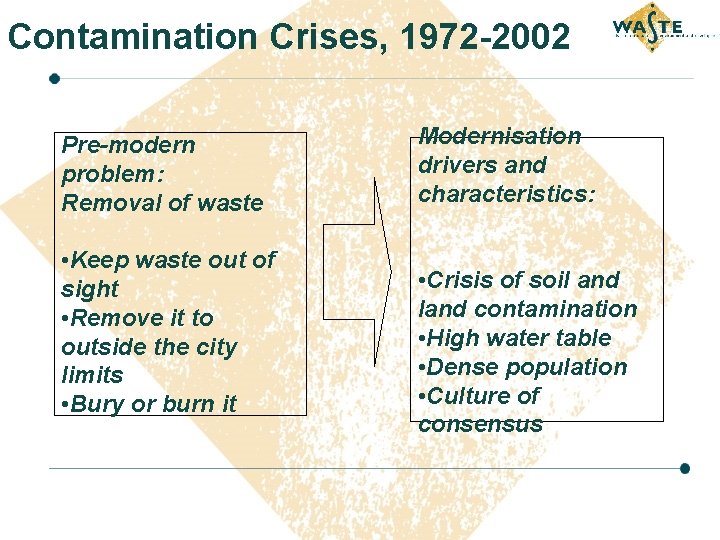
Contamination Crises, 1972 -2002 Pre-modern problem: Removal of waste • Keep waste out of sight • Remove it to outside the city limits • Bury or burn it Modernisation drivers and characteristics: • Crisis of soil and land contamination • High water table • Dense population • Culture of consensus
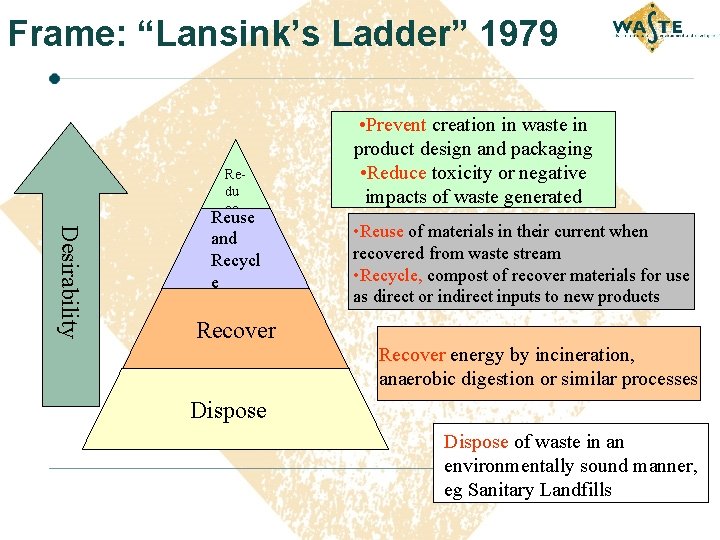
Frame: “Lansink’s Ladder” 1979 Redu ce Desirability Reuse and Recycl e Recover • Prevent creation in waste in product design and packaging • Reduce toxicity or negative impacts of waste generated • Reuse of materials in their current when recovered from waste stream • Recycle, compost of recover materials for use as direct or indirect inputs to new products Recover energy by incineration, anaerobic digestion or similar processes Dispose of waste in an environmentally sound manner, eg Sanitary Landfills
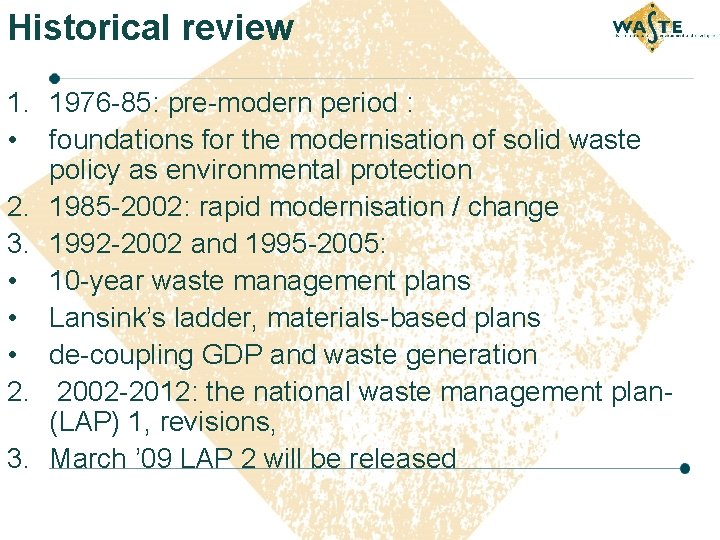
Historical review 1. 1976 -85: pre-modern period : • foundations for the modernisation of solid waste policy as environmental protection 2. 1985 -2002: rapid modernisation / change 3. 1992 -2002 and 1995 -2005: • 10 -year waste management plans • Lansink’s ladder, materials-based plans • de-coupling GDP and waste generation 2. 2002 -2012: the national waste management plan(LAP) 1, revisions, 3. March ’ 09 LAP 2 will be released
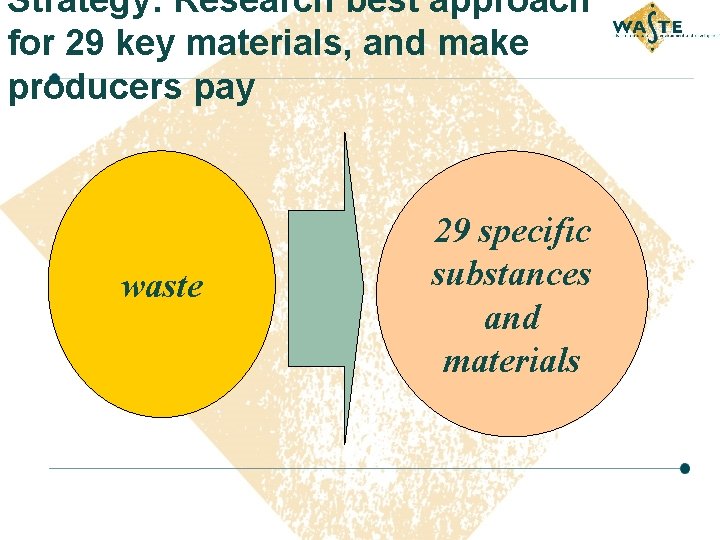
Strategy: Research best approach for 29 key materials, and make producers pay waste 29 specific substances and materials
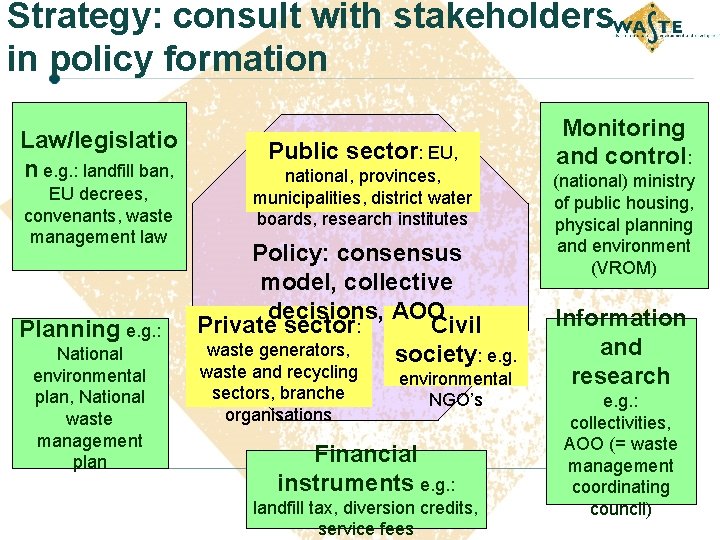
Strategy: consult with stakeholders in policy formation Law/legislatio n e. g. : landfill ban, EU decrees, convenants, waste management law Planning e. g. : National environmental plan, National waste management plan Public sector: EU, national, provinces, municipalities, district water boards, research institutes Policy: consensus model, collective decisions, AOO Private sector: Civil waste generators, society: e. g. waste and recycling sectors, branche organisations environmental NGO’s Financial instruments e. g. : landfill tax, diversion credits, service fees Monitoring and control: (national) ministry of public housing, physical planning and environment (VROM) Information and research e. g. : collectivities, AOO (= waste management coordinating council)
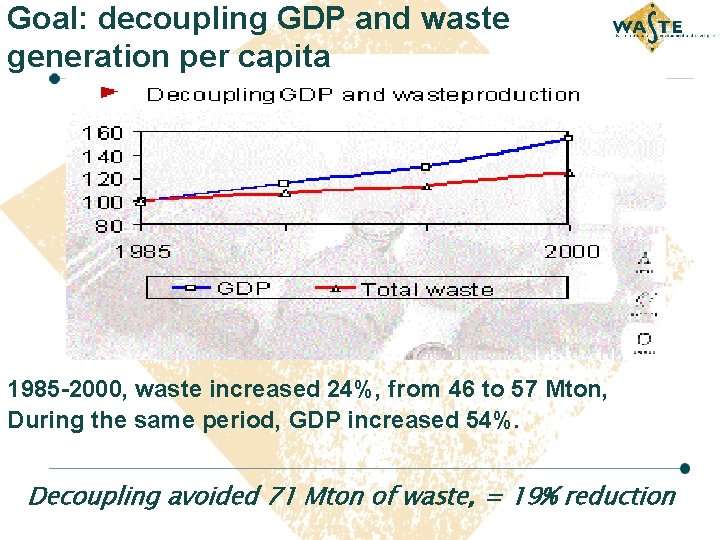
Goal: decoupling GDP and waste generation per capita 1985 -2000, waste increased 24%, from 46 to 57 Mton, During the same period, GDP increased 54%. Decoupling avoided 71 Mton of waste, = 19% reduction
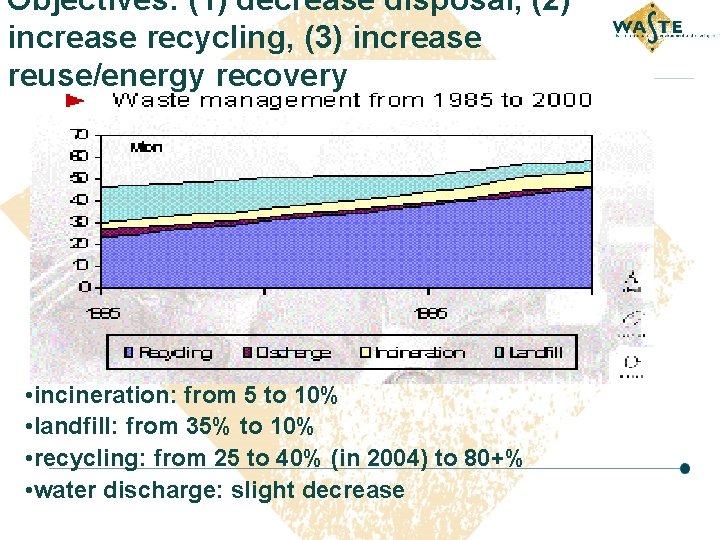
Objectives: (1) decrease disposal, (2) increase recycling, (3) increase reuse/energy recovery • incineration: from 5 to 10% • landfill: from 35% to 10% • recycling: from 25 to 40% (in 2004) to 80+% • water discharge: slight decrease
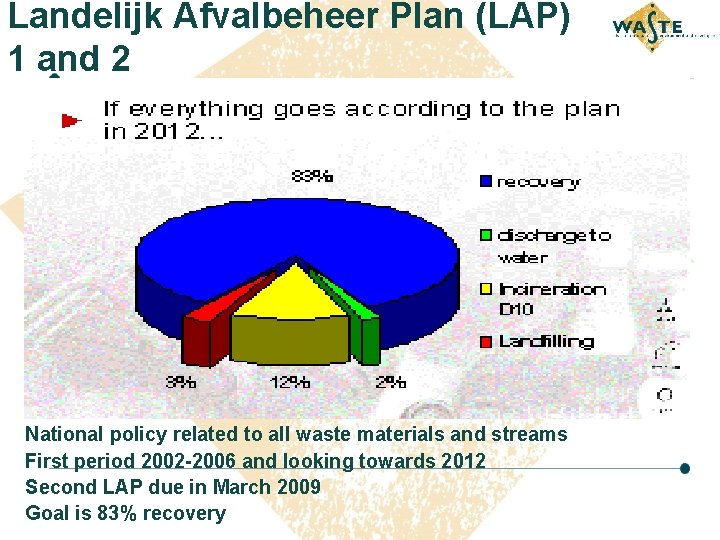
Landelijk Afvalbeheer Plan (LAP) 1 and 2 National policy related to all waste materials and streams First period 2002 -2006 and looking towards 2012 Second LAP due in March 2009 Goal is 83% recovery
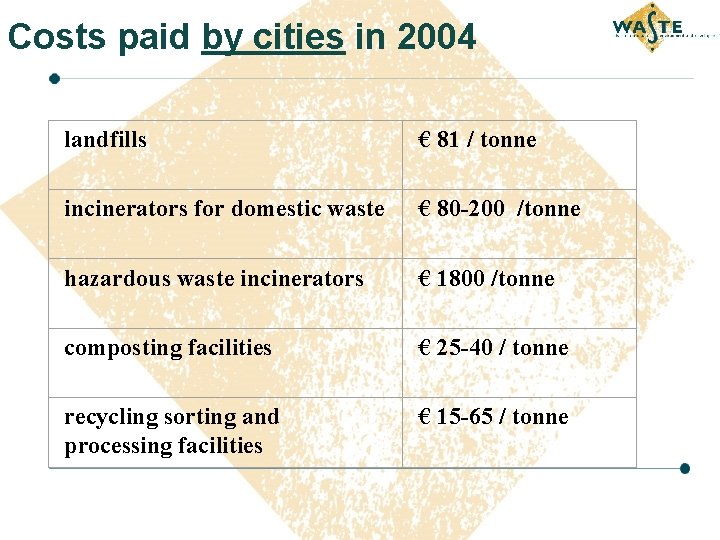
Costs paid by cities in 2004 landfills € 81 / tonne incinerators for domestic waste € 80 -200 /tonne hazardous waste incinerators € 1800 /tonne composting facilities € 25 -40 / tonne recycling sorting and processing facilities € 15 -65 / tonne
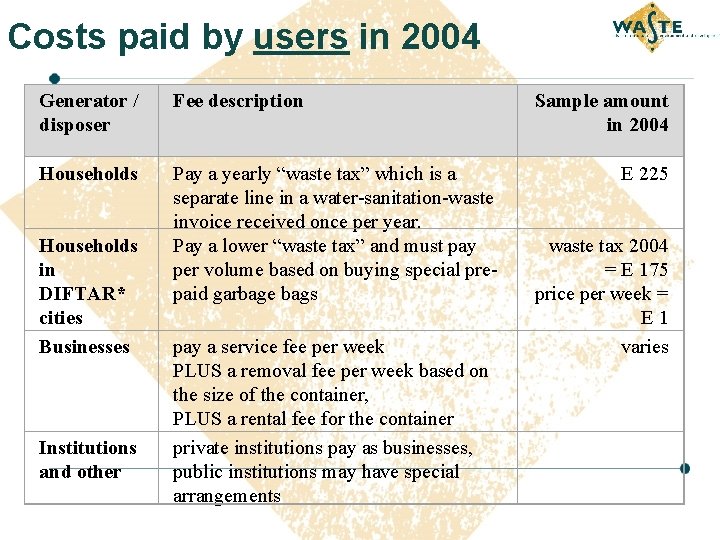
Costs paid by users in 2004 Generator / disposer Fee description Households Pay a yearly “waste tax” which is a separate line in a water-sanitation-waste invoice received once per year. Pay a lower “waste tax” and must pay per volume based on buying special prepaid garbage bags pay a service fee per week PLUS a removal fee per week based on the size of the container, PLUS a rental fee for the container private institutions pay as businesses, public institutions may have special arrangements Households in DIFTAR* cities Businesses Institutions and other Sample amount in 2004 E 225 waste tax 2004 = E 175 price per week = E 1 varies
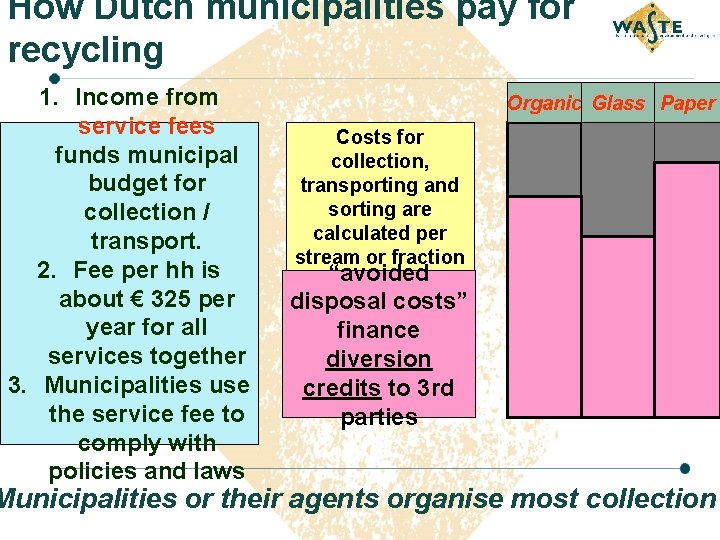
How Dutch municipalities pay for recycling 1. Income from service fees funds municipal budget for collection / transport. 2. Fee per hh is about € 325 per year for all services together 3. Municipalities use the service fee to comply with policies and laws Organic Glass Paper Costs for collection, transporting and sorting are calculated per stream or fraction “avoided disposal costs” finance diversion credits to 3 rd parties Municipalities or their agents organise most collection
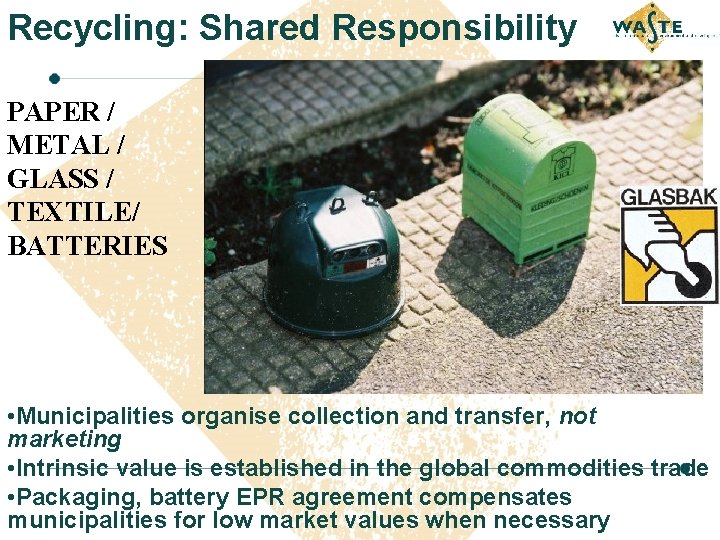
Recycling: Shared Responsibility PAPER / METAL / GLASS / TEXTILE/ BATTERIES • Municipalities organise collection and transfer, not marketing • Intrinsic value is established in the global commodities trade • Packaging, battery EPR agreement compensates municipalities for low market values when necessary
Municipal support: diversion credits 1. Transparent transfer payments acknowledge the public benefits of recycling/composting, especially when the market value is less than the environmental benefit 2. Vary per material, based on analysis of 29 streams 3. Never paid directly to the household or system user 4. Paid to third party NGO, public, or private intermediaries; 5. Serve as recycling price supports, when market value does not cover the cost to municipalities of collection. Examples: paper, bulky waste,
Features of diversion credits • • in general paid when there is a consensus that collection / marketing costs or environmental protection demands for recovering materials are too high to be recovered in commercial sale at market value. Thus there is not a diversion credit paid for scrap metal, which “pays for itself”; this is a form of support which is independent of any EPR fees paid by producers; It is made possible by the fact that all users pay a flat fee for all waste services, so-called: “afval-heffing; ” is a mechanism for municipal governments to support third party recovery without having to contract for it
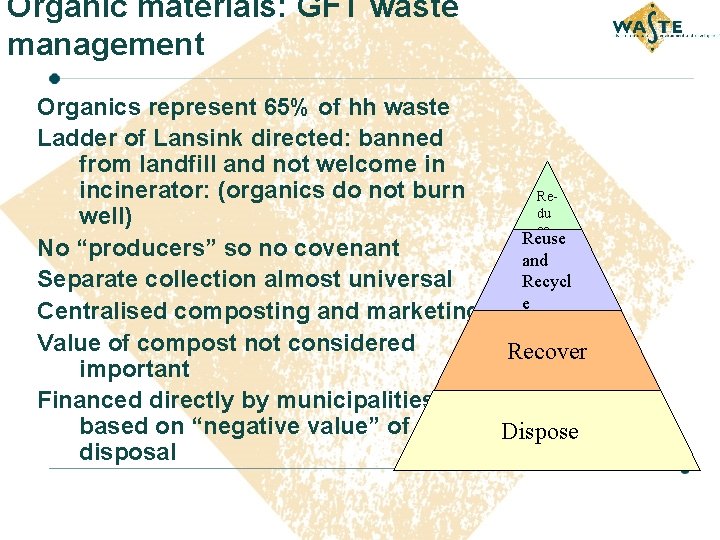
Organic materials: GFT waste management Organics represent 65% of hh waste Ladder of Lansink directed: banned from landfill and not welcome in incinerator: (organics do not burn Redu well) ce Reuse No “producers” so no covenant and Recycl Separate collection almost universal e Centralised composting and marketing Value of compost not considered Recover important Financed directly by municipalities based on “negative value” of Dispose disposal
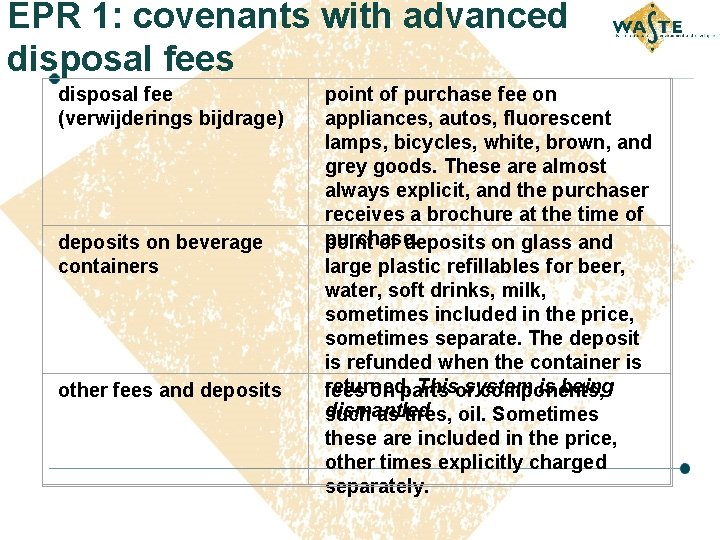
EPR 1: covenants with advanced disposal fees disposal fee (verwijderings bijdrage) deposits on beverage containers other fees and deposits point of purchase fee on appliances, autos, fluorescent lamps, bicycles, white, brown, and grey goods. These are almost always explicit, and the purchaser receives a brochure at the time of purchase. point of deposits on glass and large plastic refillables for beer, water, soft drinks, milk, sometimes included in the price, sometimes separate. The deposit is refunded when the container is returned. Thisor system is being fees on parts components, dismantled such as tires, oil. Sometimes these are included in the price, other times explicitly charged separately.
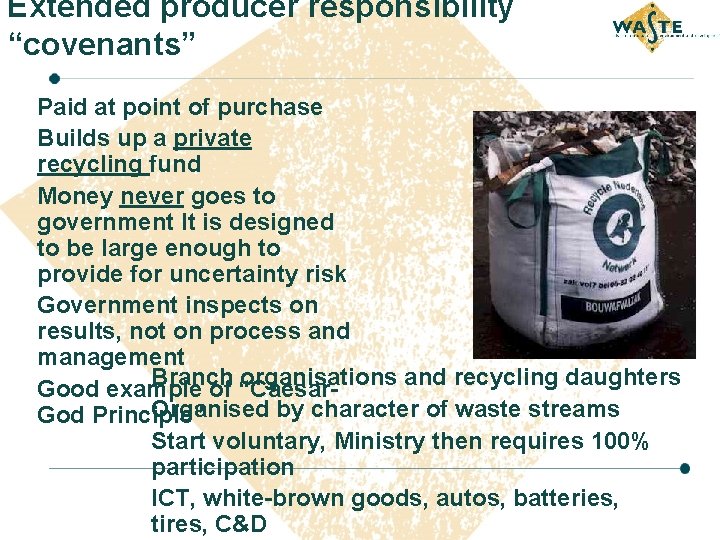
Extended producer responsibility “covenants” Paid at point of purchase Builds up a private recycling fund Money never goes to government It is designed to be large enough to provide for uncertainty risk Government inspects on results, not on process and management Branch organisations and recycling daughters Good example of “Caesar. Organised by character of waste streams God Principle” Start voluntary, Ministry then requires 100% participation ICT, white-brown goods, autos, batteries, tires, C&D
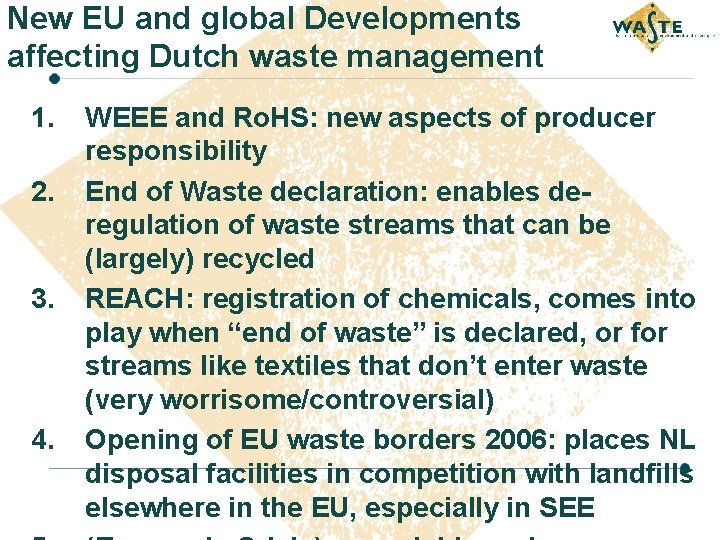
New EU and global Developments affecting Dutch waste management 1. 2. 3. 4. WEEE and Ro. HS: new aspects of producer responsibility End of Waste declaration: enables deregulation of waste streams that can be (largely) recycled REACH: registration of chemicals, comes into play when “end of waste” is declared, or for streams like textiles that don’t enter waste (very worrisome/controversial) Opening of EU waste borders 2006: places NL disposal facilities in competition with landfills elsewhere in the EU, especially in SEE
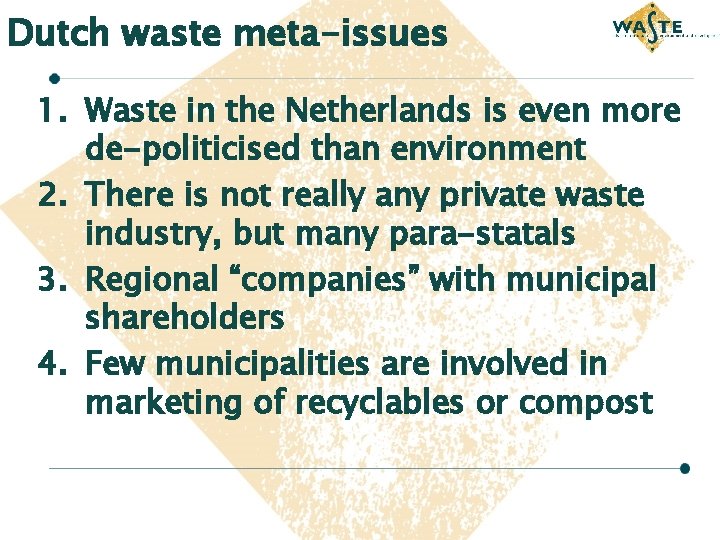
Dutch waste meta-issues 1. Waste in the Netherlands is even more de-politicised than environment 2. There is not really any private waste industry, but many para-statals 3. Regional “companies” with municipal shareholders 4. Few municipalities are involved in marketing of recyclables or compost
ZW issues in Netherlands 1. 2. 3. 4. 5. System is fragmenting at the edges Loss of refillable PET 1, 5 litre deposits serious Packaging convenant has never really worked Incineration small but significant Opening of EU waste borders is too interesting 6. EPR agreements focus on recycling, nicely ignore potential for prevention/reuse 7. Pay-as-you-throw extremely limited
What the Netherlands can learn from Zero Waste 1. The whole is more than the sum of the parts 2. Rational behaviour doesn’t prevail 3. New EU developments have unanticipated impacts, and should be studied 4. Even limited incineration reduces emphasis on valorisation side, as in Rotterdam 5. There is a tendency to be smug: as a result the EU has fined Netherlands for noncompliance 6. Dutch stakeholders know nothing about financial incentives
Thank-you very much. Questions and discussion -- and especially disagreement -- are welcome. Anne Scheinberg, <ascheinberg@waste. nl>