
Waste Heat Utilization in Wasteto Energy WTE Plants


- Slides: 10
Waste Heat Utilization in Waste-to Energy (WTE) Plants Using a Solid State Heat Engine Driven by Shape Memory Alloy (SMA) Eduardo Cristi and Masato R. Nakamura Department of Mechanical Engineering Technology and Industrial Design New York City College of Technology (City Tech) City University of New York (Cuny) 300 Jay Street, Brookyn, NY 11201
Background • Current situation? At least 70% of heat generated in a power plant is wasted. Utilizing waste heat contribute energy efficency. – Coal fire plant – Natural Gas fire plants – Biomass power plants – Nuclear Power plant – Geothermal Plant – Solar thermal Plant 89. 5% of energy came from heat powerlplants in 2009
Objective • Why Wasted heat utilization? At least 70% of heat generation in a power plant is wasted. Utilizing waste heat contribute energy efficiency. • Why SMA Engine? Self sustaining, SMA deos not require any specific hest source, help heat exchange processe
Methodology • • • How our research will be conducted CAD modeling simulation Pysical model (prototype) IR camera Thermal Analysis Then compare Simulation With Real life data
3 -1 cad modeling
Physical Model • Picture of physical model Picture of experimental work
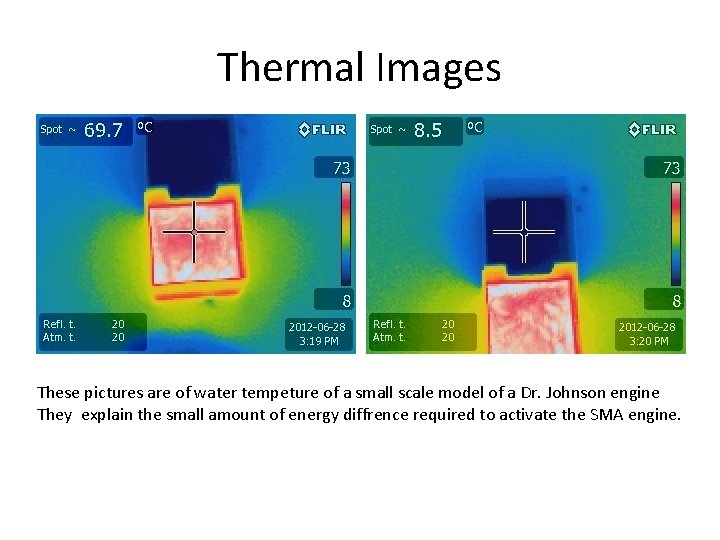
Thermal Images These pictures are of water tempeture of a small scale model of a Dr. Johnson engine They explain the small amount of energy diffrence required to activate the SMA engine.
Results and discusuions
Result and discussion part 2
Summary and future work