
Waste Classification for Soils THE AGS PRACTITIONERS GUIDE

- Slides: 33
Waste Classification for Soils THE AGS PRACTITIONERS’ GUIDE Bridget Plimmer Associate, Senior Hydrogeologist Golder Associates (UK) Ltd.
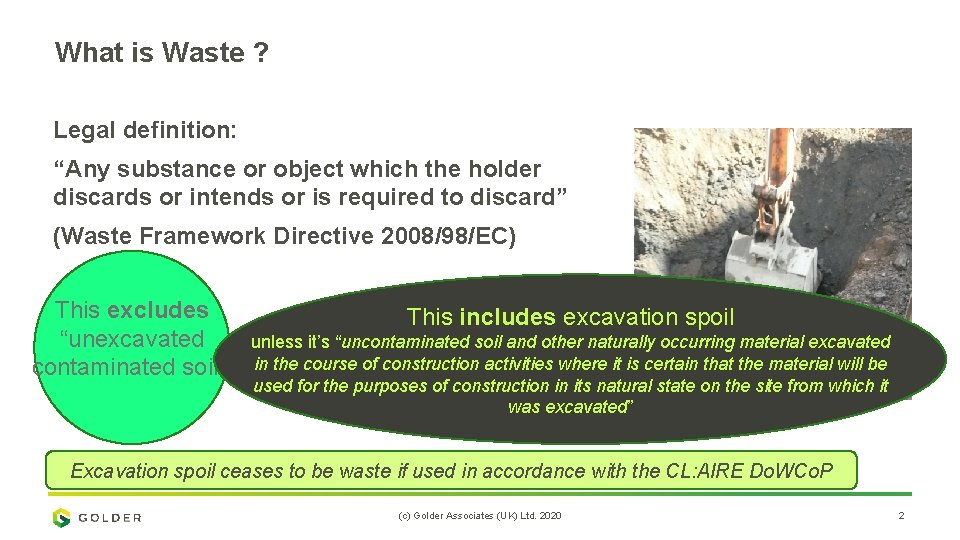
What is Waste ? Legal definition: “Any substance or object which the holder discards or intends or is required to discard” (Waste Framework Directive 2008/98/EC) This excludes “unexcavated contaminated soil”. This includes excavation spoil unless it’s “uncontaminated soil and other naturally occurring material excavated in the course of construction activities where it is certain that the material will be used for the purposes of construction in its natural state on the site from which it was excavated” Excavation spoil ceases to be waste if used in accordance with the CL: AIRE Do. WCo. P ___ (c) Golder Associates (UK) Ltd. 2020 2
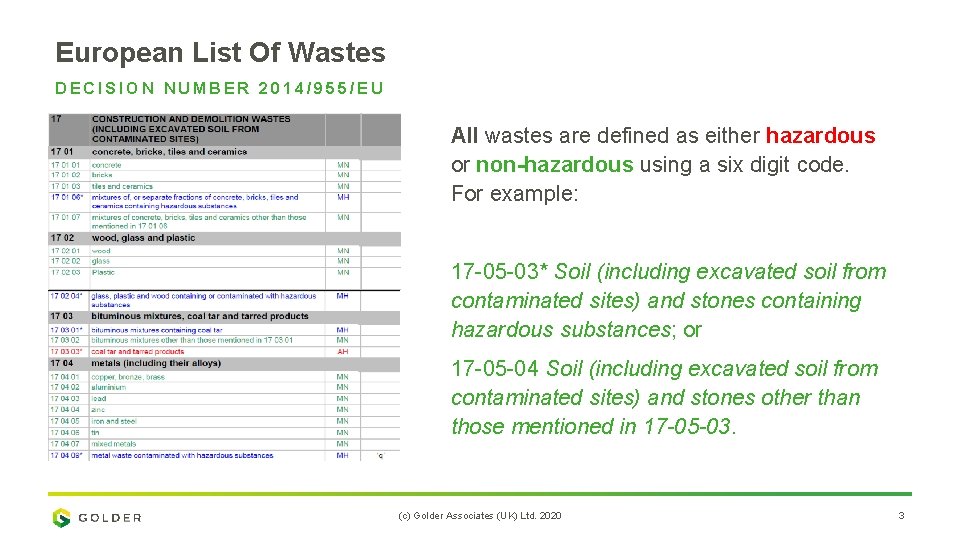
European List Of Wastes DECISION NUMBER 2014/955/EU All wastes are defined as either hazardous or non-hazardous using a six digit code. For example: 17 -05 -03* Soil (including excavated soil from contaminated sites) and stones containing hazardous substances; or 17 -05 -04 Soil (including excavated soil from contaminated sites) and stones other than those mentioned in 17 -05 -03. ___ (c) Golder Associates (UK) Ltd. 2020 3
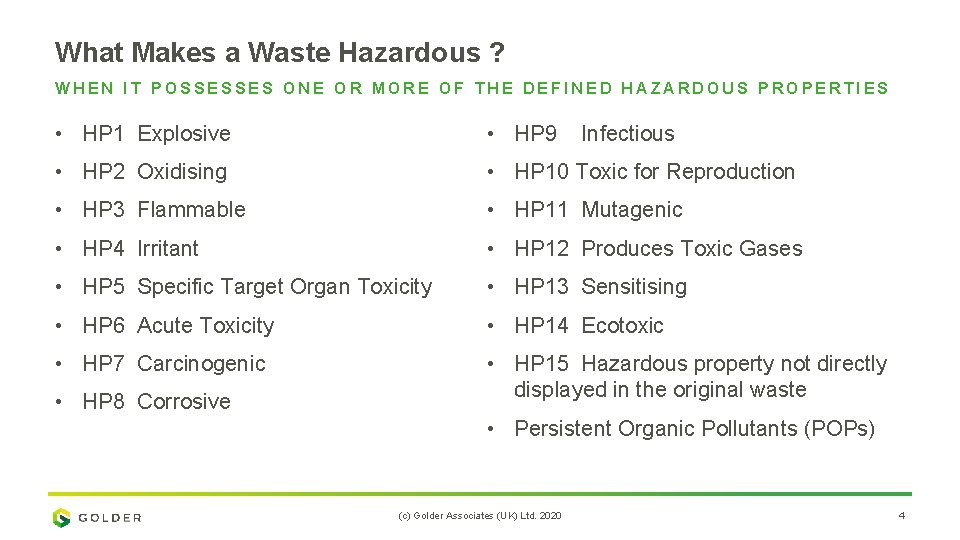
What Makes a Waste Hazardous ? WHEN IT POSSESSES ONE OR MORE OF THE DEFINED HAZARDOUS PROPERTIES • HP 1 Explosive • HP 9 • HP 2 Oxidising • HP 10 Toxic for Reproduction • HP 3 Flammable • HP 11 Mutagenic • HP 4 Irritant • HP 12 Produces Toxic Gases • HP 5 Specific Target Organ Toxicity • HP 13 Sensitising • HP 6 Acute Toxicity • HP 14 Ecotoxic • HP 7 Carcinogenic • HP 15 Hazardous property not directly displayed in the original waste • Persistent Organic Pollutants (POPs) ___ • HP 8 Corrosive Infectious (c) Golder Associates (UK) Ltd. 2020 4
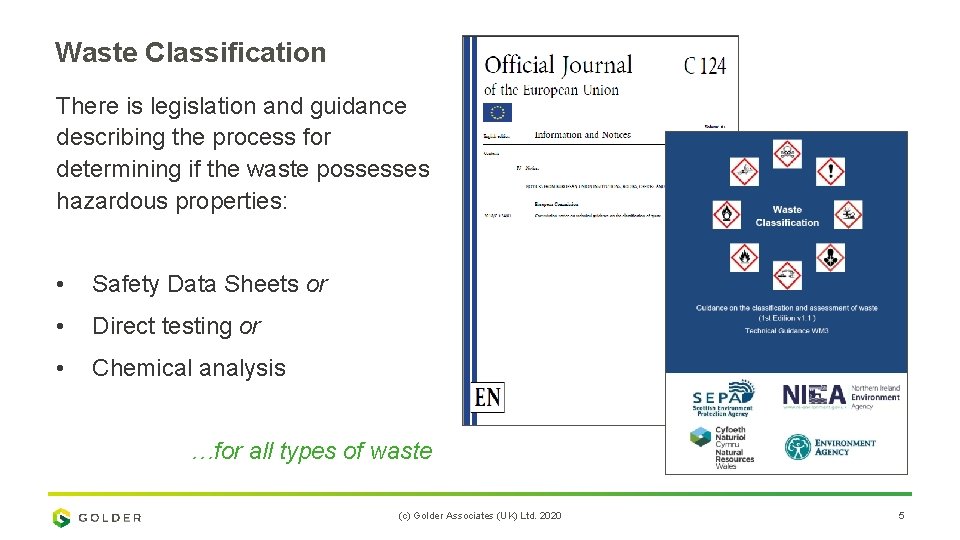
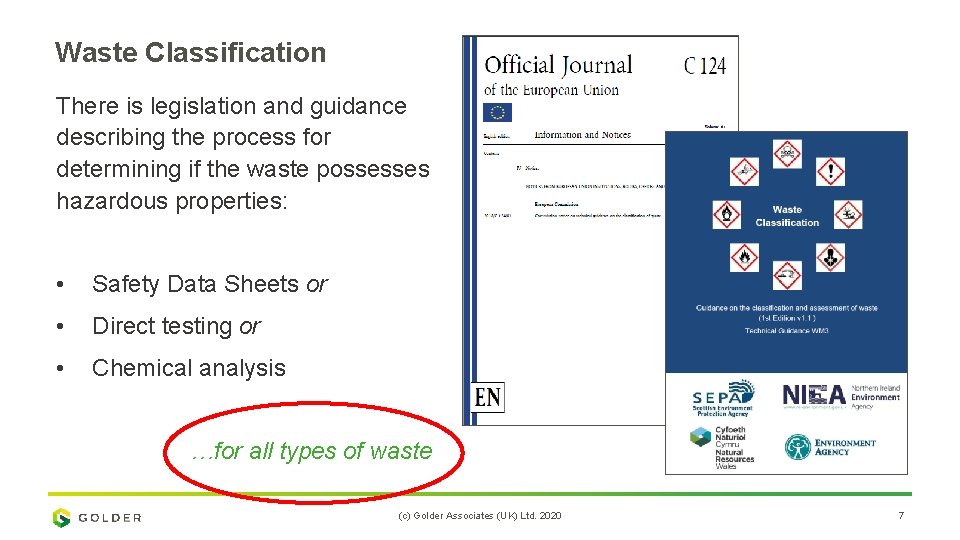
Waste Classification There is legislation and guidance describing the process for determining if the waste possesses hazardous properties: • Safety Data Sheets or • Direct testing or • Chemical analysis …for all types of waste ___ (c) Golder Associates (UK) Ltd. 2020 5
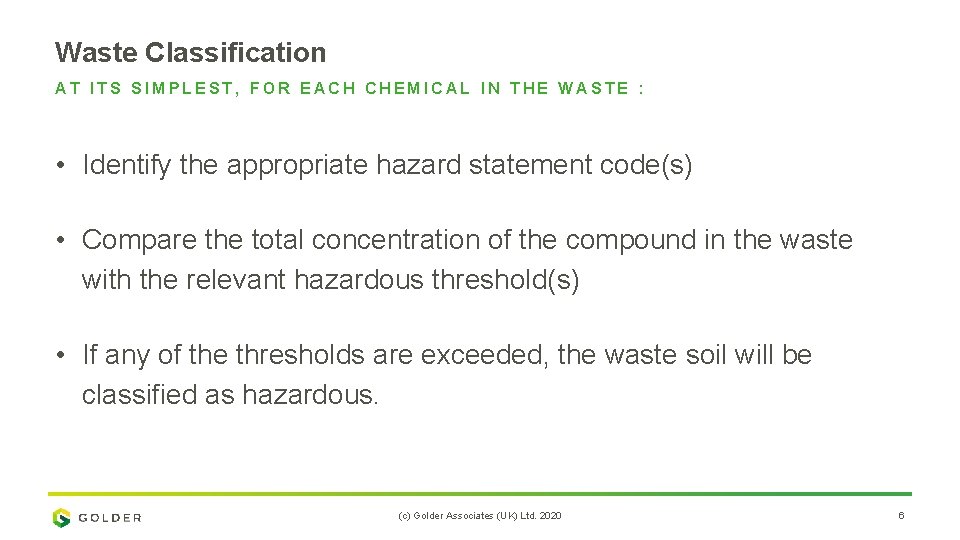
Waste Classification AT ITS SIMPLEST, FOR EACH CHEMICAL IN THE WASTE : • Identify the appropriate hazard statement code(s) • Compare the total concentration of the compound in the waste with the relevant hazardous threshold(s) • If any of the thresholds are exceeded, the waste soil will be classified as hazardous. ___ (c) Golder Associates (UK) Ltd. 2020 6
Waste Classification There is legislation and guidance describing the process for determining if the waste possesses hazardous properties: • Safety Data Sheets or • Direct testing or • Chemical analysis …for all types of waste ___ (c) Golder Associates (UK) Ltd. 2020 7
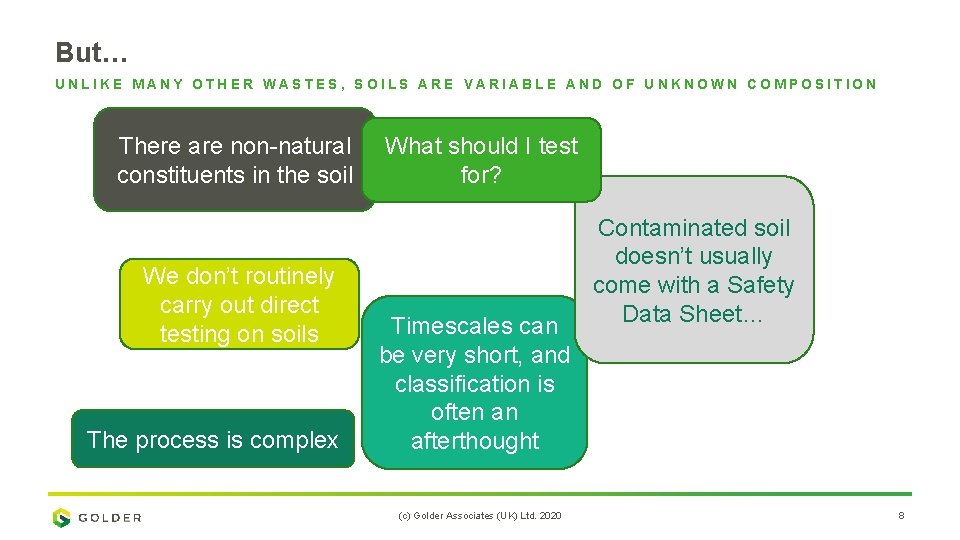
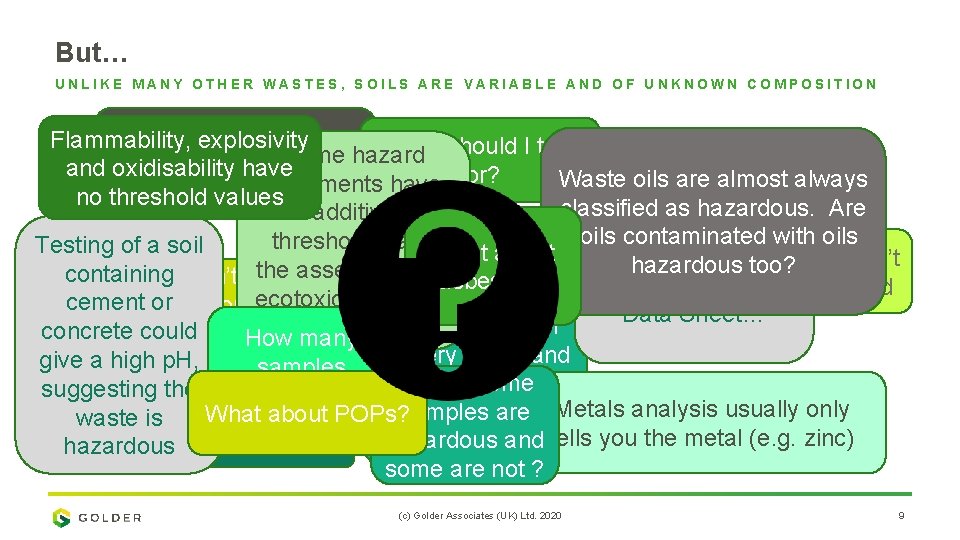
But… UNLIKE MANY OTHER WASTES, SOILS ARE VARIABLE AND OF UNKNOWN COMPOSITION We don’t routinely carry out direct testing on soils The process is complex What should I test for? Timescales can be very short, and classification is often an afterthought Contaminated soil doesn’t usually come with a Safety Data Sheet… ___ There are non-natural constituents in the soil (c) Golder Associates (UK) Ltd. 2020 8
But… UNLIKE MANY OTHER WASTES, SOILS ARE VARIABLE AND OF UNKNOWN COMPOSITION Flammability, explosivity What should I test There are non-natural Some hazard and oxidisability constituentshave instatements the soil Waste oils are almost always have for? no threshold values classified as hazardous. Are additive Contaminated soils contaminated with oils thresholds, and. What about Testing of a soil doesn’t usually Hazard codes aren’t hazardous too? the assessment of containing We don’t routinely asbestos? come withalways a Safety easy to find ecotoxicity is more cement or carry out direct Data Sheet… Timescales can complex. concrete could testing on soils How many be very short, and give a high p. H, samples What if some is suggesting the should I take ? classification are Metals analysis usually only often an What about POPs? samples waste is The process is complex hazardous and tells you the metal (e. g. zinc) afterthought hazardous some are not ? ___ (c) Golder Associates (UK) Ltd. 2020 9
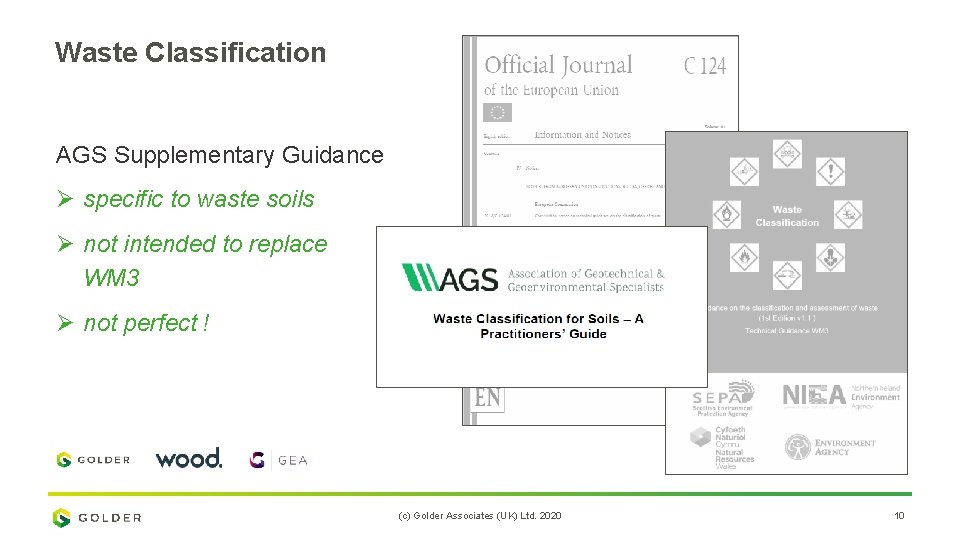
Waste Classification AGS Supplementary Guidance Ø specific to waste soils Ø not intended to replace WM 3 Ø not perfect ! ___ (c) Golder Associates (UK) Ltd. 2020 10
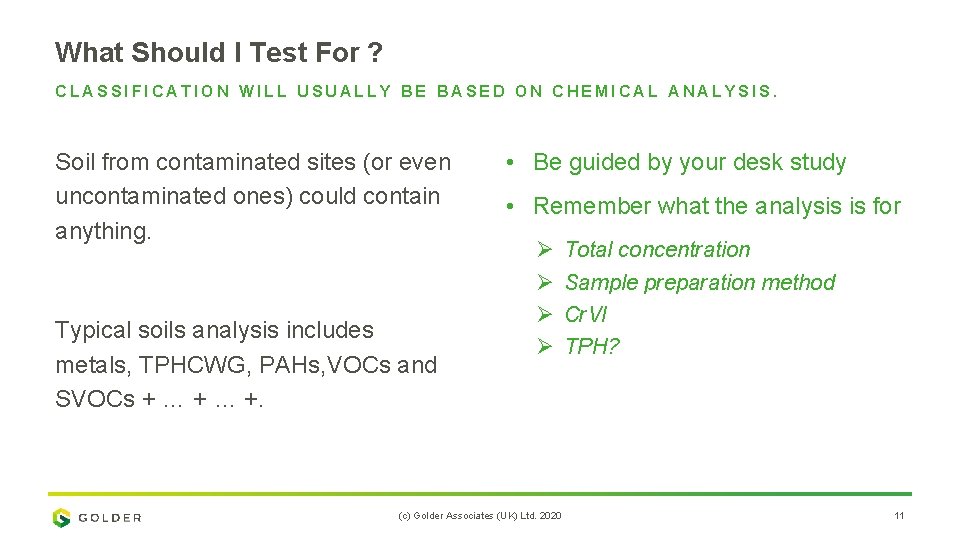
What Should I Test For ? CLASSIFICATION WILL USUALLY BE BASED ON CHEMICAL ANALYSIS. • Be guided by your desk study Soil from contaminated sites (or even uncontaminated ones) could contain anything. • Remember what the analysis is for Ø Ø Typical soils analysis includes metals, TPHCWG, PAHs, VOCs and SVOCs + … +. Total concentration Sample preparation method Cr. VI TPH? ___ (c) Golder Associates (UK) Ltd. 2020 11
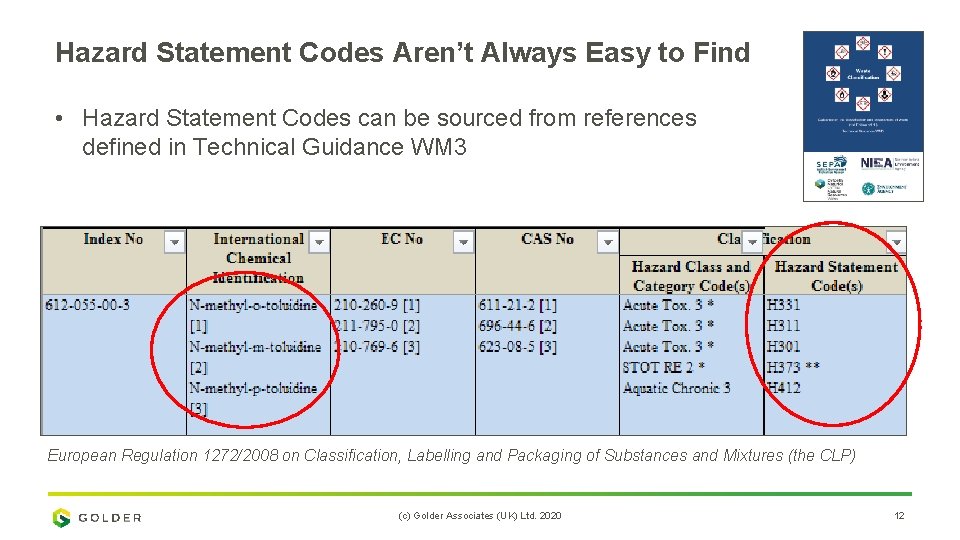
Hazard Statement Codes Aren’t Always Easy to Find • Hazard Statement Codes can be sourced from references defined in Technical Guidance WM 3 European Regulation 1272/2008 on Classification, Labelling and Packaging of Substances and Mixtures (the CLP) ___ (c) Golder Associates (UK) Ltd. 2020 12
Hazard Statement Codes Aren’t Always Easy to Find THE CLP ISN’T COMPLETE • Not all substances and codes are in the CLP • Other data sources should be used in the defined order of preference • MSDS have to be REACH-compliant (i. e. US ones don’t always count) • You may need to use different data sources for different hazardous properties • Consider the exposure route ___ (c) Golder Associates (UK) Ltd. 2020 13
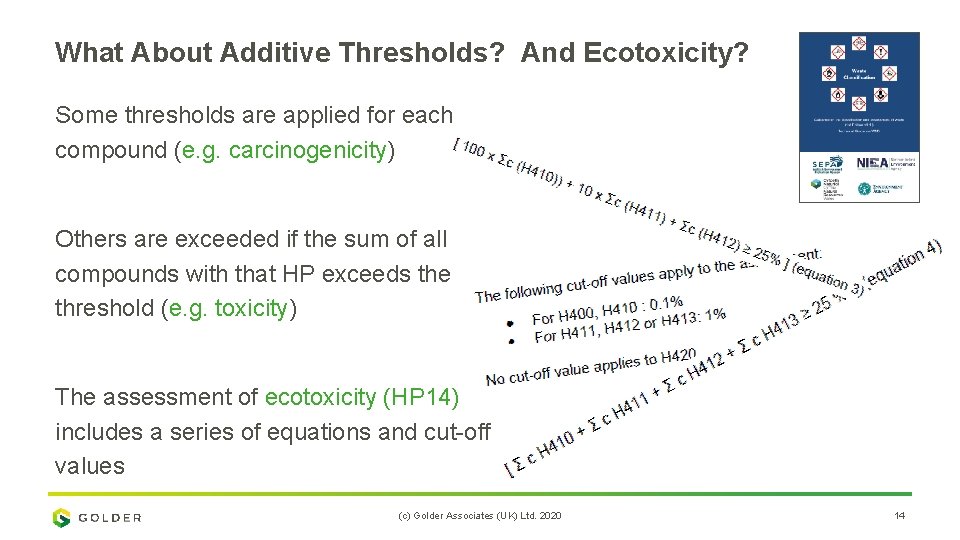
What About Additive Thresholds? And Ecotoxicity? Some thresholds are applied for each compound (e. g. carcinogenicity) Others are exceeded if the sum of all compounds with that HP exceeds the threshold (e. g. toxicity) The assessment of ecotoxicity (HP 14) includes a series of equations and cut-off values ___ (c) Golder Associates (UK) Ltd. 2020 14
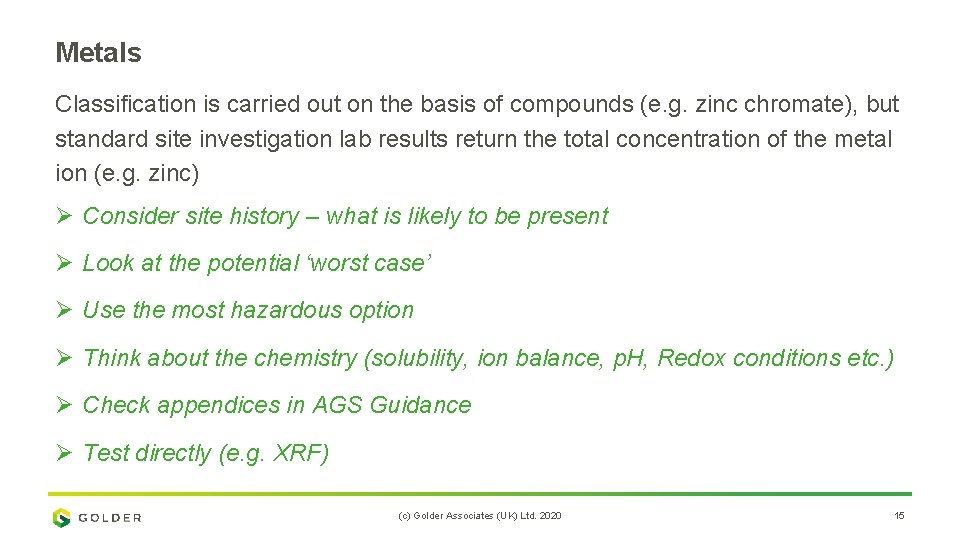
Metals Classification is carried out on the basis of compounds (e. g. zinc chromate), but standard site investigation lab results return the total concentration of the metal ion (e. g. zinc) Ø Consider site history – what is likely to be present Ø Look at the potential ‘worst case’ Ø Use the most hazardous option Ø Think about the chemistry (solubility, ion balance, p. H, Redox conditions etc. ) Ø Check appendices in AGS Guidance Ø Test directly (e. g. XRF) ___ (c) Golder Associates (UK) Ltd. 2020 15
Oils In Soils DESCRIBED IN DETAIL IN TECHNICAL GUIDANCE WM 3 • With a few specific exceptions, waste oils are classified as hazardous • If there is a small amount of oil contaminating your soil (typically <1, 000 mg/kg) it isn’t hazardous • You can still classify the soil even if you don’t know what the oil is (but it helps) Ø TPH concentration (C 6 -C 40) is used Ø Coal Tar is assessed separately Ø TPHCWG banding is insufficient to assess the oil as diesel Ø Marker compounds may be used – some oils and with conditions ! ___ (c) Golder Associates (UK) Ltd. 2020 16
Asbestos DESCRIBED WITH AN EXAMPLE IN TECHNICAL GUIDANCE WM 3 • Both identifiable pieces of asbestos containing material (ACM) and free and dispersed fibres are considered. • Where the waste soil contains identifiable pieces of ACM it should be classified as a mixed waste • Asbestos has a threshold but don’t forget even if the waste soil is non-hazardous because of the asbestos in it, the asbestos itself may be an issue. ___ (c) Golder Associates (UK) Ltd. 2020 17
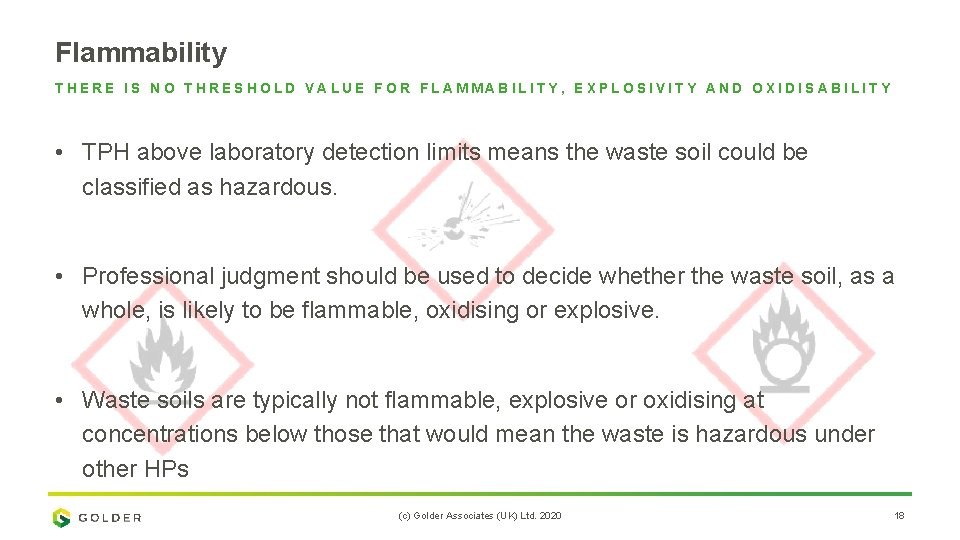
Flammability THERE IS NO THRESHOLD VALUE FOR FLAMMABILITY, EXPLOSIVITY AND OXIDISABILITY • TPH above laboratory detection limits means the waste soil could be classified as hazardous. • Professional judgment should be used to decide whether the waste soil, as a whole, is likely to be flammable, oxidising or explosive. • Waste soils are typically not flammable, explosive or oxidising at concentrations below those that would mean the waste is hazardous under other HPs ___ (c) Golder Associates (UK) Ltd. 2020 18
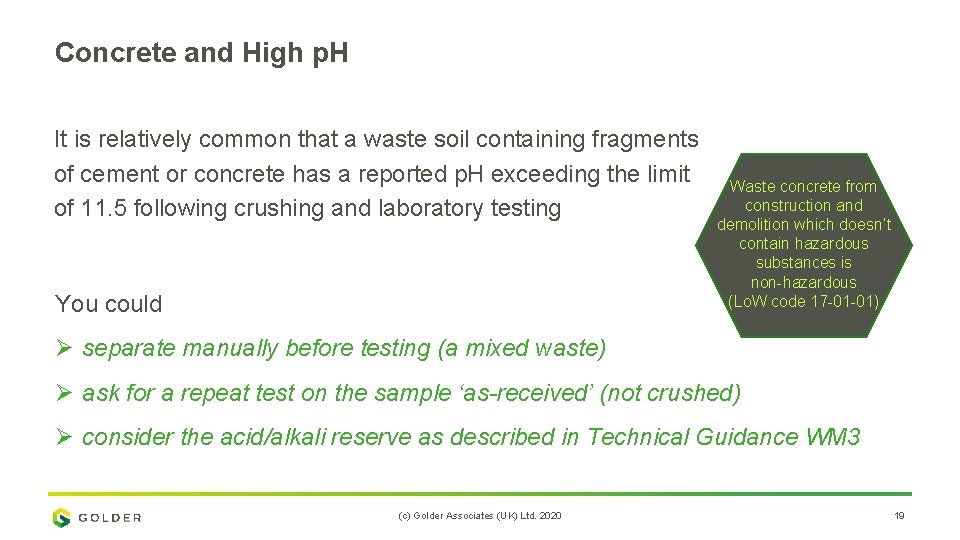
Concrete and High p. H It is relatively common that a waste soil containing fragments of cement or concrete has a reported p. H exceeding the limit of 11. 5 following crushing and laboratory testing You could Waste concrete from construction and demolition which doesn’t contain hazardous substances is non-hazardous (Lo. W code 17 -01 -01) Ø separate manually before testing (a mixed waste) Ø ask for a repeat test on the sample ‘as-received’ (not crushed) Ø consider the acid/alkali reserve as described in Technical Guidance WM 3 ___ (c) Golder Associates (UK) Ltd. 2020 19
Persistent Organic Pollutants (POPs) LISTED IN THE WFD AND IN TECHNICAL GUIDANCE WM 3 Either Ø Analyse for POPs in your waste and assess against the defined concentration limits Or Ø Explain why you have decided that POPs are unlikely to be present in the waste soil at concentrations sufficient to warrant consideration ___ (c) Golder Associates (UK) Ltd. 2020 20
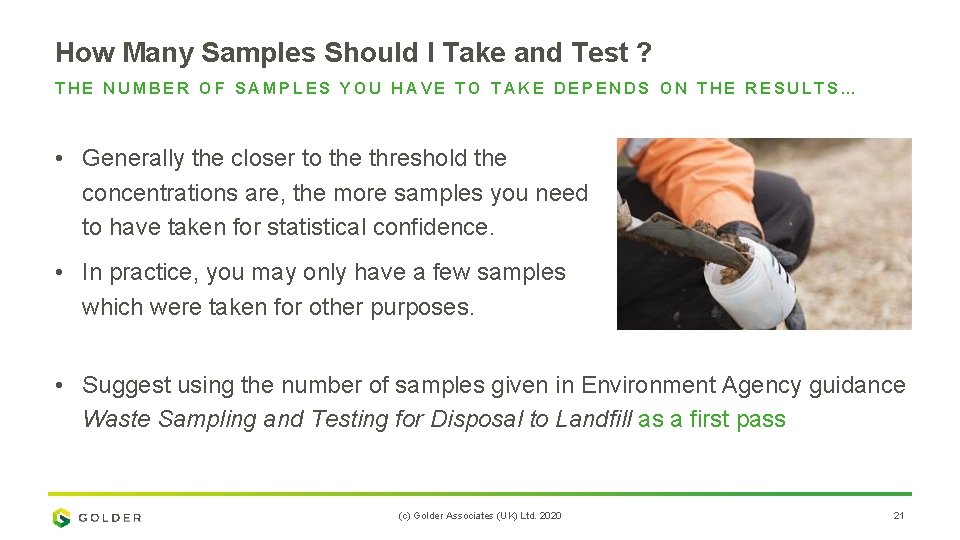
How Many Samples Should I Take and Test ? THE NUMBER OF SAMPLES YOU HAVE TO TAKE DEPENDS ON THE RESULTS… • Generally the closer to the threshold the concentrations are, the more samples you need to have taken for statistical confidence. • In practice, you may only have a few samples which were taken for other purposes. • Suggest using the number of samples given in Environment Agency guidance Waste Sampling and Testing for Disposal to Landfill as a first pass ___ (c) Golder Associates (UK) Ltd. 2020 21
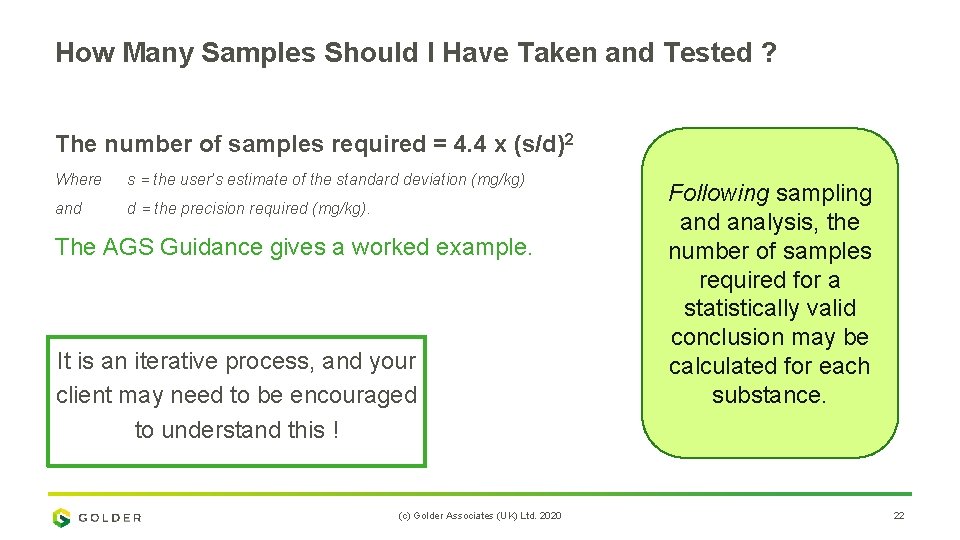
How Many Samples Should I Have Taken and Tested ? The number of samples required = 4. 4 x (s/d)2 Where s = the user’s estimate of the standard deviation (mg/kg) and d = the precision required (mg/kg). The AGS Guidance gives a worked example. It is an iterative process, and your client may need to be encouraged to understand this ! Following sampling and analysis, the number of samples required for a statistically valid conclusion may be calculated for each substance. ___ (c) Golder Associates (UK) Ltd. 2020 22
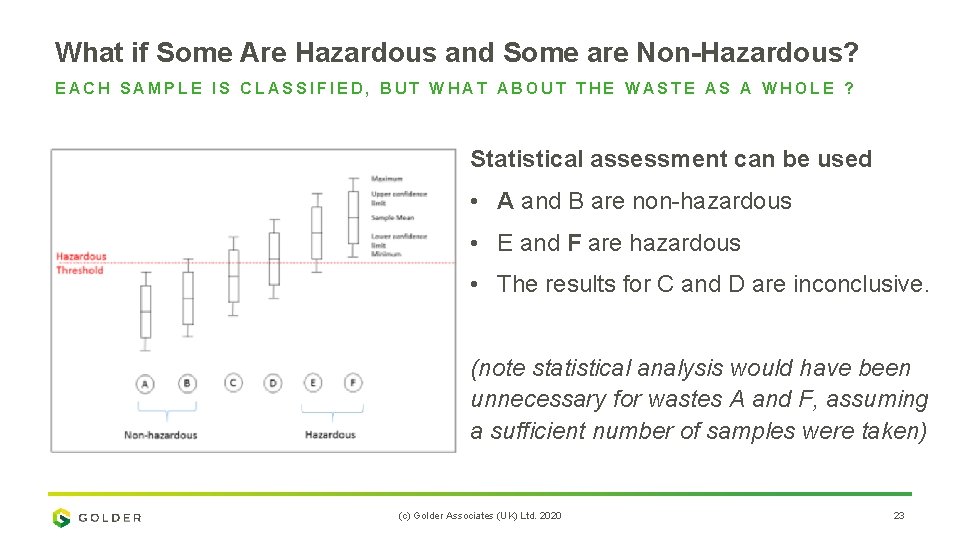
What if Some Are Hazardous and Some are Non-Hazardous? EACH SAMPLE IS CLASSIFIED, BUT WHAT ABOUT THE WASTE AS A WHOLE ? Statistical assessment can be used • A and B are non-hazardous • E and F are hazardous • The results for C and D are inconclusive. (note statistical analysis would have been unnecessary for wastes A and F, assuming a sufficient number of samples were taken) ___ (c) Golder Associates (UK) Ltd. 2020 23
An Alternative to Statistical Analysis Technical Guidance WM 3 also states that, as an alternative, the waste may be considered hazardous if Ø any individual sample has exceeded the threshold for that hazardous property, or if such a sample could reasonably be taken by another party, for example the regulator The AGS Guidance suggests that Ø the statistical approach should take precedence, assuming a single waste population and a sufficient number of samples A landfill operator is not obliged to take a waste load ___ (c) Golder Associates (UK) Ltd. 2020 24
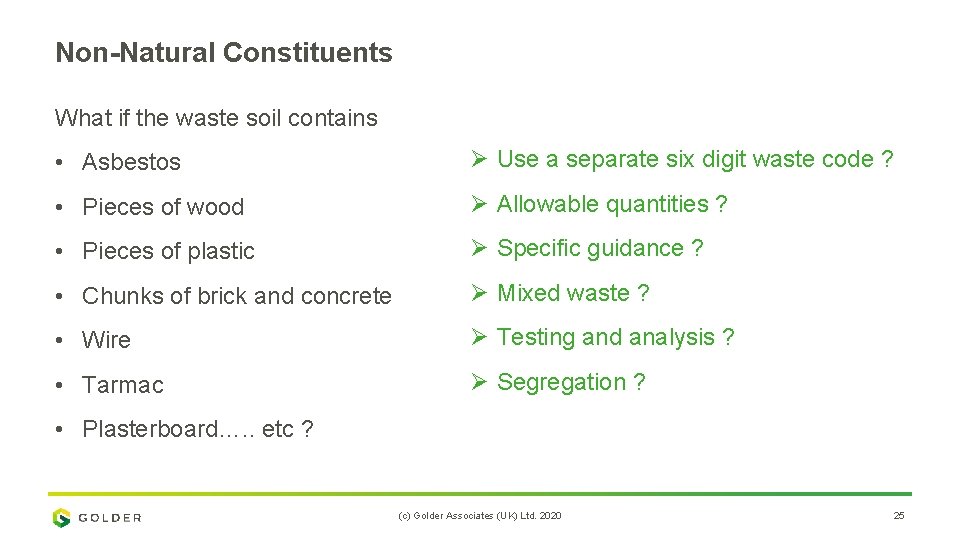
Non-Natural Constituents What if the waste soil contains • Asbestos Ø Use a separate six digit waste code ? • Pieces of wood Ø Allowable quantities ? • Pieces of plastic Ø Specific guidance ? • Chunks of brick and concrete Ø Mixed waste ? • Wire Ø Testing and analysis ? • Tarmac Ø Segregation ? • Plasterboard…. . etc ? ___ (c) Golder Associates (UK) Ltd. 2020 25
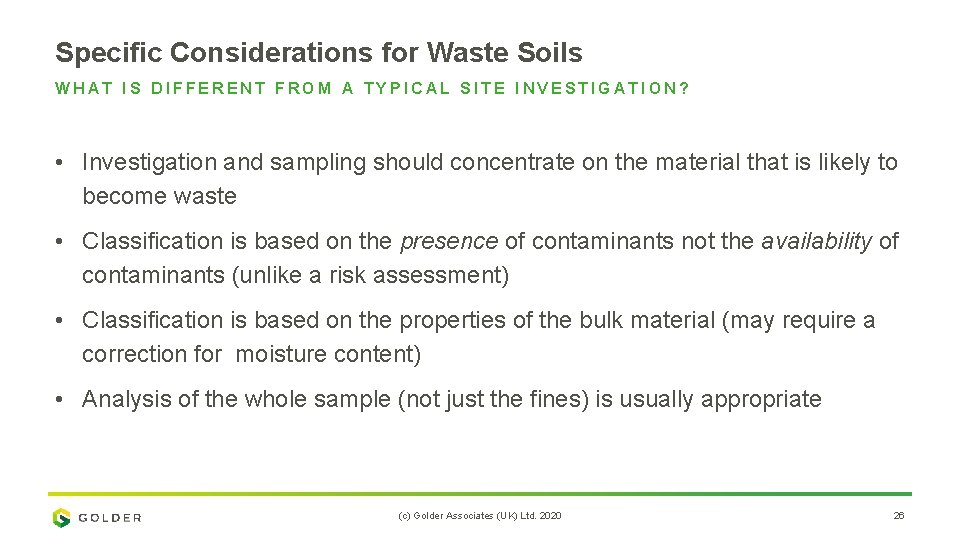
Specific Considerations for Waste Soils WHAT IS DIFFERENT FROM A TYPICAL SITE INVESTIGATION? • Investigation and sampling should concentrate on the material that is likely to become waste • Classification is based on the presence of contaminants not the availability of contaminants (unlike a risk assessment) • Classification is based on the properties of the bulk material (may require a correction for moisture content) • Analysis of the whole sample (not just the fines) is usually appropriate ___ (c) Golder Associates (UK) Ltd. 2020 26
Waste Acceptance Criteria COUNCIL DECISION 2003/33/EC But can’t I just use WAC testing to classify the waste ? ___ (c) Golder Associates (UK) Ltd. 2020 27
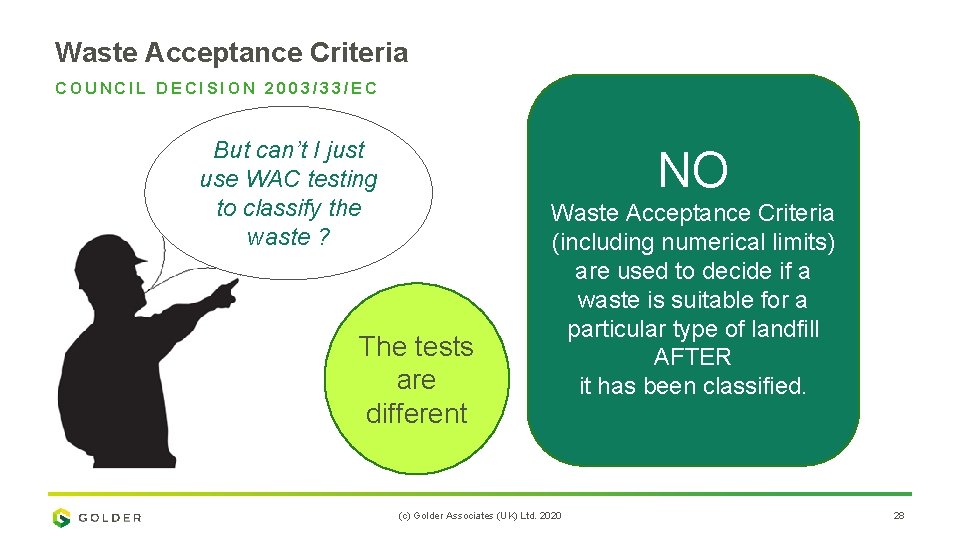
Waste Acceptance Criteria COUNCIL DECISION 2003/33/EC But can’t I just use WAC testing to classify the waste ? NO The tests are different Waste Acceptance Criteria (including numerical limits) are used to decide if a waste is suitable for a particular type of landfill AFTER it has been classified. ___ (c) Golder Associates (UK) Ltd. 2020 28
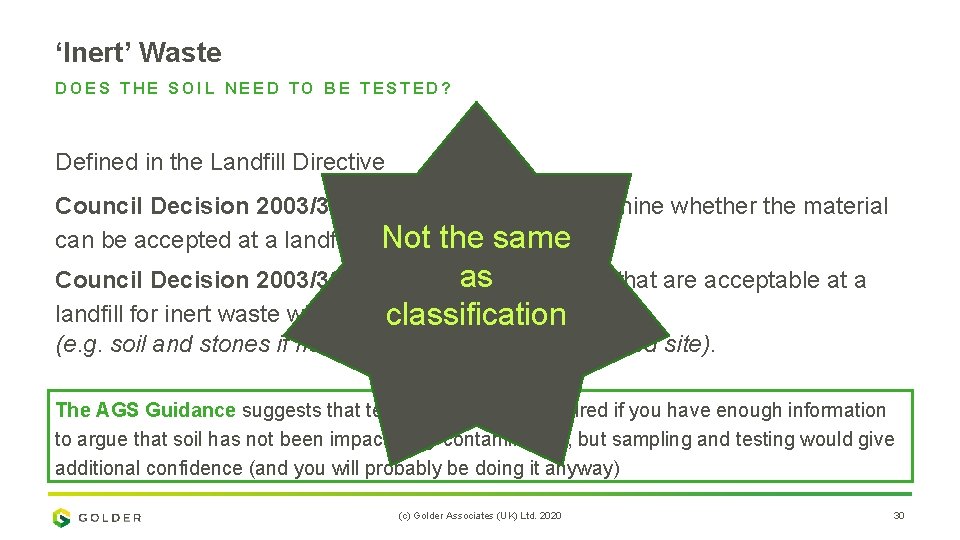
‘Inert’ Waste DOES THE SOIL NEED TO BE TESTED? Defined in the Landfill Directive Council Decision 2003/33/EC defines tests to determine whether the material can be accepted at a landfill for. Not inertthe waste same Council Decision 2003/33/EC gives aas list of wastes that are acceptable at a landfill for inert waste without testing classification (e. g. soil and stones if not topsoil or from a contaminated site). The AGS Guidance suggests that testing may not be required if you have enough information to argue that soil has not been impacted by contamination, but sampling and testing would give additional confidence (and you will probably be doing it anyway) ___ (c) Golder Associates (UK) Ltd. 2020 30
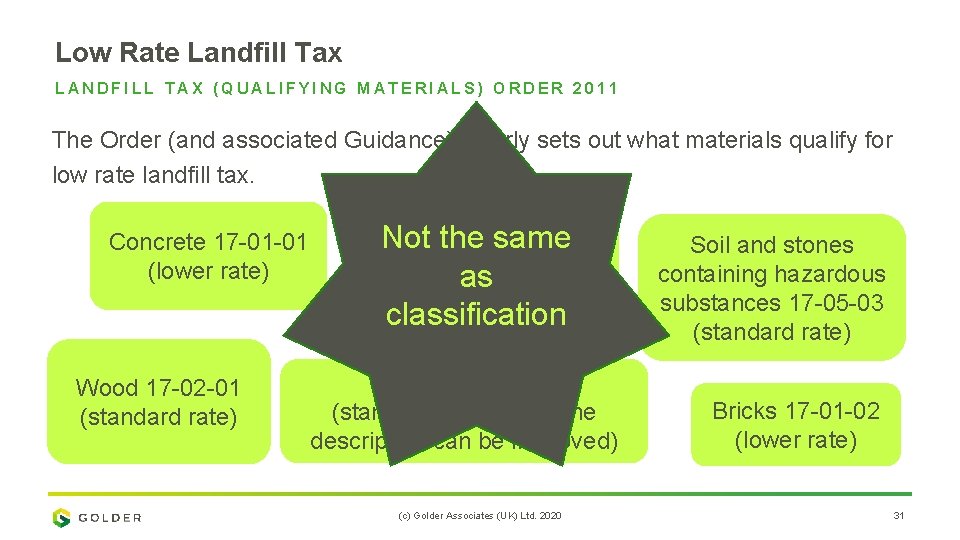
Low Rate Landfill Tax LANDFILL TAX (QUALIFYING MATERIALS) ORDER 2011 The Order (and associated Guidance) clearly sets out what materials qualify for low rate landfill tax. Naturally occurring sub-soil andsame crushed Not the Concrete 17 -01 -01 Soil and stones stone 17 -05 -04 (lower rate) containing hazardous as (lower rate) substances 17 -05 -03 classification (standard rate) Soils 17 -05 -04 (standard rate unless the description can be improved) Bricks 17 -01 -02 (lower rate) ___ Wood 17 -02 -01 (standard rate) (c) Golder Associates (UK) Ltd. 2020 31
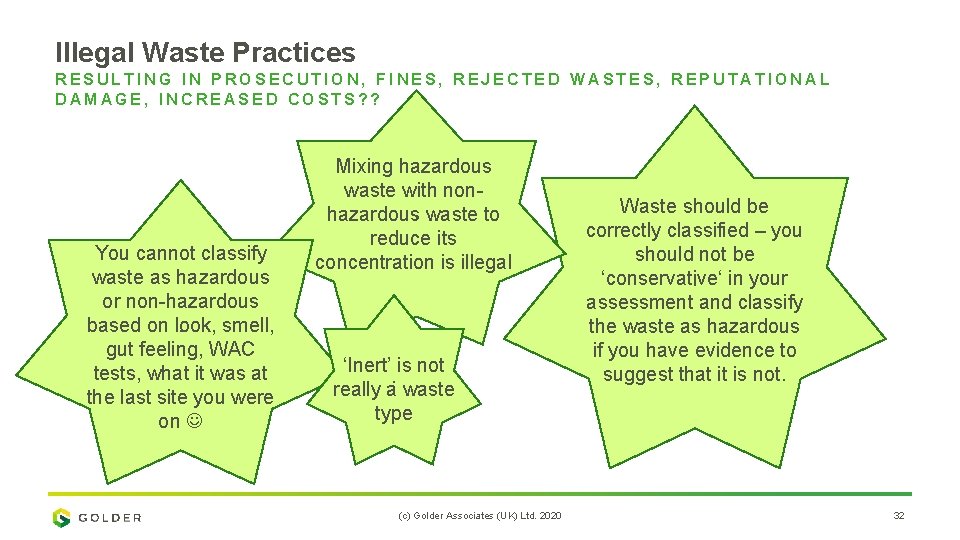
Illegal Waste Practices RESULTING IN PROSECUTION, FINES, REJECTED WASTES, REPUTATIONAL DAMAGE, INCREASED COSTS? ? ‘Inert’ is not. really a waste type Waste should be correctly classified – you should not be ‘conservative‘ in your. assessment and classify the waste as hazardous if you have evidence to suggest that it is not. ___ You cannot classify waste as hazardous or non-hazardous. based on look, smell, gut feeling, WAC tests, what it was at the last site you were on Mixing hazardous waste with nonhazardous. waste to reduce its concentration is illegal (c) Golder Associates (UK) Ltd. 2020 32
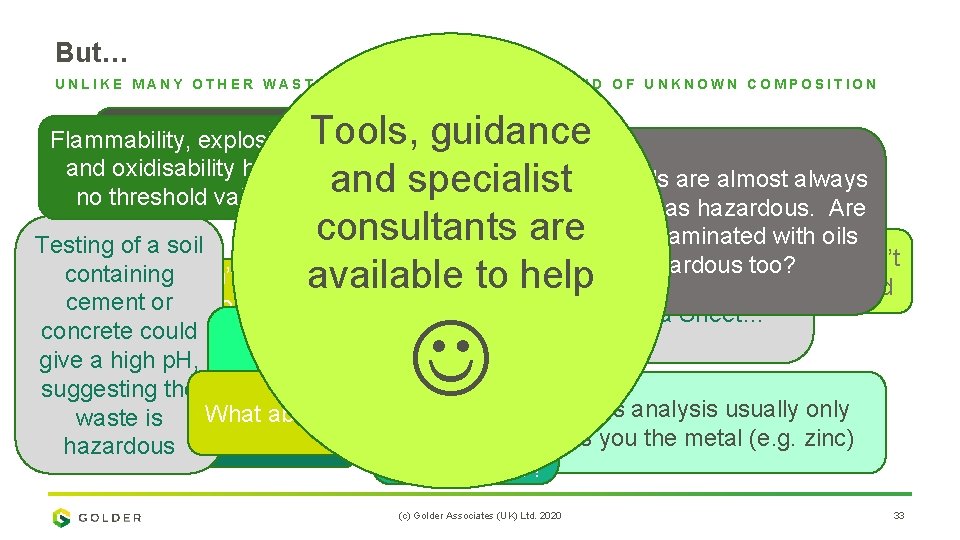
But… UNLIKE MANY OTHER WASTES, SOILS ARE VARIABLE AND OF UNKNOWN COMPOSITION Tools, guidance and specialist consultants are available to help Flammability, explosivity What should I test There are non-natural Some hazard and oxidisability constituentshave instatements the soil Waste oils are almost always have for? no threshold values classified as hazardous. Are additive Contaminated soils contaminated with oils thresholds, and. What about Testing of a soil doesn’t usually Hazard codes aren’t hazardous too? the assessment of containing We don’t routinely asbestos? come withalways a Safety easy to find ecotoxicity is more cement or carry out direct Data Sheet… Timescales can complex. concrete could testing on soils How many be very short, and give a high p. H, samples What if some is suggesting the should I take ? classification are Metals analysis usually only often an What about POPs? samples waste is The process is complex hazardous and tells you the metal (e. g. zinc) afterthought hazardous some are not ? ___ (c) Golder Associates (UK) Ltd. 2020 33
Thank You (c) Golder Associates (UK) Ltd. 2020