
Washingtons State of Transportation WSDOT moves to the
- Slides: 21
Washington’s State of Transportation WSDOT moves to the next level JOHN WYNANDS, OLYMPIC REGION ADMINISTRATOR Kitsap Regional Coordinating Council, Bremerton Oct. 2, 2018
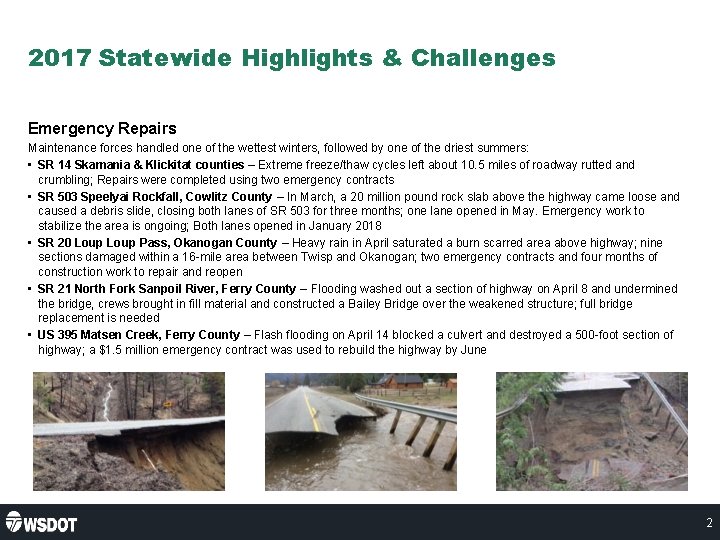
2017 Statewide Highlights & Challenges Emergency Repairs Maintenance forces handled one of the wettest winters, followed by one of the driest summers: • SR 14 Skamania & Klickitat counties – Extreme freeze/thaw cycles left about 10. 5 miles of roadway rutted and crumbling; Repairs were completed using two emergency contracts • SR 503 Speelyai Rockfall, Cowlitz County – In March, a 20 million pound rock slab above the highway came loose and caused a debris slide, closing both lanes of SR 503 for three months; one lane opened in May. Emergency work to stabilize the area is ongoing; Both lanes opened in January 2018 • SR 20 Loup Pass, Okanogan County – Heavy rain in April saturated a burn scarred area above highway; nine sections damaged within a 16 -mile area between Twisp and Okanogan; two emergency contracts and four months of construction work to repair and reopen • SR 21 North Fork Sanpoil River, Ferry County – Flooding washed out a section of highway on April 8 and undermined the bridge, crews brought in fill material and constructed a Bailey Bridge over the weakened structure; full bridge replacement is needed • US 395 Matsen Creek, Ferry County – Flash flooding on April 14 blocked a culvert and destroyed a 500 -foot section of highway; a $1. 5 million emergency contract was used to rebuild the highway by June 2
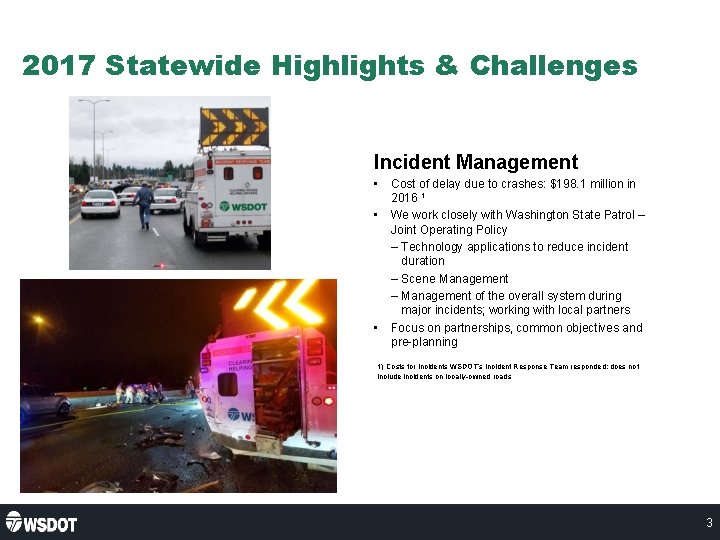
2017 Statewide Highlights & Challenges Incident Management • • • Cost of delay due to crashes: $198. 1 million in 2016 1 We work closely with Washington State Patrol – Joint Operating Policy – Technology applications to reduce incident duration – Scene Management – Management of the overall system during major incidents; working with local partners Focus on partnerships, common objectives and pre-planning 1) Costs for incidents WSDOT’s Incident Response Team responded; does not include incidents on locally-owned roads 3
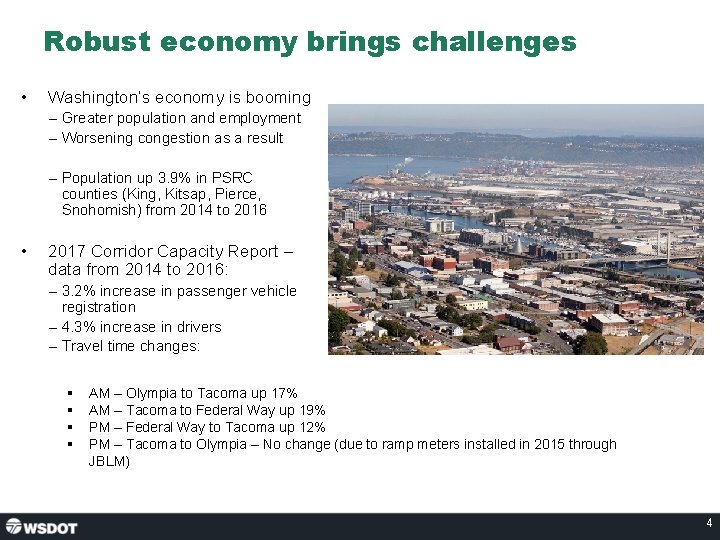
Robust economy brings challenges • Washington’s economy is booming – Greater population and employment – Worsening congestion as a result – Population up 3. 9% in PSRC counties (King, Kitsap, Pierce, Snohomish) from 2014 to 2016 • 2017 Corridor Capacity Report – data from 2014 to 2016: – 3. 2% increase in passenger vehicle registration – 4. 3% increase in drivers – Travel time changes: § § AM – Olympia to Tacoma up 17% AM – Tacoma to Federal Way up 19% PM – Federal Way to Tacoma up 12% PM – Tacoma to Olympia – No change (due to ramp meters installed in 2015 through JBLM) 4
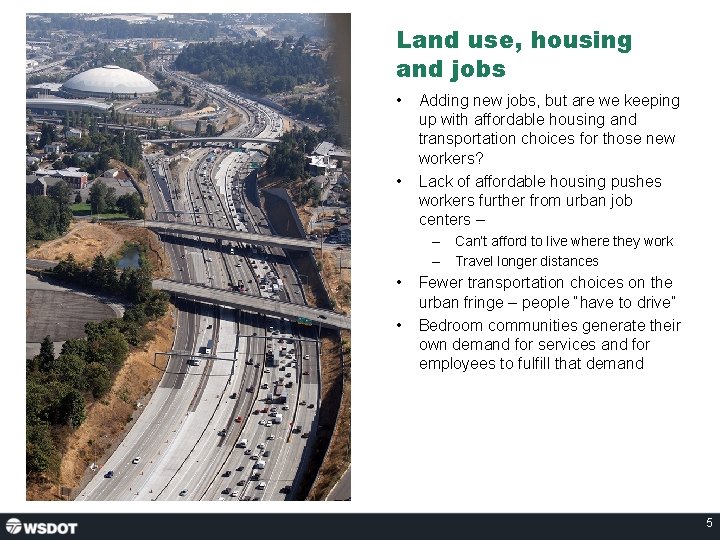
Land use, housing and jobs • • Adding new jobs, but are we keeping up with affordable housing and transportation choices for those new workers? Lack of affordable housing pushes workers further from urban job centers – – Can’t afford to live where they work – Travel longer distances • • Fewer transportation choices on the urban fringe – people “have to drive” Bedroom communities generate their own demand for services and for employees to fulfill that demand 5
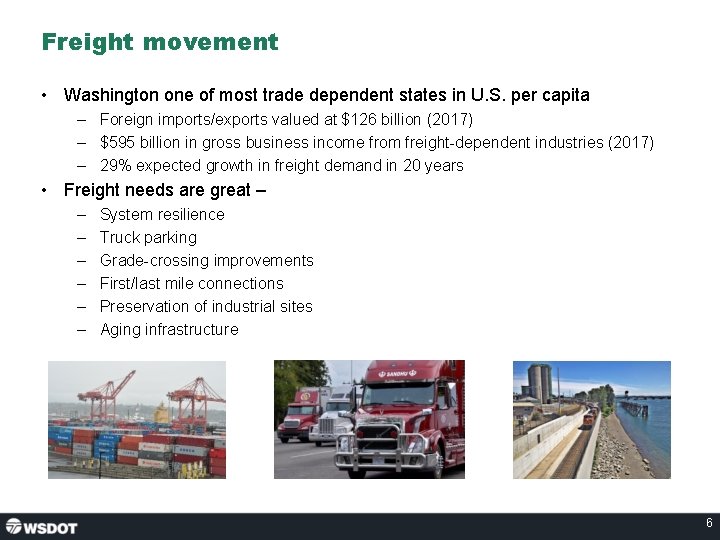
Freight movement • Washington one of most trade dependent states in U. S. per capita – Foreign imports/exports valued at $126 billion (2017) – $595 billion in gross business income from freight-dependent industries (2017) – 29% expected growth in freight demand in 20 years • Freight needs are great – – – – System resilience Truck parking Grade-crossing improvements First/last mile connections Preservation of industrial sites Aging infrastructure 6
New Opportunities for WSDOT • Convergence of complex issues – – Job centers – experiencing unprecedented growth throughout the region – Competing interests – § Developers – want to meet new demand, reliant on financing that is risk averse § Local jurisdictions – advocate for smart growth, struggle to fund local infrastructure and services – 45 cranes in Seattle today – New York has 18, LA has 36 – tremendous amount of activity • Growth in the state is uneven – some communities feel left behind • Need for even better coordination – We’ve had good success, also struggles – Small changes on state highway system can affect local streets, vice-versa – Closures on the state system can bring gridlock to city streets • Reinforces need for a broader perspective, agency-wide view of our work – Examine impacts regionally, not just locally – look at entire system 7
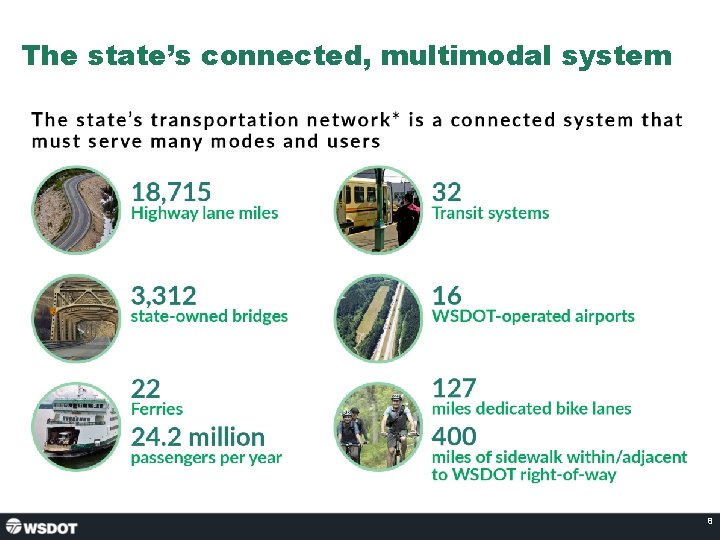
The state’s connected, multimodal system 8
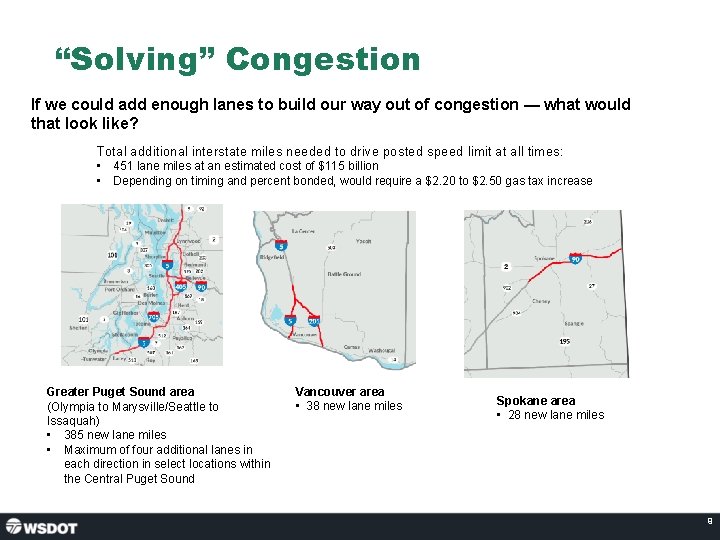
“Solving” Congestion If we could add enough lanes to build our way out of congestion — what would that look like? Total additional interstate miles needed to drive posted speed limit at all times: • • 451 lane miles at an estimated cost of $115 billion Depending on timing and percent bonded, would require a $2. 20 to $2. 50 gas tax increase Greater Puget Sound area (Olympia to Marysville/Seattle to Issaquah) • 385 new lane miles • Maximum of four additional lanes in each direction in select locations within the Central Puget Sound Vancouver area • 38 new lane miles Spokane area • 28 new lane miles 9
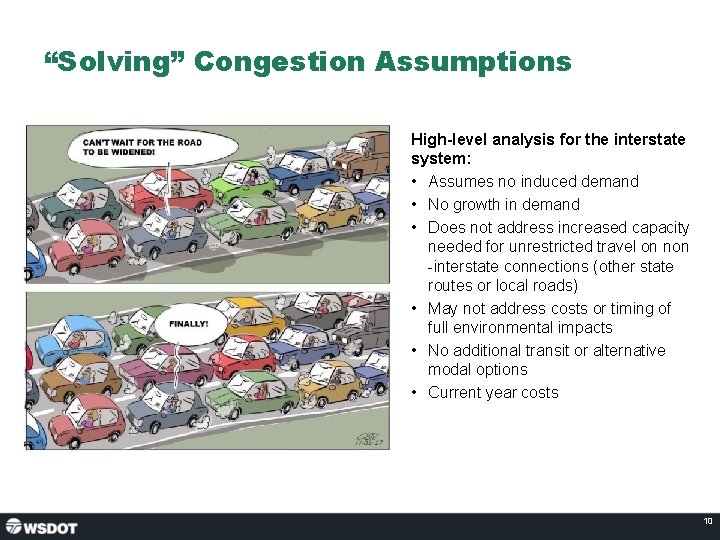
“Solving” Congestion Assumptions High-level analysis for the interstate system: • Assumes no induced demand • No growth in demand • Does not address increased capacity needed for unrestricted travel on non -interstate connections (other state routes or local roads) • May not address costs or timing of full environmental impacts • No additional transit or alternative modal options • Current year costs 10
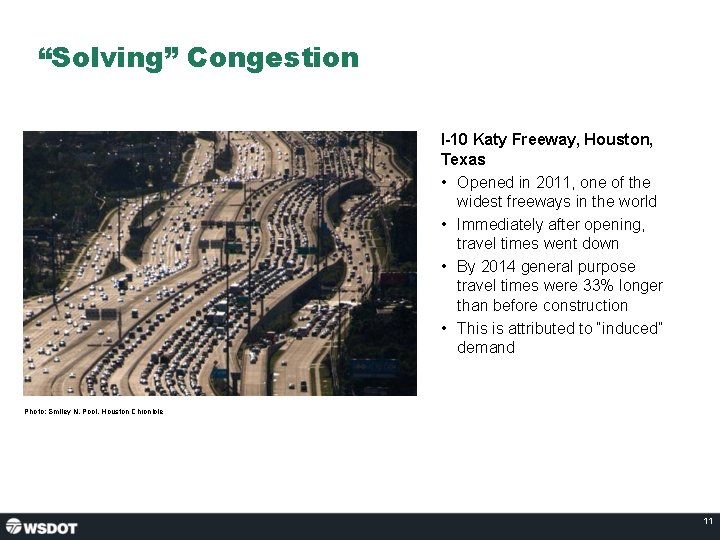
“Solving” Congestion I-10 Katy Freeway, Houston, Texas • Opened in 2011, one of the widest freeways in the world • Immediately after opening, travel times went down • By 2014 general purpose travel times were 33% longer than before construction • This is attributed to “induced” demand Photo: Smiley N. Pool, Houston Chronicle 11
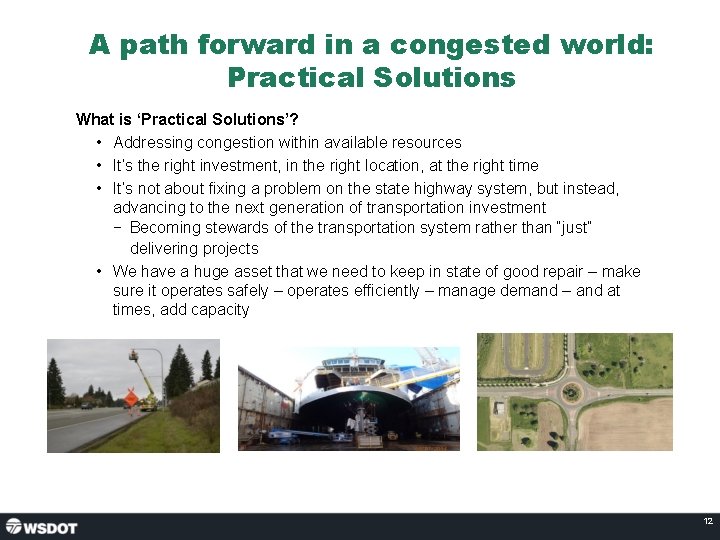
A path forward in a congested world: Practical Solutions What is ‘Practical Solutions’? • Addressing congestion within available resources • It’s the right investment, in the right location, at the right time • It’s not about fixing a problem on the state highway system, but instead, advancing to the next generation of transportation investment − Becoming stewards of the transportation system rather than “just” delivering projects • We have a huge asset that we need to keep in state of good repair – make sure it operates safely – operates efficiently – manage demand – and at times, add capacity 12
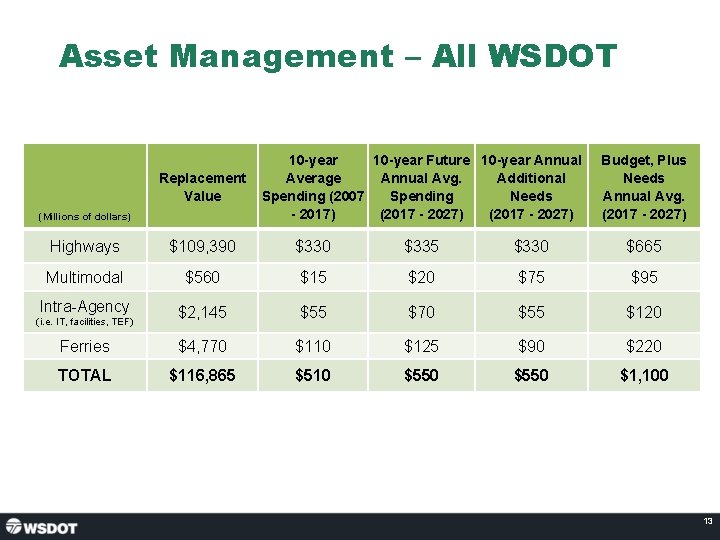
Asset Management – All WSDOT Replacement Value (Millions of dollars) 10 -year Future 10 -year Annual Average Annual Avg. Additional Spending (2007 Spending Needs - 2017) (2017 - 2027) Budget, Plus Needs Annual Avg. (2017 - 2027) Highways $109, 390 $335 $330 $665 Multimodal $560 $15 $20 $75 $95 Intra-Agency $2, 145 $55 $70 $55 $120 Ferries $4, 770 $110 $125 $90 $220 TOTAL $116, 865 $510 $550 $1, 100 (i. e. IT, facilities, TEF) 13
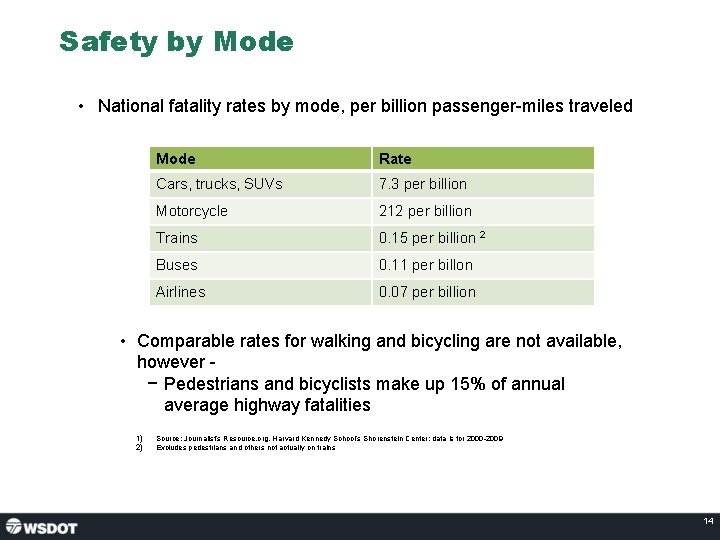
Safety by Mode • National fatality rates by mode, per billion passenger-miles traveled Mode Rate Cars, trucks, SUVs 7. 3 per billion Motorcycle 212 per billion Trains 0. 15 per billion 2 Buses 0. 11 per billon Airlines 0. 07 per billion • Comparable rates for walking and bicycling are not available, however − Pedestrians and bicyclists make up 15% of annual average highway fatalities 1) 2) Source: Journalist’s Resource. org, Harvard Kennedy School’s Shorenstein Center; data is for 2000 -2009 Excludes pedestrians and others not actually on trains 14
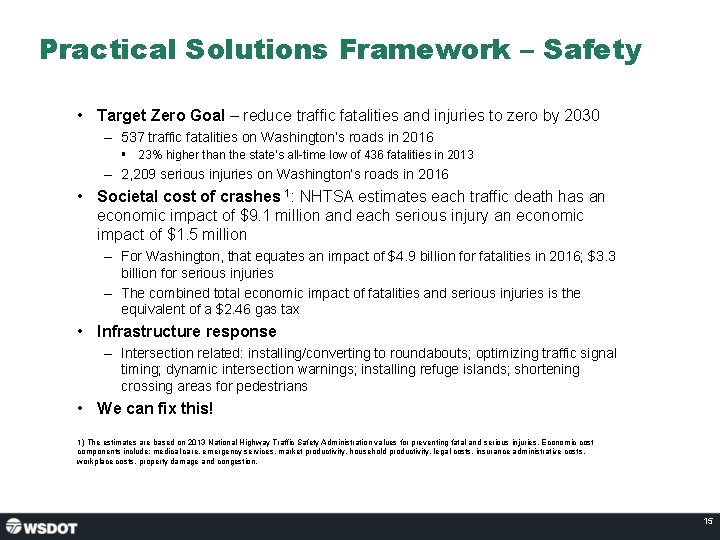
Practical Solutions Framework – Safety • Target Zero Goal – reduce traffic fatalities and injuries to zero by 2030 – 537 traffic fatalities on Washington’s roads in 2016 § 23% higher than the state’s all-time low of 436 fatalities in 2013 – 2, 209 serious injuries on Washington’s roads in 2016 • Societal cost of crashes 1: NHTSA estimates each traffic death has an economic impact of $9. 1 million and each serious injury an economic impact of $1. 5 million – For Washington, that equates an impact of $4. 9 billion for fatalities in 2016; $3. 3 billion for serious injuries – The combined total economic impact of fatalities and serious injuries is the equivalent of a $2. 46 gas tax • Infrastructure response – Intersection related: installing/converting to roundabouts; optimizing traffic signal timing; dynamic intersection warnings; installing refuge islands; shortening crossing areas for pedestrians • We can fix this! 1) The estimates are based on 2013 National Highway Traffic Safety Administration values for preventing fatal and serious injuries. Economic cost components include: medical care, emergency services, market productivity, household productivity, legal costs, insurance administrative costs, workplace costs, property damage and congestion. 15
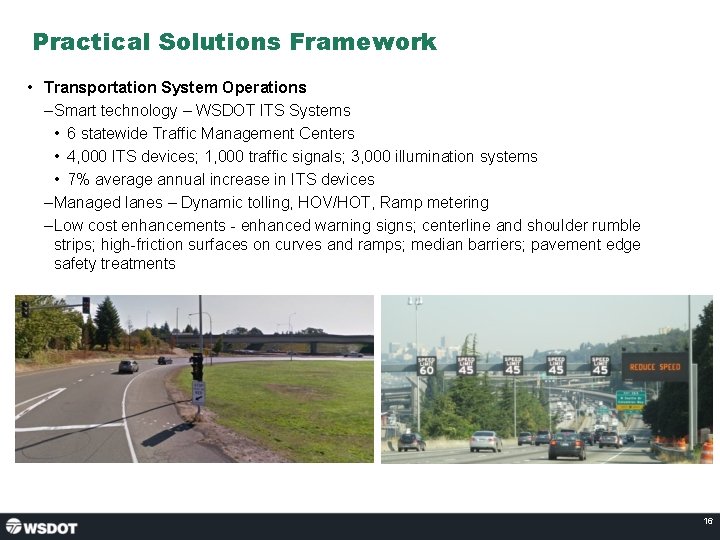
Practical Solutions Framework • Transportation System Operations – Smart technology – WSDOT ITS Systems • 6 statewide Traffic Management Centers • 4, 000 ITS devices; 1, 000 traffic signals; 3, 000 illumination systems • 7% average annual increase in ITS devices – Managed lanes – Dynamic tolling, HOV/HOT, Ramp metering – Low cost enhancements - enhanced warning signs; centerline and shoulder rumble strips; high-friction surfaces on curves and ramps; median barriers; pavement edge safety treatments 16
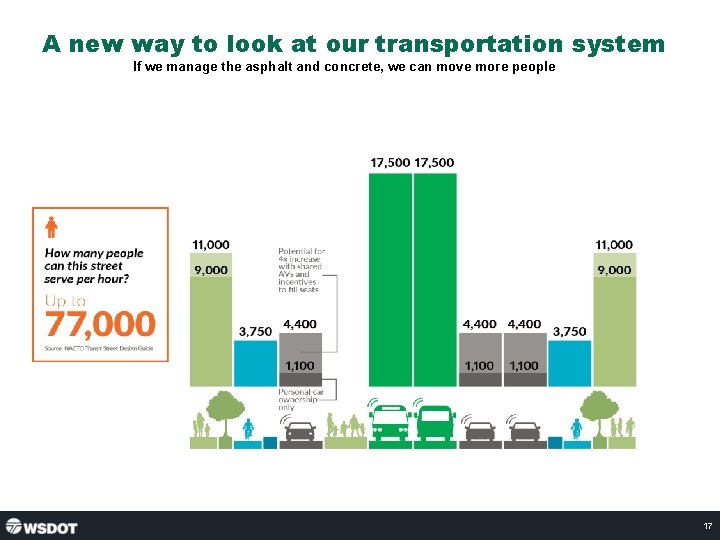
A new way to look at our transportation system If we manage the asphalt and concrete, we can move more people 17
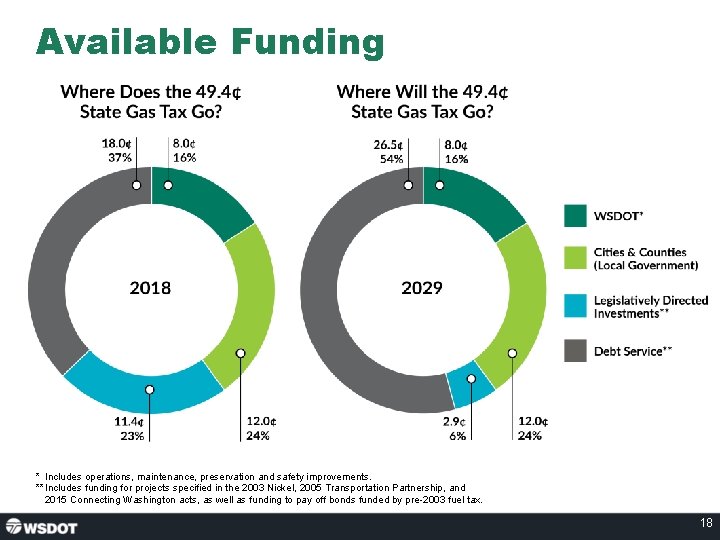
Available Funding * Includes operations, maintenance, preservation and safety improvements. **Includes funding for projects specified in the 2003 Nickel, 2005 Transportation Partnership, and 2015 Connecting Washington acts, as well as funding to pay off bonds funded by pre-2003 fuel tax. 18
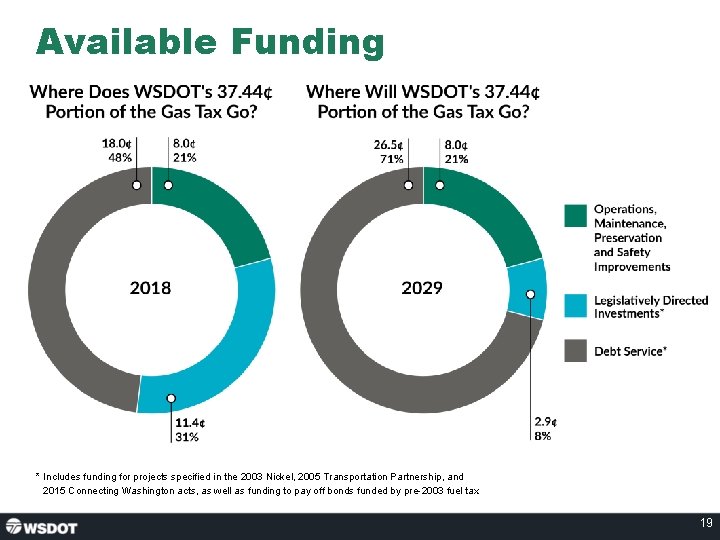
Available Funding * Includes funding for projects specified in the 2003 Nickel, 2005 Transportation Partnership, and 2015 Connecting Washington acts, as well as funding to pay off bonds funded by pre-2003 fuel tax. 19
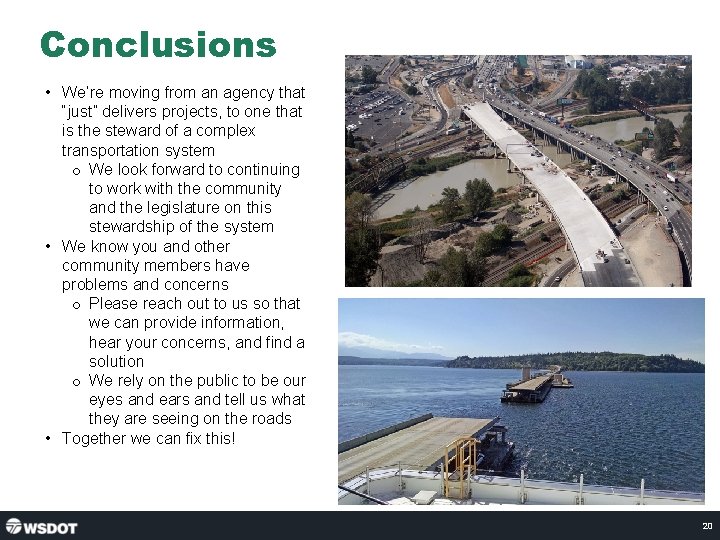
Conclusions • We’re moving from an agency that “just” delivers projects, to one that is the steward of a complex transportation system o We look forward to continuing to work with the community and the legislature on this stewardship of the system • We know you and other community members have problems and concerns o Please reach out to us so that we can provide information, hear your concerns, and find a solution o We rely on the public to be our eyes and ears and tell us what they are seeing on the roads • Together we can fix this! 20
Questions? John Wynands Olympic Region Administrator Washington State Department of Transportation 360 -357 -2658 (phone) Wynand. J@wsdot. wa. gov