
Washington Update Christy Seyfert Assistant Vice President ZurichRCIS

- Slides: 26
Washington Update Christy Seyfert Assistant Vice President, Zurich-RCIS February 6, 2019
Overview • Legislative processes to monitor • Farm bill • Impact of mid-term congressional elections 2
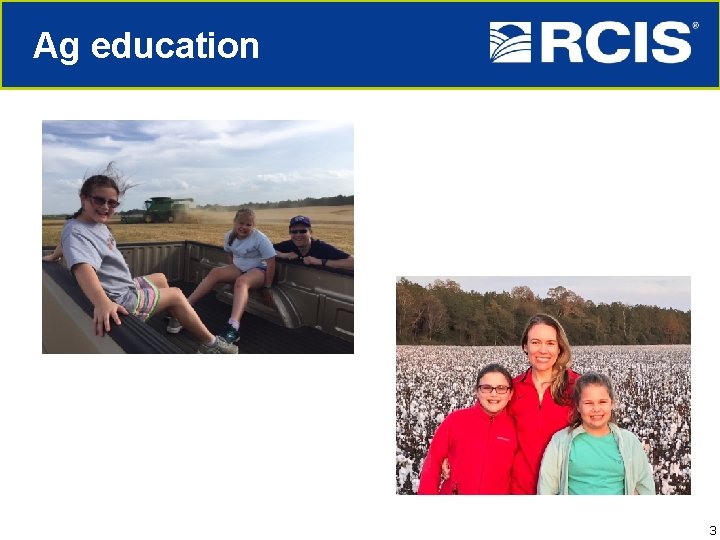
Ag education 3
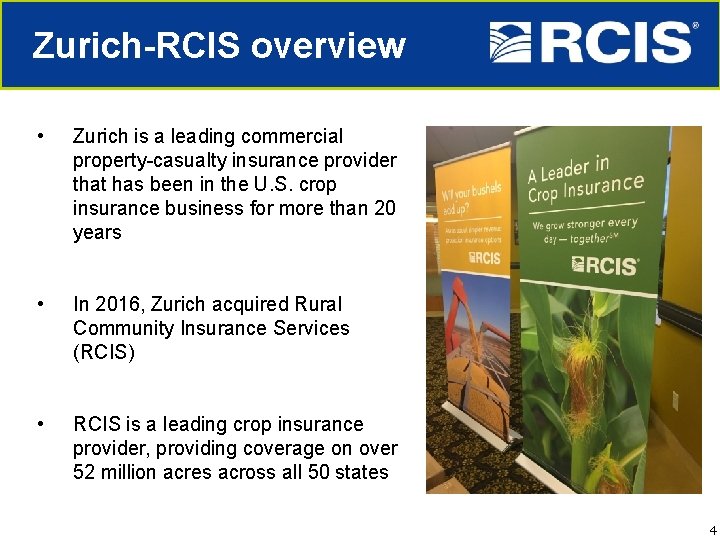
Zurich-RCIS overview • Zurich is a leading commercial property-casualty insurance provider that has been in the U. S. crop insurance business for more than 20 years • In 2016, Zurich acquired Rural Community Insurance Services (RCIS) • RCIS is a leading crop insurance provider, providing coverage on over 52 million acres across all 50 states 4
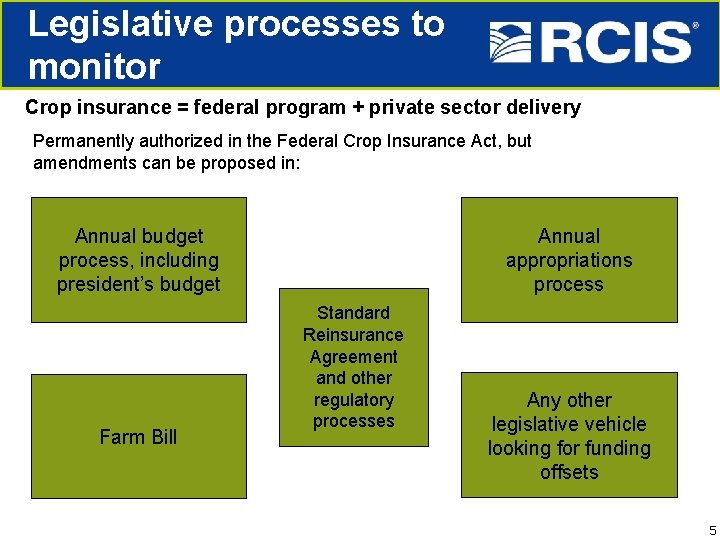
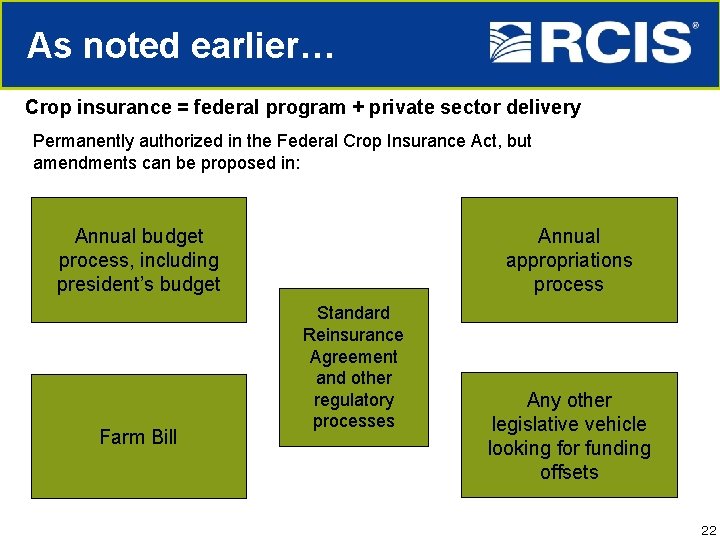
Legislative processes to monitor Crop insurance = federal program + private sector delivery Permanently authorized in the Federal Crop Insurance Act, but amendments can be proposed in: Annual appropriations process Annual budget process, including president’s budget Farm Bill Standard Reinsurance Agreement and other regulatory processes Any other legislative vehicle looking for funding offsets 5
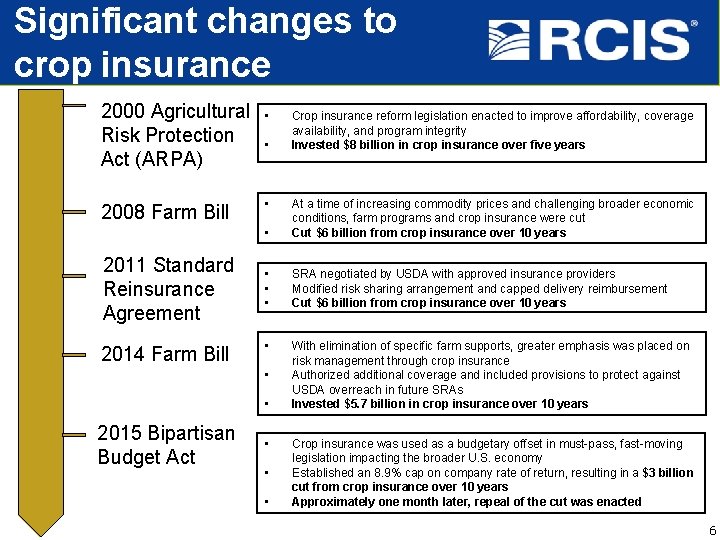
Significant changes to to crop insurance Significant tochanges crop Significant changes government insurance crop insurance 2000 Agricultural Risk Protection Act (ARPA) 2008 Farm Bill 2011 Standard Reinsurance Agreement 2014 Farm Bill • • At a time of increasing commodity prices and challenging broader economic conditions, farm programs and crop insurance were cut Cut $6 billion from crop insurance over 10 years • • • SRA negotiated by USDA with approved insurance providers Modified risk sharing arrangement and capped delivery reimbursement Cut $6 billion from crop insurance over 10 years • With elimination of specific farm supports, greater emphasis was placed on risk management through crop insurance Authorized additional coverage and included provisions to protect against USDA overreach in future SRAs Invested $5. 7 billion in crop insurance over 10 years • • 2015 Bipartisan Budget Act Crop insurance reform legislation enacted to improve affordability, coverage availability, and program integrity Invested $8 billion in crop insurance over five years • • • Crop insurance was used as a budgetary offset in must-pass, fast-moving legislation impacting the broader U. S. economy Established an 8. 9% cap on company rate of return, resulting in a $3 billion cut from crop insurance over 10 years Approximately one month later, repeal of the cut was enacted 6
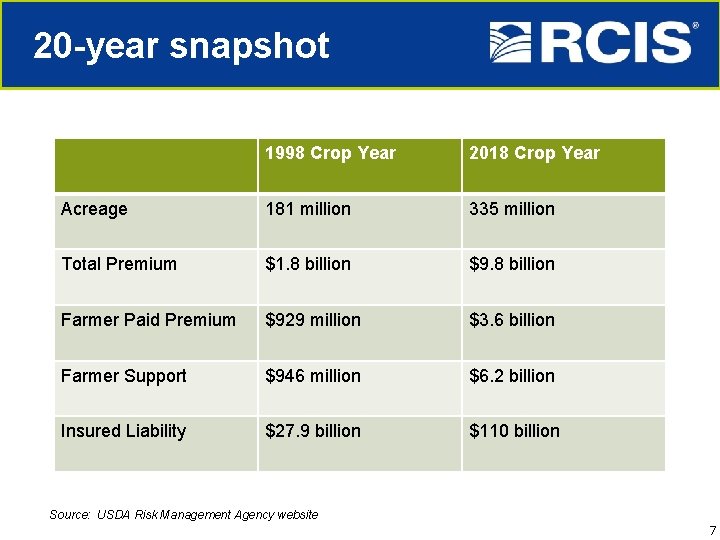
20 -year snapshot 1998 Crop Year 2018 Crop Year Acreage 181 million 335 million Total Premium $1. 8 billion $9. 8 billion Farmer Paid Premium $929 million $3. 6 billion Farmer Support $946 million $6. 2 billion Insured Liability $27. 9 billion $110 billion Source: USDA Risk Management Agency website 7
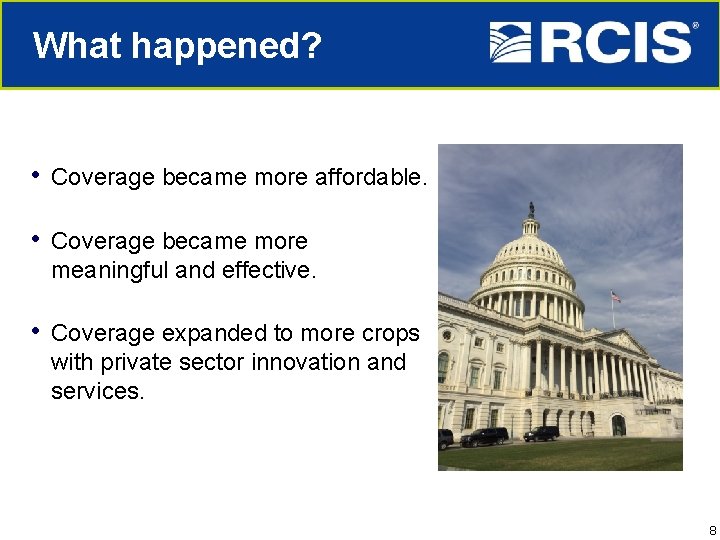
What happened? • Coverage became more affordable. • Coverage became more meaningful and effective. • Coverage expanded to more crops with private sector innovation and services. 8
Our message Crop insurance is an investment worth protecting, especially in this tough farm economy Ø to farmers as a risk management tool to protect against weather and market volatility Ø to rural economies for financial stability and jobs Ø to consumers for food security Ø to taxpayers for cost-sharing with farmers and risk-sharing with private sector providers 9
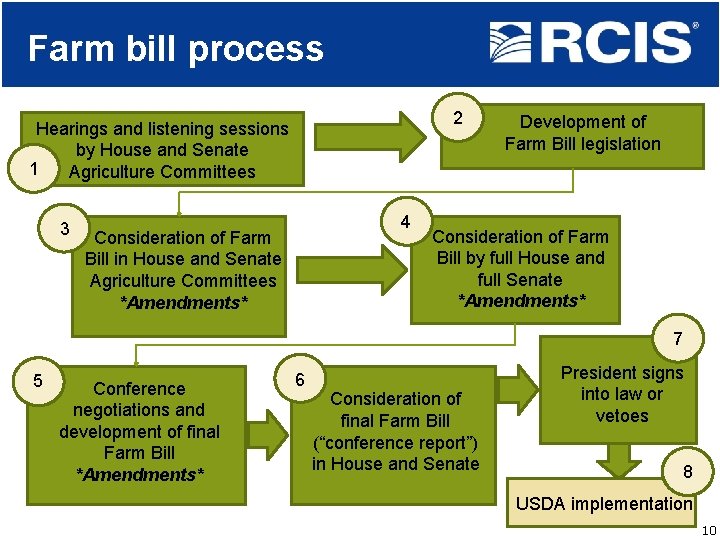
Farm bill process 2 Hearings and listening sessions by House and Senate 1 Agriculture Committees 3 4 Consideration of Farm Bill in House and Senate Agriculture Committees *Amendments* Development of Farm Bill legislation Consideration of Farm Bill by full House and full Senate *Amendments* 7 5 Conference negotiations and development of final Farm Bill *Amendments* 6 Consideration of final Farm Bill (“conference report”) in House and Senate President signs into law or vetoes 8 USDA implementation 10
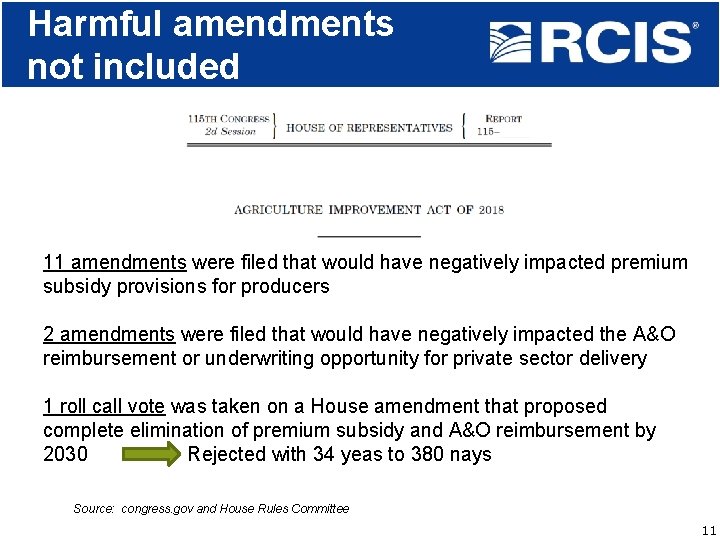
Harmful amendments not included 11 amendments were filed that would have negatively impacted premium subsidy provisions for producers 2 amendments were filed that would have negatively impacted the A&O reimbursement or underwriting opportunity for private sector delivery 1 roll call vote was taken on a House amendment that proposed complete elimination of premium subsidy and A&O reimbursement by 2030 Rejected with 34 yeas to 380 nays Source: congress. gov and House Rules Committee 11
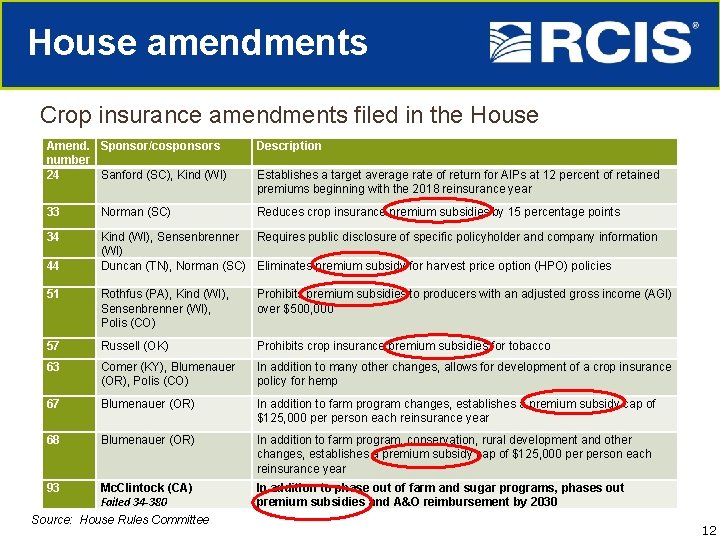
House amendments Crop insurance amendments filed in the House Amend. Sponsor/cosponsors number 24 Sanford (SC), Kind (WI) Description 33 Norman (SC) Reduces crop insurance premium subsidies by 15 percentage points 34 Kind (WI), Sensenbrenner Requires public disclosure of specific policyholder and company information (WI) Duncan (TN), Norman (SC) Eliminates premium subsidy for harvest price option (HPO) policies 44 Establishes a target average rate of return for AIPs at 12 percent of retained premiums beginning with the 2018 reinsurance year 51 Rothfus (PA), Kind (WI), Sensenbrenner (WI), Polis (CO) Prohibits premium subsidies to producers with an adjusted gross income (AGI) over $500, 000 57 Russell (OK) Prohibits crop insurance premium subsidies for tobacco 63 Comer (KY), Blumenauer (OR), Polis (CO) In addition to many other changes, allows for development of a crop insurance policy for hemp 67 Blumenauer (OR) In addition to farm program changes, establishes a premium subsidy cap of $125, 000 person each reinsurance year 68 Blumenauer (OR) In addition to farm program, conservation, rural development and other changes, establishes a premium subsidy cap of $125, 000 person each reinsurance year 93 Mc. Clintock (CA) Failed 34 -380 In addition to phase out of farm and sugar programs, phases out premium subsidies and A&O reimbursement by 2030 Source: House Rules Committee 12
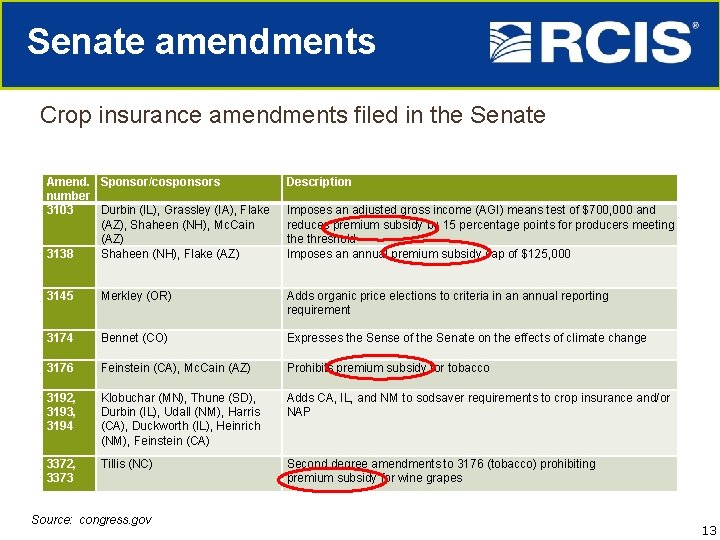
Senate amendments Crop insurance amendments filed in the Senate Amend. Sponsor/cosponsors number 3103 Durbin (IL), Grassley (IA), Flake (AZ), Shaheen (NH), Mc. Cain (AZ) 3138 Shaheen (NH), Flake (AZ) Description 3145 Merkley (OR) Adds organic price elections to criteria in an annual reporting requirement 3174 Bennet (CO) Expresses the Sense of the Senate on the effects of climate change 3176 Feinstein (CA), Mc. Cain (AZ) Prohibits premium subsidy for tobacco 3192, 3193, 3194 Klobuchar (MN), Thune (SD), Durbin (IL), Udall (NM), Harris (CA), Duckworth (IL), Heinrich (NM), Feinstein (CA) Adds CA, IL, and NM to sodsaver requirements to crop insurance and/or NAP 3372, 3373 Tillis (NC) Second degree amendments to 3176 (tobacco) prohibiting premium subsidy for wine grapes Source: congress. gov Imposes an adjusted gross income (AGI) means test of $700, 000 and reduces premium subsidy by 15 percentage points for producers meeting the threshold Imposes an annual premium subsidy cap of $125, 000 13
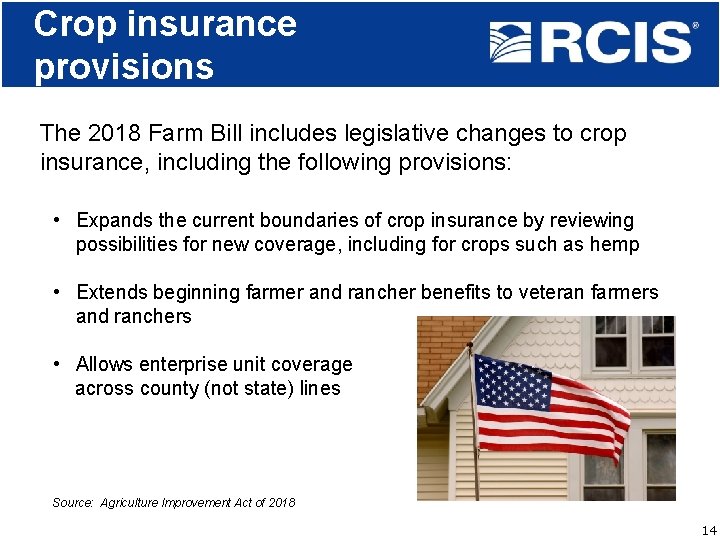
Crop insurance provisions The 2018 Farm Bill includes legislative changes to crop insurance, including the following provisions: • Expands the current boundaries of crop insurance by reviewing possibilities for new coverage, including for crops such as hemp • Extends beginning farmer and rancher benefits to veteran farmers and ranchers • Allows enterprise unit coverage across county (not state) lines Source: Agriculture Improvement Act of 2018 14
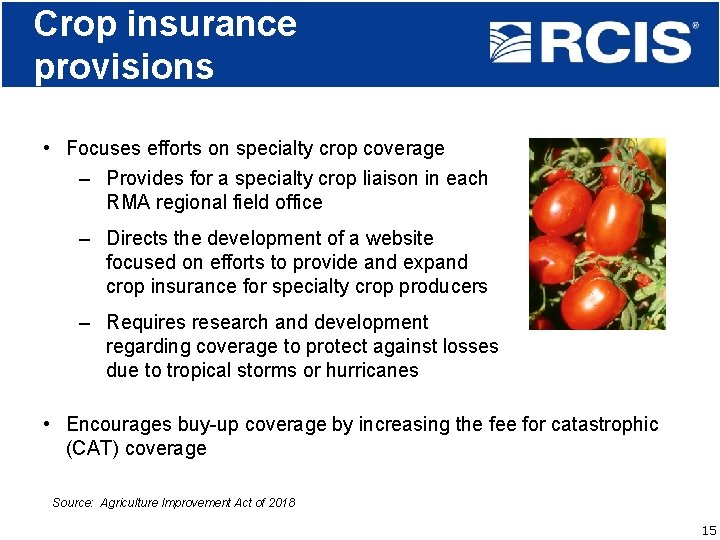
Crop insurance provisions • Focuses efforts on specialty crop coverage – Provides for a specialty crop liaison in each RMA regional field office – Directs the development of a website focused on efforts to provide and expand crop insurance for specialty crop producers – Requires research and development regarding coverage to protect against losses due to tropical storms or hurricanes • Encourages buy-up coverage by increasing the fee for catastrophic (CAT) coverage Source: Agriculture Improvement Act of 2018 15
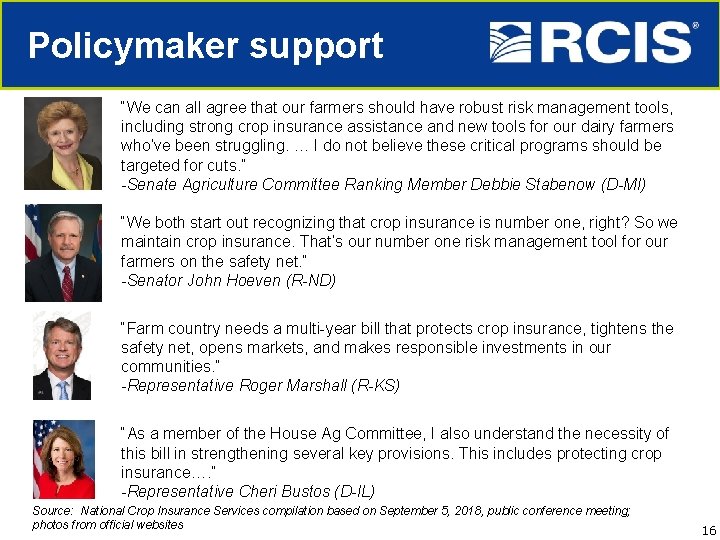
Policymaker support “We can all agree that our farmers should have robust risk management tools, including strong crop insurance assistance and new tools for our dairy farmers who’ve been struggling. … I do not believe these critical programs should be targeted for cuts. ” -Senate Agriculture Committee Ranking Member Debbie Stabenow (D-MI) “We both start out recognizing that crop insurance is number one, right? So we maintain crop insurance. That’s our number one risk management tool for our farmers on the safety net. ” -Senator John Hoeven (R-ND) “Farm country needs a multi-year bill that protects crop insurance, tightens the safety net, opens markets, and makes responsible investments in our communities. ” -Representative Roger Marshall (R-KS) “As a member of the House Ag Committee, I also understand the necessity of this bill in strengthening several key provisions. This includes protecting crop insurance…. ” -Representative Cheri Bustos (D-IL) Source: National Crop Insurance Services compilation based on September 5, 2018, public conference meeting; photos from official websites 16
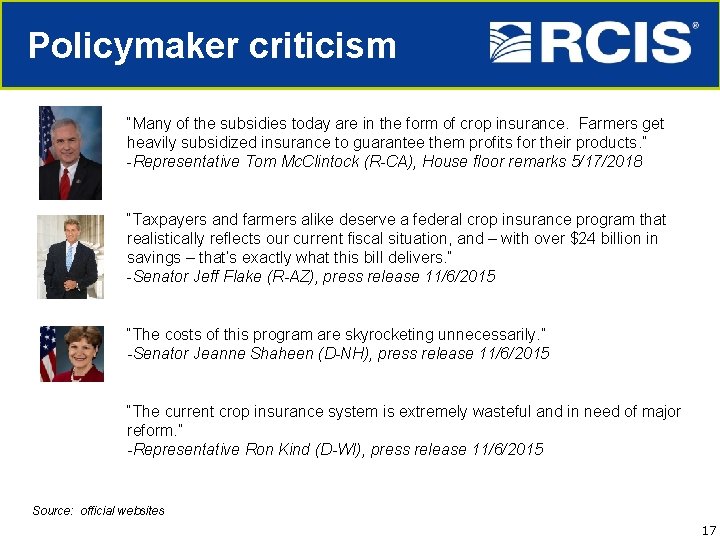
Policymaker criticism “Many of the subsidies today are in the form of crop insurance. Farmers get heavily subsidized insurance to guarantee them profits for their products. ” -Representative Tom Mc. Clintock (R-CA), House floor remarks 5/17/2018 “Taxpayers and farmers alike deserve a federal crop insurance program that realistically reflects our current fiscal situation, and – with over $24 billion in savings – that’s exactly what this bill delivers. ” -Senator Jeff Flake (R-AZ), press release 11/6/2015 “The costs of this program are skyrocketing unnecessarily. ” -Senator Jeanne Shaheen (D-NH), press release 11/6/2015 “The current crop insurance system is extremely wasteful and in need of major reform. ” -Representative Ron Kind (D-WI), press release 11/6/2015 Source: official websites 17
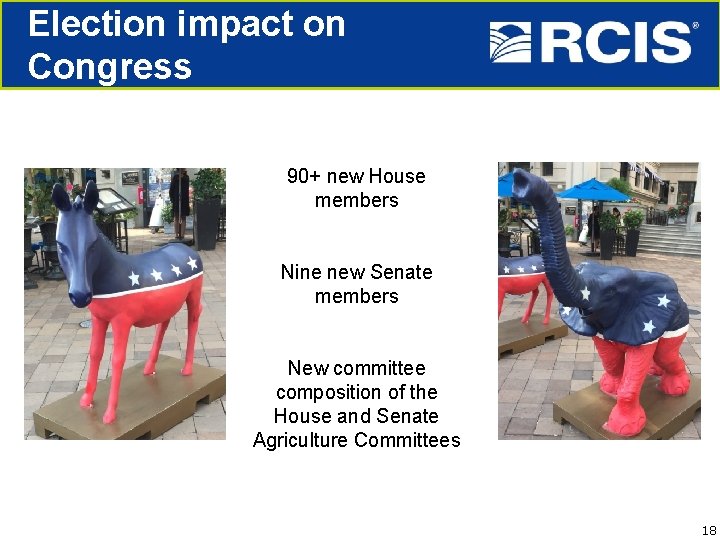
Election impact on Congress 90+ new House members Nine new Senate members New committee composition of the House and Senate Agriculture Committees 18
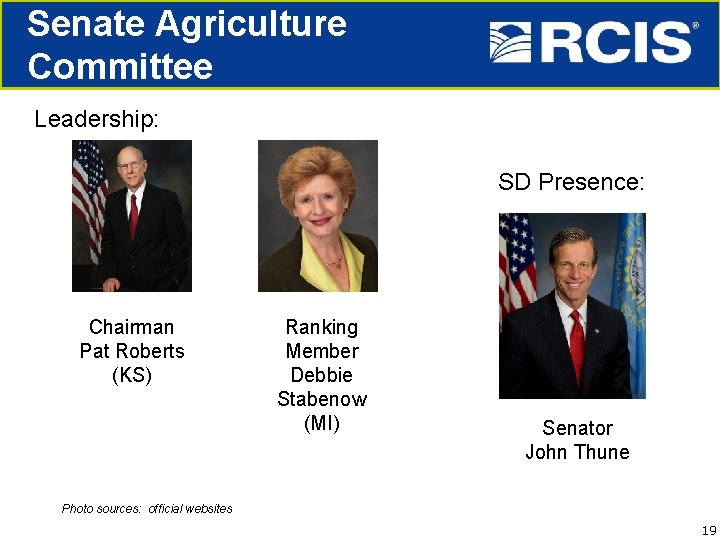
Senate Agriculture Committee Leadership: SD Presence: Chairman Pat Roberts (KS) Ranking Member Debbie Stabenow (MI) Senator John Thune Photo sources: official websites 19
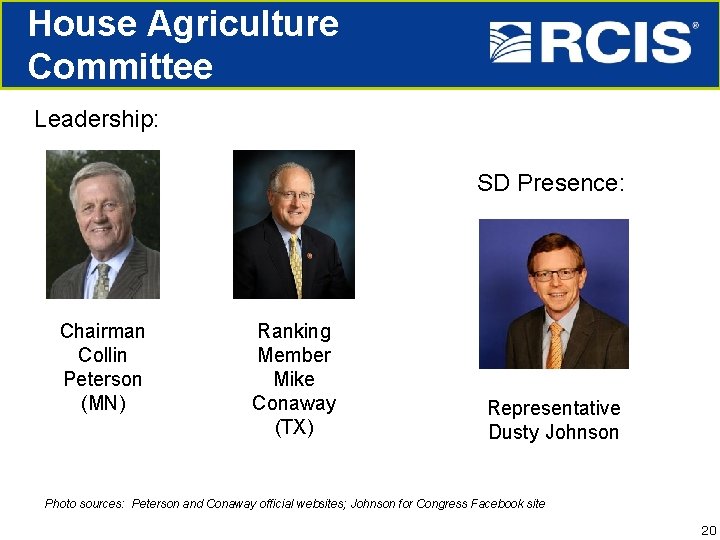
House Agriculture Committee Leadership: SD Presence: Chairman Collin Peterson (MN) Ranking Member Mike Conaway (TX) Representative Dusty Johnson Photo sources: Peterson and Conaway official websites; Johnson for Congress Facebook site 20
Legislative landscape Federal funding will remain a hot topic in early 2019: • Appropriations • Federal funding resolution for FY 2019 beyond February 15? • FY 2020 begins October 1, 2019 • President’s budget release for FY 2020 – February? • Debt ceiling – March? 21
As noted earlier… Crop insurance = federal program + private sector delivery Permanently authorized in the Federal Crop Insurance Act, but amendments can be proposed in: Annual appropriations process Annual budget process, including president’s budget Farm Bill Standard Reinsurance Agreement and other regulatory processes Any other legislative vehicle looking for funding offsets 22
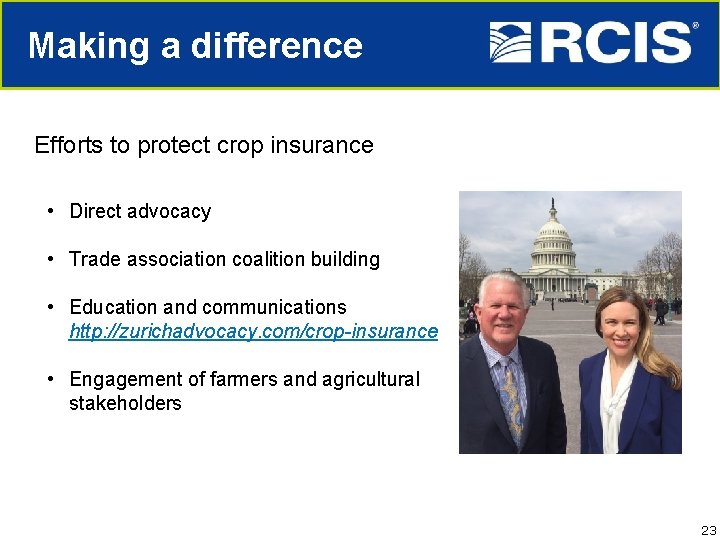
Making a difference Efforts to protect crop insurance • Direct advocacy • Trade association coalition building • Education and communications http: //zurichadvocacy. com/crop-insurance • Engagement of farmers and agricultural stakeholders 23
Key points • Many agricultural stakeholders and policymakers engaged to protect crop insurance and private sector delivery in the Farm Bill reauthorization process • Relationship building and educational efforts must continue to protect crop insurance in future battles • Farm Bill implementation and policy development takes time – patience will be necessary http: //zurichadvocacy. com/crop-insurance/ 24
Questions? christy. seyfert@rcis. com 25
The content of this presentation does not modify the policy or procedures published by the Risk Management Agency (RMA). Non-Discrimination Statement In accordance with Federal law and U. S. Department of Agriculture (USDA) civil rights regulations and policies, the USDA, its Agencies, offices, and employees, and institutions participating in or administering USDA programs are prohibited from discriminating on the basis of race, color, national origin, religion, sex, gender identity (including gender expression), sexual orientation, disability, age, marital status, family/parental status, income derived from a public assistance program, political beliefs, or reprisal or retaliation for prior civil rights activity, in any program or activity conducted or funded by USDA (not all bases apply to all programs). To File a Program Complaint If you wish to file a Civil Rights program complaint of discrimination, complete the USDA Program Discrimination Complaint Form, found online at https: //www. ascr. usda. gov/ad-3027 -usda-program-discrimination-complaint-form, or at any USDA office, or call (866) 632 -9992 to request the form. You may also write a letter containing all of the information requested in the form. Send your completed complaint form or letter by mail to the U. S. Department of Agriculture, Office of the Assistant Secretary for Civil Rights, 1400 Independence Avenue, S. W. , Washington, D. C. 20250 -9410 or email at program. intake@usda. gov. Persons with Disabilities Persons with disabilities who require alternative means of communication for program information (e. g. , Braille, large print, audiotape, American Sign Language, etc. ) should contact the responsible State or local Agency that administers the program or USDA's TARGET Center at (202) 720 -2600 (voice and TTY) or contact USDA through the Federal Relay Service at (800) 877 -8339. Additionally, program information may be made available in languages other than English. Persons with disabilities, who wish to file a program complaint, please see information above on how to contact the Department by mail directly or by email. ” Some products not available in all states or counties. This is intended as a general description of certain types of insurance and services available to qualified customers provided solely for informational purposes. Coverage is underwritten in all states by Rural Community Insurance Company, Anoka, MN except in Montana where hail coverage is underwritten by Tri-County Farmers Mutual Insurance Company, Malta, MT. Nothing herein should be construed as a solicitation, offer, advice, recommendation, or any other service with regard to any type of insurance product or services. Your policy is the contract that specifically and fully describes your coverage, terms and conditions. The description of the policy provisions gives a broad overview of coverages and does not revise or amend the policy. Coverage may vary by state. Coverages and rates are subject to individual insured meeting our underwriting qualifications and product availability in applicable states. RCIS is a registered trademark of Rural Community Insurance Company. RCIC is an equal opportunity provider. © 2018 Rural Community Insurance Company. All rights reserved. 26