
Washington State University Strategic Plan 2014 19 Overview
- Slides: 33
Washington State University Strategic Plan 2014 -19 Overview and Implementation Process On web site at www. strategicplan. wsu. edu Updated Jan. 2016
On web site at www. strategicplan. wsu. edu
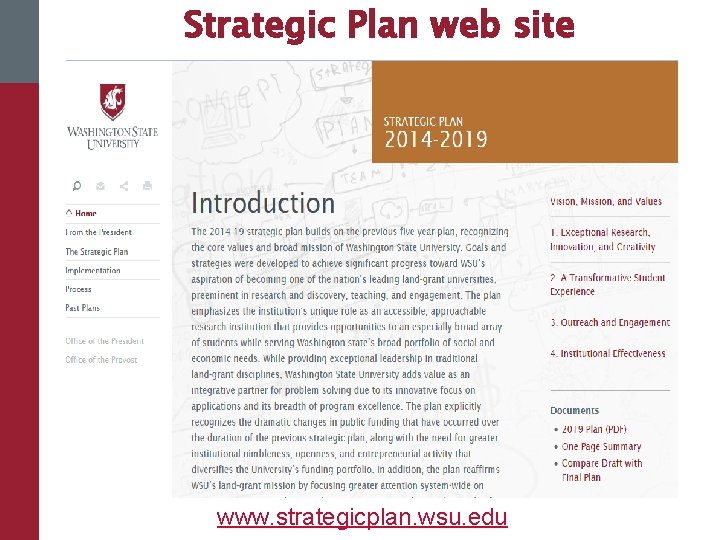
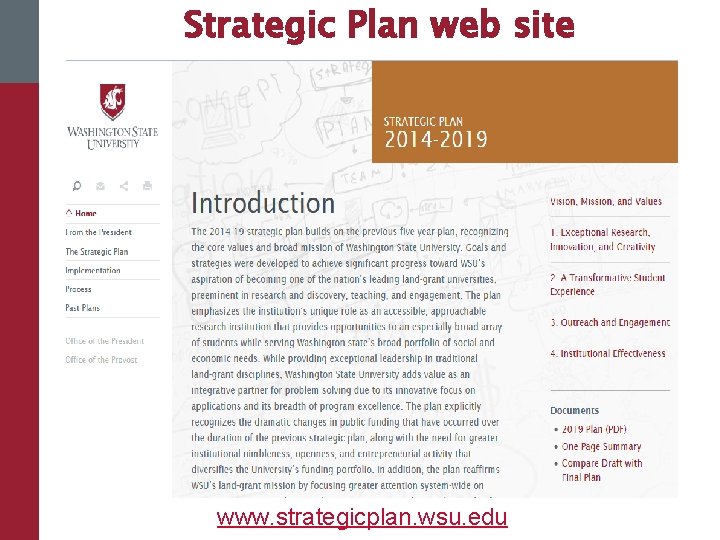
Strategic Plan web site www. strategicplan. wsu. edu
It’s important to have a strategic plan http: //upload. wikimedia. org/wikipedia/com mons/a/a 7/Longleat-maze. jpg
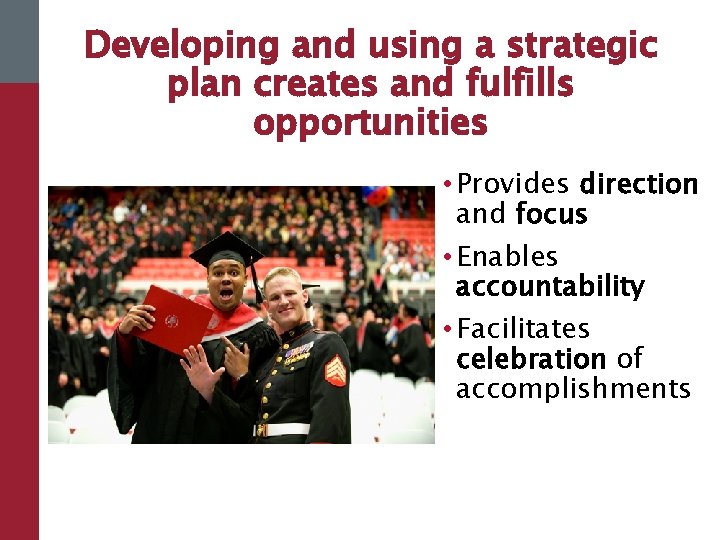
Developing and using a strategic plan creates and fulfills opportunities • Provides direction and focus • Enables accountability • Facilitates celebration of accomplishments
It also is required for accreditation, which: • Enables students to receive federal aid • Enables institution to receive federal funds • Helps students move across institutions • Certifies graduates’ credentials to employers • Communicates verification of quality to the public
Some of what we accomplished under previous strategic plan • Undergrad enrollment up 20% • Increase from 15%-27% ethnically diverse • Largest grant ever: $40 M USDA biofuels project • Faculty size grew 8% (mostly clinical) • Sponsored research expenditures up 20% • Publications per faculty FTE up 48% • Enrollment in grad prof. programs > doubled • New UCore curriculum, Common Reading • Vast majority of programs doing assessment • Service learning hours more than doubled http: //strategicplan. wsu. edu/archives/2008 -2013/report/
How we created the 2014 -19 plan • Iterative committees • Feedback loops • Web site updates for transparency • Approval by Board of Regents • Development of implementation plan
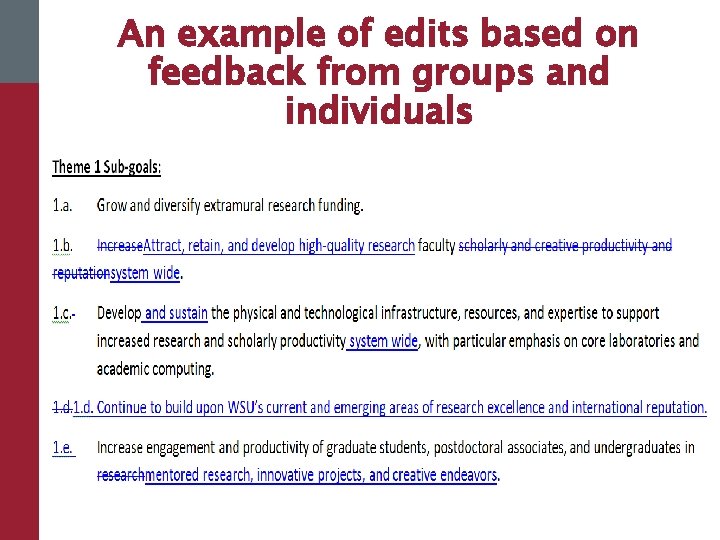
An example of edits based on feedback from groups and individuals
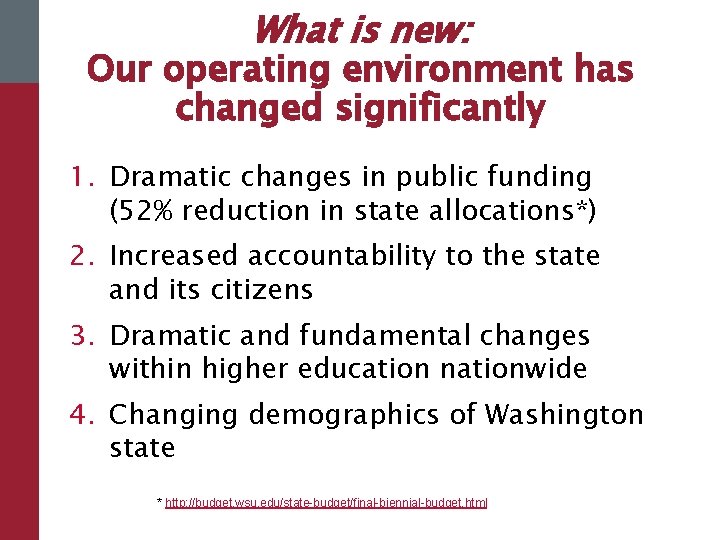
What is new: Our operating environment has changed significantly 1. Dramatic changes in public funding (52% reduction in state allocations*) 2. Increased accountability to the state and its citizens 3. Dramatic and fundamental changes within higher education nationwide 4. Changing demographics of Washington state * http: //budget. wsu. edu/state-budget/final-biennial-budget. html
Overarching features 1. “Refresh” – mission, vision, values largely unchanged. 2. Emphasizes unique mission as a land-grant research university. 3. More attention to infrastructure needs and resource alignment. 4. Infuses commitment to diversity and inclusiveness throughout plan. 5. Emphasizes implementation and measurement of progress.
Vision = How we contribute Washington State University will be one of the nation’s leading landgrant universities, preeminent in research and discovery, teaching, and engagement. Our ultimate destination
Mission = Why we exist (Directs how we intend to achieve our vision) Washington State University is a public research university committed to its land-grant heritage and tradition of service to society. Our mission is threefold: • To advance knowledge… • To extend knowledge through innovative educational programs in which students and emerging scholars are mentored to realize their highest potential and assume roles of leadership, responsibility, and service to society. • To apply knowledge through local and global engagement that will improve quality of life and enhance the economy of the state, nation, and world.
Values = Operating principles • • • Quality and Excellence Integrity, Trust, and Respect Research, Innovation, and Creativity Diversity and Global Citizenship Freedom of Expression Stewardship and Accountability
Two central foci 1. Offering a truly transformative educational experience to undergraduate and graduate students 2. Accelerating the development of a preeminent research portfolio
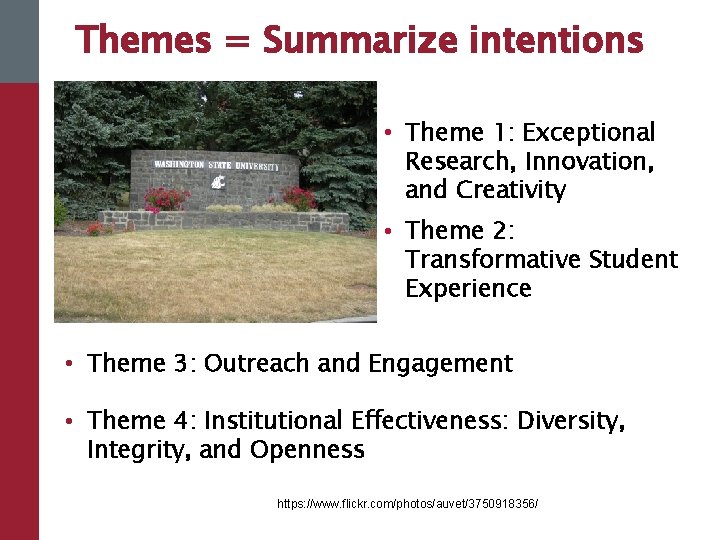
Themes = Summarize intentions • Theme 1: Exceptional Research, Innovation, and Creativity • Theme 2: Transformative Student Experience • Theme 3: Outreach and Engagement • Theme 4: Institutional Effectiveness: Diversity, Integrity, and Openness https: //www. flickr. com/photos/auvet/3750918356/
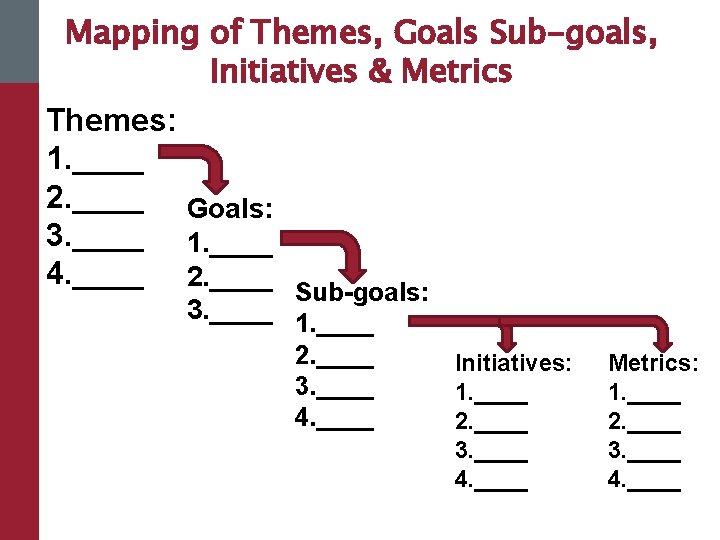
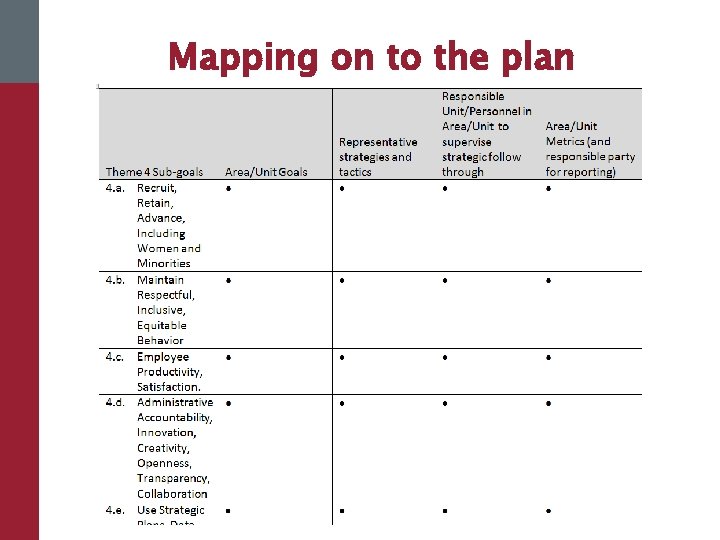
Mapping of Themes, Goals Sub-goals, Initiatives & Metrics Themes: 1. ____ 2. ____ Goals: 3. ____ 1. ____ 4. ____ 2. ____ Sub-goals: 3. ____ 1. ____ 2. ____ Initiatives: 3. ____ 1. ____ 4. ____ 2. ____ 3. ____ 4. ____ Metrics: 1. ____ 2. ____ 3. ____ 4. ____
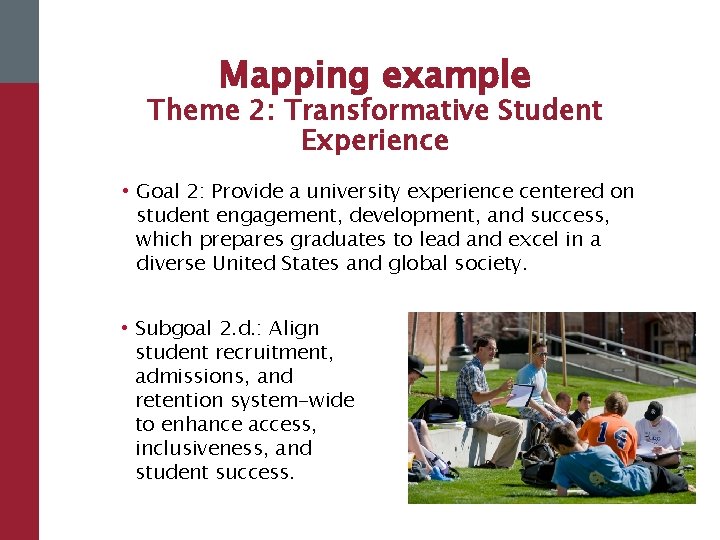
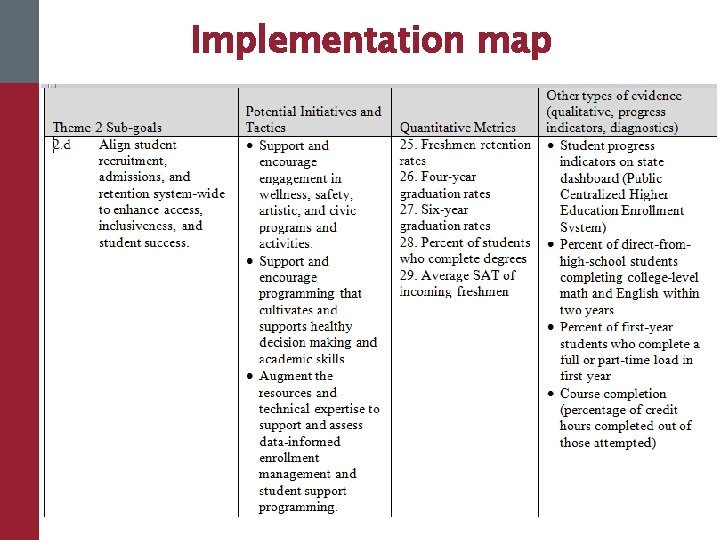
Mapping example Theme 2: Transformative Student Experience • Goal 2: Provide a university experience centered on student engagement, development, and success, which prepares graduates to lead and excel in a diverse United States and global society. • Subgoal 2. d. : Align student recruitment, admissions, and retention system-wide to enhance access, inclusiveness, and student success.
Implementation map
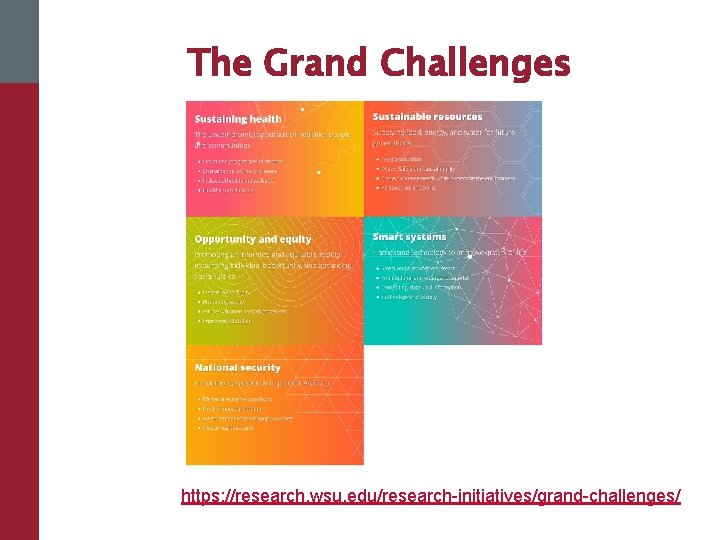
Implementation plan • Strategic planning implementation committee: Institutional Effectiveness Council • Council will define quantitative benchmarks for each of the 55 metrics • Grand Challenges identify current and emerging areas of research excellence • Annual report of progress to be issued by Provost’s Office
The Grand Challenges https: //research. wsu. edu/research-initiatives/grand-challenges/
The Institutional Effectiveness Council: “A coordinated, sustainable system to pursue university institutional effectiveness” • To coordinate strategic planning implementation, required accountability reporting, and decision support; • To reduce redundancy and increase efficiency, transparency, and accountability among strategic planning, institutional management, university accreditation, and other state and federal reporting requirements; and • To optimize usefulness of data and reports system-wide at all levels.
The IEC Steering Committee • Provost and Executive Vice President (Erica Austin for Dan Bernardo) — Chair • Vice President for Research (Chris Keane)—Theme 1 Chair • Vice Provost for Academic Affairs (Craig Parks for Erica Austin)—Theme 2 Chair • Vice President for External Affairs and Government Relations (Colleen Kerr)—Theme 3 Chair • Academic Dean (Michael Trevisan) —Theme 4 Co-Chair • Vice President for Finance and Administration (Vicky Murray) —Theme 4 Co-Chair • Executive Director of Institutional Research (Fran Hermanson) —Supervisor of Institution-Level Metrics Collection • Urban Campus Chancellor (Keith Moo Young)
IEC Steering Committee purpose • Oversees implementation and fulfillment of strategic plan. • Directs and resources the Council and the Accreditation, Assessment and Academic Program Review Committee. • Reviews and approves recommendations from the Council for strategic planning implementation and institution-level accountability metrics • Ensures alignment of data collection and reporting for institutional effectiveness, NWCCU accreditation standards, other external report mandates, and other internal needs for data and evaluation.
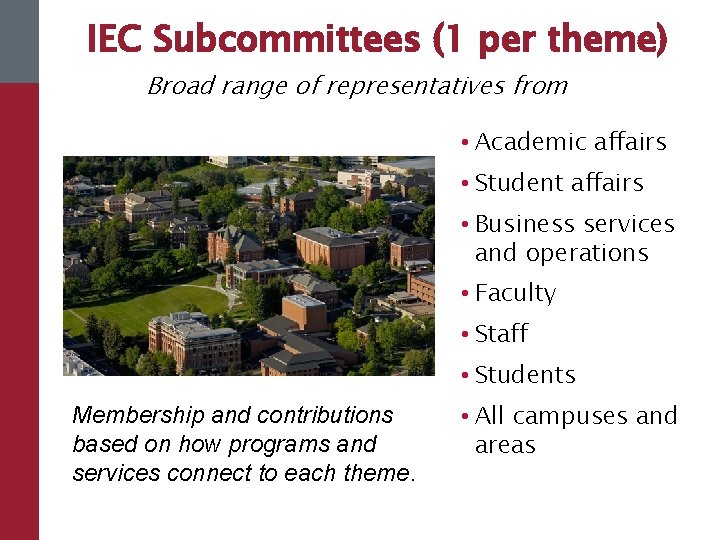
IEC Subcommittees (1 per theme) Broad range of representatives from • Academic affairs • Student affairs • Business services and operations • Faculty • Staff • Students Membership and contributions based on how programs and services connect to each theme. • All campuses and areas
What IEC subcommittees do • Facilitate unit- and program-level fulfillment of strategic plan goals, including collection and analysis of data to track progress toward theme’s objectives. • Monitor and report to steering committee on infrastructure and training needs from units and programs. • Contribute to a university-wide annual inventory of assessment activities for each theme. • Promote awareness and communication about these topics among WSU units and employees. • Provide summary reports on strategic plan fulfillment annually to the IEC Steering Committee.
How the strategic plan relates to accreditation NWCCU’s Five Standards: • The institution's Mission and Core Themes; • How the Core Themes translate into assessable objectives supported by programs and services; • Appraisal of the institution's potential to fulfill the Mission; • Planning and implementation involved to achieve and assess desired outcomes of programs and services; • An evaluation of mission-fulfillment efforts and sustainability. http: //accreditation. wsu. edu http: //nwccu. org
Mapping on to the plan
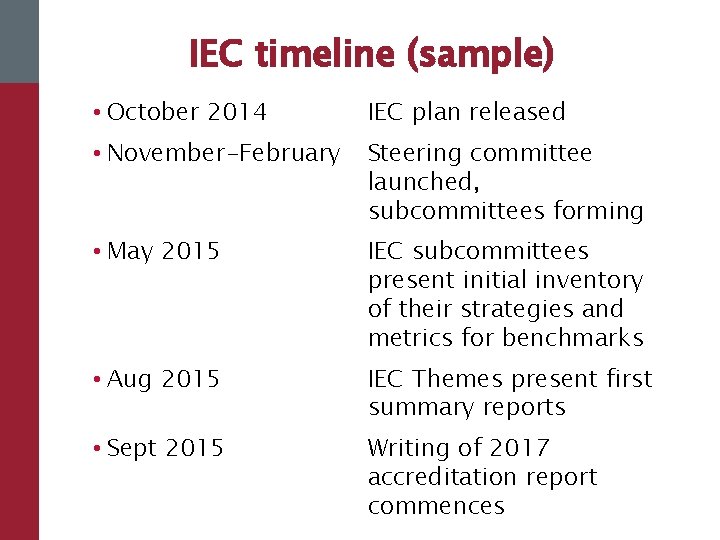
IEC timeline (sample) • October 2014 IEC plan released • November-February Steering committee launched, subcommittees forming • May 2015 IEC subcommittees present initial inventory of their strategies and metrics for benchmarks • Aug 2015 IEC Themes present first summary reports • Sept 2015 Writing of 2017 accreditation report commences
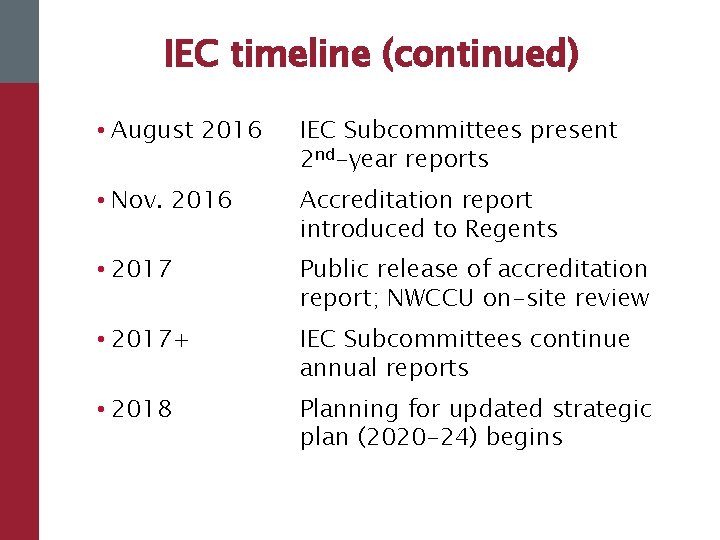
IEC timeline (continued) • August 2016 IEC Subcommittees present 2 nd-year reports • Nov. 2016 Accreditation report introduced to Regents • 2017 Public release of accreditation report; NWCCU on-site review • 2017+ IEC Subcommittees continue annual reports • 2018 Planning for updated strategic plan (2020 -24) begins
Strategic Plan web site www. strategicplan. wsu. edu
More information • Erica Austin (eaustin@wsu. edu), 335 -5581 • www. strategicplan. wsu. edu
This has been a WSU Training Videoconference If you attended this live training session and wish to have your attendance documented in your training history, please notify Human Resource Services within 24 hours of today's date: hrstraining@wsu. edu