
Washington Irving Father of American literature Study Questions
- Slides: 28
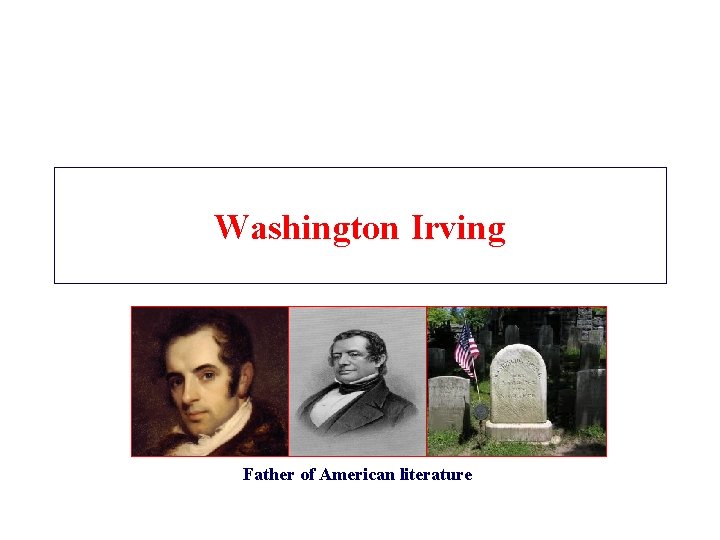
Washington Irving Father of American literature
Study Questions • • • 1. Why were Puritans so confident and optimistic, living a hard life in the new and indifferent world? 2. Why is American literature born with romanticism? 3. What helped to bring new Americans a renaissance in arts and culture? 4. Why should American literature start with Washington Irving? 思考题: 1. 美国早期清教徒在陌生、冷酷的土地上过着艰苦的生活,但却很乐观,对 自己信心十足。 为什么? 2. 为什么美国文学始于浪漫主义? 3. 是什么给美国初民带来艺术与文化上的繁荣? 4. 为什么说真正的美国文学始于华盛顿·欧文?
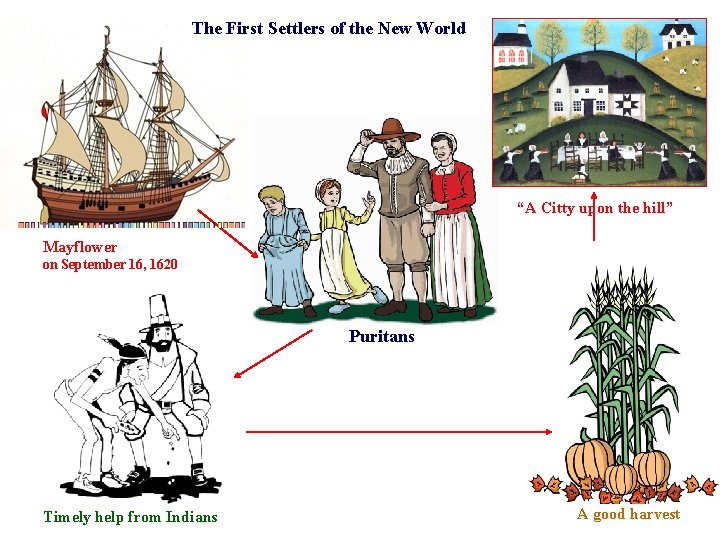
The First Settlers of the New World “A Citty upon the hill” Mayflower on September 16, 1620 Puritans Timely help from Indians A good harvest
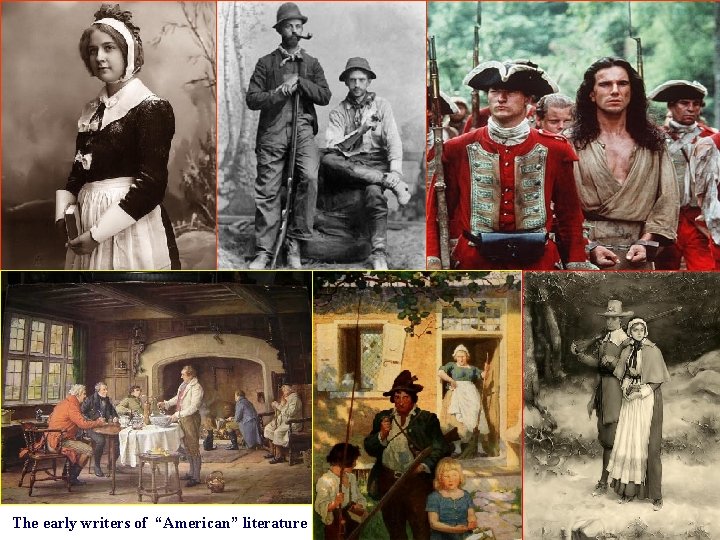
The early writers of “American” literature
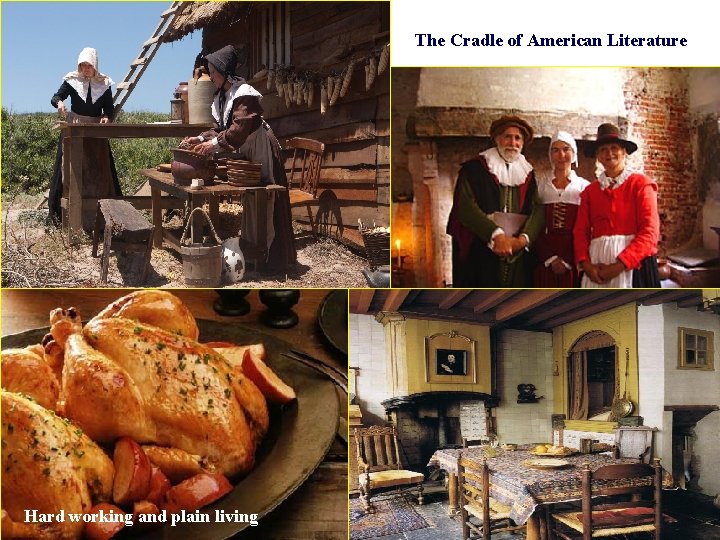
The Cradle of American Literature Hard working and plain living
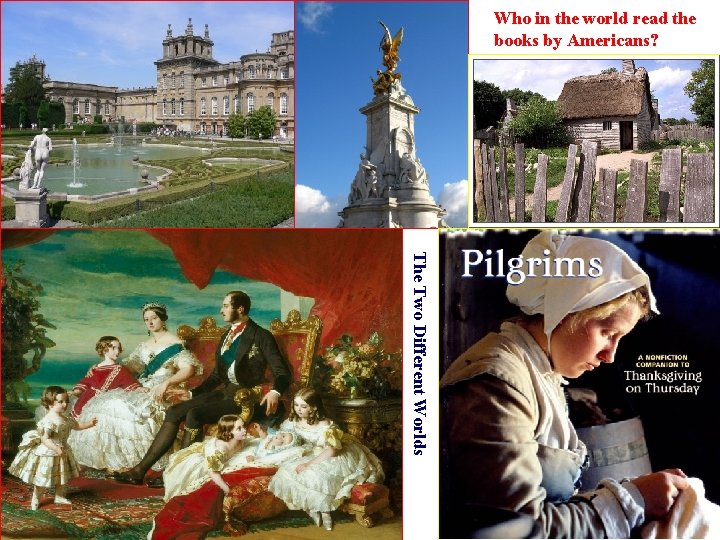
Who in the world read the books by Americans? The Two Different Worlds
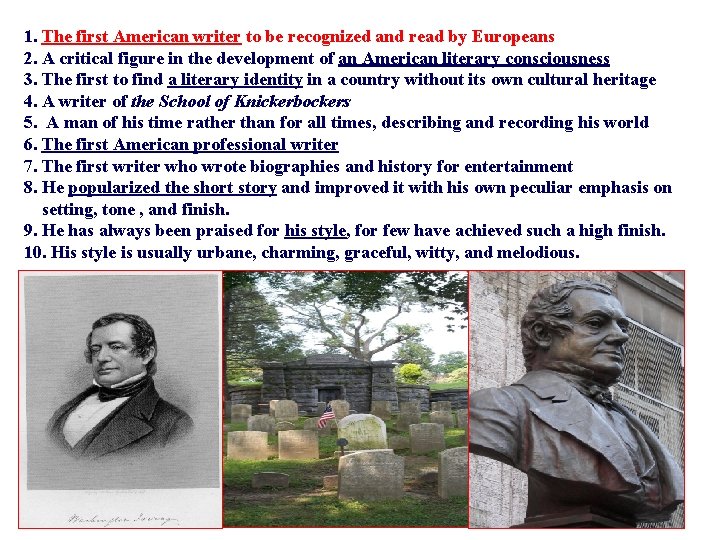
1. The first American writer to be recognized and read by Europeans 2. A critical figure in the development of an American literary consciousness 3. The first to find a literary identity in a country without its own cultural heritage 4. A writer of the School of Knickerbockers 5. A man of his time rather than for all times, describing and recording his world 6. The first American professional writer 7. The first writer who wrote biographies and history for entertainment 8. He popularized the short story and improved it with his own peculiar emphasis on setting, tone , and finish. 9. He has always been praised for his style, for few have achieved such a high finish. 10. His style is usually urbane, charming, graceful, witty, and melodious.
It was not easy to be the first professional American writer. 1. There were no clear literary and cultural identities in the new world then. 2. Men were judged by the gun, and the axe, and women by the lipsticks. 3. Literature was made for the people who had time and money, so was the profession of a writer.
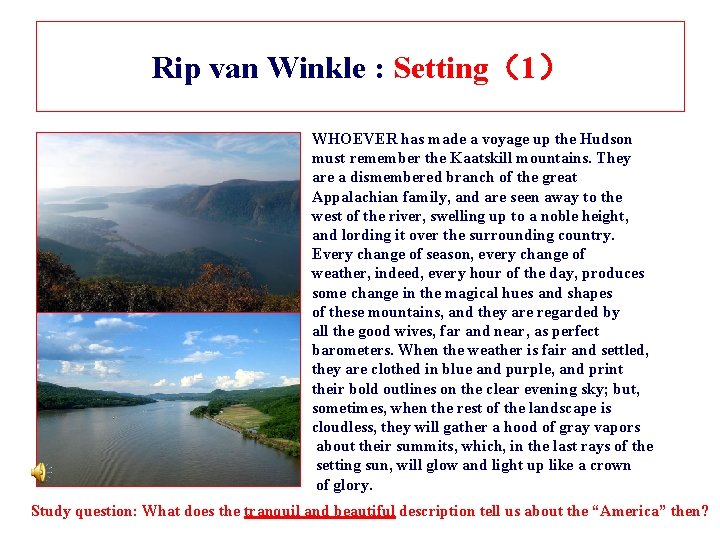
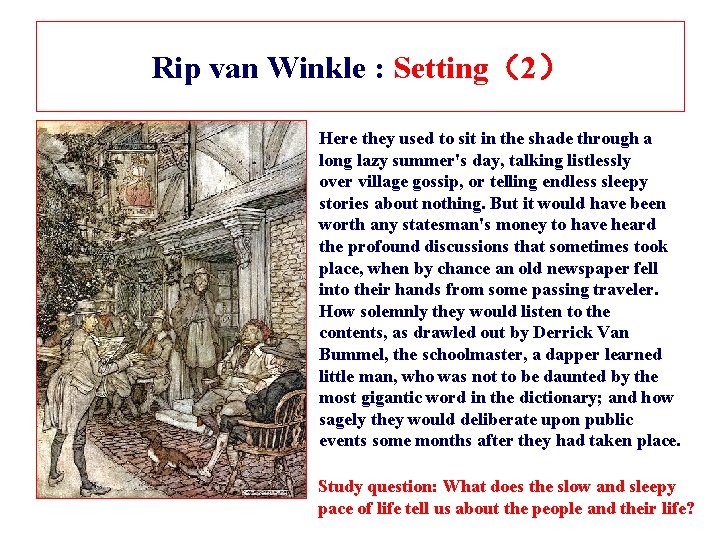
Rip van Winkle : Setting(1) WHOEVER has made a voyage up the Hudson must remember the Kaatskill mountains. They are a dismembered branch of the great Appalachian family, and are seen away to the west of the river, swelling up to a noble height, and lording it over the surrounding country. Every change of season, every change of weather, indeed, every hour of the day, produces some change in the magical hues and shapes of these mountains, and they are regarded by all the good wives, far and near, as perfect barometers. When the weather is fair and settled, they are clothed in blue and purple, and print their bold outlines on the clear evening sky; but, sometimes, when the rest of the landscape is cloudless, they will gather a hood of gray vapors about their summits, which, in the last rays of the setting sun, will glow and light up like a crown of glory. Study question: What does the tranquil and beautiful description tell us about the “America” then?
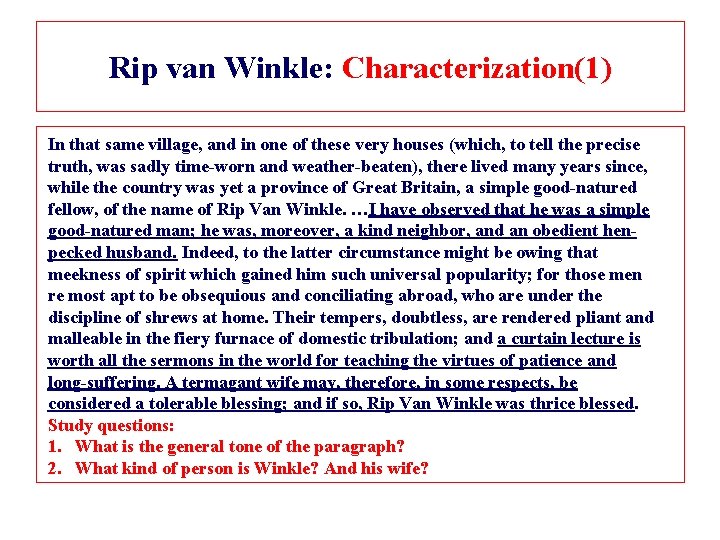
Rip van Winkle : Setting(2) Here they used to sit in the shade through a long lazy summer's day, talking listlessly over village gossip, or telling endless sleepy stories about nothing. But it would have been worth any statesman's money to have heard the profound discussions that sometimes took place, when by chance an old newspaper fell into their hands from some passing traveler. How solemnly they would listen to the contents, as drawled out by Derrick Van Bummel, the schoolmaster, a dapper learned little man, who was not to be daunted by the most gigantic word in the dictionary; and how sagely they would deliberate upon public events some months after they had taken place. Study question: What does the slow and sleepy pace of life tell us about the people and their life?
Rip van Winkle: Characterization(1) In that same village, and in one of these very houses (which, to tell the precise truth, was sadly time-worn and weather-beaten), there lived many years since, while the country was yet a province of Great Britain, a simple good-natured fellow, of the name of Rip Van Winkle. …I have observed that he was a simple good-natured man; he was, moreover, a kind neighbor, and an obedient henpecked husband. Indeed, to the latter circumstance might be owing that meekness of spirit which gained him such universal popularity; for those men re most apt to be obsequious and conciliating abroad, who are under the discipline of shrews at home. Their tempers, doubtless, are rendered pliant and malleable in the fiery furnace of domestic tribulation; and a curtain lecture is worth all the sermons in the world for teaching the virtues of patience and long-suffering. A termagant wife may, therefore, in some respects, be considered a tolerable blessing; and if so, Rip Van Winkle was thrice blessed. Study questions: 1. What is the general tone of the paragraph? 2. What kind of person is Winkle? And his wife?
Rip van Winkle: Characterization(2) Rip Van Winkle, however, was one of those happy mortals, of foolish, well-oiled dispositions, who take the world easy, eat white bread or brown, whichever can be got with least thought or trouble, and would rather starve on a penny than work for a pound. If left to himself, he would have whistled life away in perfect contentment; but his wife kept continually dinning in his ears about his idleness, his carelessness, and the ruin he was bringing on his family. Morning, noon, and night, her tongue was incessantly going, and every thing he said or did was sure to produce a torrent of household eloquence. Rip had but one way of replying to all lectures of the kind, and that, by frequent use, had grown into a habit. He shrugged his shoulders, shook his head, cast up his eyes, but said nothing. This, however, always provoked a fresh volley from his wife so that he was fain to draw off his forces, and take to the outside of the house, the only side which, in truth, belongs to a hen-pecked husband. Study questions: 1. How did Winkle develop into a hen-pecked husband? 2. What does Winkle’s wife symbolize?
Rip van Winkle: Characterization(3) His children, too, were as ragged and wild as if they belonged to nobody. His son Rip, an urchin begotten in his own likeness, promised to inherit the habits, with the old clothes of his father. He was generally seen trooping like a colt at his mother's heels, equipped in a pair of his father's cast-off galligaskins, which he had much ado to hold up with one hand, as a fine lady does her train in bad weather. Study questions; 1. Is the tone bitter or humorous in the characterization of the main character Winkle and his son? And what does that tell us about Irving himself and the life then in the would-be America? 2. Do you think from the story that the life then and there was hard?
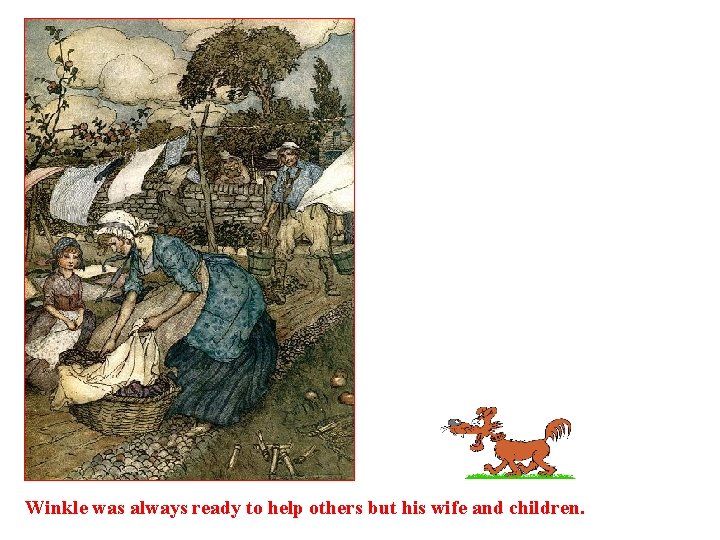
Winkle was always ready to help others but his wife and children.
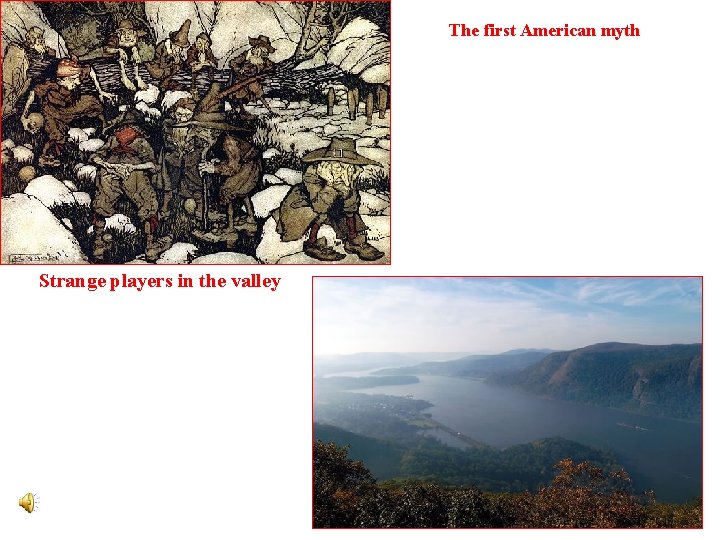
The first American myth Strange players in the valley
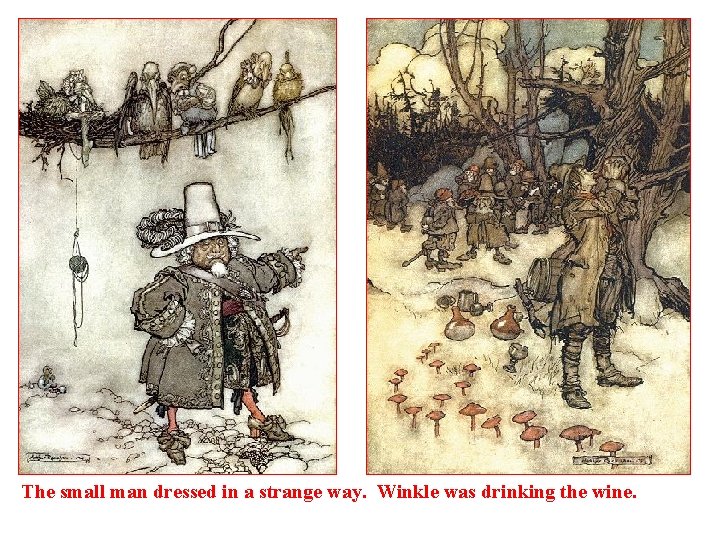
The small man dressed in a strange way. Winkle was drinking the wine.
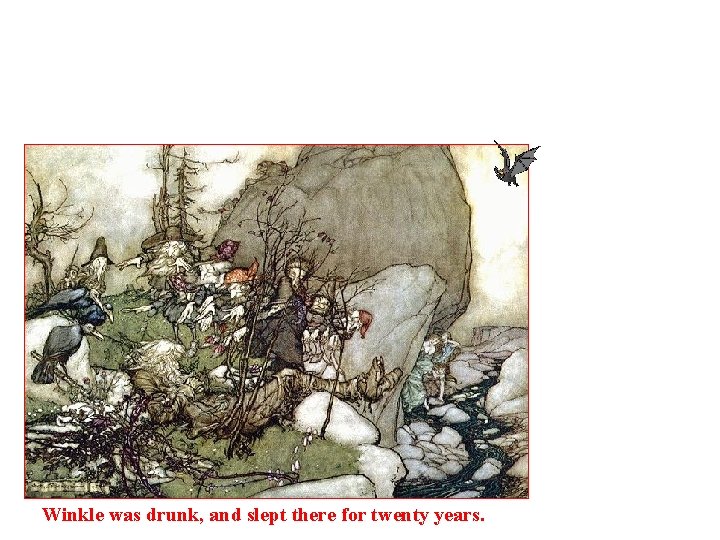
Winkle was drunk, and slept there for twenty years.
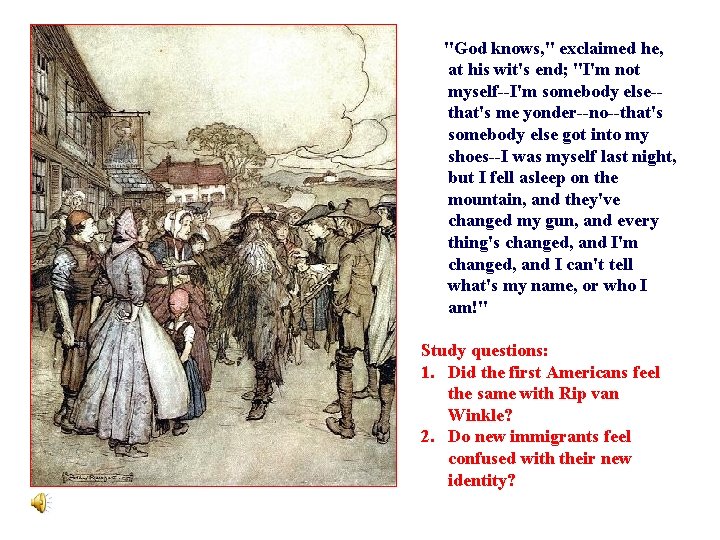
"God knows, " exclaimed he, at his wit's end; "I'm not myself--I'm somebody else-that's me yonder--no--that's somebody else got into my shoes--I was myself last night, but I fell asleep on the mountain, and they've changed my gun, and every thing's changed, and I'm changed, and I can't tell what's my name, or who I am!" Study questions: 1. Did the first Americans feel the same with Rip van Winkle? 2. Do new immigrants feel confused with their new identity?
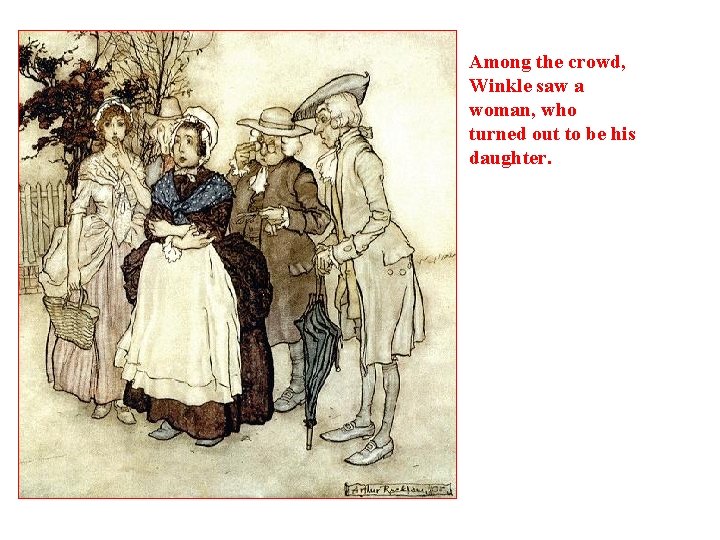
Among the crowd, Winkle saw a woman, who turned out to be his daughter.
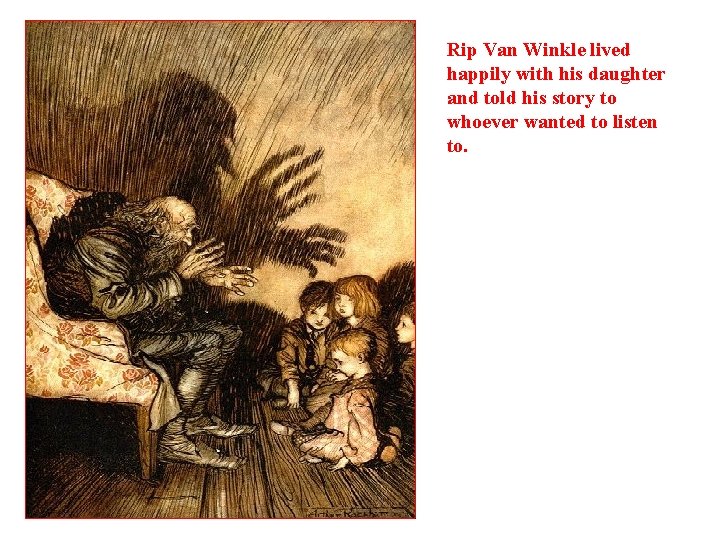
Rip Van Winkle lived happily with his daughter and told his story to whoever wanted to listen to.
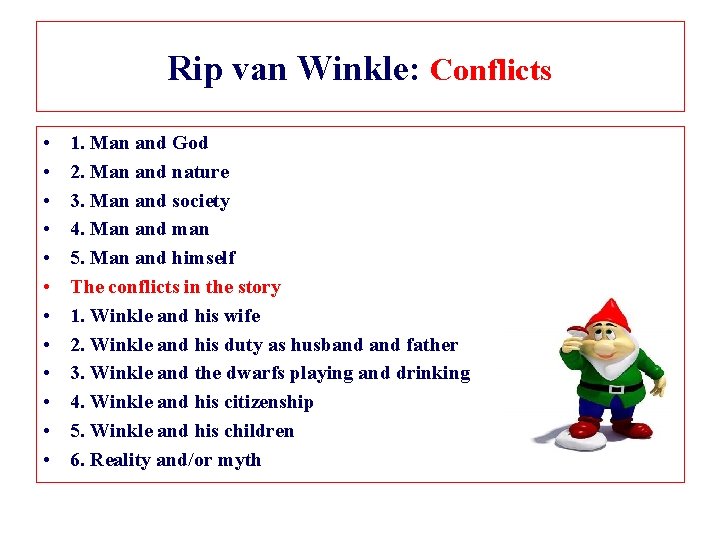
Rip van Winkle: Conflicts • • • 1. Man and God 2. Man and nature 3. Man and society 4. Man and man 5. Man and himself The conflicts in the story 1. Winkle and his wife 2. Winkle and his duty as husband father 3. Winkle and the dwarfs playing and drinking 4. Winkle and his citizenship 5. Winkle and his children 6. Reality and/or myth
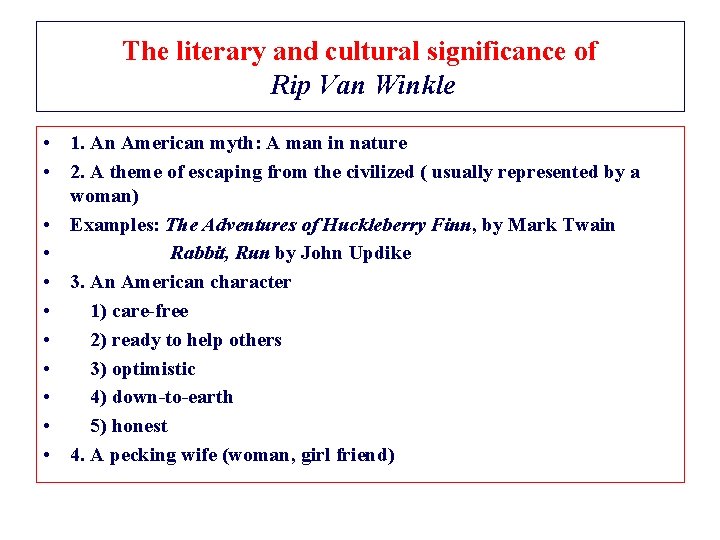
The literary and cultural significance of Rip Van Winkle • 1. An American myth: A man in nature • 2. A theme of escaping from the civilized ( usually represented by a woman) • Examples: The Adventures of Huckleberry Finn, by Mark Twain • Rabbit, Run by John Updike • 3. An American character • 1) care-free • 2) ready to help others • 3) optimistic • 4) down-to-earth • 5) honest • 4. A pecking wife (woman, girl friend)
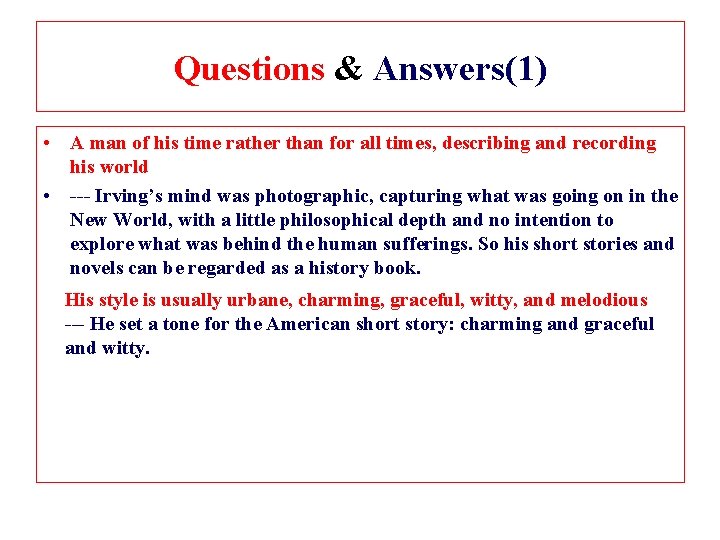
Questions & Answers(1) • A man of his time rather than for all times, describing and recording his world • --- Irving’s mind was photographic, capturing what was going on in the New World, with a little philosophical depth and no intention to explore what was behind the human sufferings. So his short stories and novels can be regarded as a history book. His style is usually urbane, charming, graceful, witty, and melodious --- He set a tone for the American short story: charming and graceful and witty.
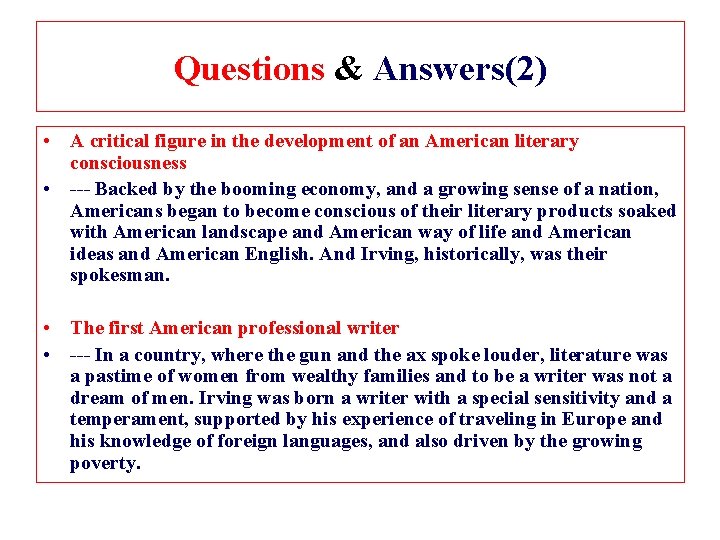
Questions & Answers(2) • A critical figure in the development of an American literary consciousness • --- Backed by the booming economy, and a growing sense of a nation, Americans began to become conscious of their literary products soaked with American landscape and American way of life and American ideas and American English. And Irving, historically, was their spokesman. • The first American professional writer • --- In a country, where the gun and the ax spoke louder, literature was a pastime of women from wealthy families and to be a writer was not a dream of men. Irving was born a writer with a special sensitivity and a temperament, supported by his experience of traveling in Europe and his knowledge of foreign languages, and also driven by the growing poverty.
Washington Irving: Life • • • 1. Born in New York in 1783, named after George Washington the hero of the new country 2. The eleventh child, growing up in a religious family, softened by a good library and cultural activities of his brothers 3. Reading law from 1799 -1804 and admitted to the bar in 1806 4. A family-financed tour of Europe in 1804 -1806 ---his substitute for Columbia College 5. Falling in love with Judge Hoffman’s daughter Matilda Hoffman when he was 24, and saddened by her death when she was 17 ( He remained single all his life. )
Washington Irving: A Career • • • 1. Beginning his 17 -year stay abroad to help his family business from 1815 -1818, and when the business failed, wrote to make a living 2. Encouraged by Scott (瓦尔特-司各特), he began to study European folk materials 3. Back to US in 1832, famous and honored, began to study the new America 4. Recognized as Father of American Literature, and upon his death, anyone who read English, read him.
Washington Irving: Works • • • 1. A History of New York from the Creation of the World to the End of the Dutch Dynasty (1809) 《纽约外史》 ( by Diedrich Knickerbocker) 2. The Sketch Book of Geoffrey Crayon, Gent. ( 1819 -1820) 《见闻札记》 ( Of 33 essays and stories, only 4 are about America, and 2 of them are still read: Rip Van Winkle, and The Legend of Sleepy Hollow) 3. The Life and Voyages of Christopher Columbus (1828) 《哥伦布传》 4. A Tour on the Prairies( 1835) 《草原游记》 5. Life of George Washington( 1855 -1859) 《华盛顿传》
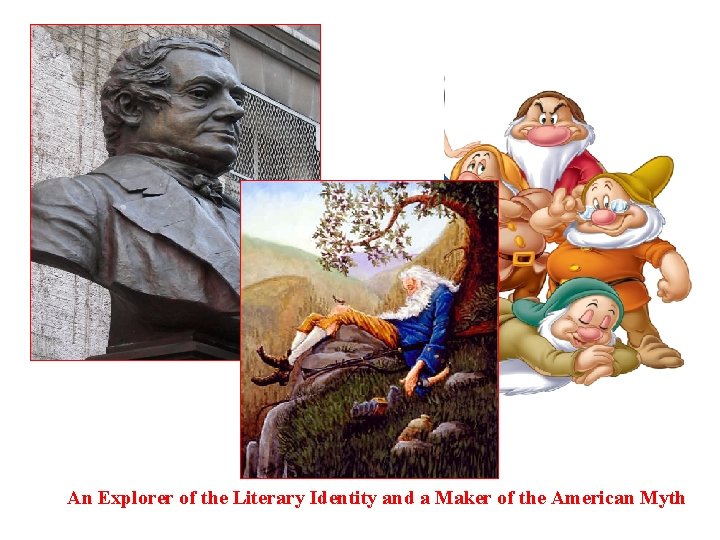
An Explorer of the Literary Identity and a Maker of the American Myth