
Washington Clean Energy Fund 1 Final Results and


- Slides: 15
Washington Clean Energy Fund 1 - Final Results and Insights Alasdair Crawford, Computational Scientist Pacific Northwest National Laboratory DOE OE Energy Storage Peer Review Albuquerque, NM September 24, 2019 Support from DOE Office of Electricity Delivery & Energy Reliability ENERGY STORAGE PROGRAM PNNL is operated by Battelle for the U. S. Department of Energy Other contributing authors: Patrick Balducci, Charlie Vartanian, Vish Viswanathan
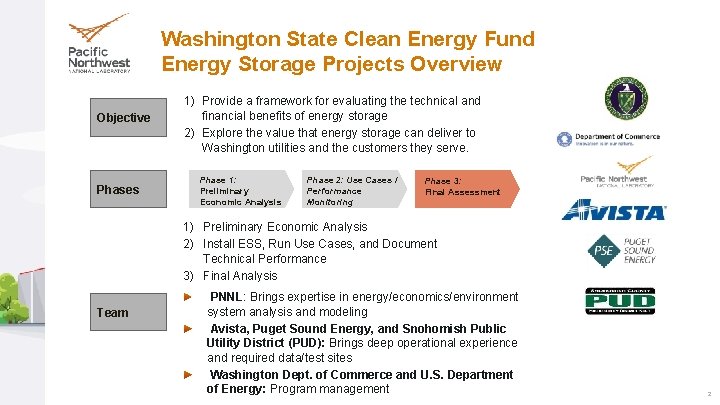
Washington State Clean Energy Fund Energy Storage Projects Overview Objective Phases 1) Provide a framework for evaluating the technical and financial benefits of energy storage 2) Explore the value that energy storage can deliver to Washington utilities and the customers they serve. Phase 1: Preliminary Economic Analysis Phase 2: Use Cases / Performance Monitoring Phase 3: Final Assessment 1) Preliminary Economic Analysis 2) Install ESS, Run Use Cases, and Document Technical Performance 3) Final Analysis Team PNNL: Brings expertise in energy/economics/environment system analysis and modeling Avista, Puget Sound Energy, and Snohomish Public Utility District (PUD): Brings deep operational experience and required data/test sites Washington Dept. of Commerce and U. S. Department of Energy: Program management 2
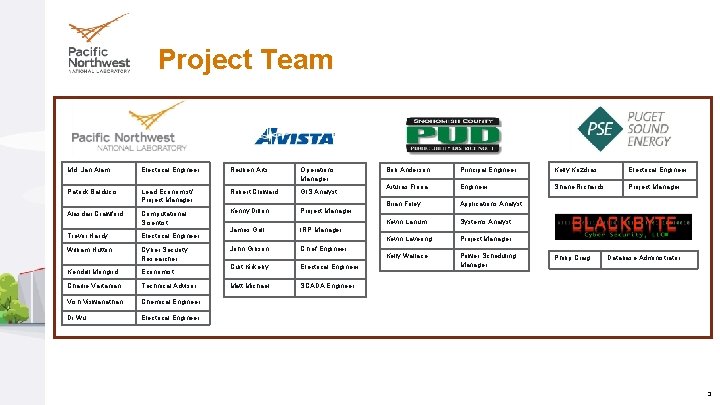
Project Team Md. Jan Alam Electrical Engineer Reuben Arts Operations Manager Patrick Balducci Lead Economist/ Project Manager Robert Cloward GIS Analyst Alasdair Crawford Computational Scientist Kenny Dillon Project Manager James Gall IRP Manager John Gibson Chief Engineer Curt Kirkeby Electrical Engineer Matt Michael SCADA Engineer Trevor Hardy Electrical Engineer William Hutton Cyber Security Researcher Kendall Mongird Economist Charlie Vartanian Technical Advisor Vish Viswanathan Chemical Engineer Di Wu Electrical Engineer Bob Anderson Principal Engineer Kelly Kozdras Electrical Engineer Arturas Floria Engineer Shane Richards Project Manager Brian Foley Applications Analyst Kevin Lanum Systems Analyst Kevin Lavering Project Manager Kelly Wallace Power Scheduling Manager Philip Craig Database Administrator 3
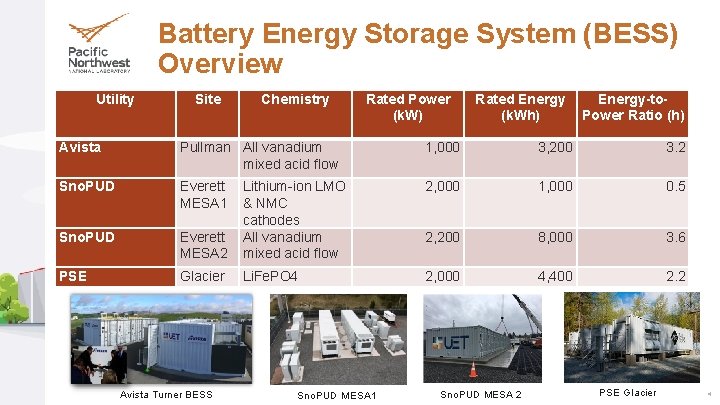
Battery Energy Storage System (BESS) Overview Utility Site Chemistry Rated Power (k. W) Rated Energy (k. Wh) Energy-to. Power Ratio (h) Avista Pullman All vanadium mixed acid flow 1, 000 3, 200 3. 2 Sno. PUD Everett MESA 1 2, 000 1, 000 0. 5 Sno. PUD Everett MESA 2 Lithium-ion LMO & NMC cathodes All vanadium mixed acid flow 2, 200 8, 000 3. 6 PSE Glacier Li. Fe. PO 4 2, 000 4, 400 2. 2 Avista Turner BESS Sno. PUD MESA 1 Sno. PUD MESA 2 PSE Glacier 4
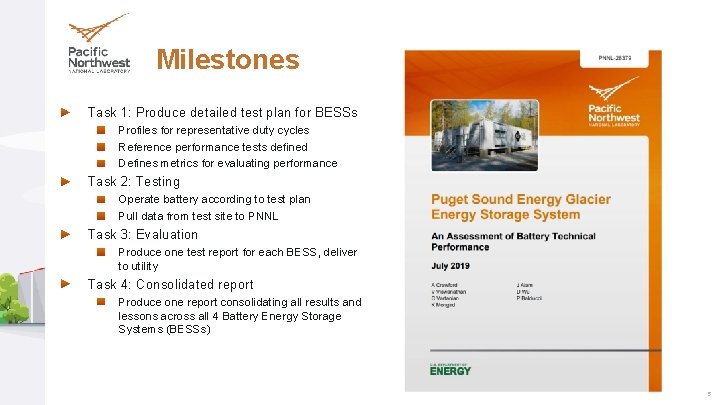
Milestones Task 1: Produce detailed test plan for BESSs Profiles for representative duty cycles Reference performance tests defined Defines metrics for evaluating performance Task 2: Testing Operate battery according to test plan Pull data from test site to PNNL Task 3: Evaluation Produce one test report for each BESS, deliver to utility Task 4: Consolidated report Produce one report consolidating all results and lessons across all 4 Battery Energy Storage Systems (BESSs) 5
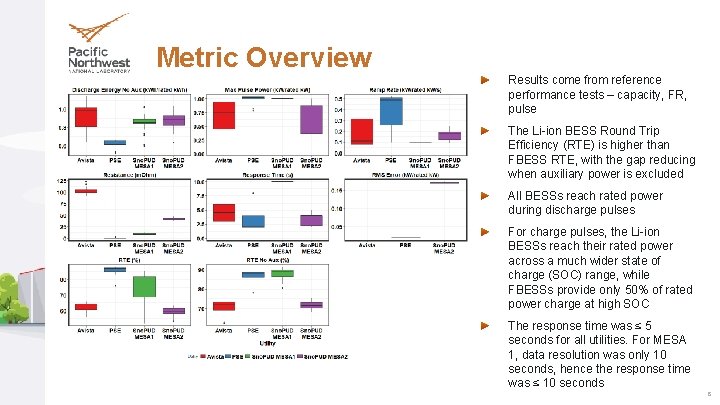
Metric Overview Results come from reference performance tests – capacity, FR, pulse The Li-ion BESS Round Trip Efficiency (RTE) is higher than FBESS RTE, with the gap reducing when auxiliary power is excluded All BESSs reach rated power during discharge pulses For charge pulses, the Li-ion BESSs reach their rated power across a much wider state of charge (SOC) range, while FBESSs provide only 50% of rated power charge at high SOC The response time was ≤ 5 seconds for all utilities. For MESA 1, data resolution was only 10 seconds, hence the response time was ≤ 10 seconds 6
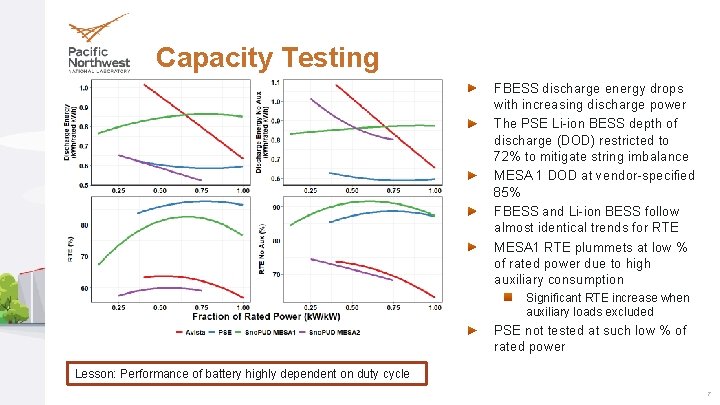
Capacity Testing FBESS discharge energy drops with increasing discharge power The PSE Li-ion BESS depth of discharge (DOD) restricted to 72% to mitigate string imbalance MESA 1 DOD at vendor-specified 85% FBESS and Li-ion BESS follow almost identical trends for RTE MESA 1 RTE plummets at low % of rated power due to high auxiliary consumption Significant RTE increase when auxiliary loads excluded PSE not tested at such low % of rated power Lesson: Performance of battery highly dependent on duty cycle 7
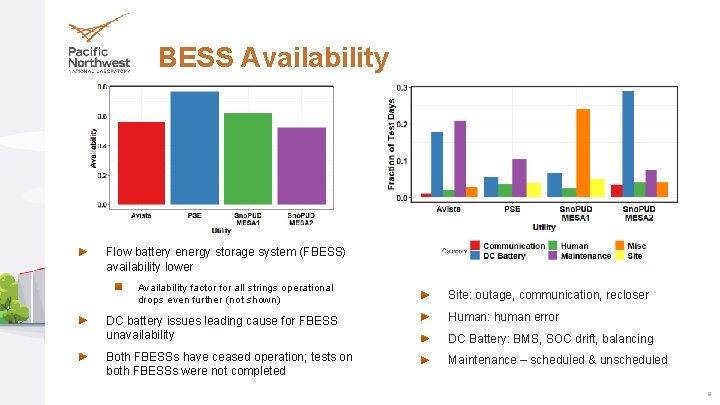
BESS Availability Flow battery energy storage system (FBESS) availability lower Availability factor for all strings operational drops even further (not shown) Site: outage, communication, recloser DC battery issues leading cause for FBESS unavailability Human: human error Both FBESSs have ceased operation; tests on both FBESSs were not completed Maintenance – scheduled & unscheduled DC Battery: BMS, SOC drift, balancing 8
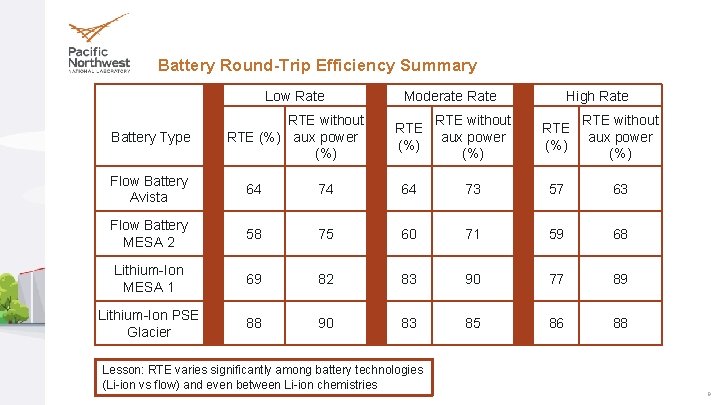
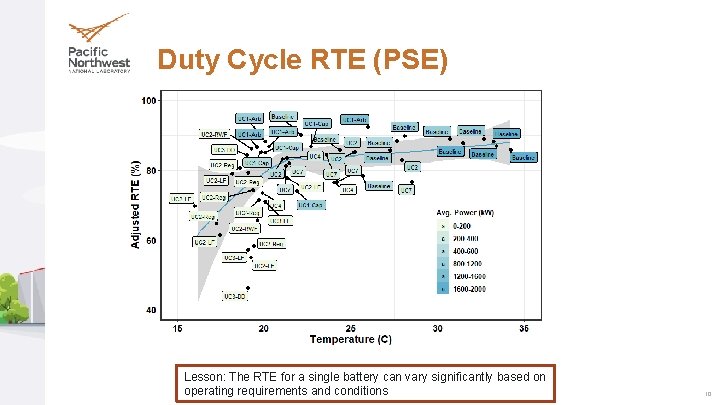
Battery Round-Trip Efficiency Summary Battery Type Flow Battery Avista Low Rate RTE without RTE (%) aux power (%) Flow Battery MESA 2 64 74 58 75 Moderate RTE without RTE aux power (%) 64 73 60 71 High Rate RTE without RTE aux power (%) 57 63 59 68 Lithium-Ion MESA 1 69 82 83 90 77 89 Lithium-Ion PSE Glacier 88 90 83 85 86 88 Lesson: RTE varies significantly among battery technologies (Li-ion vs flow) and even between Li-ion chemistries 9
Duty Cycle RTE (PSE) Lesson: The RTE for a single battery can vary significantly based on operating requirements and conditions 10
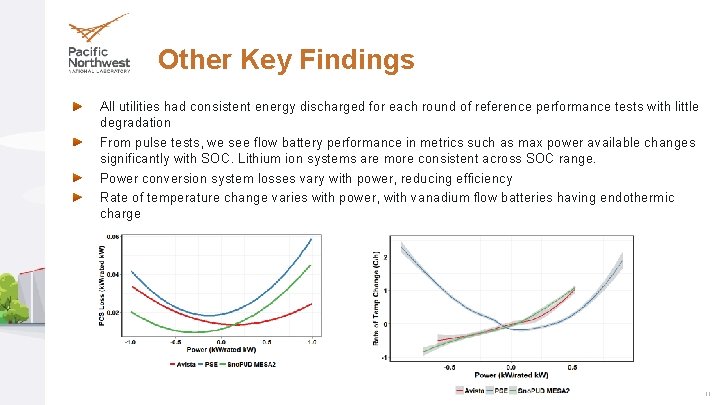
Other Key Findings All utilities had consistent energy discharged for each round of reference performance tests with little degradation From pulse tests, we see flow battery performance in metrics such as max power available changes significantly with SOC. Lithium ion systems are more consistent across SOC range. Power conversion system losses vary with power, reducing efficiency Rate of temperature change varies with power, with vanadium flow batteries having endothermic charge 11
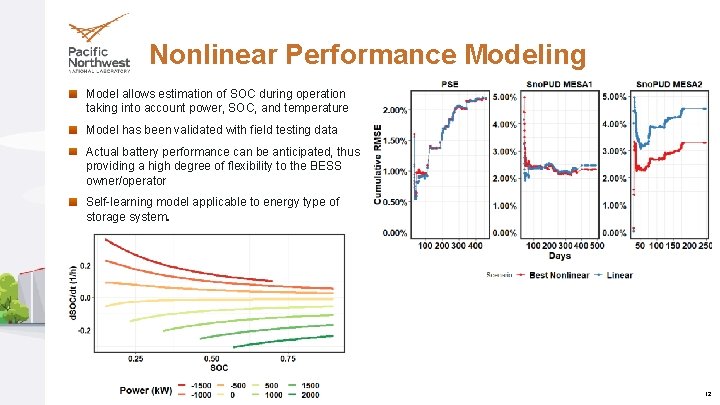
Nonlinear Performance Modeling Model allows estimation of SOC during operation taking into account power, SOC, and temperature Model has been validated with field testing data Actual battery performance can be anticipated, thus providing a high degree of flexibility to the BESS owner/operator Self-learning model applicable to energy type of storage system. 12
Looking Forward Reports can be found at: https: //energystorage. pnnl. gov/pdf/PNNL-28379. pdf https: //energystorage. pnnl. gov/pdf/PNNL-28480. pdf https: //energystorage. pnnl. gov/pdf/PNNL-28478. pdf https: //energystorage. pnnl. gov/pdf/PNNL-27237. pdf Patent resulting from performance modeling work https: //patents. google. com/patent/US 20180131200 A 1/ Next Steps PNNL will continue working with utilities to evaluate their battery performance, such as Powin Energy, Eugene Water and Electric Board, Energy Northwest, and Orcas Power and Light Co-op All projects sent command to BESS at the PCS level – power exchange with grid was different, leads to poor signal tracking. Site controller needs to adjust for this PNNL will seek to publish a paper on performance modeling 13
Acknowledgments Dr. Imre Gyuk, DOE ‒ Department of Energy Office of Electricity Bob Kirchmeier – Washington Department of Commerce Mission ‒ to ensure a resilient, reliable, and flexible electricity system through research, partnerships, facilitation, modeling and analytics, and emergency preparedness. https: //www. energy. gov/oe/activities/technologydevelopment/energy-storage 14
Q/A and Further Information Alasdair Crawford PNNL Alasdair. Crawford@pnnl. gov https: //energystorage. pnnl. gov/ 15