
Washington Capital Area Chapter of ICEAA Calculating a
- Slides: 28
Washington Capital Area Chapter of ICEAA Calculating a Project’s Reserve Dollars from its S-Curve (cost distribution) A method to estimate the funds needed to cover your project if it exceeds its Point Estimate Presenter: Marc Greenberg Strategic Investment Division (SID) National Aeronautics and Space Administration 13 December 2017
Percentile Budgeting is Only Half the Story • Risk analysis provides insight into the cost and schedule range and likelihood of achieving the cost and launch dates. • Percentile budgeting (choosing a specific confidence level) uses the risk analysis results to ensure that enough money is available in the budget to protect for that likelihood of success, and/or that enough time has been reserved to protect for the target launch dates. • Percentile budgeting establishes a protection level, but there is the other dimension of the “risk” of overrun. – A 70% budget indicates that 30% of the time there is an overrun – Overruns affect the portfolio & require re-allocation to ensure that the project can continue – Current techniques do not provide insight into the likelihood and magnitude of the potential overruns and how it can affect the portfolio NASA Strategic Investment Division (SID) 2
Cost Research Task (2015) NASA-funded work completed by Tecolote • Develop techniques to assess the overall risk exposure a project holds at any given time. – What is meant by project risk exposure? – How is project risk exposure calculated? – What are metrics of risk exposure? • Develop methodology and associated metrics to determine the risk exposure a program, theme, or directorate (an Agency portfolio) is carrying at any given time. – What does portfolio risk exposure mean? – How is portfolio risk exposure calculated? – How can portfolio risk exposure be used to support fund allocation? • Develop a prototype tool to support calculations and visualization of metrics for a project’s risk exposure and support communication within NASA stakeholders • Conduct a test case on a sample NASA portfolio NASA Strategic Investment Division (SID) 3
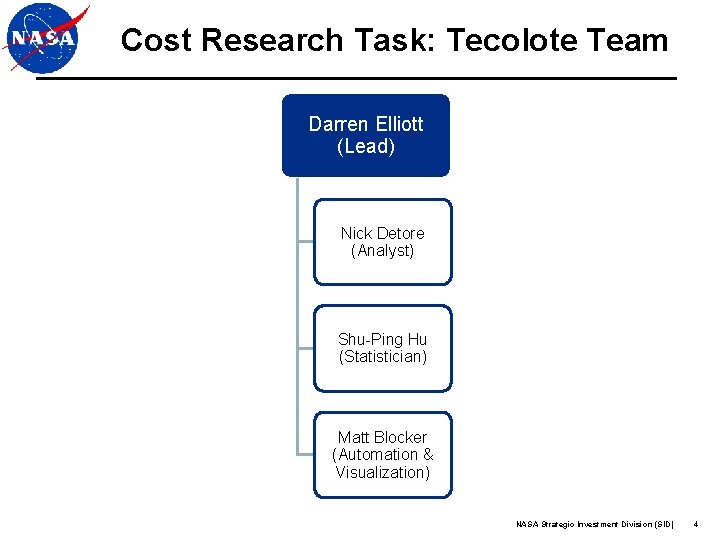
Cost Research Task: Tecolote Team Darren Elliott (Lead) Nick Detore (Analyst) Shu-Ping Hu (Statistician) Matt Blocker (Automation & Visualization) NASA Strategic Investment Division (SID) 4
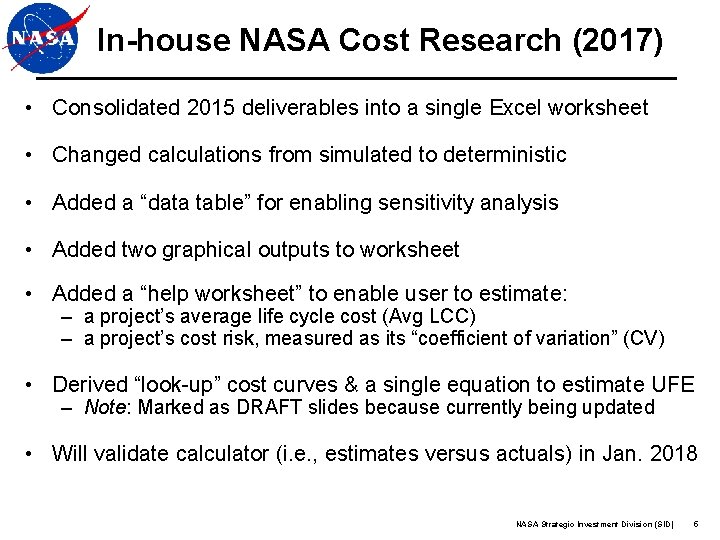
In-house NASA Cost Research (2017) • Consolidated 2015 deliverables into a single Excel worksheet • Changed calculations from simulated to deterministic • Added a “data table” for enabling sensitivity analysis • Added two graphical outputs to worksheet • Added a “help worksheet” to enable user to estimate: – a project’s average life cycle cost (Avg LCC) – a project’s cost risk, measured as its “coefficient of variation” (CV) • Derived “look-up” cost curves & a single equation to estimate UFE – Note: Marked as DRAFT slides because currently being updated • Will validate calculator (i. e. , estimates versus actuals) in Jan. 2018 NASA Strategic Investment Division (SID) 5
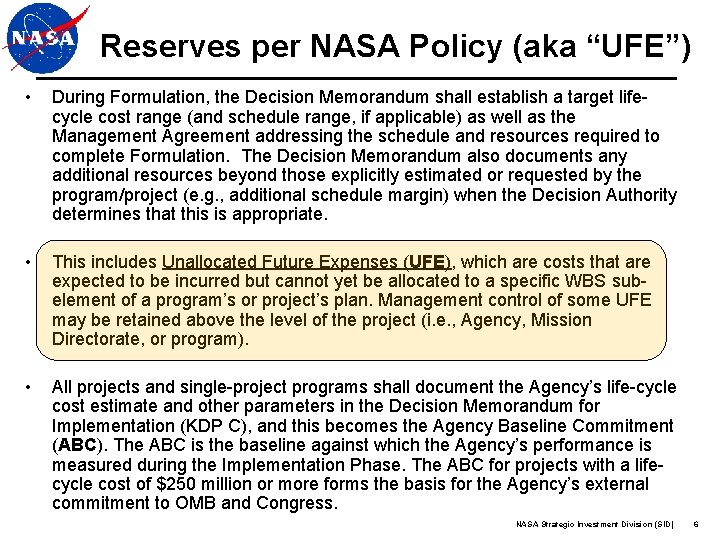
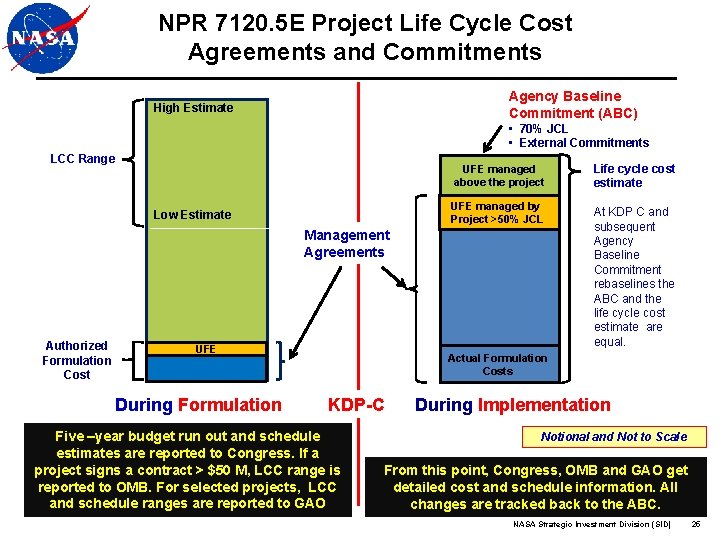
Reserves per NASA Policy (aka “UFE”) • During Formulation, the Decision Memorandum shall establish a target lifecycle cost range (and schedule range, if applicable) as well as the Management Agreement addressing the schedule and resources required to complete Formulation. The Decision Memorandum also documents any additional resources beyond those explicitly estimated or requested by the program/project (e. g. , additional schedule margin) when the Decision Authority determines that this is appropriate. • This includes Unallocated Future Expenses (UFE), which are costs that are expected to be incurred but cannot yet be allocated to a specific WBS subelement of a program’s or project’s plan. Management control of some UFE may be retained above the level of the project (i. e. , Agency, Mission Directorate, or program). • All projects and single-project programs shall document the Agency’s life-cycle cost estimate and other parameters in the Decision Memorandum for Implementation (KDP C), and this becomes the Agency Baseline Commitment (ABC). The ABC is the baseline against which the Agency’s performance is measured during the Implementation Phase. The ABC for projects with a lifecycle cost of $250 million or more forms the basis for the Agency’s external commitment to OMB and Congress. NASA Strategic Investment Division (SID) 6
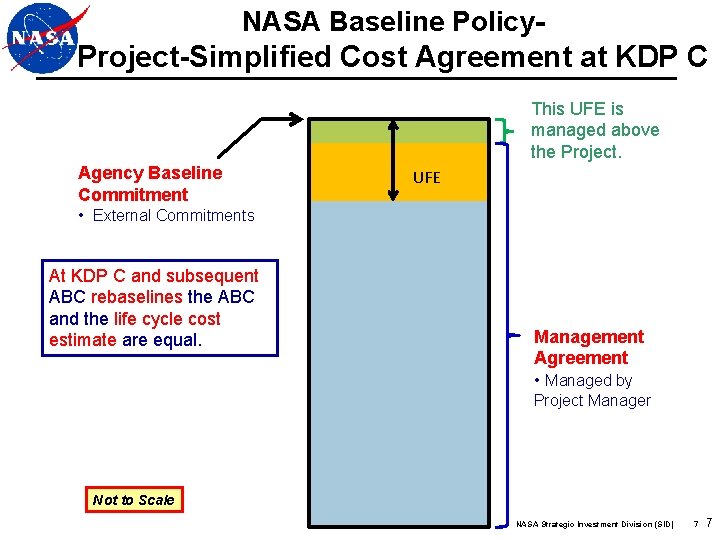
NASA Baseline Policy- Project-Simplified Cost Agreement at KDP C This UFE is managed above the Project. Agency Baseline Commitment UFE • External Commitments At KDP C and subsequent ABC rebaselines the ABC and the life cycle cost estimate are equal. Management Agreement • Managed by Project Manager Not to Scale NASA Strategic Investment Division (SID) 7 7
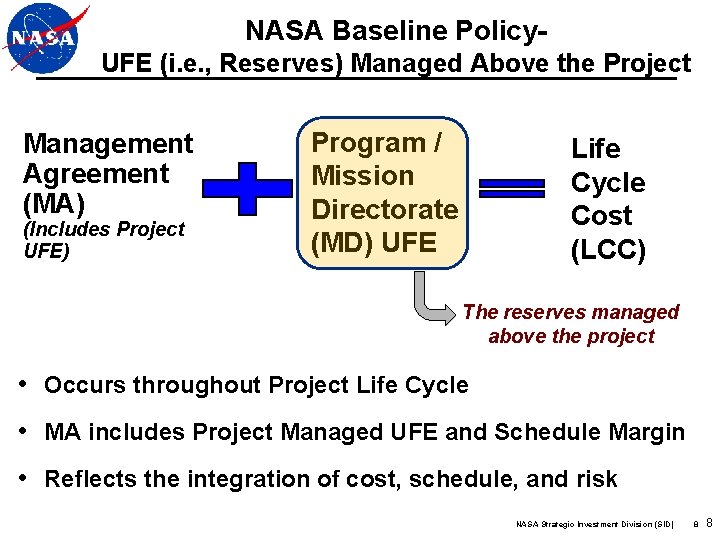
NASA Baseline Policy. UFE (i. e. , Reserves) Managed Above the Project (Includes Project UFE) Management Agreement (MA) (Includes Project UFE) Program / Mission Directorate (MD) UFE Life Cycle Cost (LCC) The reserves managed above the project • Occurs throughout Project Life Cycle • MA includes Project Managed UFE and Schedule Margin • Reflects the integration of cost, schedule, and risk NASA Strategic Investment Division (SID) 8 8
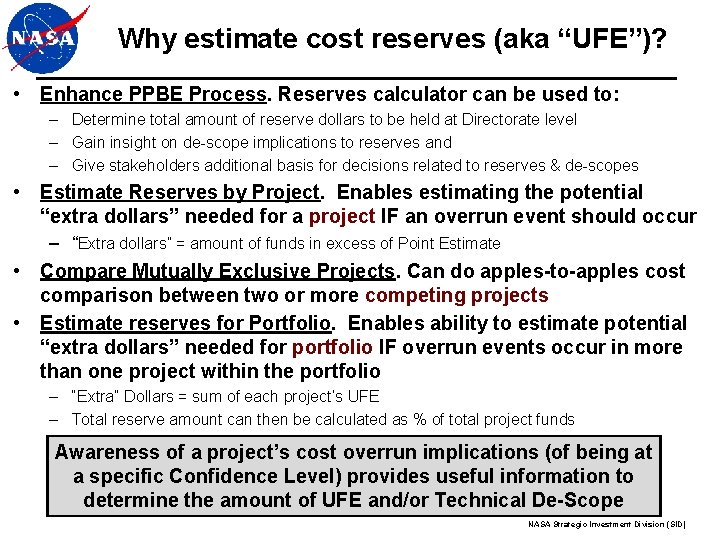
Why estimate cost reserves (aka “UFE”)? • Enhance PPBE Process. Reserves calculator can be used to: – Determine total amount of reserve dollars to be held at Directorate level – Gain insight on de-scope implications to reserves and – Give stakeholders additional basis for decisions related to reserves & de-scopes • Estimate Reserves by Project. Enables estimating the potential “extra dollars” needed for a project IF an overrun event should occur – “Extra dollars” = amount of funds in excess of Point Estimate • Compare Mutually Exclusive Projects. Can do apples-to-apples cost comparison between two or more competing projects • Estimate reserves for Portfolio. Enables ability to estimate potential “extra dollars” needed for portfolio IF overrun events occur in more than one project within the portfolio – “Extra” Dollars = sum of each project’s UFE – Total reserve amount can then be calculated as % of total project funds Awareness of a project’s cost overrun implications (of being at a specific Confidence Level) provides useful information to determine the amount of UFE and/or Technical De-Scope NASA Strategic Investment Division (SID)
METHODOLOGY & EXAMPLES NASA Strategic Investment Division (SID) 10
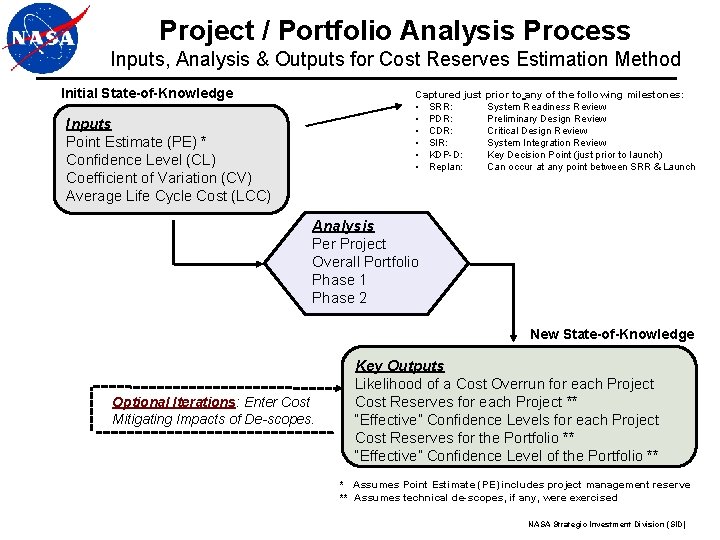
Project / Portfolio Analysis Process Inputs, Analysis & Outputs for Cost Reserves Estimation Method Initial State-of-Knowledge Captured just prior to any of the following milestones: • SRR: System Readiness Review • PDR: Preliminary Design Review • CDR: Critical Design Review • SIR: System Integration Review • KDP-D: Key Decision Point (just prior to launch) • Replan: Can occur at any point between SRR & Launch Inputs Point Estimate (PE) * Confidence Level (CL) Coefficient of Variation (CV) Average Life Cycle Cost (LCC) Analysis Per Project Overall Portfolio Phase 1 Phase 2 New State-of-Knowledge Optional Iterations: Enter Cost Mitigating Impacts of De-scopes. Key Outputs Likelihood of a Cost Overrun for each Project Cost Reserves for each Project ** “Effective” Confidence Levels for each Project Cost Reserves for the Portfolio ** “Effective” Confidence Level of the Portfolio ** * Assumes Point Estimate (PE) includes project management reserve ** Assumes technical de-scopes, if any, were exercised NASA Strategic Investment Division (SID)
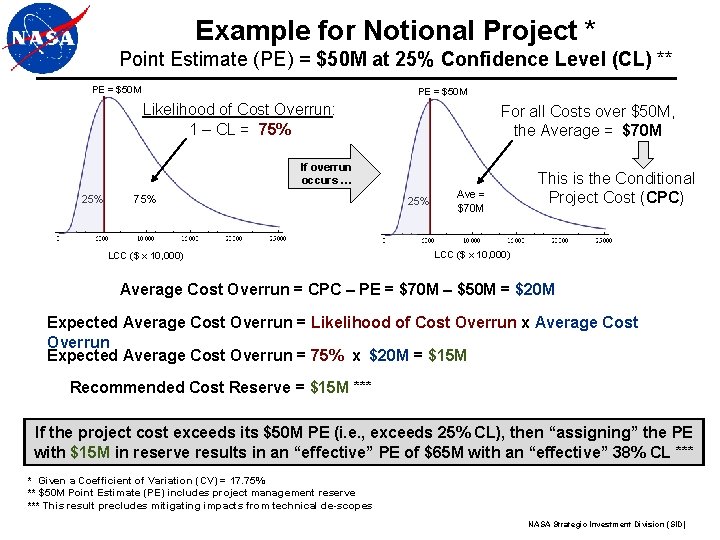
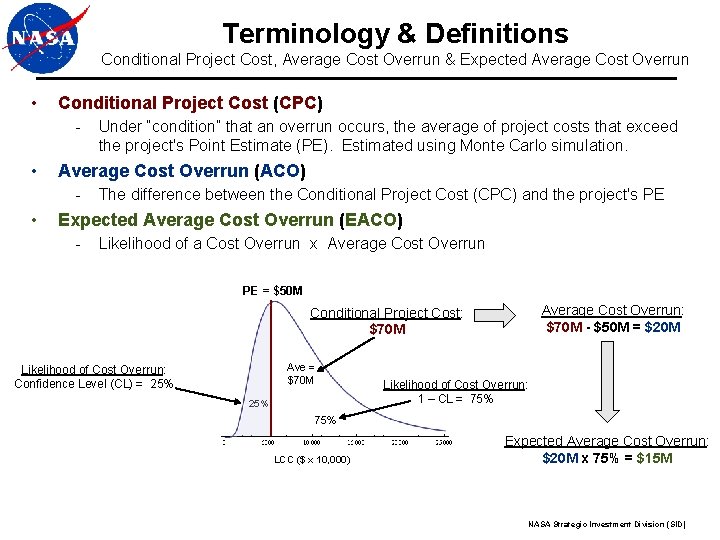
Example for Notional Project * Point Estimate (PE) = $50 M at 25% Confidence Level (CL) ** PE = $50 M Likelihood of Cost Overrun: 1 – CL = 75% For all Costs over $50 M, the Average = $70 M If overrun occurs … 25% 75% LCC ($ x 10, 000) 25% Ave = $70 M This is the Conditional Project Cost (CPC) LCC ($ x 10, 000) Average Cost Overrun = CPC – PE = $70 M – $50 M = $20 M Expected Average Cost Overrun = Likelihood of Cost Overrun x Average Cost Overrun Expected Average Cost Overrun = 75% x $20 M = $15 M Recommended Cost Reserve = $15 M *** If the project cost exceeds its $50 M PE (i. e. , exceeds 25% CL), then “assigning” the PE with $15 M in reserve results in an “effective” PE of $65 M with an “effective” 38% CL *** * Given a Coefficient of Variation (CV) = 17. 75% ** $50 M Point Estimate (PE) includes project management reserve *** This result precludes mitigating impacts from technical de-scopes NASA Strategic Investment Division (SID)
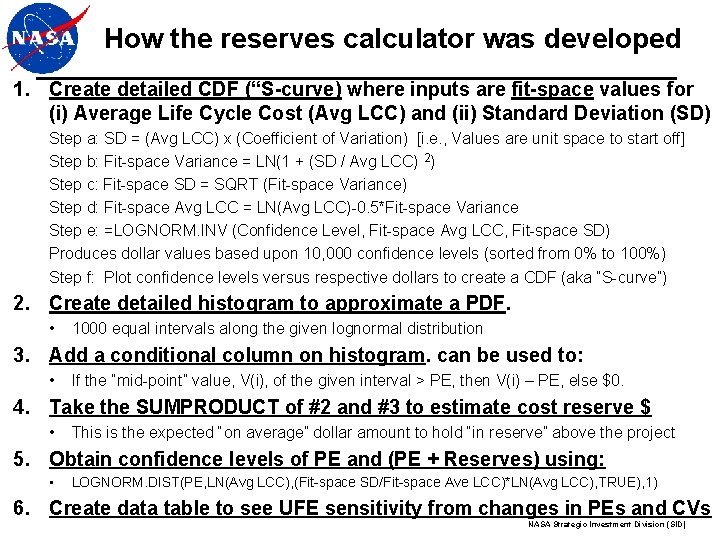
How the reserves calculator was developed 1. Create detailed CDF (“S-curve) where inputs are fit-space values for (i) Average Life Cycle Cost (Avg LCC) and (ii) Standard Deviation (SD) Step a: SD = (Avg LCC) x (Coefficient of Variation) [i. e. , Values are unit space to start off] Step b: Fit-space Variance = LN(1 + (SD / Avg LCC) 2) Step c: Fit-space SD = SQRT (Fit-space Variance) Step d: Fit-space Avg LCC = LN(Avg LCC)-0. 5*Fit-space Variance Step e: =LOGNORM. INV (Confidence Level, Fit-space Avg LCC, Fit-space SD) Produces dollar values based upon 10, 000 confidence levels (sorted from 0% to 100%) Step f: Plot confidence levels versus respective dollars to create a CDF (aka “S-curve”) 2. Create detailed histogram to approximate a PDF. • 1000 equal intervals along the given lognormal distribution 3. Add a conditional column on histogram. can be used to: • If the “mid-point” value, V(i), of the given interval > PE, then V(i) – PE, else $0. 4. Take the SUMPRODUCT of #2 and #3 to estimate cost reserve $ • This is the expected “on average” dollar amount to hold “in reserve” above the project 5. Obtain confidence levels of PE and (PE + Reserves) using: • LOGNORM. DIST(PE, LN(Avg LCC), (Fit-space SD/Fit-space Ave LCC)*LN(Avg LCC), TRUE), 1) 6. Create data table to see UFE sensitivity from changes in PEs and CVs NASA Strategic Investment Division (SID)
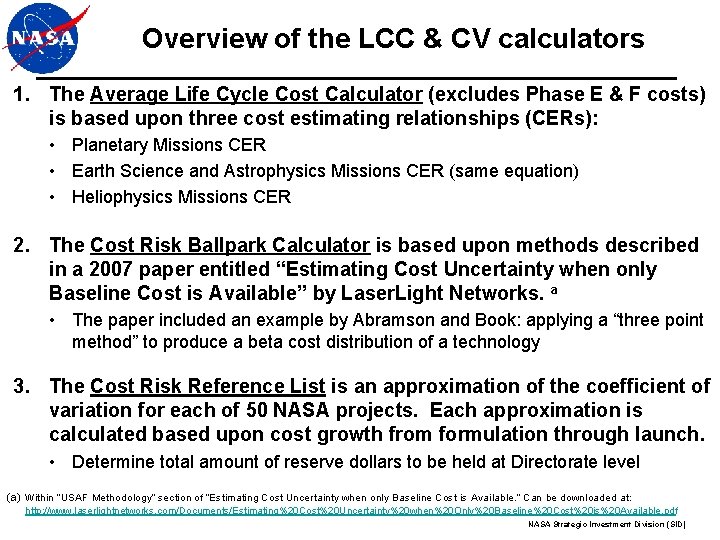
Overview of the LCC & CV calculators 1. The Average Life Cycle Cost Calculator (excludes Phase E & F costs) is based upon three cost estimating relationships (CERs): • Planetary Missions CER • Earth Science and Astrophysics Missions CER (same equation) • Heliophysics Missions CER 2. The Cost Risk Ballpark Calculator is based upon methods described in a 2007 paper entitled “Estimating Cost Uncertainty when only Baseline Cost is Available” by Laser. Light Networks. a • The paper included an example by Abramson and Book: applying a “three point method” to produce a beta cost distribution of a technology 3. The Cost Risk Reference List is an approximation of the coefficient of variation for each of 50 NASA projects. Each approximation is calculated based upon cost growth from formulation through launch. • Determine total amount of reserve dollars to be held at Directorate level (a) Within “USAF Methodology” section of “Estimating Cost Uncertainty when only Baseline Cost is Available. ” Can be downloaded at: http: //www. laserlightnetworks. com/Documents/Estimating%20 Cost%20 Uncertainty%20 when%20 Only%20 Baseline%20 Cost%20 is%20 Available. pdf NASA Strategic Investment Division (SID)
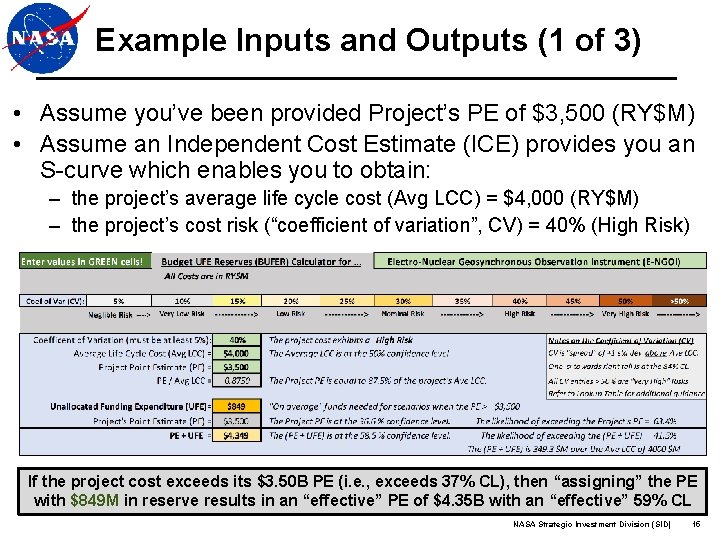
Example Inputs and Outputs (1 of 3) • Assume you’ve been provided Project’s PE of $3, 500 (RY$M) • Assume an Independent Cost Estimate (ICE) provides you an S-curve which enables you to obtain: – the project’s average life cycle cost (Avg LCC) = $4, 000 (RY$M) – the project’s cost risk (“coefficient of variation”, CV) = 40% (High Risk) If the project cost exceeds its $3. 50 B PE (i. e. , exceeds 37% CL), then “assigning” the PE with $849 M in reserve results in an “effective” PE of $4. 35 B with an “effective” 59% CL NASA Strategic Investment Division (SID) 15
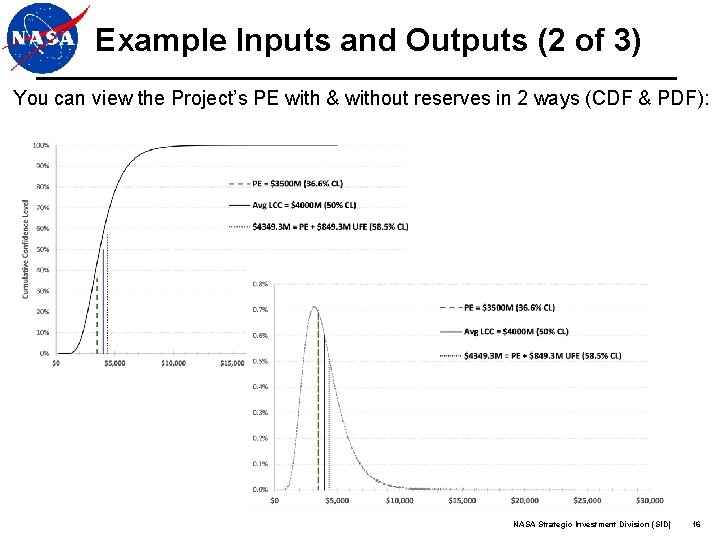
Example Inputs and Outputs (2 of 3) You can view the Project’s PE with & without reserves in 2 ways (CDF & PDF): NASA Strategic Investment Division (SID) 16
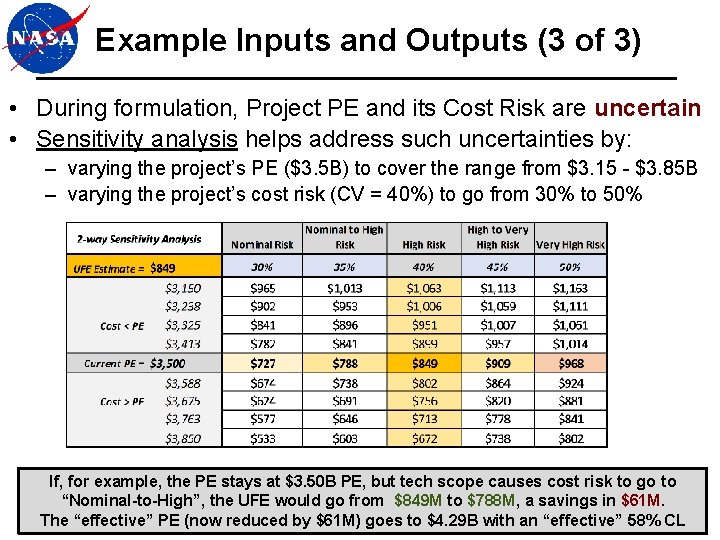
Example Inputs and Outputs (3 of 3) • During formulation, Project PE and its Cost Risk are uncertain • Sensitivity analysis helps address such uncertainties by: – varying the project’s PE ($3. 5 B) to cover the range from $3. 15 - $3. 85 B – varying the project’s cost risk (CV = 40%) to go from 30% to 50% If, for example, the PE stays at $3. 50 B PE, but tech scope causes cost risk to go to “Nominal-to-High”, the UFE would go from $849 M to $788 M, a savings in $61 M. The “effective” PE (now reduced by $61 M) goes to $4. 29 B with. NASA an Strategic “effective” 58%(SID)CL Investment Division 17
DEMONSTRATION NASA Strategic Investment Division (SID)
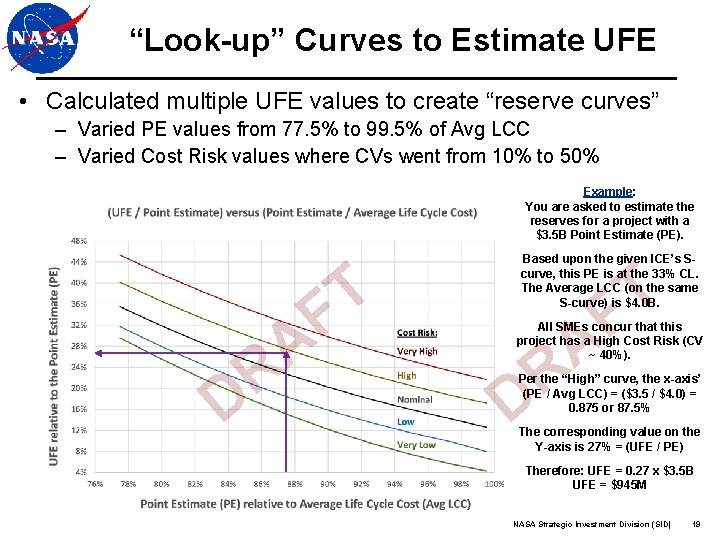
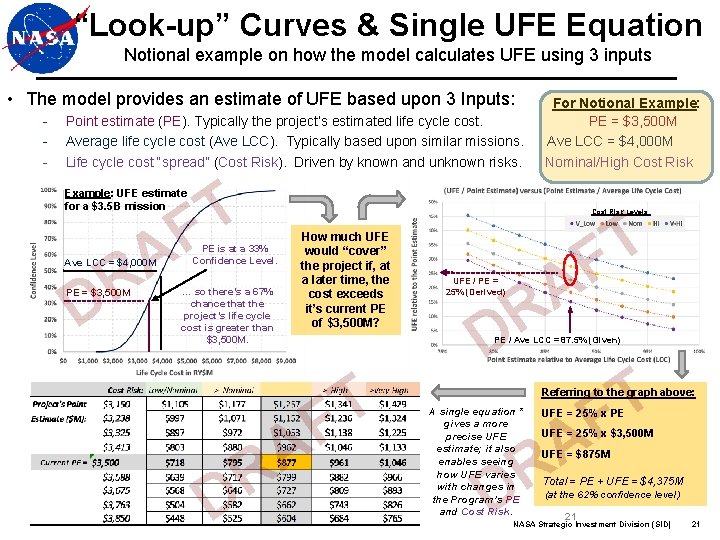
“Look-up” Curves to Estimate UFE • Calculated multiple UFE values to create “reserve curves” – Varied PE values from 77. 5% to 99. 5% of Avg LCC – Varied Cost Risk values where CVs went from 10% to 50% Example: You are asked to estimate the reserves for a project with a $3. 5 B Point Estimate (PE). R D T F A Based upon the given ICE’s Scurve, this PE is at the 33% CL. The Average LCC (on the same S-curve) is $4. 0 B. T F A All SMEs concur that this project has a High Cost Risk (CV ~ 40%). R D Per the “High” curve, the x-axis’ (PE / Avg LCC) = ($3. 5 / $4. 0) = 0. 875 or 87. 5% The corresponding value on the Y-axis is 27% = (UFE / PE) Therefore: UFE = 0. 27 x $3. 5 B UFE = $945 M NASA Strategic Investment Division (SID) 19
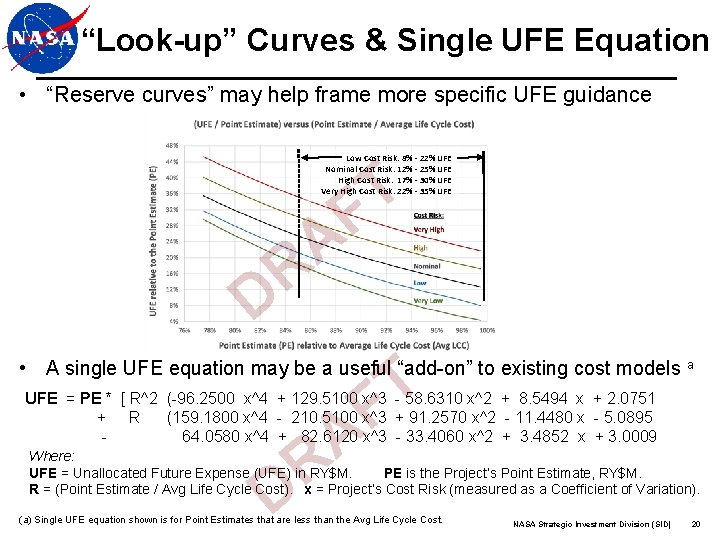
“Look-up” Curves & Single UFE Equation • “Reserve curves” may help frame more specific UFE guidance Low Cost Risk: 8% - 22% UFE Nominal Cost Risk: 12% - 25% UFE High Cost Risk: 17% - 30% UFE Very High Cost Risk: 22% - 35% UFE T F D A R T F • A single UFE equation may be a useful “add-on” to existing cost models a UFE = PE * [ R^2 (-96. 2500 x^4 + 129. 5100 x^3 - 58. 6310 x^2 + 8. 5494 x + 2. 0751 + R (159. 1800 x^4 - 210. 5100 x^3 + 91. 2570 x^2 - 11. 4480 x - 5. 0895 64. 0580 x^4 + 82. 6120 x^3 - 33. 4060 x^2 + 3. 4852 x + 3. 0009 A R Where: UFE = Unallocated Future Expense (UFE) in RY$M. PE is the Project’s Point Estimate, RY$M. R = (Point Estimate / Avg Life Cycle Cost). x = Project’s Cost Risk (measured as a Coefficient of Variation). D (a) Single UFE equation shown is for Point Estimates that are less than the Avg Life Cycle Cost. NASA Strategic Investment Division (SID) 20
“Look-up” Curves & Single UFE Equation Notional example on how the model calculates UFE using 3 inputs • The model provides an estimate of UFE based upon 3 Inputs: - Point estimate (PE). Typically the project’s estimated life cycle cost. Average life cycle cost (Ave LCC). Typically based upon similar missions. Life cycle cost “spread” (Cost Risk). Driven by known and unknown risks. For Notional Example: PE = $3, 500 M Ave LCC = $4, 000 M Nominal/High Cost Risk T F A R Example: UFE estimate for a $3. 5 B mission Ave LCC = $4, 000 M D PE = $3, 500 M Cost Risk Levels: How much UFE would “cover” the project if, at a later time, the cost exceeds it’s current PE of $3, 500 M? PE is at a 33% Confidence Level. … so there’s a 67% chance that the project’s life cycle cost is greater than $3, 500 M. T F A R UFE / PE = 25% (Derived) D PE / Ave LCC = 87. 5% (Given) R D T F A R Referring to the graph above: A single equation * gives a more precise UFE estimate; it also enables seeing how UFE varies with changes in the Program’s PE and Cost Risk. D UFE = 25% x PE UFE = 25% x $3, 500 M UFE = $875 M Total = PE + UFE = $4, 375 M (at the 62% confidence level) 21 NASA Strategic Investment Division (SID) 21
BACKUP SLIDES NASA Strategic Investment Division (SID)
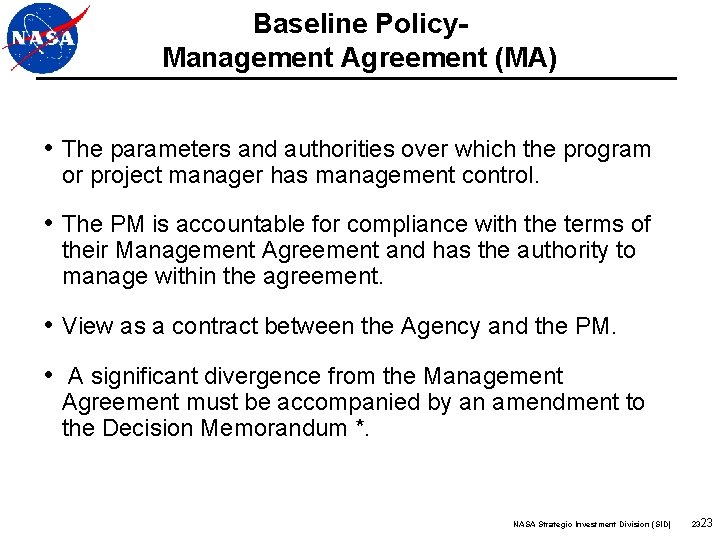
Baseline Policy. Management Agreement (MA) • The parameters and authorities over which the program or project manager has management control. • The PM is accountable for compliance with the terms of their Management Agreement and has the authority to manage within the agreement. • View as a contract between the Agency and the PM. • A significant divergence from the Management Agreement must be accompanied by an amendment to the Decision Memorandum *. NASA Strategic Investment Division (SID) 2323
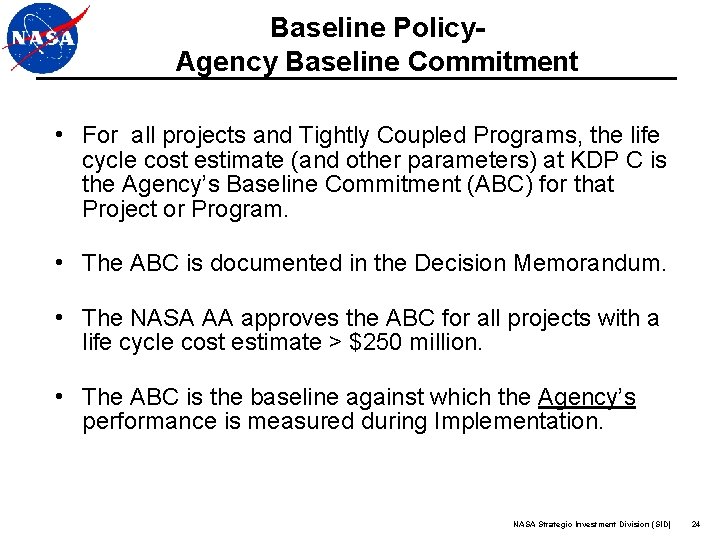
Baseline Policy. Agency Baseline Commitment • For all projects and Tightly Coupled Programs, the life cycle cost estimate (and other parameters) at KDP C is the Agency’s Baseline Commitment (ABC) for that Project or Program. • The ABC is documented in the Decision Memorandum. • The NASA AA approves the ABC for all projects with a life cycle cost estimate > $250 million. • The ABC is the baseline against which the Agency’s performance is measured during Implementation. NASA Strategic Investment Division (SID) 24
NPR 7120. 5 E Project Life Cycle Cost Agreements and Commitments Agency Baseline Commitment (ABC) High Estimate • 70% JCL • External Commitments LCC Range UFE managed above the project UFE managed by Project >50% JCL Low Estimate Management Agreements Authorized Formulation Cost UFE During Formulation Life cycle cost estimate At KDP C and subsequent Agency Baseline Commitment rebaselines the ABC and the life cycle cost estimate are equal. Actual Formulation Costs KDP-C Five –year budget run out and schedule estimates are reported to Congress. If a project signs a contract > $50 M, LCC range is reported to OMB. For selected projects, LCC and schedule ranges are reported to GAO During Implementation Notional and Not to Scale From this point, Congress, OMB and GAO get detailed cost and schedule information. All changes are tracked back to the ABC. NASA Strategic Investment Division (SID) 25
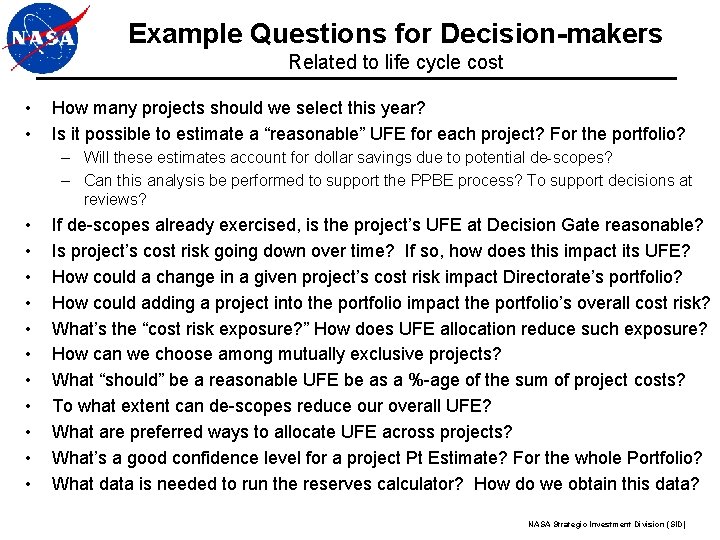
Example Questions for Decision-makers Related to life cycle cost • • How many projects should we select this year? Is it possible to estimate a “reasonable” UFE for each project? For the portfolio? – Will these estimates account for dollar savings due to potential de-scopes? – Can this analysis be performed to support the PPBE process? To support decisions at reviews? • • • If de-scopes already exercised, is the project’s UFE at Decision Gate reasonable? Is project’s cost risk going down over time? If so, how does this impact its UFE? How could a change in a given project’s cost risk impact Directorate’s portfolio? How could adding a project into the portfolio impact the portfolio’s overall cost risk? What’s the “cost risk exposure? ” How does UFE allocation reduce such exposure? How can we choose among mutually exclusive projects? What “should” be a reasonable UFE be as a %-age of the sum of project costs? To what extent can de-scopes reduce our overall UFE? What are preferred ways to allocate UFE across projects? What’s a good confidence level for a project Pt Estimate? For the whole Portfolio? What data is needed to run the reserves calculator? How do we obtain this data? NASA Strategic Investment Division (SID)
Terminology & Definitions Conditional Project Cost, Average Cost Overrun & Expected Average Cost Overrun • Conditional Project Cost (CPC) - • Average Cost Overrun (ACO) - • Under “condition” that an overrun occurs, the average of project costs that exceed the project's Point Estimate (PE). Estimated using Monte Carlo simulation. The difference between the Conditional Project Cost (CPC) and the project's PE Expected Average Cost Overrun (EACO) - Likelihood of a Cost Overrun x Average Cost Overrun PE = $50 M Average Cost Overrun: $70 M - $50 M = $20 M Conditional Project Cost: $70 M Ave = $70 M Likelihood of Cost Overrun: Confidence Level (CL) = 25% Likelihood of Cost Overrun: 1 – CL = 75% LCC ($ x 10, 000) Expected Average Cost Overrun: $20 M x 75% = $15 M NASA Strategic Investment Division (SID)
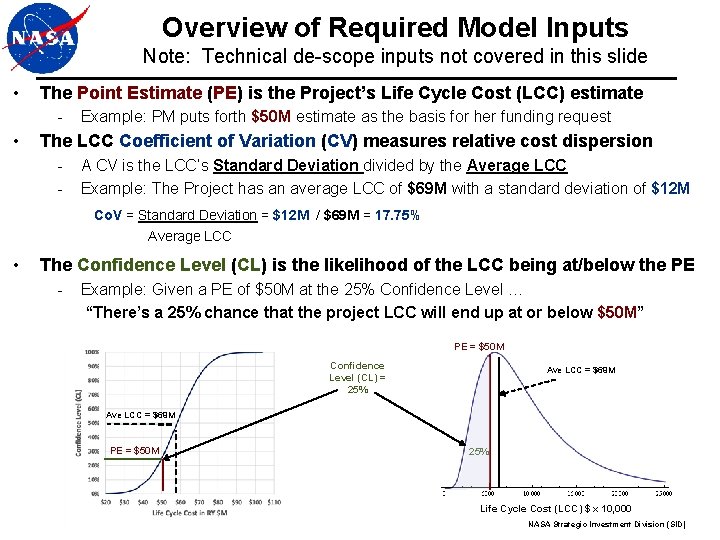
Overview of Required Model Inputs Note: Technical de-scope inputs not covered in this slide • The Point Estimate (PE) is the Project’s Life Cycle Cost (LCC) estimate - • Example: PM puts forth $50 M estimate as the basis for her funding request The LCC Coefficient of Variation (CV) measures relative cost dispersion - A CV is the LCC’s Standard Deviation divided by the Average LCC Example: The Project has an average LCC of $69 M with a standard deviation of $12 M Co. V = Standard Deviation = $12 M / $69 M = 17. 75% Average LCC • The Confidence Level (CL) is the likelihood of the LCC being at/below the PE - Example: Given a PE of $50 M at the 25% Confidence Level … “There’s a 25% chance that the project LCC will end up at or below $50 M” PE = $50 M Confidence Level (CL) = 25% Ave LCC = $69 M PE = $50 M 25% Life Cycle Cost (LCC) $ x 10, 000 NASA Strategic Investment Division (SID)