
Washing Line Strategy A pedagogical approach to teaching


- Slides: 14
“Washing Line Strategy” A pedagogical approach to teaching brief development Lesley Pearce National Coordinator Technology The University of Auckland February 2013
Aim for this webcast To explore a teaching strategy to develop deep learning about a concept for technology students
Washing Line Strategy • Aim to generate discussion and thinking around a process for brief development
• The washing line strategy is ideal for challenging, engaging and thinking for the whole class to test prior learning from the previous lesson • There are many approaches to this strategy This is only one approach
• Aim: to define what brief development is and how it is part of technological practice and not a one off exercise • To do: Discuss in groups of 4 and create a process for brief development using words used in the achievement objective
Prior learning • The academic words are identified in the Achievement Objective – Brief Development • In groups students have a list of words and their meanings and match them up • For each word one student becomes the guardian of the word and ensures they know what this means in relationship to brief development
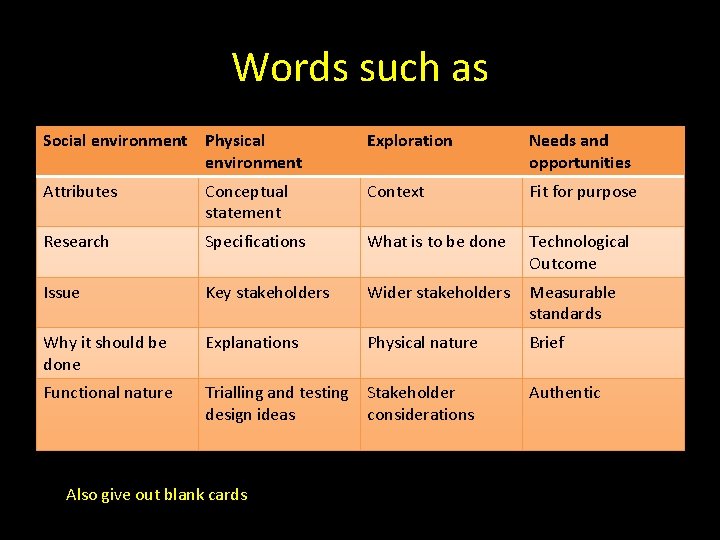
Words such as Social environment Physical environment Exploration Needs and opportunities Attributes Conceptual statement Context Fit for purpose Research Specifications What is to be done Technological Outcome Issue Key stakeholders Wider stakeholders Measurable standards Why it should be done Explanations Physical nature Brief Functional nature Trialling and testing design ideas Stakeholder considerations Authentic Also give out blank cards
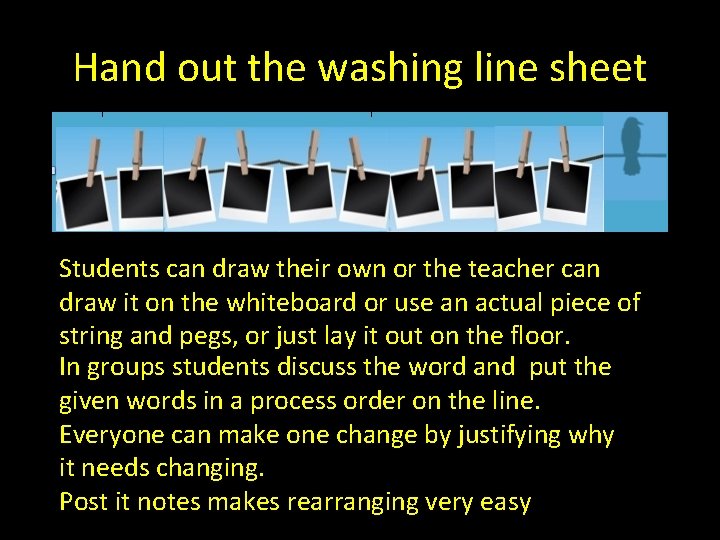
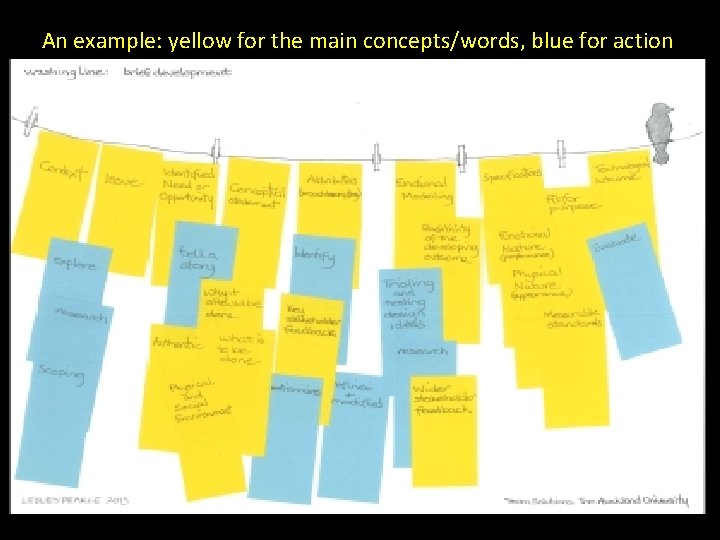
Hand out the washing line sheet Students can draw their own or the teacher can draw it on the whiteboard or use an actual piece of string and pegs, or just lay it out on the floor. In groups students discuss the word and put the given words in a process order on the line. Everyone can make one change by justifying why it needs changing. Post it notes makes rearranging very easy
Rules: 1. Using all the words arrange them into an order of process you would expect to carry out brief development. Place them on the washing line. 2. Each team member is allowed to move one word in the order and justify the change. Eventually a “process” for brief development should be agreed upon. If any words are part of the same process they can be placed together. 3. Blank cards are for each group to decide on an aspect that they think is missing. These could be action words. (Or give out action words as well) 4. Using the action words place them next to the relevant process.
An example: yellow for the main concepts/words, blue for action
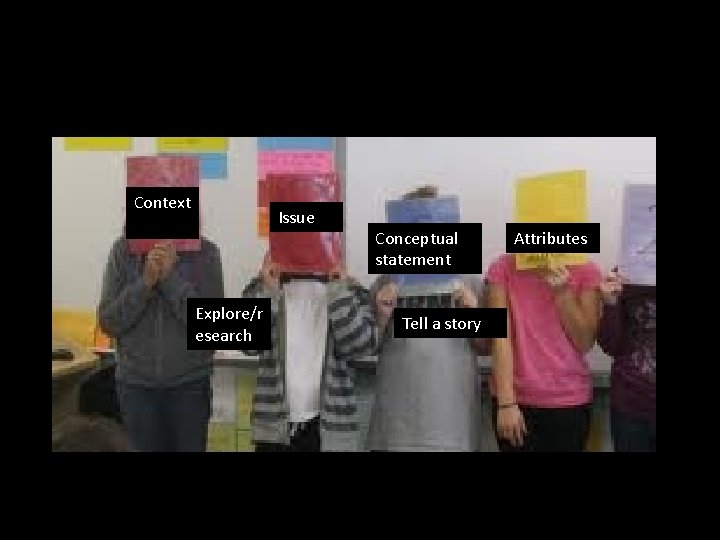
Alternative ideas • As students walk into the classroom greet them with a card with one of the words or actions that suggest a process • Students then share with others their word and say what it means. • Students then line up with the words to create a process then the action word holders are added to the group.
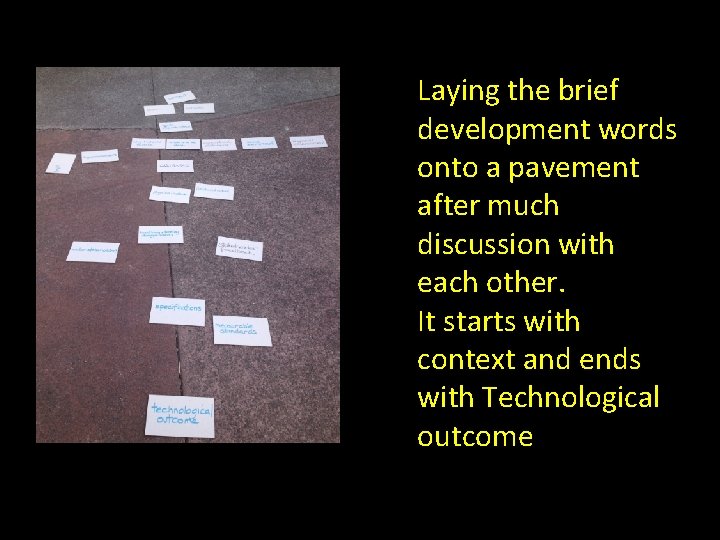
Laying the brief development words onto a pavement after much discussion with each other. It starts with context and ends with Technological outcome
Context t Issue Explore/r esearch Conceptual statement Tell a story Attributes
Contact details Lesley Pearce National Coordinator Technology The University of Auckland l. pearce@auckland. ac. nz