
WASH Enabling Environment Sector Policy and Strategy Outline
WASH Enabling Environment Sector Policy and Strategy
Outline • • • Learning Objectives Purpose Context Activities Group Work WASH EE Support process Group Work UNICEF Support Scoring
Learning Objectives By the end of this session you will be able to • Explain the importance of policy and strategy development to support the WASH EE • Describe the framework for supporting policy and strategy development efforts • Identify actions and steps to strengthen policy making and strategy development in support of WASH EE
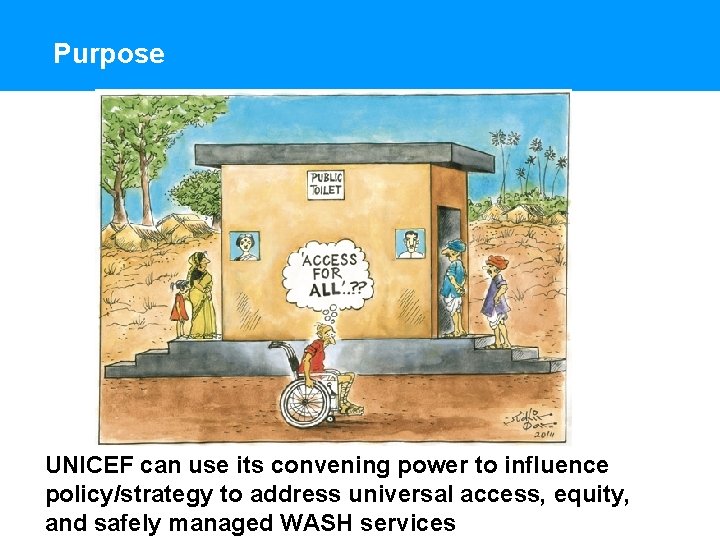
Purpose UNICEF can use its convening power to influence policy/strategy to address universal access, equity, and safely managed WASH services

Context: WASH EE Framework
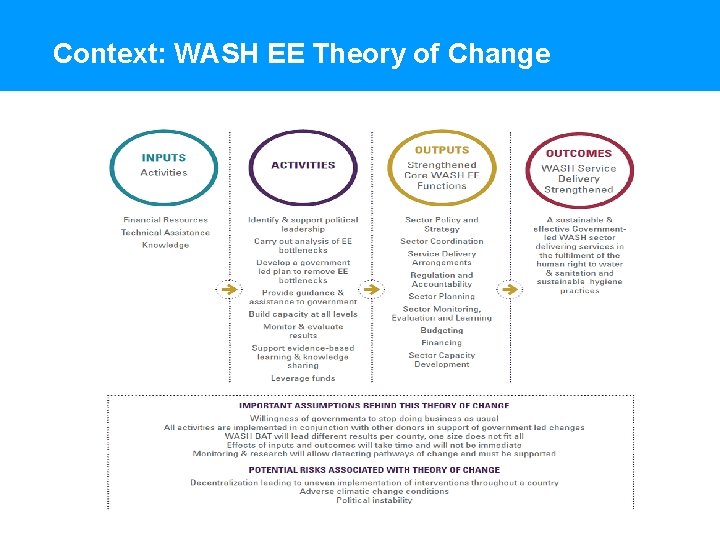
Context: WASH EE Theory of Change
Activities • Share WASH best practices and lessons from other countries • Create debate about WASH policy making & strategy development by collecting evidence, holding stakeholder consultations, writing drafts of policy documents • Support policy & strategy documents based on country contexts, alignment with SDGs, experiences/best practices from other countries • Support policy & strategy dissemination/capacity building

Group Work Choose one country among participants • How has UNICEF influenced WASH policy and strategy in this country? • What elements were used? • What worked and why? • What could have been done better/differently? • How has this experience compared with other experiences in the group?
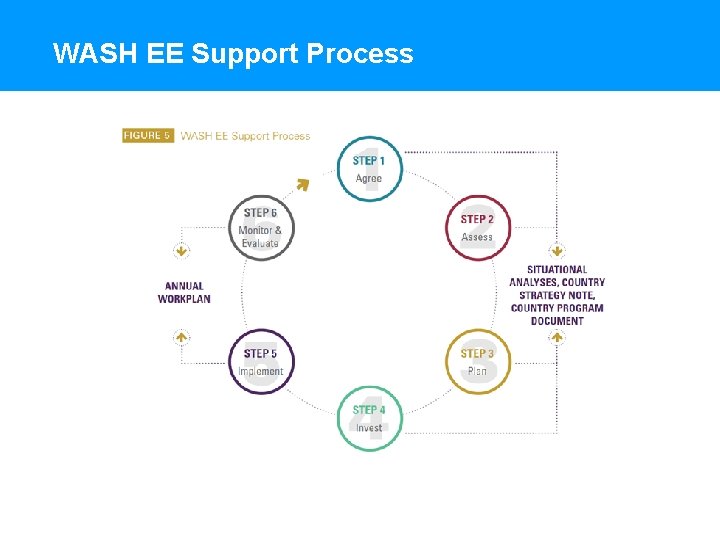
WASH EE Support Process
Support Process Step 1: Agree 1. Who are the stakeholders and what is required to enact a WASH policy in a country? 2. How is a privatized water supply different from public sector? 3. How is a big country different from a small country?
Support Process Step 2: Assess What do you need to assess when examining a water, sanitation or hygiene policy? What levels of responsibilities are required of the different government actors in a decentralized environment?
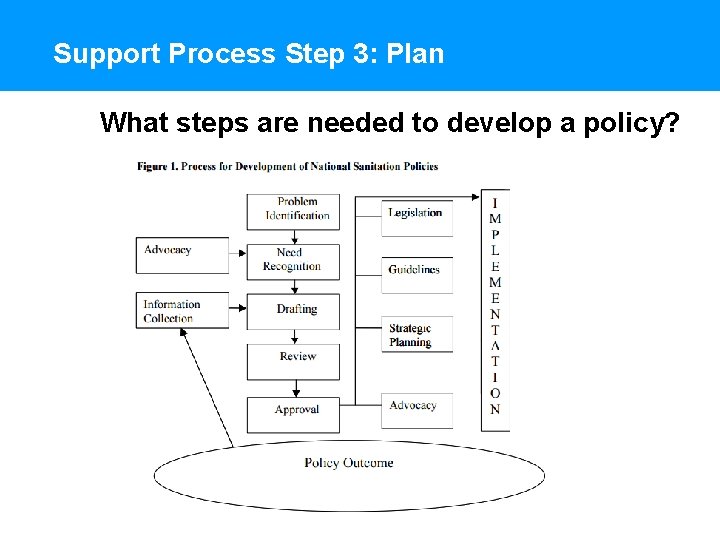
Support Process Step 3: Plan What steps are needed to develop a policy?
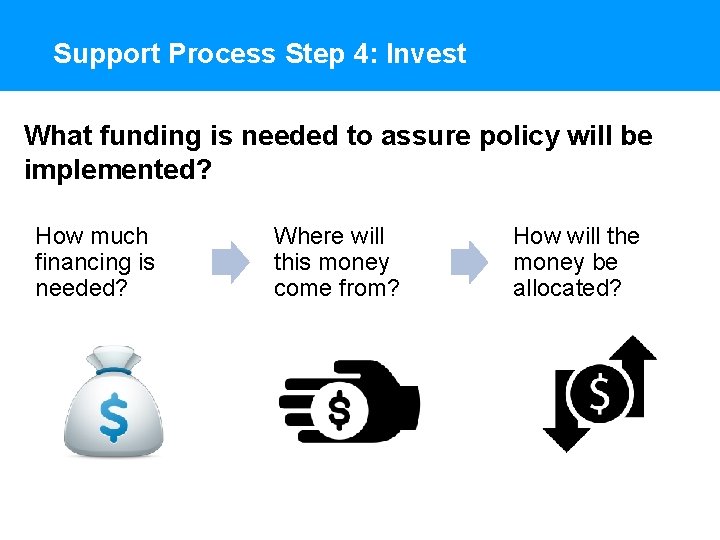
Support Process Step 4: Invest What funding is needed to assure policy will be implemented? How much financing is needed? Where will this money come from? How will the money be allocated?
Support Process Step 5: Implement What actions must be taken to implement a policy and/or strategy?
Support Process Step 6: Monitor & Evaluate • What actions are required to monitor whether the policy has been implemented? • What have the effects of the policy been? • Is any revision needed? If so, how will this be addressed?
Group Work UNICEF’s engagement in WASH policy / strategy • Now that you have gone through the policy process, how should policy making be reflected in the UNICEF program cycle in your country?
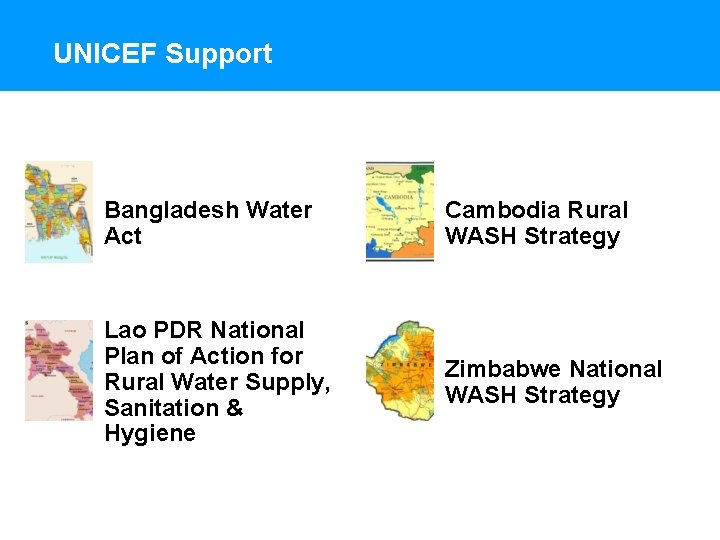
UNICEF Support Bangladesh Water Act Cambodia Rural WASH Strategy Lao PDR National Plan of Action for Rural Water Supply, Sanitation & Hygiene Zimbabwe National WASH Strategy
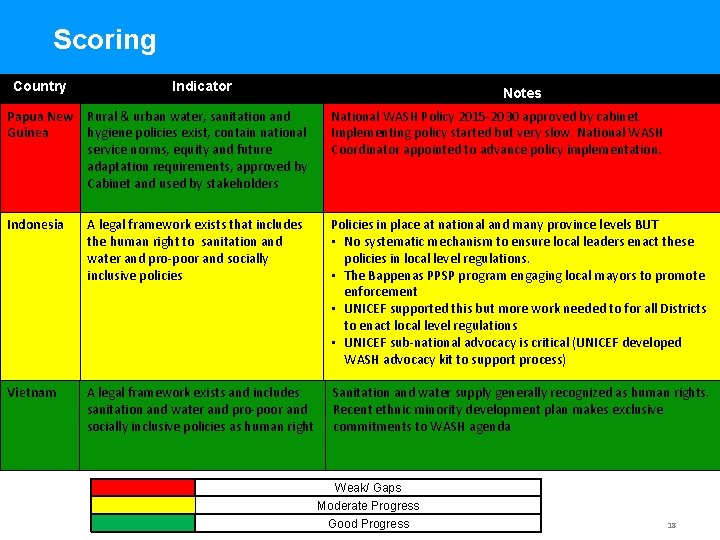
Scoring Country Indicator Notes Papua New Guinea Rural & urban water, sanitation and hygiene policies exist, contain national service norms, equity and future adaptation requirements, approved by Cabinet and used by stakeholders National WASH Policy 2015 -2030 approved by cabinet. Implementing policy started but very slow. National WASH Coordinator appointed to advance policy implementation. Indonesia A legal framework exists that includes the human right to sanitation and water and pro-poor and socially inclusive policies Policies in place at national and many province levels BUT • No systematic mechanism to ensure local leaders enact these policies in local level regulations. • The Bappenas PPSP program engaging local mayors to promote enforcement • UNICEF supported this but more work needed to for all Districts to enact local level regulations • UNICEF sub-national advocacy is critical (UNICEF developed WASH advocacy kit to support process) Vietnam A legal framework exists and includes sanitation and water and pro-poor and socially inclusive policies as human right Sanitation and water supply generally recognized as human rights. Recent ethnic minority development plan makes exclusive commitments to WASH agenda Weak/ Gaps Moderate Progress Good Progress 18
For more information, please contact David Tsetse, Ph. D. WASH Specialist, Planning Monitoring and Capacity Building Programme Division Tel: 917 -265 -4663 E-mail: dtsetse@unicef. org © United Nations Children’s Fund June 2016 Cover photo © UNICEF
- Slides: 19