
WASH Enabling Environment Capacity Development Outline Learning Objectives
WASH Enabling Environment Capacity Development
Outline • • • Learning Objectives Context Strategies Group Work WASH EE Support Process Scoring 2
Learning Objectives By the end of this session, UNICEF staff will be able to: • Explain the importance of capacity development in WASH EE strengthening • Describe the framework and for supporting capacity development efforts • Identify actions and develop capacity support process to strengthen the EE 3
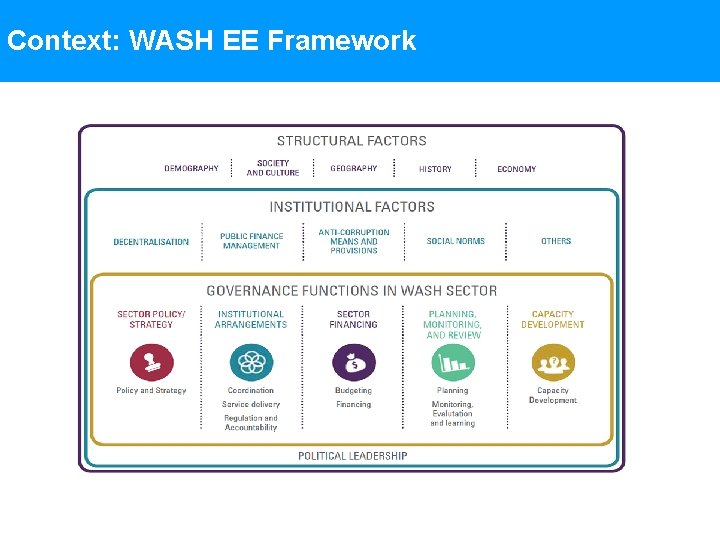
Context: WASH EE Framework
Context: WASH EE Theory of Change
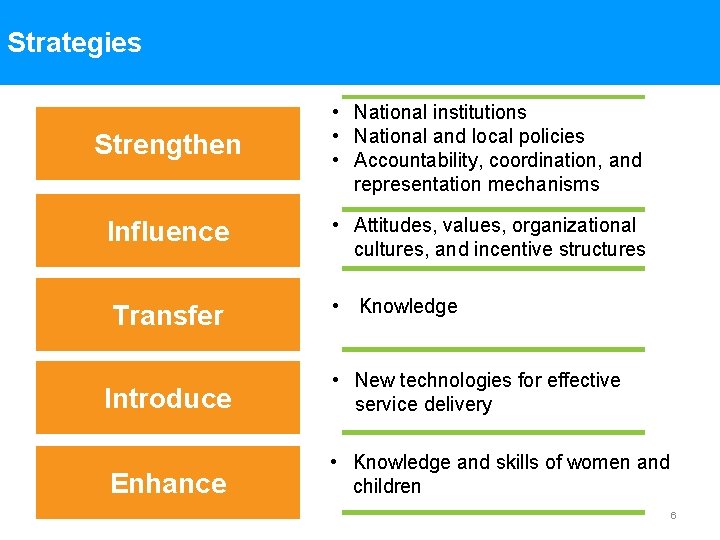
Strategies • Strengthen • National institutions • National and local policies • Accountability, coordination, and representation mechanisms Influence • Attitudes, values, organizational cultures, and incentive structures Transfer • Knowledge Introduce • New technologies for effective service delivery Enhance • Knowledge and skills of women and children 6
Group Work • Read the case study on Liberia. Use your existing knowledge and experience to answer the 4 questions that are included in your packet. • As a large group, each table will take the lead in answering the questions. The other tables will add to the discussion if they have other comments to make. 7
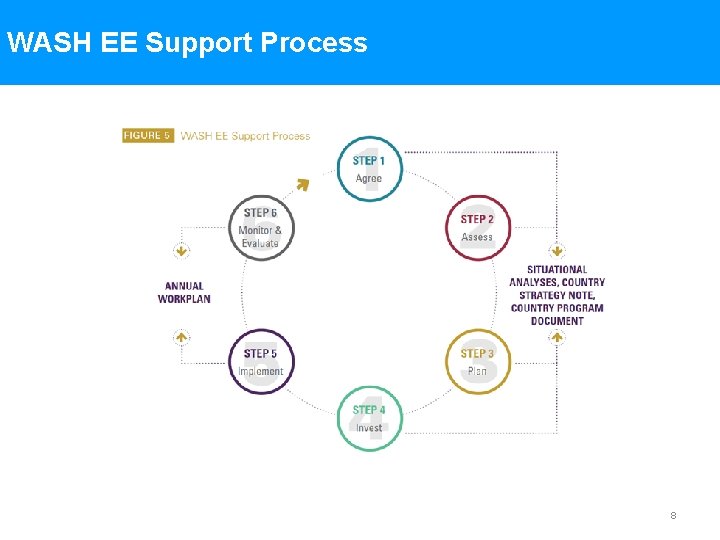
WASH EE Support Process 8
Support Process Step 1: Agree • To obtain consensus for developing a Capacity Development Plan, which stakeholders need to sit at the table? • What should the consensus exercise examine? • What procedures should be adopted to arrive at a consensus? 9
Support Process Step 2: Assess 1. What information is available to understand current country capacity? Who will gather and analyze it? 2. What capacity is required to implement WASH within the country? 3. Where is this capacity located? 4. What key enabling factors exist that will help the WASH sector to develop 5. Do capacity development bottlenecks/challenges exist that constrain the sector 10
Support Process Step 3: Plan UNICEF has agreed to assist the government in designing a Capacity Development Plan 1. What are the components needed as part of this plan? 2. Design a framework for identifying what exists, what is needed and how the needs can be met. 11
Support Process Step 4: Invest • What costs are important to consider when thinking of supporting capacity development for WASH EE purposes? • What sources of funding need to be tapped to support capacity development efforts for WASH EE purposes? 12
Support Process Step 5: Implement 1. Brainstorm a list of opportunities that UNICEF can suggest to the government to improve capacity and competencies of its staff. 2. Discuss strategies UNICEF has taken to assist countries improve capacity for delivering WASH services. 3. Describe how to determine that capacity development needs have been met. 14
Support Process Step 6: Monitor and Evaluate • What indicators need to be retained to monitor and evaluate a capacity development strategy or plan? • How often should be the monitoring of the plan occur? • When should an evaluation of a capacity development strategy/plan be set for? 15
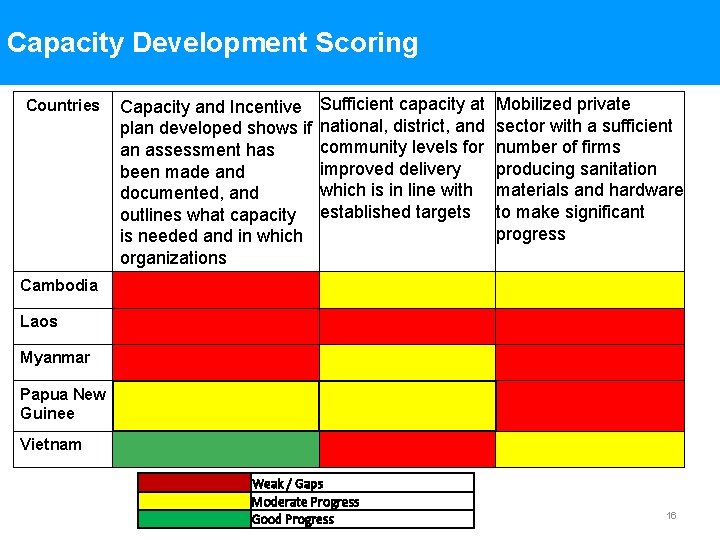
Capacity Development Scoring Countries Capacity and Incentive plan developed shows if an assessment has been made and documented, and outlines what capacity is needed and in which organizations Sufficient capacity at national, district, and community levels for improved delivery which is in line with established targets Mobilized private sector with a sufficient number of firms producing sanitation materials and hardware to make significant progress Cambodia Laos Myanmar Papua New Guinee Vietnam Weak / Gaps Moderate Progress Good Progress 16
For more information, please contact David Tsetse, Ph. D. WASH Specialist, Planning Monitoring and Capacity Building Programme Division Tel: 917 -265 -4663 E-mail: dtsetse@unicef. org © United Nations Children’s Fund June 2016 Cover photo © UNICEF
- Slides: 16