
WasaatCOSY Dibaryons at COSY Mikhail Bashkanov Types of
Wasa-at-COSY Dibaryons at COSY Mikhail Bashkanov
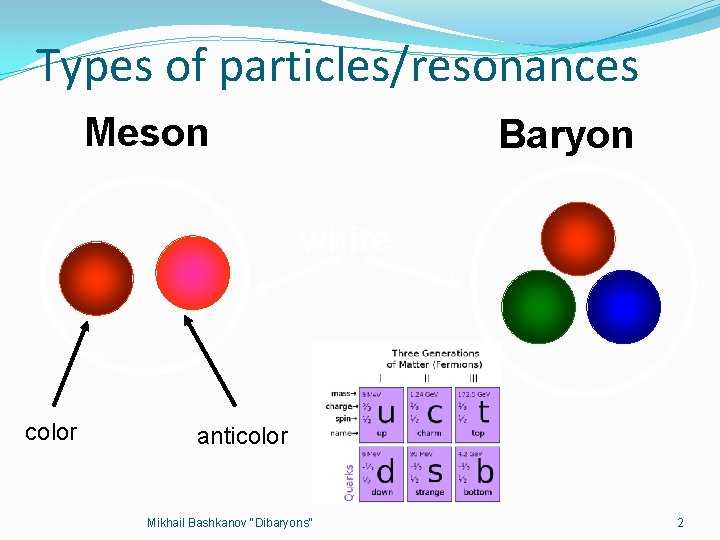
Types of particles/resonances Meson Baryon white color anticolor Mikhail Bashkanov "Dibaryons" 2
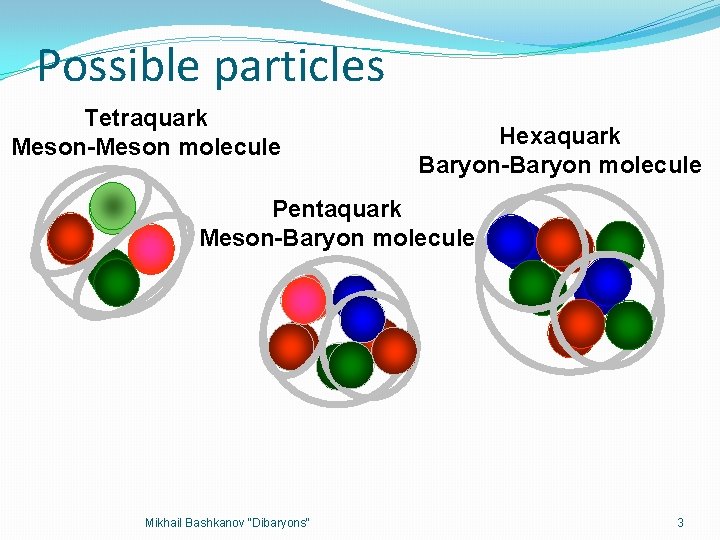
Possible particles Tetraquark Meson-Meson molecule Hexaquark Baryon-Baryon molecule Pentaquark Meson-Baryon molecule Mikhail Bashkanov "Dibaryons" 3
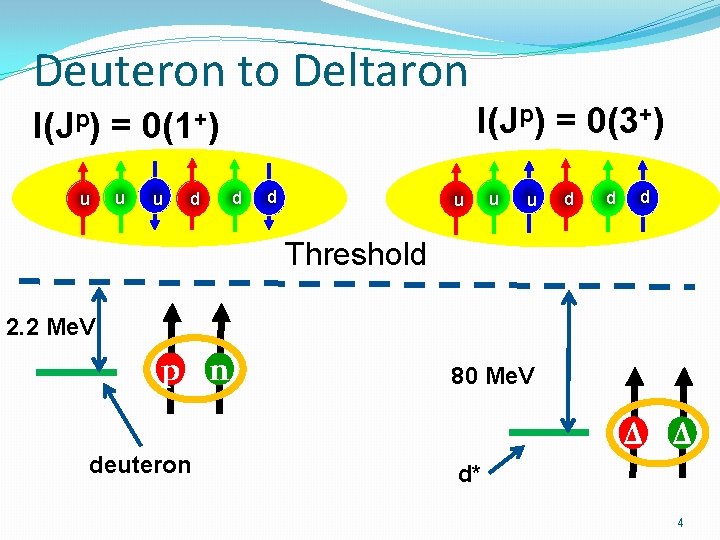
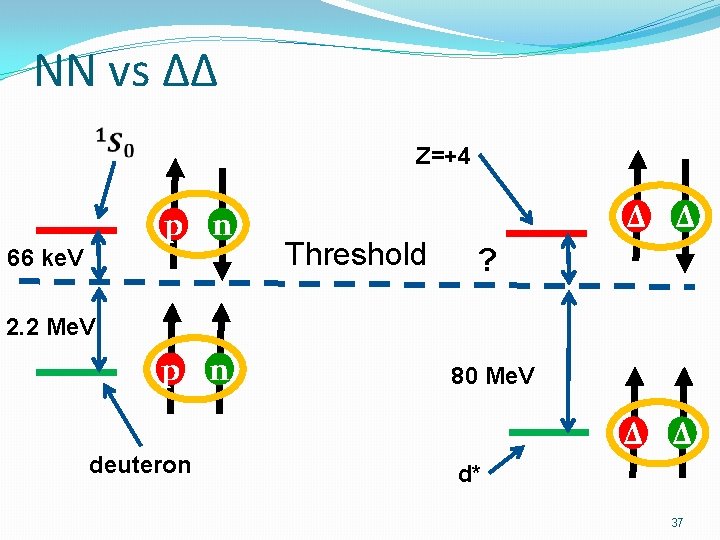
Deuteron to Deltaron I(Jp) u = u I(Jp) = 0(3+) 0(1+) u d d d u u u d d d Threshold 2. 2 Me. V p n deuteron 80 Me. V Δ Δ d* 4
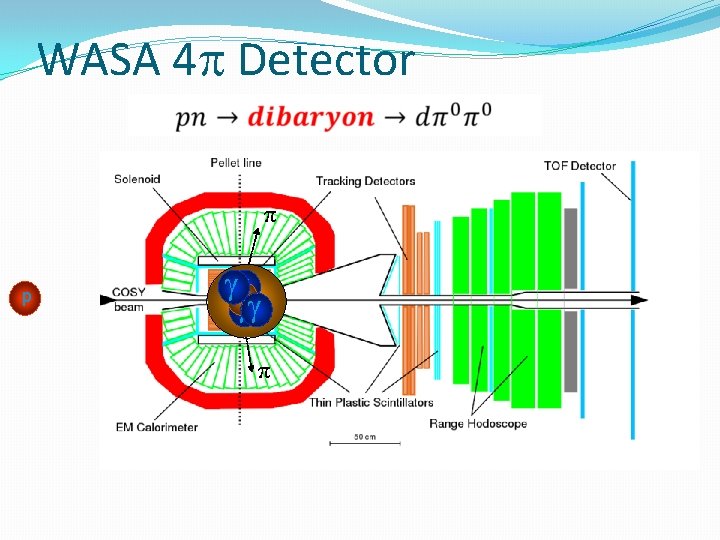
WASA 4 Detector π p n d π
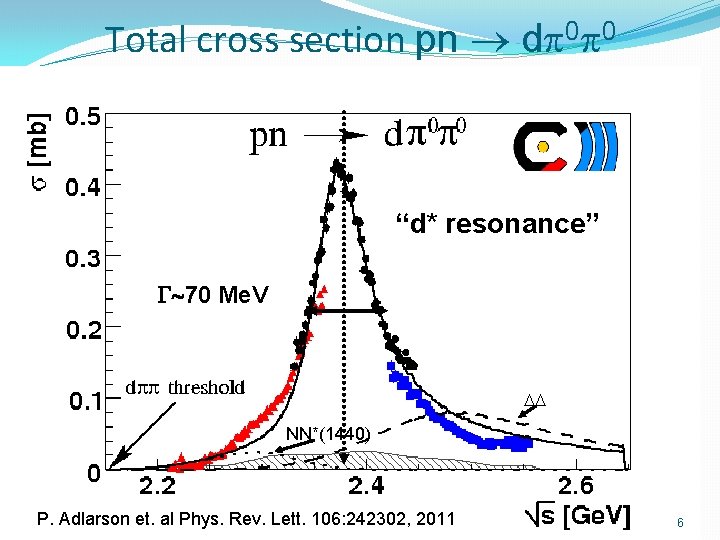
Total cross section pn d 0 0 “d* resonance” 70 Me. V NN*(1440) P. Adlarson et. al Phys. Rev. Lett. 106: 242302, 2011 6
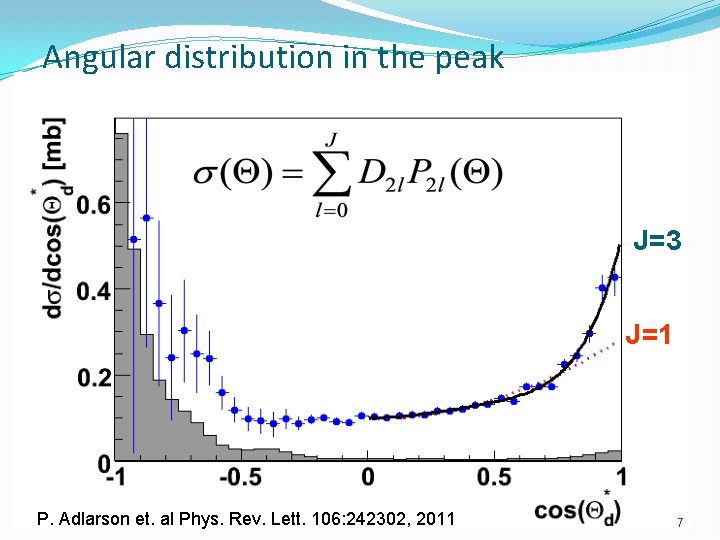
Angular distribution in the peak J=3 J=1 P. Adlarson et. al Phys. Rev. Lett. 106: 242302, 2011 7
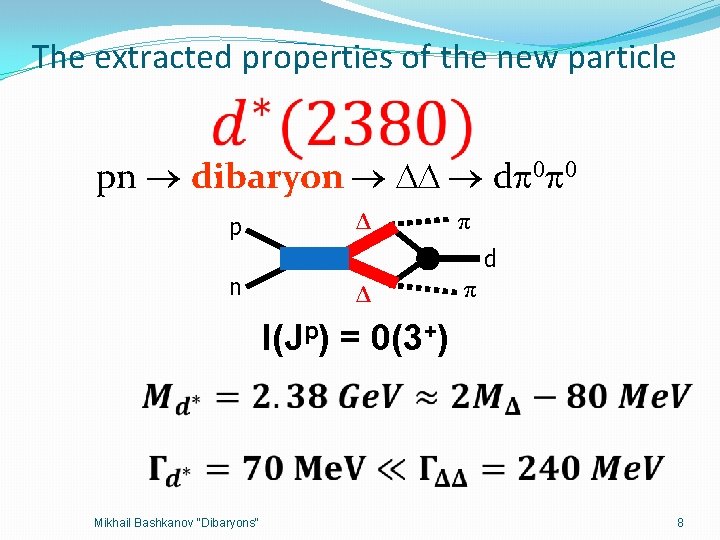
The extracted properties of the new particle pn dibaryon d 0 0 p n Δ π d Δ π I(Jp) = 0(3+) Mikhail Bashkanov "Dibaryons" 8
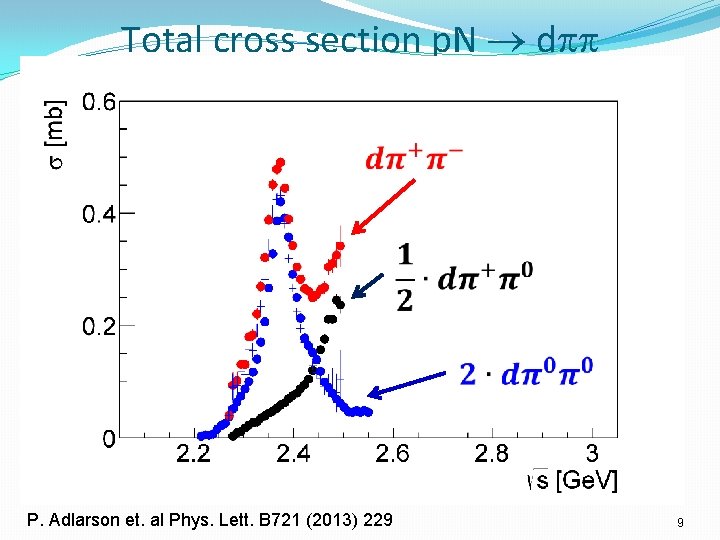
Total cross section p. N d P. Adlarson et. al Phys. Lett. B 721 (2013) 229 9

Non-fusion channels 10
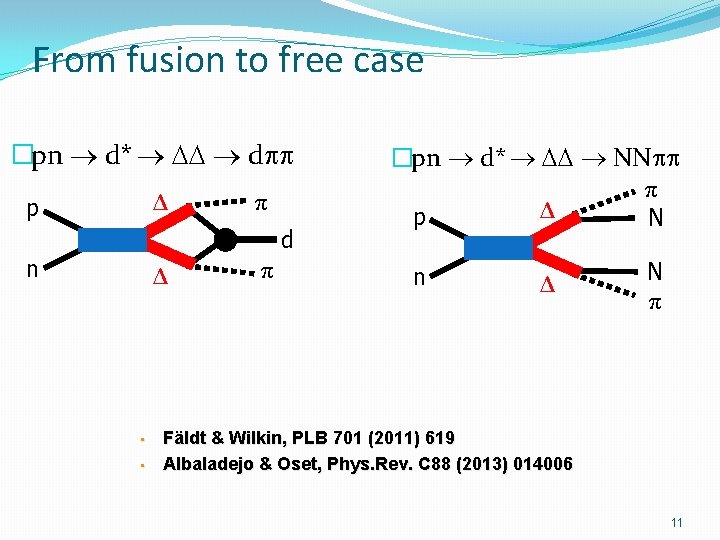
From fusion to free case �pn d* d Δ p π d n Δ • • π �pn d* NN π Δ p N n Δ N π Fäldt & Wilkin, PLB 701 (2011) 619 Albaladejo & Oset, Phys. Rev. C 88 (2013) 014006 11
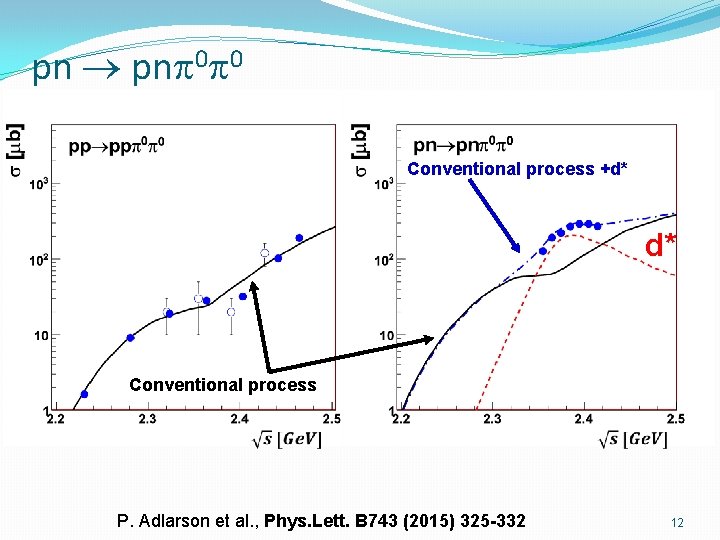
pn pn 0 0 Conventional process +d* d* Conventional process P. Adlarson et al. , Phys. Lett. B 743 (2015) 325 -332 d* 12
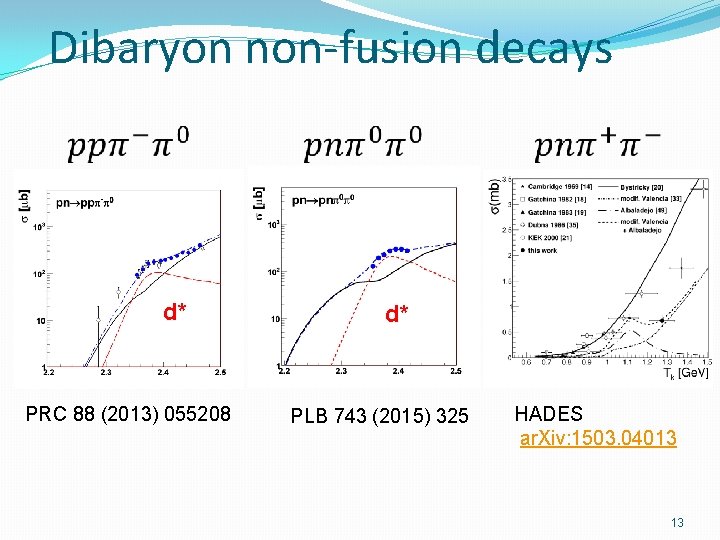
Dibaryon non-fusion decays d* PRC 88 (2013) 055208 d* PLB 743 (2015) 325 HADES ar. Xiv: 1503. 04013 13
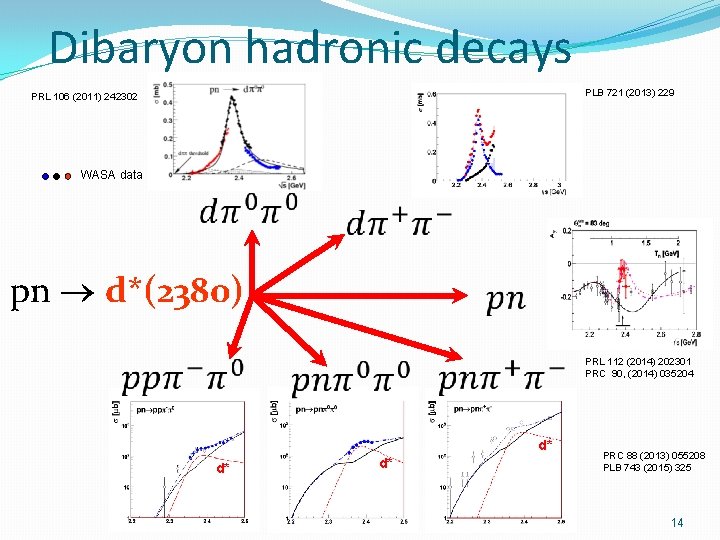
Dibaryon hadronic decays PLB 721 (2013) 229 PRL 106 (2011) 242302 WASA data pn d*(2380) PRL 112 (2014) 202301 PRC 90, (2014) 035204 d* d* d* PRC 88 (2013) 055208 PLB 743 (2015) 325 14
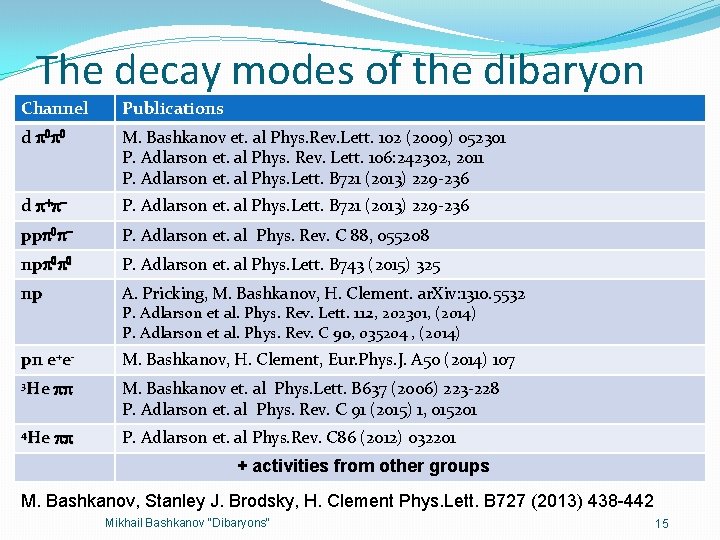
The decay modes of the dibaryon Channel Publications d p 0 p 0 M. Bashkanov et. al Phys. Rev. Lett. 102 (2009) 052301 P. Adlarson et. al Phys. Rev. Lett. 106: 242302, 2011 P. Adlarson et. al Phys. Lett. B 721 (2013) 229 -236 d p+p- P. Adlarson et. al Phys. Lett. B 721 (2013) 229 -236 ppp 0 p- P. Adlarson et. al Phys. Rev. C 88, 055208 npp 0 p 0 P. Adlarson et. al Phys. Lett. B 743 (2015) 325 np A. Pricking, M. Bashkanov, H. Clement. ar. Xiv: 1310. 5532 pn e+e- M. Bashkanov, H. Clement, Eur. Phys. J. A 50 (2014) 107 3 He pp M. Bashkanov et. al Phys. Lett. B 637 (2006) 223 -228 P. Adlarson et. al Phys. Rev. C 91 (2015) 1, 015201 4 He pp P. Adlarson et. al Phys. Rev. C 86 (2012) 032201 P. Adlarson et al. Phys. Rev. Lett. 112, 202301, (2014) P. Adlarson et al. Phys. Rev. C 90, 035204 , (2014) + activities from other groups M. Bashkanov, Stanley J. Brodsky, H. Clement Phys. Lett. B 727 (2013) 438 -442 Mikhail Bashkanov "Dibaryons" 15

Elastic channel 16
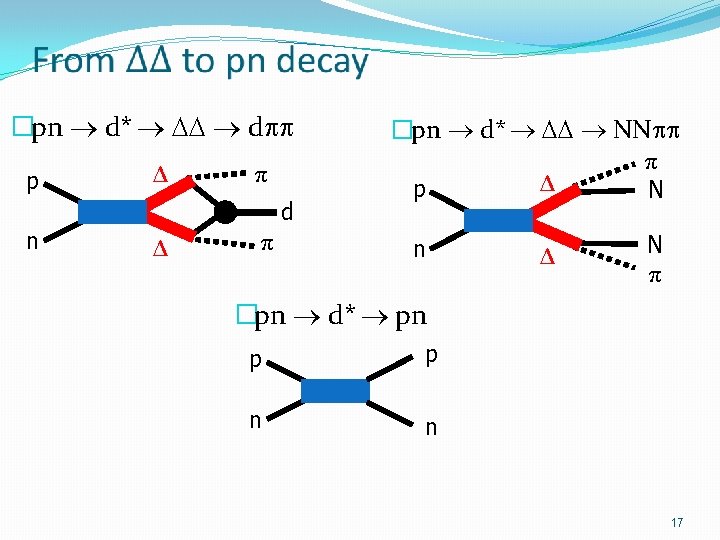
�pn d* d p n Δ π d Δ π �pn d* NN π Δ p N n Δ N π �pn d* pn p p n n 17
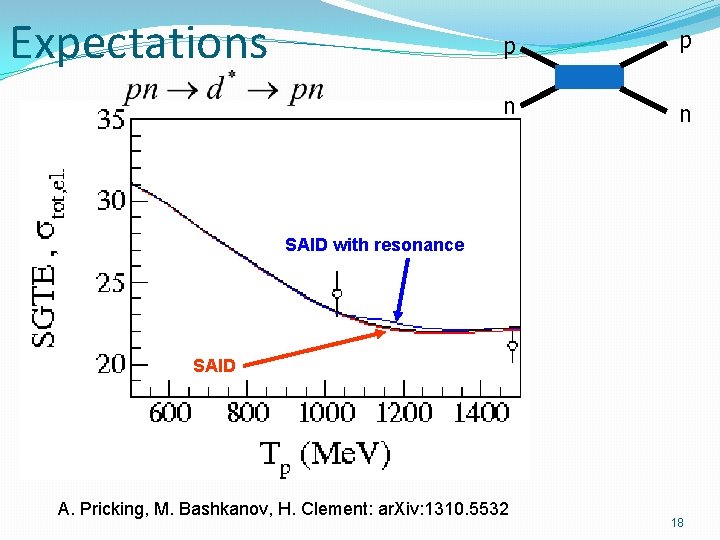
Expectations p p n n SAID with resonance SAID A. Pricking, M. Bashkanov, H. Clement: ar. Xiv: 1310. 5532 18
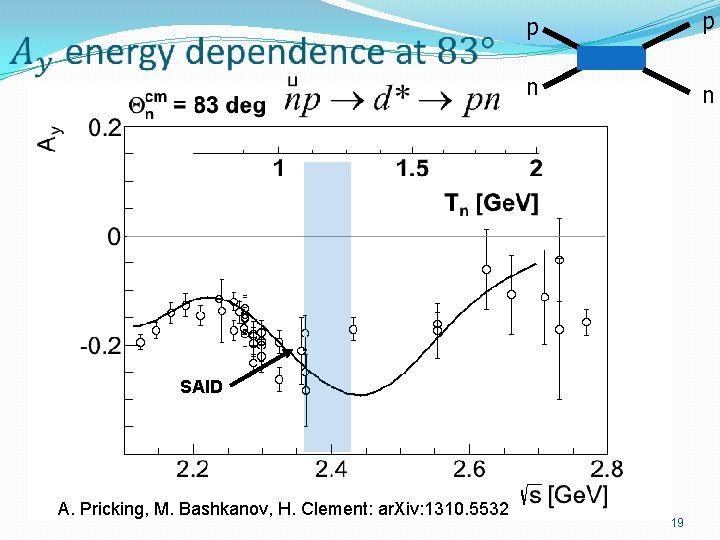
p p n n SAID A. Pricking, M. Bashkanov, H. Clement: ar. Xiv: 1310. 5532 19
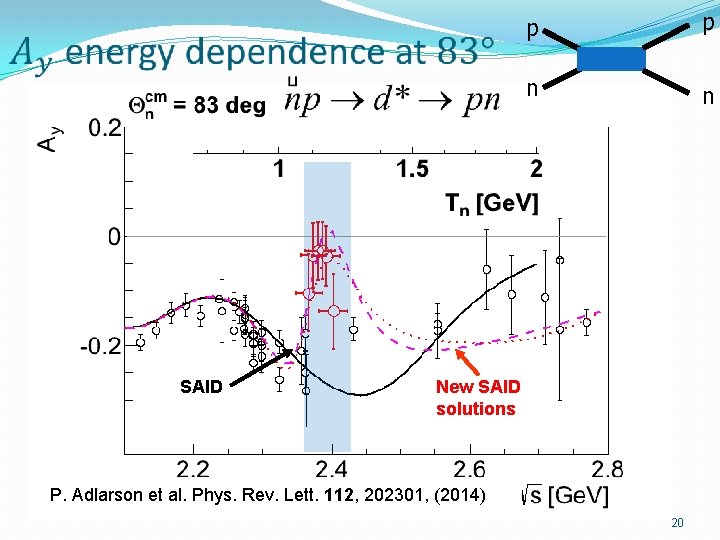
SAID p p n n New SAID solutions P. Adlarson et al. Phys. Rev. Lett. 112, 202301, (2014) 20
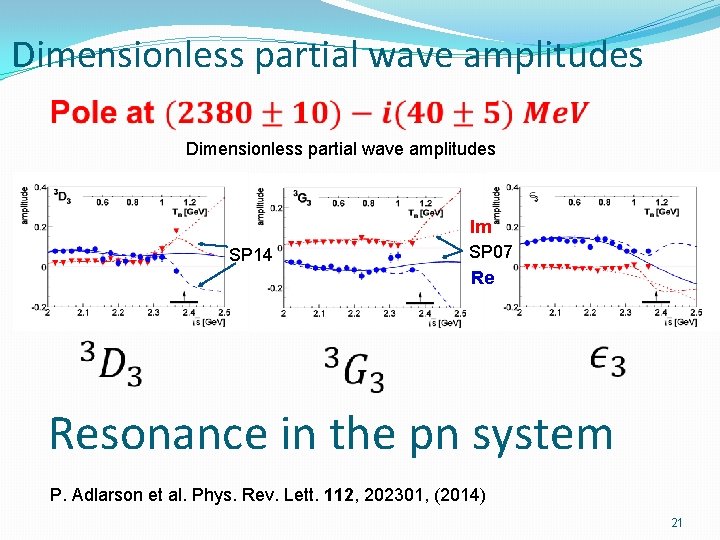
Dimensionless partial wave amplitudes Im SP 07 Re SP 14 Resonance in the pn system P. Adlarson et al. Phys. Rev. Lett. 112, 202301, (2014) 21
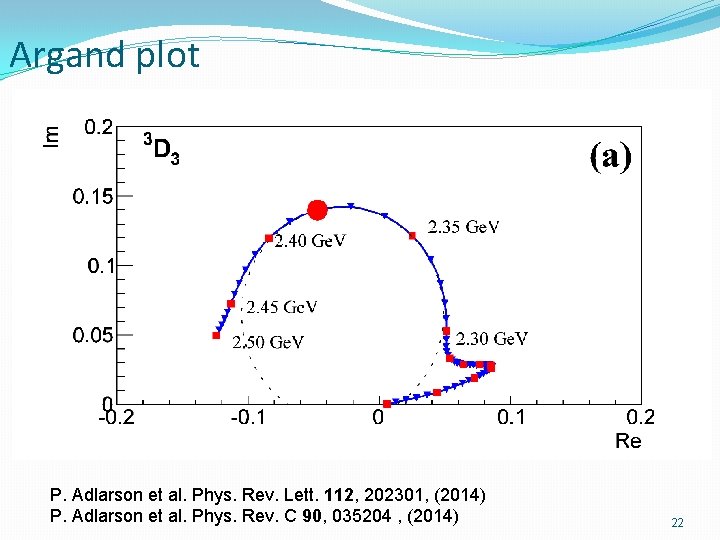
Argand plot P. Adlarson et al. Phys. Rev. Lett. 112, 202301, (2014) P. Adlarson et al. Phys. Rev. C 90, 035204 , (2014) 22
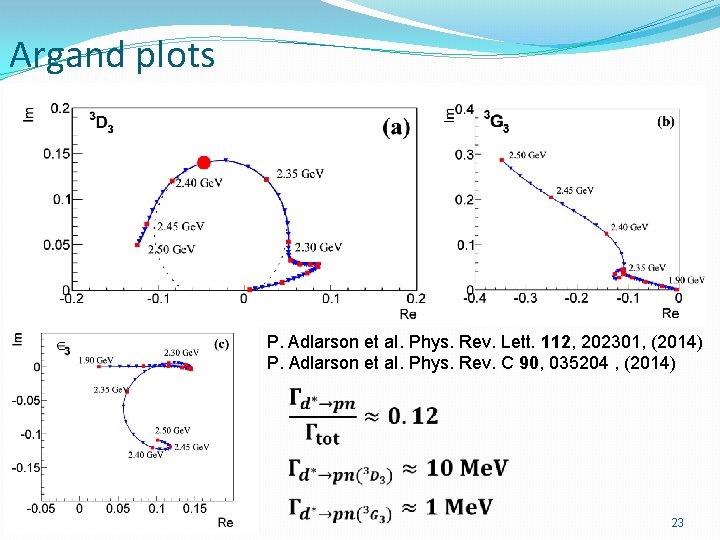
Argand plots P. Adlarson et al. Phys. Rev. Lett. 112, 202301, (2014) P. Adlarson et al. Phys. Rev. C 90, 035204 , (2014) 23
Molecule vs Hexaquark 24
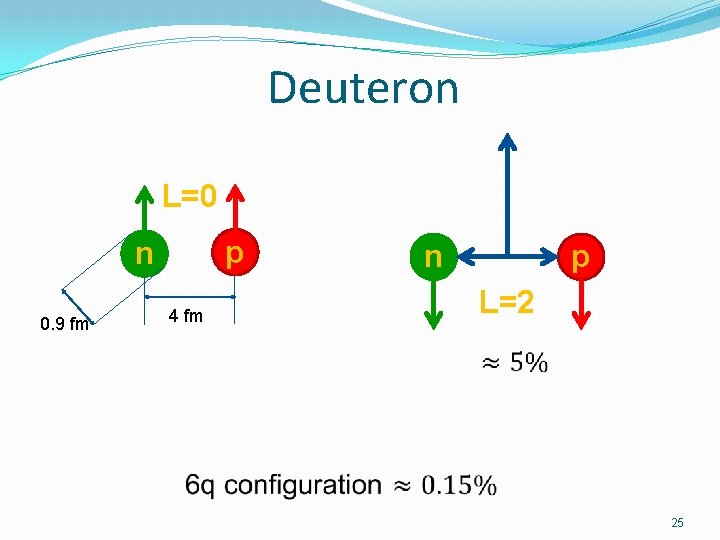
Deuteron L=0 p n 0. 9 fm 4 fm n p L=2 25
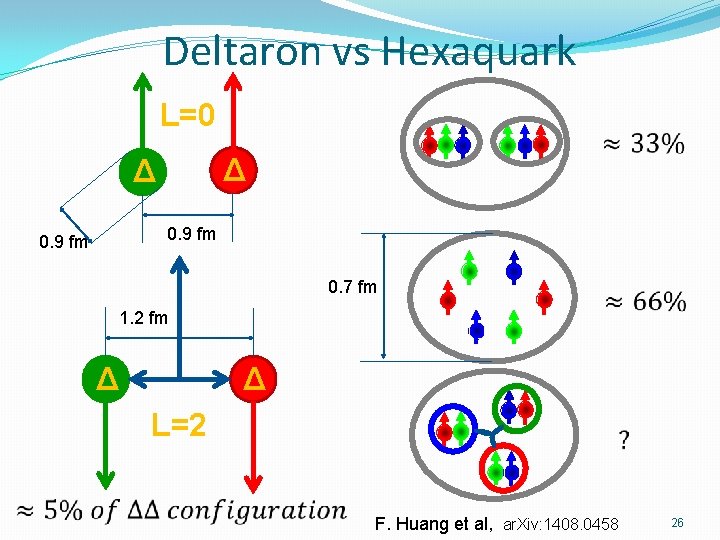
Deltaron vs Hexaquark L=0 Δ Δ 0. 9 fm 0. 7 fm 1. 2 fm Δ Δ L=2 F. Huang et al, ar. Xiv: 1408. 0458 26
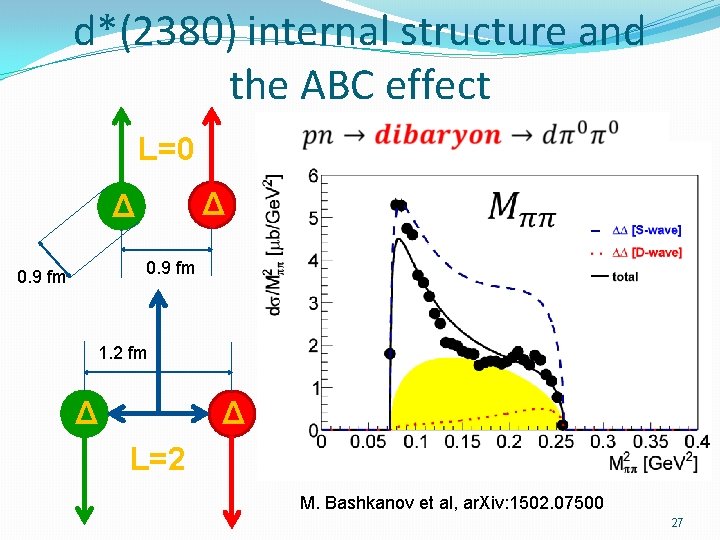
d*(2380) internal structure and the ABC effect L=0 Δ Δ 0. 9 fm 1. 2 fm Δ Δ L=2 M. Bashkanov et al, ar. Xiv: 1502. 07500 27

The family of dibaryons 28
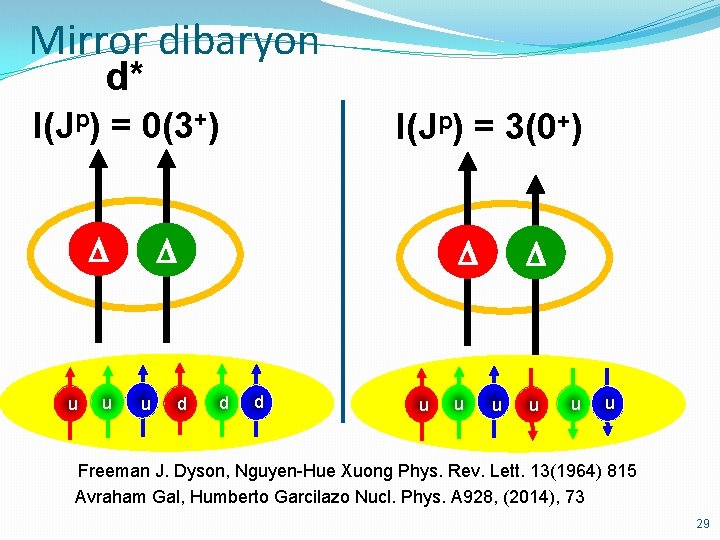
Mirror dibaryon d* I(Jp) = 0(3+) D u u I(Jp) = 3(0+) D u D d d d u u D u u Freeman J. Dyson, Nguyen-Hue Xuong Phys. Rev. Lett. 13(1964) 815 Avraham Gal, Humberto Garcilazo Nucl. Phys. A 928, (2014), 73 29
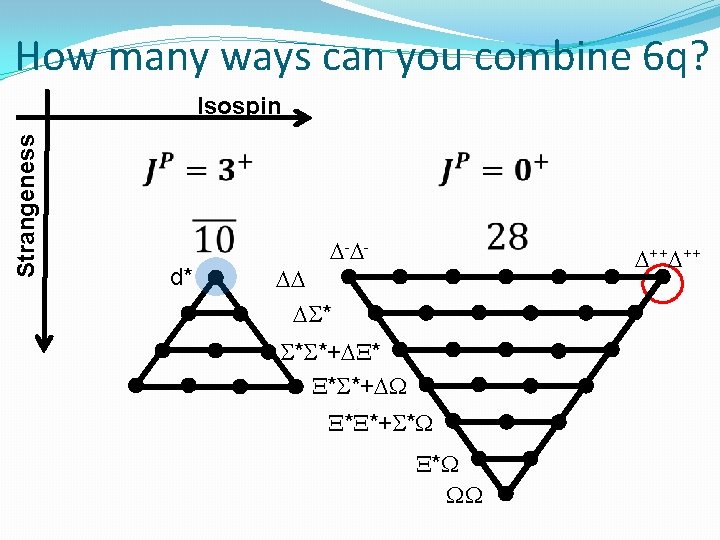
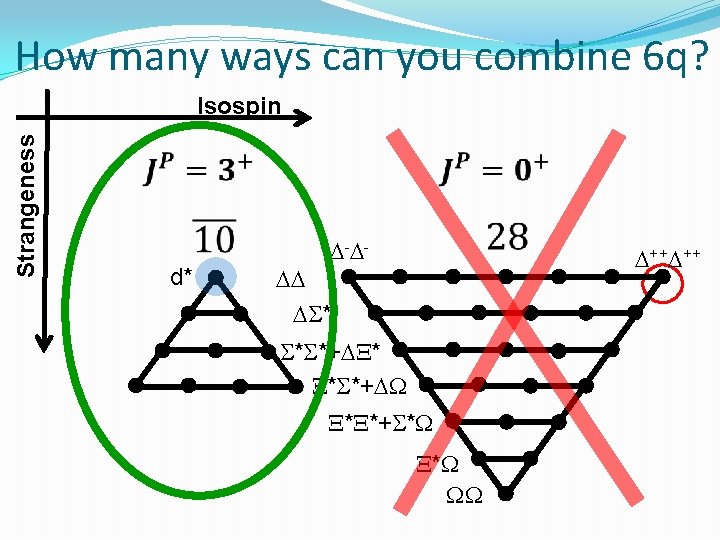
How many ways can you combine 6 q? Strangeness Isospin d* - - ++ ++ * * *+ * *
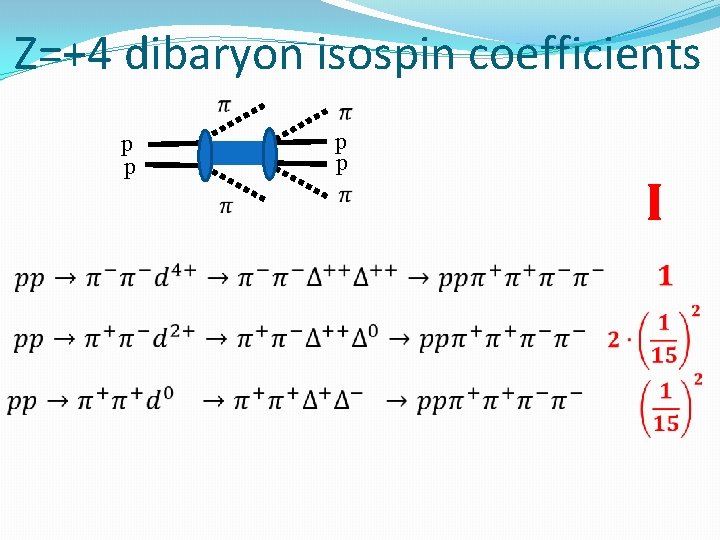
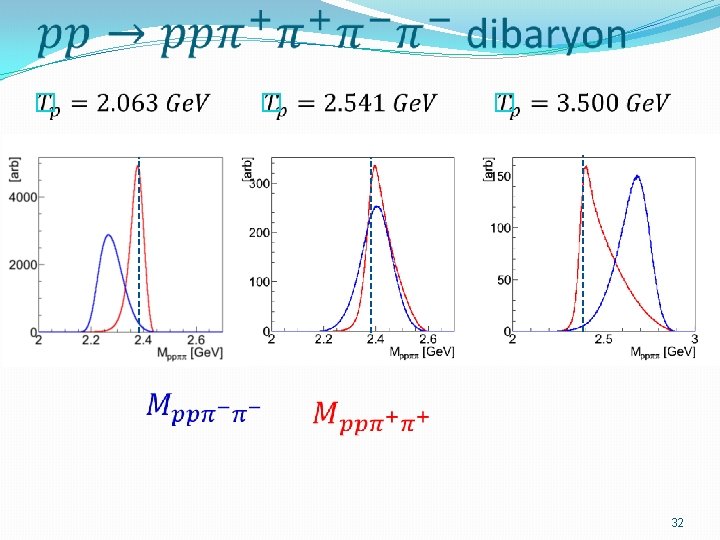
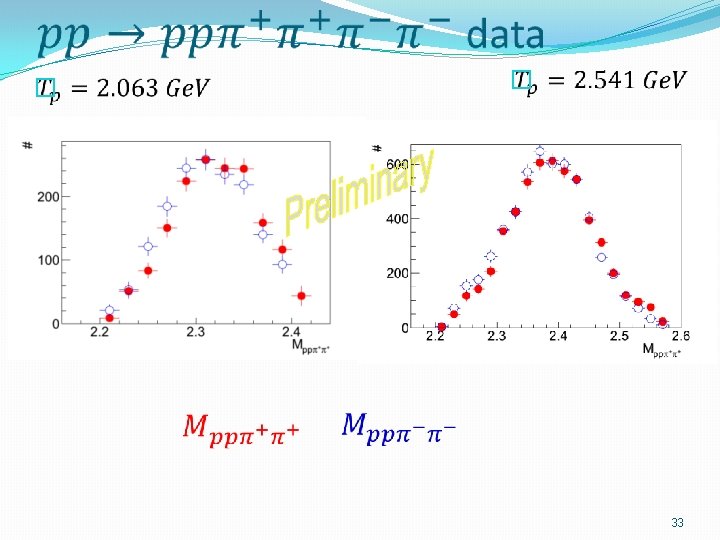
Z=+4 dibaryon isospin coefficients p p I
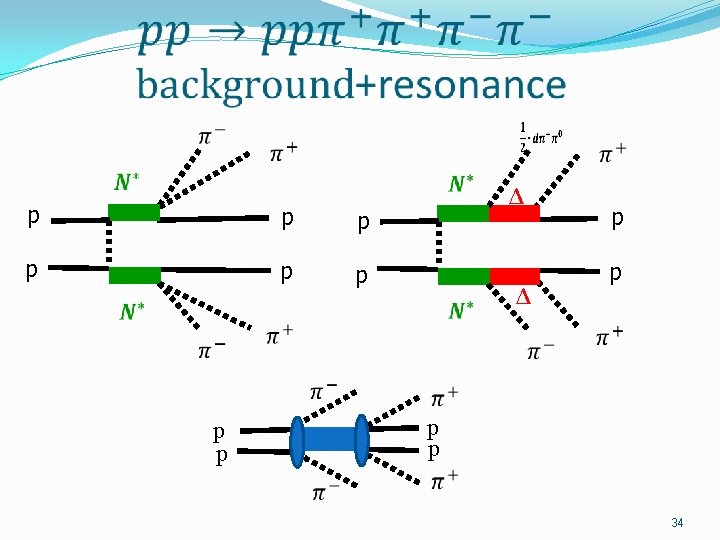
p p p Δ p p Δ p p 34
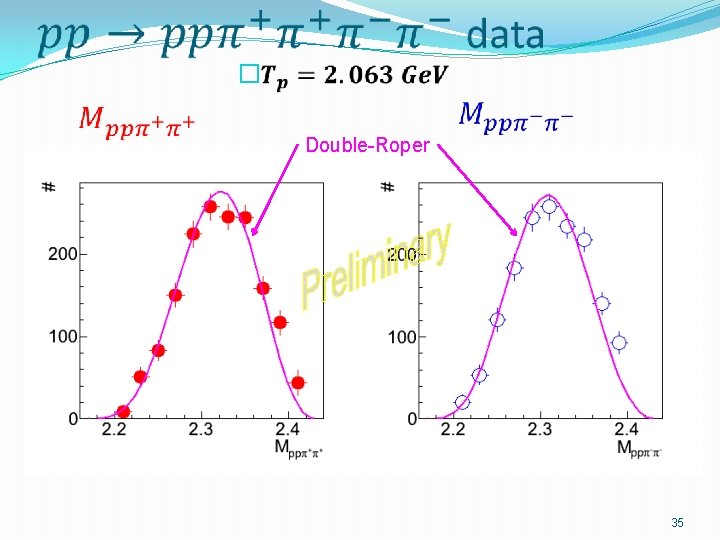
� Double-Roper 35
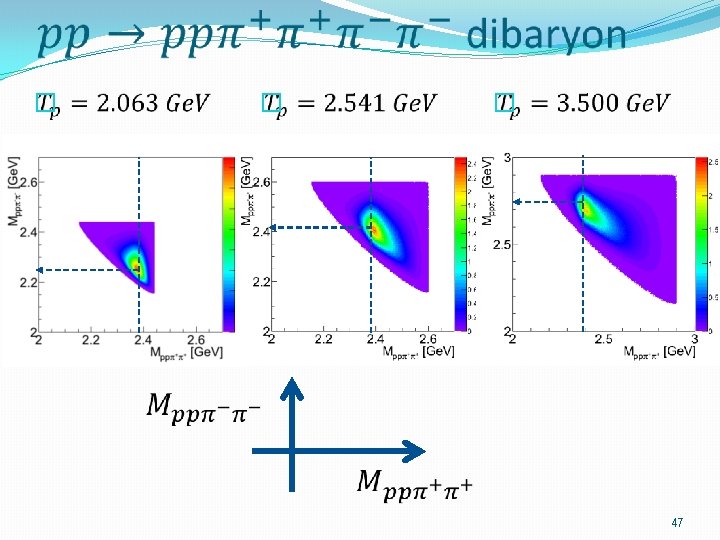
Charge Z=+4 dibaryon upper limit 36
NN vs ΔΔ Z=+4 p n 66 ke. V Δ Δ Threshold ? 2. 2 Me. V p n deuteron 80 Me. V Δ Δ d* 37
How many ways can you combine 6 q? Strangeness Isospin d* - - ++ ++ * * *+ * *
d*(2380) SU(3) multiplet Jp = 3+ * * 39
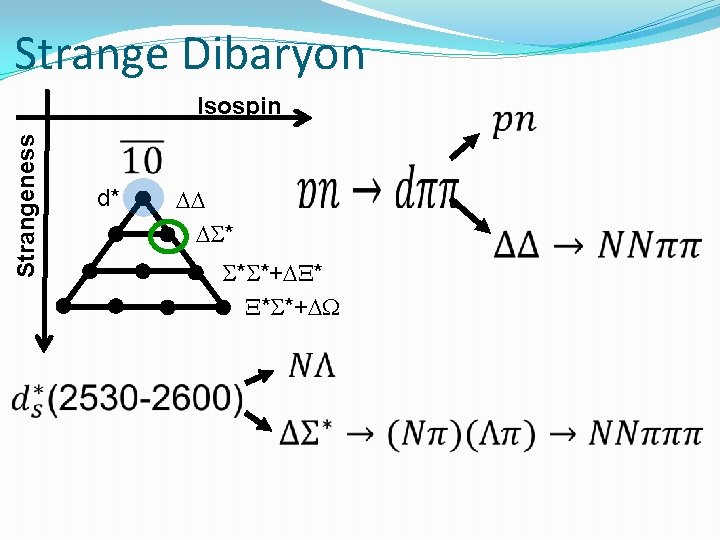
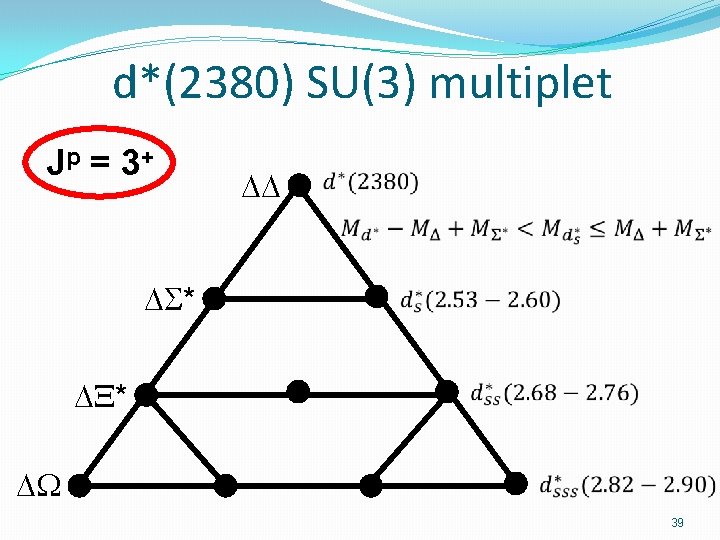
Strange Dibaryon Strangeness Isospin d* * * *+
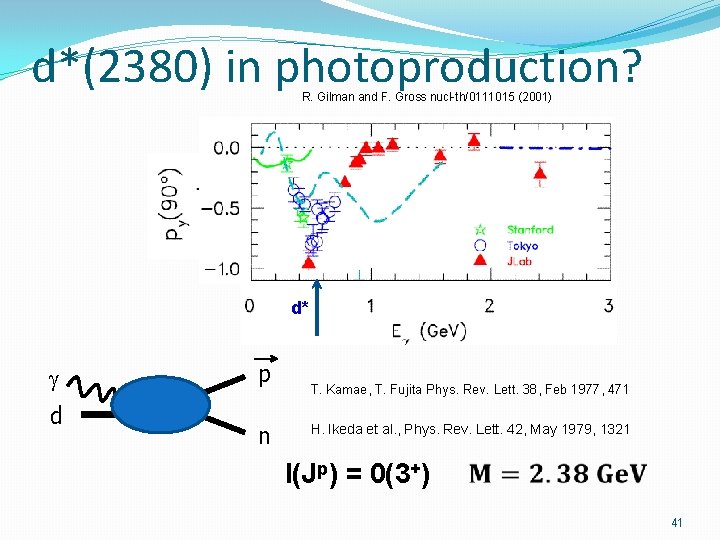
d*(2380) in photoproduction? R. Gilman and F. Gross nucl-th/0111015 (2001) d* d p n T. Kamae, T. Fujita Phys. Rev. Lett. 38, Feb 1977, 471 H. Ikeda et al. , Phys. Rev. Lett. 42, May 1979, 1321 I(Jp) = 0(3+) 41
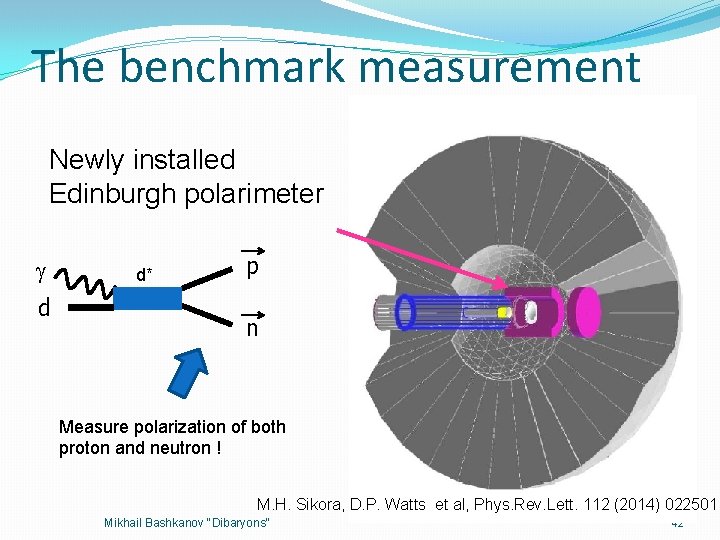
The benchmark measurement Newly installed Edinburgh polarimeter d d* p n Measure polarization of both proton and neutron ! M. H. Sikora, D. P. Watts et al, Phys. Rev. Lett. 112 (2014) 022501 Mikhail Bashkanov "Dibaryons" 42
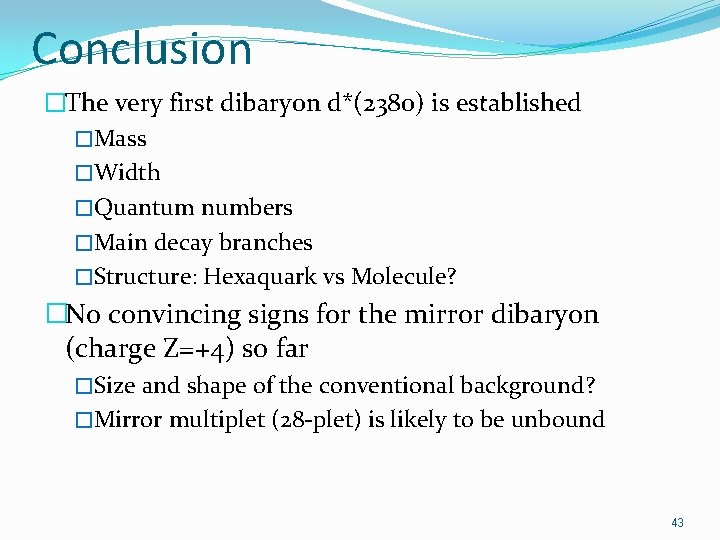
Conclusion �The very first dibaryon d*(2380) is established �Mass �Width �Quantum numbers �Main decay branches �Structure: Hexaquark vs Molecule? �No convincing signs for the mirror dibaryon (charge Z=+4) so far �Size and shape of the conventional background? �Mirror multiplet (28 -plet) is likely to be unbound 43

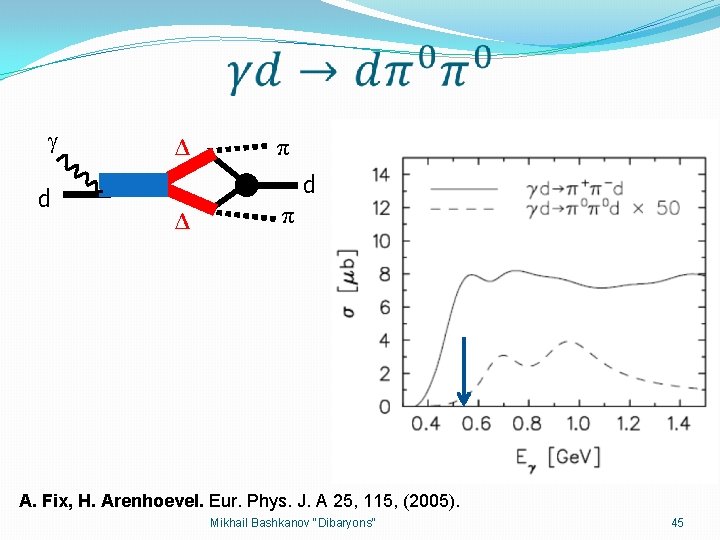
d Δ π A. Fix, H. Arenhoevel. Eur. Phys. J. A 25, 115, (2005). Mikhail Bashkanov "Dibaryons" 45
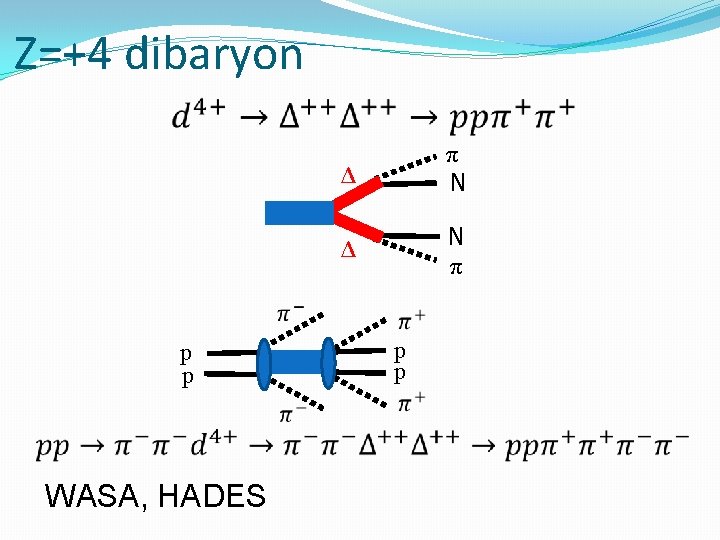
Z=+4 dibaryon WASA, HADES Δ N π p p Δ π N
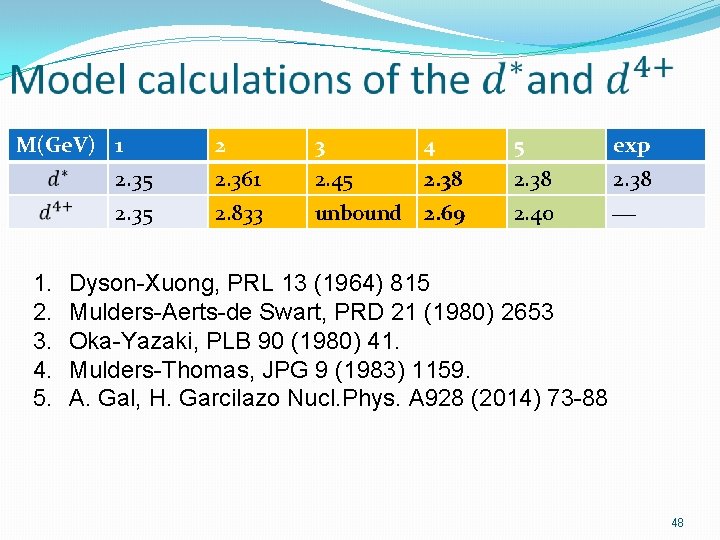
M(Ge. V) 1 1. 2. 3. 4. 5. 2 3 4 5 exp 2. 35 2. 361 2. 45 2. 38 2. 35 2. 833 unbound 2. 69 2. 40 Dyson-Xuong, PRL 13 (1964) 815 Mulders-Aerts-de Swart, PRD 21 (1980) 2653 Oka-Yazaki, PLB 90 (1980) 41. Mulders-Thomas, JPG 9 (1983) 1159. A. Gal, H. Garcilazo Nucl. Phys. A 928 (2014) 73 -88 48
- Slides: 48