
Was Taj Mahal Tejo Mahalaya an ancient Shiva


- Slides: 24
Was Taj Mahal Tejo Mahalaya, an ancient Shiva Temple?
Taj Mahal is a corrupt form of the sanskrit term Tejo-Mahalaya signifying a Shiva Temple. The tradition of removing the shoes before climbing the marble platform originates from pre Shahjahan times when the Taj was a Shiva Temple. Had the Taj originated as a tomb, shoes need not have to be removed because shoes are a necessity in a cemetery. The term Tajmahal itself never occurs in any mogul court paper or chronicle even in Aurangzeb’s time. The ending “Mahal” is used for hindu palaces and is never muslim because in none of the muslim countries around the world is there a building known as “Mahal“. Taj Mahal este o formă coruptă a termenului sanscrit Tejo-Mahalaya ceea ce înseamnă un templu Shiva. Tradiția de a scoate pantofii înainte de a urca platforma de marmura provine de la pre Shahjahan când Taj era un templu Shiva. Era Taj original un mormânt, pantofii nu trebuie să fie scoşi, deoarece pantofii sunt o necesitate într-un cimitir. Tajmahal în sine nu apare niciodată în nici o hârtie sau cronică mogulă, chiar și în timpul lui Aurangzeb. Terminația "Mahal" este folosită pentru palatele hinduse și nu este niciodată musulmană pentru că în nici una dintre țările din întreaga lume musulmană nu există o clădire cunoscută sub numele de "Mahal".
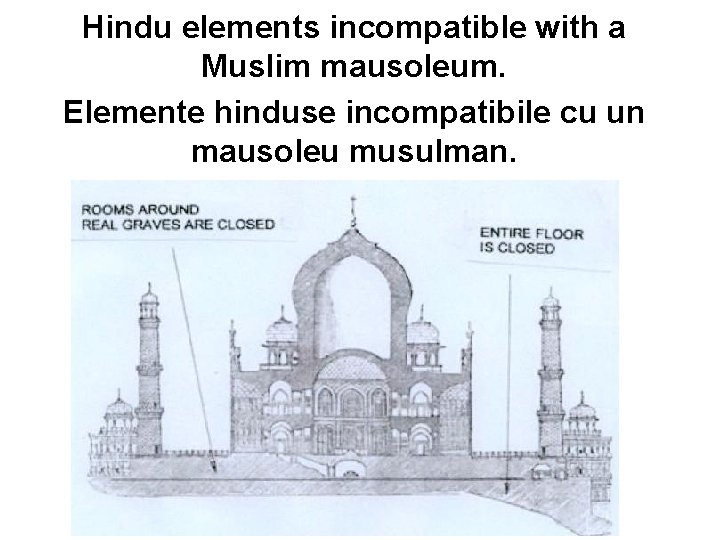
Hindu elements incompatible with a Muslim mausoleum. Elemente hinduse incompatibile cu un mausoleu musulman.
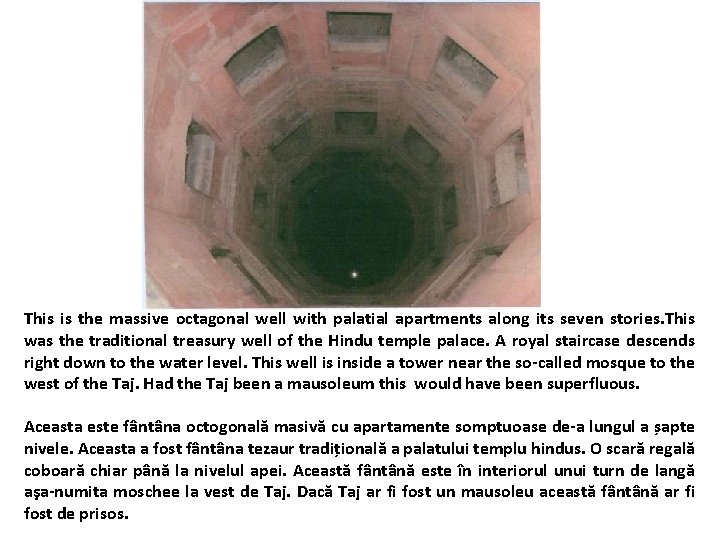
This is the massive octagonal well with palatial apartments along its seven stories. This was the traditional treasury well of the Hindu temple palace. A royal staircase descends right down to the water level. This well is inside a tower near the so-called mosque to the west of the Taj. Had the Taj been a mausoleum this would have been superfluous. Aceasta este fântâna octogonală masivă cu apartamente somptuoase de-a lungul a șapte nivele. Aceasta a fost fântâna tezaur tradițională a palatului templu hindus. O scară regală coboară chiar până la nivelul apei. Această fântână este în interiorul unui turn de langă aşa-numita moschee la vest de Taj. Dacă Taj ar fi fost un mausoleu această fântână ar fi fost de prisos.
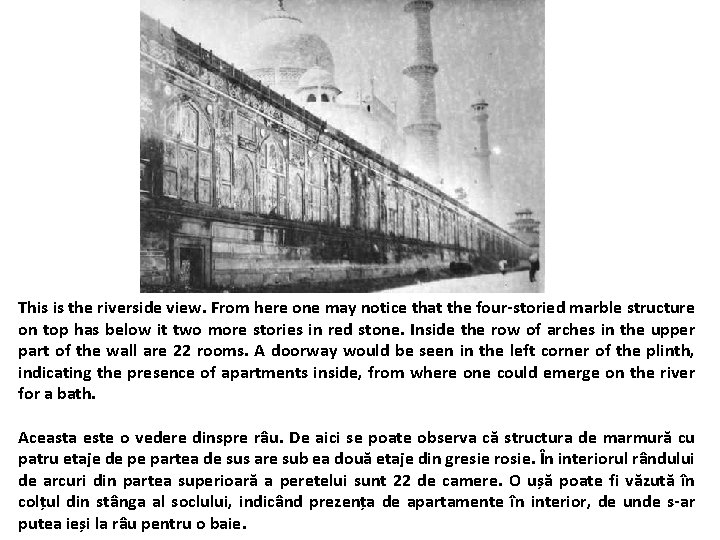
This is the riverside view. From here one may notice that the four-storied marble structure on top has below it two more stories in red stone. Inside the row of arches in the upper part of the wall are 22 rooms. A doorway would be seen in the left corner of the plinth, indicating the presence of apartments inside, from where one could emerge on the river for a bath. Aceasta este o vedere dinspre râu. De aici se poate observa că structura de marmură cu patru etaje de pe partea de sus are sub ea două etaje din gresie rosie. În interiorul rândului de arcuri din partea superioară a peretelui sunt 22 de camere. O ușă poate fi văzută în colțul din stânga al soclului, indicând prezența de apartamente în interior, de unde s-ar putea ieși la râu pentru o baie.
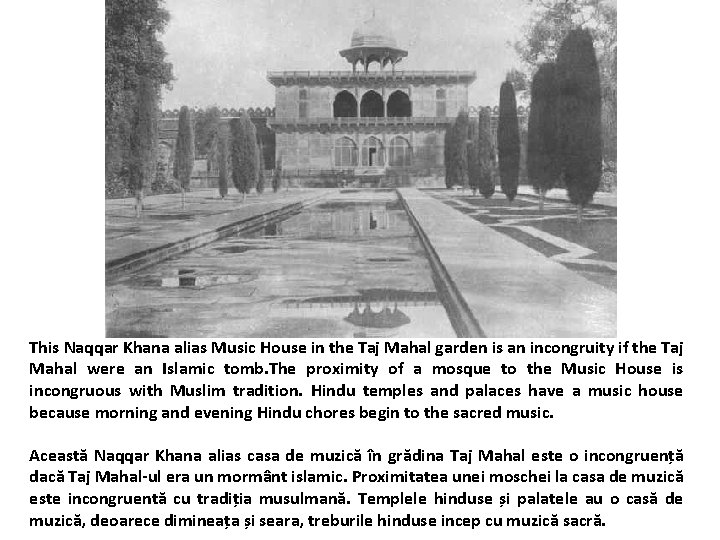
This Naqqar Khana alias Music House in the Taj Mahal garden is an incongruity if the Taj Mahal were an Islamic tomb. The proximity of a mosque to the Music House is incongruous with Muslim tradition. Hindu temples and palaces have a music house because morning and evening Hindu chores begin to the sacred music. Această Naqqar Khana alias casa de muzică în grădina Taj Mahal este o incongruență dacă Taj Mahal-ul era un mormânt islamic. Proximitatea unei moschei la casa de muzică este incongruentă cu tradiția musulmană. Templele hinduse și palatele au o casă de muzică, deoarece dimineața și seara, treburile hinduse incep cu muzică sacră.
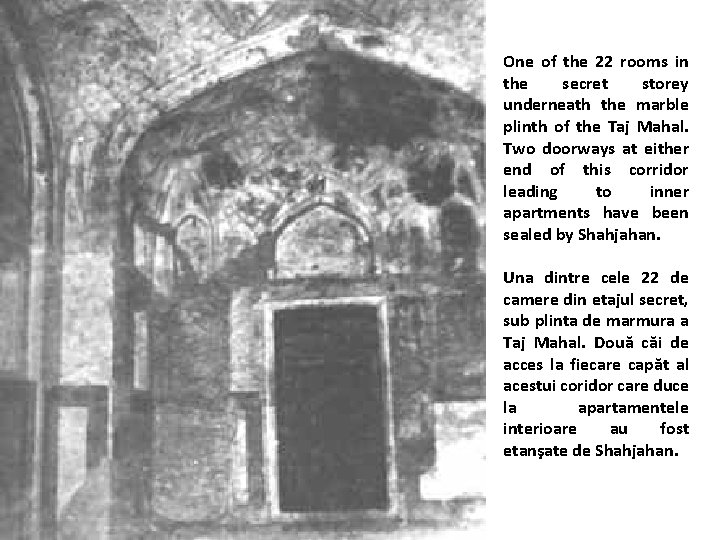
One of the 22 rooms in the secret storey underneath the marble plinth of the Taj Mahal. Two doorways at either end of this corridor leading to inner apartments have been sealed by Shahjahan. Una dintre cele 22 de camere din etajul secret, sub plinta de marmura a Taj Mahal. Două căi de acces la fiecare capăt al acestui coridor care duce la apartamentele interioare au fost etanşate de Shahjahan.
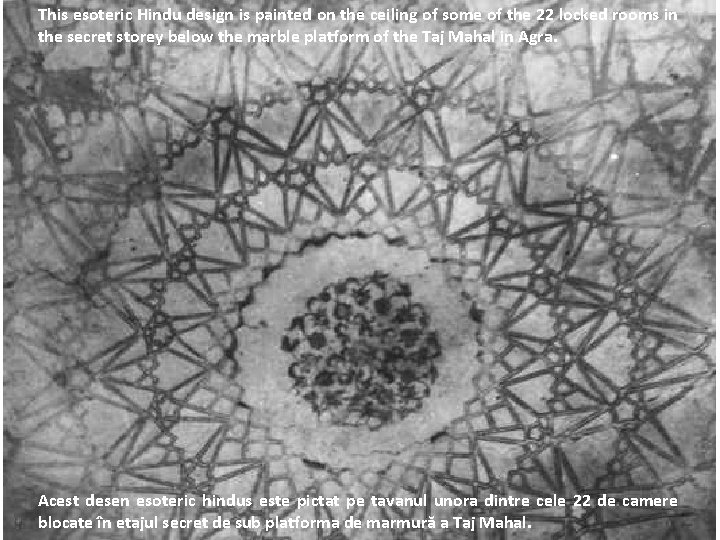
This esoteric Hindu design is painted on the ceiling of some of the 22 locked rooms in the secret storey below the marble platform of the Taj Mahal in Agra. Acest desen esoteric hindus este pictat pe tavanul unora dintre cele 22 de camere blocate în etajul secret de sub platforma de marmură a Taj Mahal.
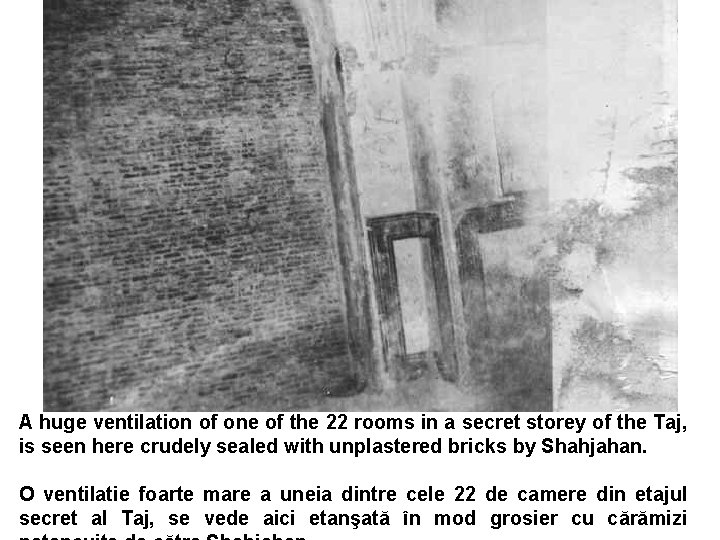
A huge ventilation of one of the 22 rooms in a secret storey of the Taj, is seen here crudely sealed with unplastered bricks by Shahjahan. O ventilatie foarte mare a uneia dintre cele 22 de camere din etajul secret al Taj, se vede aici etanşată în mod grosier cu cărămizi
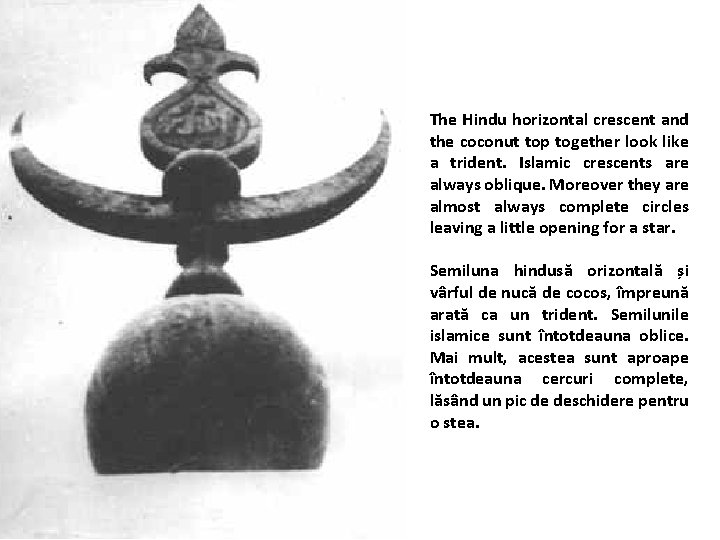
The Hindu horizontal crescent and the coconut top together look like a trident. Islamic crescents are always oblique. Moreover they are almost always complete circles leaving a little opening for a star. Semiluna hindusă orizontală și vârful de nucă de cocos, împreună arată ca un trident. Semilunile islamice sunt întotdeauna oblice. Mai mult, acestea sunt aproape întotdeauna cercuri complete, lăsând un pic de deschidere pentru o stea.
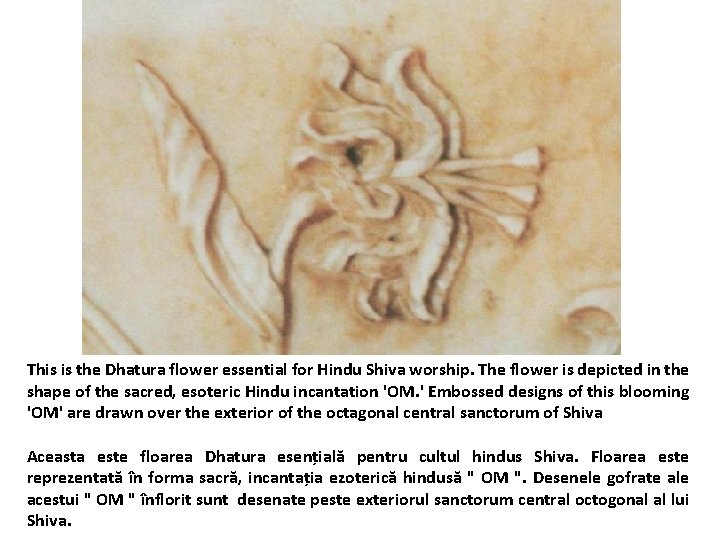
This is the Dhatura flower essential for Hindu Shiva worship. The flower is depicted in the shape of the sacred, esoteric Hindu incantation 'OM. ' Embossed designs of this blooming 'OM' are drawn over the exterior of the octagonal central sanctorum of Shiva Aceasta este floarea Dhatura esențială pentru cultul hindus Shiva. Floarea este reprezentată în forma sacră, incantația ezoterică hindusă " OM ". Desenele gofrate ale acestui " OM " înflorit sunt desenate peste exteriorul sanctorum central octogonal al lui Shiva.
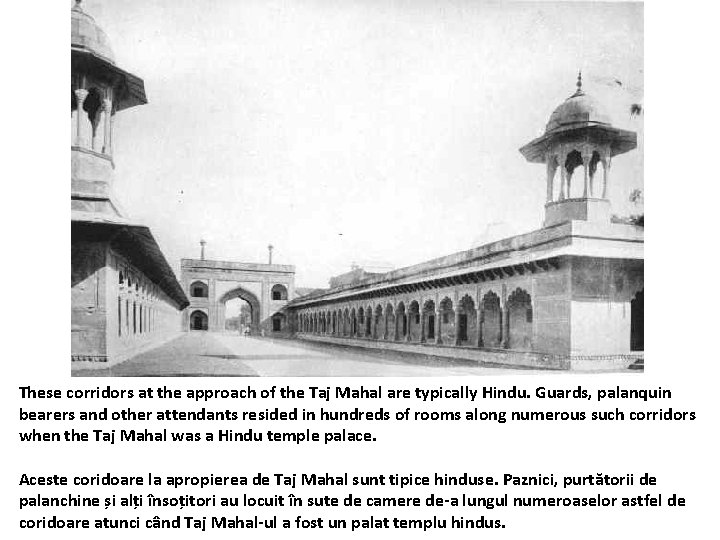
These corridors at the approach of the Taj Mahal are typically Hindu. Guards, palanquin bearers and other attendants resided in hundreds of rooms along numerous such corridors when the Taj Mahal was a Hindu temple palace. Aceste coridoare la apropierea de Taj Mahal sunt tipice hinduse. Paznici, purtătorii de palanchine și alți însoțitori au locuit în sute de camere de-a lungul numeroaselor astfel de coridoare atunci când Taj Mahal-ul a fost un palat templu hindus.
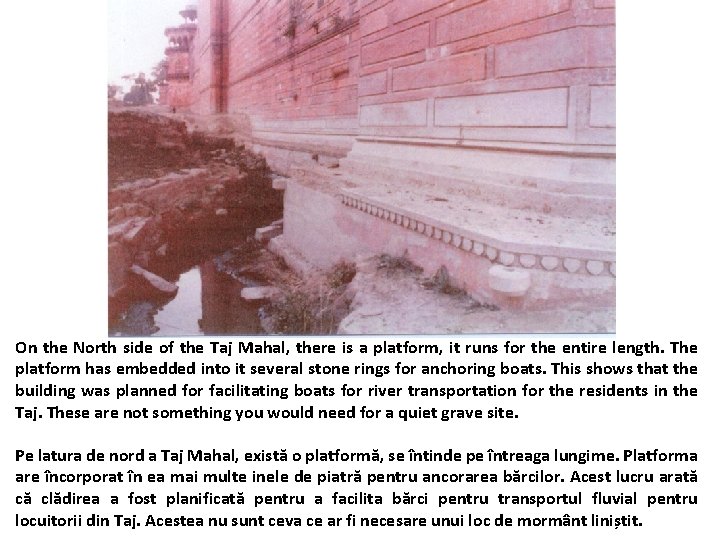
On the North side of the Taj Mahal, there is a platform, it runs for the entire length. The platform has embedded into it several stone rings for anchoring boats. This shows that the building was planned for facilitating boats for river transportation for the residents in the Taj. These are not something you would need for a quiet grave site. Pe latura de nord a Taj Mahal, există o platformă, se întinde pe întreaga lungime. Platforma are încorporat în ea mai multe inele de piatră pentru ancorarea bărcilor. Acest lucru arată că clădirea a fost planificată pentru a facilita bărci pentru transportul fluvial pentru locuitorii din Taj. Acestea nu sunt ceva ce ar fi necesare unui loc de mormânt liniștit.
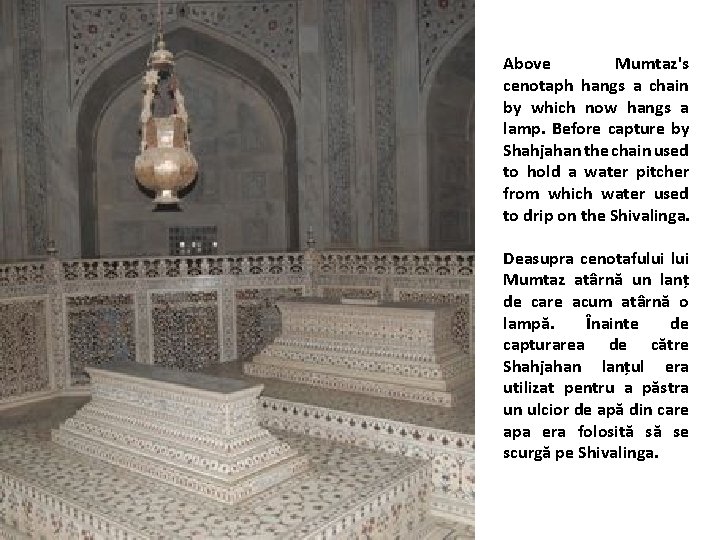
Above Mumtaz's cenotaph hangs a chain by which now hangs a lamp. Before capture by Shahjahan the chain used to hold a water pitcher from which water used to drip on the Shivalinga. Deasupra cenotafului Mumtaz atârnă un lanț de care acum atârnă o lampă. Înainte de capturarea de către Shahjahan lanțul era utilizat pentru a păstra un ulcior de apă din care apa era folosită să se scurgă pe Shivalinga.
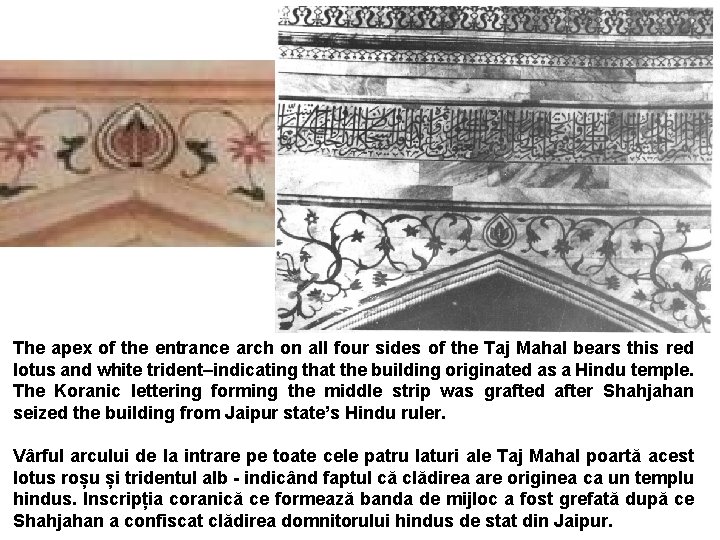
The apex of the entrance arch on all four sides of the Taj Mahal bears this red lotus and white trident–indicating that the building originated as a Hindu temple. The Koranic lettering forming the middle strip was grafted after Shahjahan seized the building from Jaipur state’s Hindu ruler. Vârful arcului de la intrare pe toate cele patru laturi ale Taj Mahal poartă acest lotus roșu și tridentul alb - indicând faptul că clădirea are originea ca un templu hindus. Inscripția coranică ce formează banda de mijloc a fost grefată după ce Shahjahan a confiscat clădirea domnitorului hindus de stat din Jaipur.
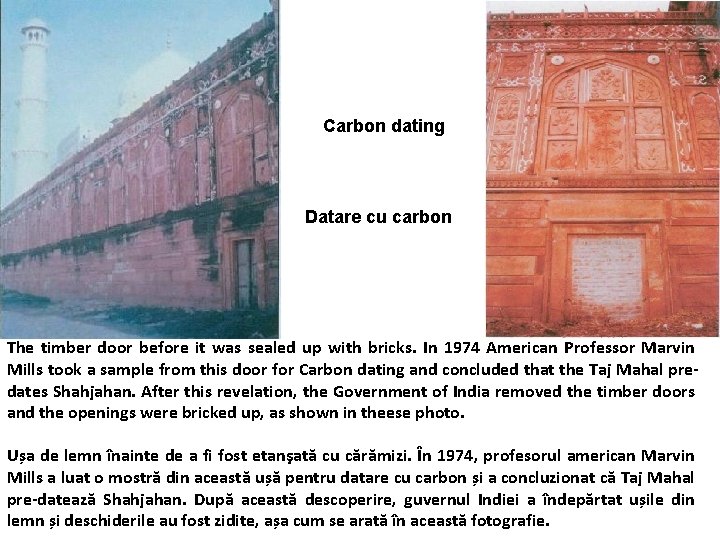
Carbon dating Datare cu carbon The timber door before it was sealed up with bricks. In 1974 American Professor Marvin Mills took a sample from this door for Carbon dating and concluded that the Taj Mahal predates Shahjahan. After this revelation, the Government of India removed the timber doors and the openings were bricked up, as shown in theese photo. Ușa de lemn înainte de a fi fost etanşată cu cărămizi. În 1974, profesorul american Marvin Mills a luat o mostră din această ușă pentru datare cu carbon și a concluzionat că Taj Mahal pre-datează Shahjahan. După această descoperire, guvernul Indiei a îndepărtat ușile din lemn și deschiderile au fost zidite, așa cum se arată în această fotografie.
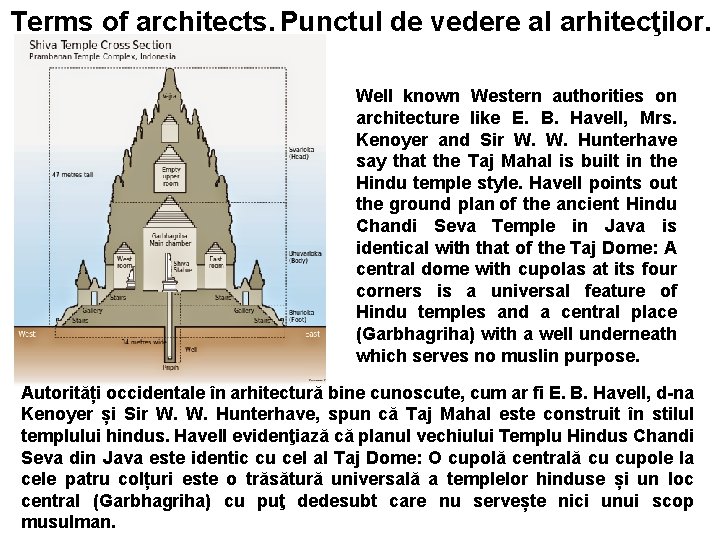
Terms of architects. Punctul de vedere al arhitecţilor. Well known Western authorities on architecture like E. B. Havell, Mrs. Kenoyer and Sir W. W. Hunterhave say that the Taj Mahal is built in the Hindu temple style. Havell points out the ground plan of the ancient Hindu Chandi Seva Temple in Java is identical with that of the Taj Dome: A central dome with cupolas at its four corners is a universal feature of Hindu temples and a central place (Garbhagriha) with a well underneath which serves no muslin purpose. Autorități occidentale în arhitectură bine cunoscute, cum ar fi E. B. Havell, d-na Kenoyer și Sir W. W. Hunterhave, spun că Taj Mahal este construit în stilul templului hindus. Havell evidenţiază că planul vechiului Templu Hindus Chandi Seva din Java este identic cu cel al Taj Dome: O cupolă centrală cu cupole la cele patru colțuri este o trăsătură universală a templelor hinduse și un loc central (Garbhagriha) cu puţ dedesubt care nu servește nici unui scop musulman.
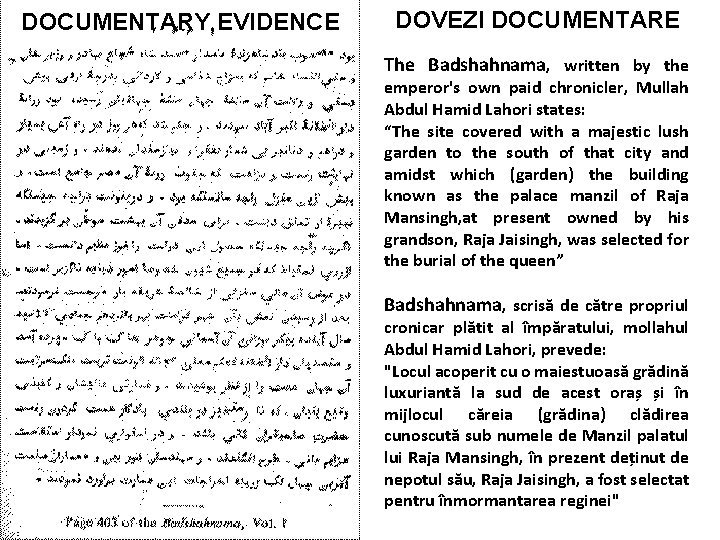
DOCUMENTARY EVIDENCE DOVEZI DOCUMENTARE The Badshahnama, written by the emperor's own paid chronicler, Mullah Abdul Hamid Lahori states: “The site covered with a majestic lush garden to the south of that city and amidst which (garden) the building known as the palace manzil of Raja Mansingh, at present owned by his grandson, Raja Jaisingh, was selected for the burial of the queen” Badshahnama, scrisă de către propriul cronicar plătit al împăratului, mollahul Abdul Hamid Lahori, prevede: "Locul acoperit cu o maiestuoasă grădină luxuriantă la sud de acest oraș și în mijlocul căreia (grădina) clădirea cunoscută sub numele de Manzil palatul lui Raja Mansingh, în prezent deținut de nepotul său, Raja Jaisingh, a fost selectat pentru înmormantarea reginei"
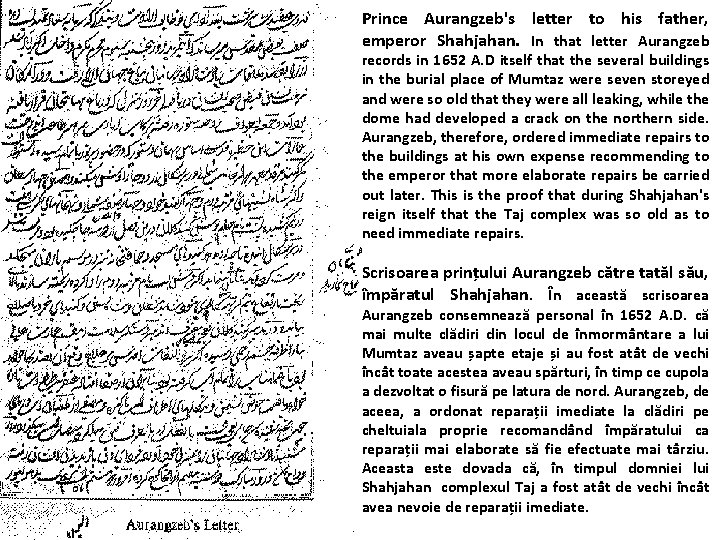
Prince Aurangzeb's letter to his father, emperor Shahjahan. In that letter Aurangzeb records in 1652 A. D itself that the several buildings in the burial place of Mumtaz were seven storeyed and were so old that they were all leaking, while the dome had developed a crack on the northern side. Aurangzeb, therefore, ordered immediate repairs to the buildings at his own expense recommending to the emperor that more elaborate repairs be carried out later. This is the proof that during Shahjahan's reign itself that the Taj complex was so old as to need immediate repairs. Scrisoarea prințului Aurangzeb către tatăl său, împăratul Shahjahan. În această scrisoarea Aurangzeb consemnează personal în 1652 A. D. că mai multe clădiri din locul de înmormântare a lui Mumtaz aveau șapte etaje și au fost atât de vechi încât toate acestea aveau spărturi, în timp ce cupola a dezvoltat o fisură pe latura de nord. Aurangzeb, de aceea, a ordonat reparații imediate la clădiri pe cheltuiala proprie recomandând împăratului ca reparații mai elaborate să fie efectuate mai târziu. Aceasta este dovada că, în timpul domniei lui Shahjahan complexul Taj a fost atât de vechi încât avea nevoie de reparații imediate.
Munj Bateswar Edict In 1900 A. D. was discovered an edict, now known as the Munj Bateswar Edict. The epigraph contains 34 verses written in Sanskrit. An English translation of the 25 th, 26 th and 34 th verses: “He built a marble temple which is the abode of Lord Vishnu and the King bows down to touch His feet” (25). “The King has built another marble temple which has been dedicated to the Lord Who has the moon as His ornament on His forehead” (26). “Today, the 5 th day of the bright half in the month of Ashwin, the Sunday, in the year 1212 of the Vikram Samvat, the edict is being laid” (34). Mr. D. J. Kale, a well known archaeologist, has mentioned in Epigraphica India: “The Munj Bateswar Edict was laid by King Paramardi Deo of the Chandratreya dynasty on Sukla Panchami in the month of Ashwin, in the year 1212 Vikram Samvat (or A. D. 1156). … King Paramardi Deo built two magnificent temples with white marble, one for Lords Vishnu and the other for Lord Shiva and they were desecrated later on by the Muslim invaders” Today, there are two marble palaces in Agra, one is the Mausoleum of Idmat-ud. Daula and the other is Taj Mahal, and it is evident from the Munj Bateswar edict that, once upon a time, one of them was the temple of Lord Vishnu and the other was a temple of Lord Shiva. Experts believe that it is the temple of Vishnu that has been made the mausoleum of Idmat-ud-Daula, and the temple of Shiva has been converted into the mausoleum of the queen Arjumand Banu.
În 1900 A. D. , a fost descoperit un edict, acum cunoscut sub numele de Munj Bateswar Edict. Epigraful contine 34 de versete scrise în sanscrită. O traducere în engleză a versetelor 25, 26 și 34: "El a construit un templu din marmură, care este lăcașul lui Lord Vishnu și regele se apleacă să atingă picioarele Lui" (25). "Regele a construit un alt templu din marmură, care a fost dedicat Domnului, care luna ca ornament pe fruntea lui" (26). "Astăzi, a 5 -a zi a jumătăţii luminoase în luna Ashwin, duminica, în anul 1212 al lui Vikram Samvat, edictul este stabilit" (34). Dl D. J. Kale, un arheolog bine cunoscut, a menționat în Epigraphica India: "Munj Bateswar Edict a fost stabilit de regele Paramardi Deo al dinastiei Chandratreya pe Sukla Panchami în luna Ashwin, în anul 1212, Vikram Samvat (sau AD 1156). . Regele Paramardi Deo a construit doua temple magnifice cu marmură albă, unul pentru Lord Vishnu și celălalt pentru Lord Shiva și au fost profanate mai târziu de invadatorii musulmani". Astăzi, există două palate de marmură în Agra, unul este Mausoleul lui Idmatud-Daula iar celălalt este Taj Mahal, și este evident din edictul Munj Bateswar că, o dată la un moment dat, unul dintre ele a fost templul lui Lord Vishnu și celălalt a fost un templul lui Lord Shiva. Experții sunt de părere că templul lui Vishnu este cel care a fost făcut mauzoleul lui Idmat-ud-Daula, iar templul lui Shiva a fost transformat în mausoleul reginei Arjumand Banu.
Political statement Declaraţie politică Uttar Pradesh BJP (Bharatiya Janata Party = Indian People's Party) chief Laxmi Kant Bajpai said in 2014 that "Shah Jahan purchased a part of Tejo Mahalaya temple's land from Raja Jai Singh” and claimed that documents to prove it still exist. Şeful BJP (Bharatiya Janata Party = Partidul Poporului Indian) din Uttar Pradesh, Laxmi Kant Bajpai a declarat în 2014 că "Shah Jahan a cumpărat o parte din terenul templului Tejo Mahalaya de la Raja Jai Singh" și a susținut că încă mai există documente să dovedească asta.
Sources Surse The Distorted History of Taj Mahal by Dr Radhasyam Brahmachari The True Story of the Taj Mahal by P. N. Oak Was the Taj Mahal a Vedic Temple? The Photographic Evidence by Stephen Knapp Mystery of Taj Mahal By Smriti Iyer 04. 2016 The End Sfârşit