
Was Reconstruction a Success Priority Standard Critique deliberative
Was Reconstruction a Success? Priority Standard – Critique deliberative processes used by a wide variety of groups in various settings. I can describe and assess processes used by a variety of groups during Reconstruction. I can summarize the end of Reconstruction. I can describe the plan for the “New South” and its successes and failures. I can identify and describe growing efforts of white Southerners to discriminate against African Americans.
The End of Reconstruction During Grant’s presidency, Northerners began losing interest in Reconstruction. It was time to move on. Reconstruction slowly ended for several other reasons: * The older Radical Republicans began to retire or leave office for other reasons. * Opponents of Reconstruction argued that only Southerners really knew what was best for the South. * Many Southerners hated the idea that the U. S. Army was still being used to enforce Reconstruction efforts and laws It did not help that people in Grant’s administration were guilty of corruption and taking advantage of the American public. In Southern states, Democrats were regaining control and the Ku Klux Klan increased their terror against African Americans and Republicans Was Reconstruction a Success?
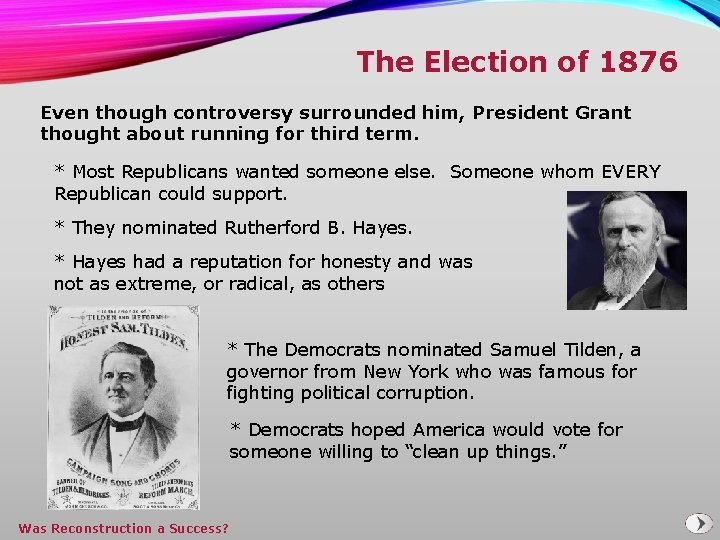
The Election of 1876 Even though controversy surrounded him, President Grant thought about running for third term. * Most Republicans wanted someone else. Someone whom EVERY Republican could support. * They nominated Rutherford B. Hayes. * Hayes had a reputation for honesty and was not as extreme, or radical, as others * The Democrats nominated Samuel Tilden, a governor from New York who was famous for fighting political corruption. * Democrats hoped America would vote for someone willing to “clean up things. ” Was Reconstruction a Success?
Compromise of 1877 The election of 1876 had no clear winner and the outcome could not be decided. . * A commission made up of Republicans and Democrats was formed to decide the winner of the election and the next President of the U. S. * In the end, the committee compromised. It named Hayes President and allowed Republicans to keep the White House. * For giving up the presidency, the Democrats would, in return, get the following: * Republicans promised to give more help and support to the South. * Biggest of all, Republicans promised to pull all U. S. soldiers out of Southern states, effectively ending Reconstruction. Was Reconstruction a Success?
Change in the South – Democrats in Control Many Southern whites hated Republicans for the Civil War and Reconstruction. With Reconstruction over, they took back power in the South. * Wealthy landowners continued to rule in some parts of the South, but merchants, bank owners, and other business leaders also became political leaders in the South. * These new leaders called themselves “Redeemers” because they had redeemed, or saved, the South from Republican rule. * Now in charge, they began cutting and eliminating programs put in place by the Republicans. * Southern Democrats got rid of services that helped African Americans and poor whites, such as public education. Was Reconstruction a Success?

Rise of the “New South” By the 1880 s, many Southerners believed that the South must develop a strong industrial economy, like their neighbors in the North. * They argued that the South lost the Civil War because it relied on agriculture too much, rather than industry. * Leaders urged Southerners to build a “New South” that would have industries based on the region’s coal, tobacco, cotton, and lumber supplies. * Industry DID improve – textile mills sprang up in North Carolina, tobacco farms dominated Virginia, and Georgia became a major supplier of the nation’s lumber. * Still, the South’s industry still fell short of the North’s. In the South, agriculture still remained the main economic source. Was Reconstruction a Success?
Rural Economy Supporters of the New South hoped to change Southern farming as well as industry. * The goal was to create small, money-making farms that grew a variety of crops like corn and wheat instead of just cotton. * Unfortunately, most wealthy landowners used their large land for sharecropping, which continued to raise cotton and failed to make money. * Debt became a major problem. Poor farmers often borrowed money to buy supplies sold at high prices. Low crop prices made it difficult to repay these loans and credit. * This resulted in more sharecropping, and less variety of farming. * Southern farming and agriculture hardly improved at all. Was Reconstruction a Success?
A Divided Society With the end of Reconstruction, the hopes for racial equality faded and true freedom for African Americans became a dream. Voting Restrictions The Fifteenth Amendment made it illegal for any state to keep African American men from voting. Southern leaders found ways around the amendment. * Southern states began to require poll taxes, fees (money) that had to be paid so someone could vote. * Because many African Americans could not pay the fee, they were kept from voting. * The poll tax also prevented many poor whites from voting, which Southern lawmakers also believed was okay. Was Reconstruction a Success?
Voting Restrictions The Fifteenth Amendment made it illegal for any state to keep African American men from voting. Southern leaders found ways around the amendment. * Another form of discrimination was the requirement of literacy tests or exams in which a possible voter had to read parts of the U. S. Constitution. * These forms of discrimination often affected poor white Southerners. In order to protect their right to vote, lawmakers created grandfather clauses. * These laws allowed people who could not pay the poll tax or pass the literacy test the chance to vote if their father or grandfathers had been able to vote at one time. * This discrimination, along with continued violence from groups such as the Ku Klux Klan, kept tens of thousands of African Americans from voting. Was Reconstruction a Success?
Jim Crow Laws By the 1880 s, segregation, or the forced separation of races, had become common throughout the South. * Southern states passed “Jim Crow” laws that required African Americans and whites to be separated in public places across the South. * In 1896, the Supreme Court ruled that Jim Crow laws were legal and allowed under the Constitution. * Homer Plessy had been forced to sit in a railroad car for African Americans only. He sued, claiming his rights had been violated. * The court decided that segregation was legal, as long as public places for both races was “separate but equal. ” This was RARELY the case. * Not until 1954, when the Supreme Court struck down its own ruling, would African American and whites in the South share the same places in public. Was Reconstruction a Success?
Jim Crow Laws By the 1880 s, segregation, or the forced separation of races, had become common throughout the South. * Violence towards African Americans increased as well. One such form was lynching – angry mobs kidnapping a killing a person by hanging. * From 1882 -1968, 4, 743 lynchings occurred in the United States. African Americans accounted for 72. 7% of the people lynched. * Because whites sought to protect their families and friends, not every incident of lynching was ever recorded. * Most of the lynching that took place happened in the South after the Civil War. Mississippi had the highest number of lynching from 18821968 with 581. Georgia was second with 531, and Texas was third with 493. 79% of lynching happened in the South. Was Reconstruction a Success?
Reconstruction’s Impact Reconstruction was seen as both a success and a failure. * It succeeded in rebuilding the South, physically, and economically. * It succeeded by helping former enslaved people gain freedom and African Americans experiencing greater equality. * It succeeded by giving African Americans the right to participate in a government that they helped influence. * It failed to improve its farming and agriculture by continuing the “virtual slavery” of sharecropping. * It failed to protect African Americans by allowing discrimination, terrorism, and other acts of violence to occur and continue. Civil Rights leader W. E. B. Du. Bois summarized Reconstruction best – “The slave went free; stood a brief moment in the sun; then moved back again toward slavery. ” Was Reconstruction a Success?
- Slides: 12