
Was Andrew Carnegie a hero BR What are
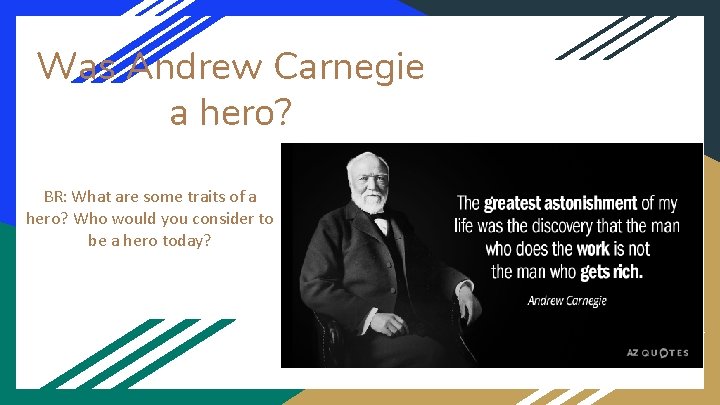
Was Andrew Carnegie a hero? BR: What are some traits of a hero? Who would you consider to be a hero today?
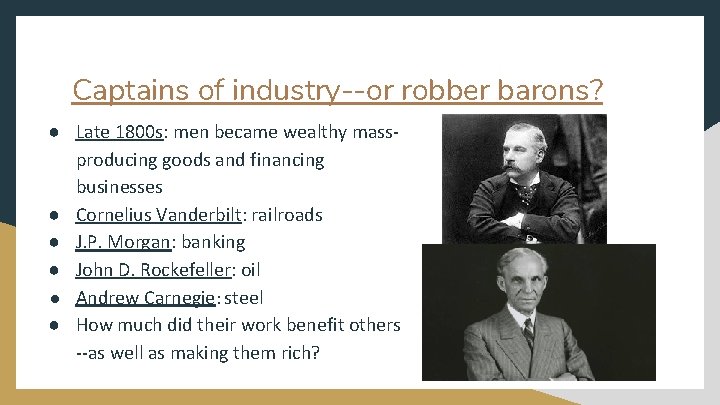
Captains of industry--or robber barons? ● Late 1800 s: men became wealthy massproducing goods and financing businesses ● Cornelius Vanderbilt: railroads ● J. P. Morgan: banking ● John D. Rockefeller: oil ● Andrew Carnegie: steel ● How much did their work benefit others --as well as making them rich?
Document 1: Carnegie’s houses ● Social: he started off with very little and lived in a small cottage ● He eventually became so wealthy he bought a castle ● Yes--he was a hero for working hard and showing others how to improve their social position
Document 2: Carnegie’s “Wealth” excerpt ● ● Social and economic Better for some to be wealthy--than no one Factories produce quality at lower prices--better for everyone Competition is good to ensure “survival of the fittest” (weak die and strong survive) ● Yes: some benefits for people ● No: says that it’s okay if there is inequality
Document 3: quote about Carnegie ● Social: shows Carnegie as most concerned about making money ● No: he was greedy and wanted wealth for himself
Document 4: graph on production costs and selling prices of steel rails ● Economic: it cost less to produce steel over time--and the profit was large at first and less over time ● Yes: lower prices benefited more people; profit was earned for taking a risk
Document 5: map of Carnegie Properties ● Economic and environmental: Carnegie controlled businesses that got the raw materials, transported the goods, and produced the steel ● Yes: it was more efficient and cheaper--thus cutting costs ● No: the profit went to Carnegie and hurt the environment
Document 6: journalist account of the Homestead Steel Mill ● Economic: describes the conditions for workers in the steel mills ● No: very dangerous conditions for workers (hot furnaces and horrible smells); they received little pay and work long hours; called the “deathtrap” for workers being killed on the job
Document 7: pay for U. S. manufacturing workers in 1892 ● Social and economic ● No: workers were paid $1 to $2 per day--while Carnegie earned $92, 000 per day; he made a lot of profit off of the workers ● Yes: he may have motivated others to work hard to attain the wealth that he had
Document 8: excerpt from Carnegie’s “Wealth” ● Social and cultural: discusses what the upper class should do with all the money they have ● Should NOT leave it to their children ● Should NOT hold onto it; “the man who dies rich dies disgraced” ● gospel of wealth: upper classes should donate their wealth to the community ● Yes: wealthy people can make a difference with their donations
Document 9: list of Carnegie’s donations (philanthropy) ● Social and cultural: Carnegie donated $350 million to universities, libraries, churches, teachers and foundations; it currently donates $100 million a year--mostly for education ● Yes: he followed the Gospel of Wealth to donate a lot of money to charity
Document 10: newspaper political cartoon of Carnegie from 1892 ● Social and Cultural: Carnegie has two heads--one that makes donations and the other that reduces his employees’ wages ● No: even though Carnegie donated money to charity, he treated his workers poorly and even lowered their wages (despite the fact that he made a large profit)
Using the documents, answer the following prompt in a paragraph of at least 10 sentences: Was Andrew Carnegie a hero? Why or why not?
- Slides: 13