
Warpage Adhesion and Reliability Thermal and Chemical Stress
Warpage, Adhesion, and Reliability
Thermal and Chemical Stress in Assemblies q Thermal stress is created by temperature excursions during assembly and product life § Joining materials with different CTEs can cause stress failures § Silicon and glass differ widely from organics and metals q Chemical shrinkage stress is created during the cure of an epoxy (or any thermoset resin) § Temperature of cure and extent of cure directly affects chemical stress q Crosslinking polymers tend to form non-uniform agglomerates with thermal reaction fronts which lead to internal stress fractures Note: 1. Once the extent of cure is complete, the stress properties do not change 2. Incompletely cured epoxies will change properties with higher temperature steps (extent of cure changes) producing unexpected shrinkage stress.
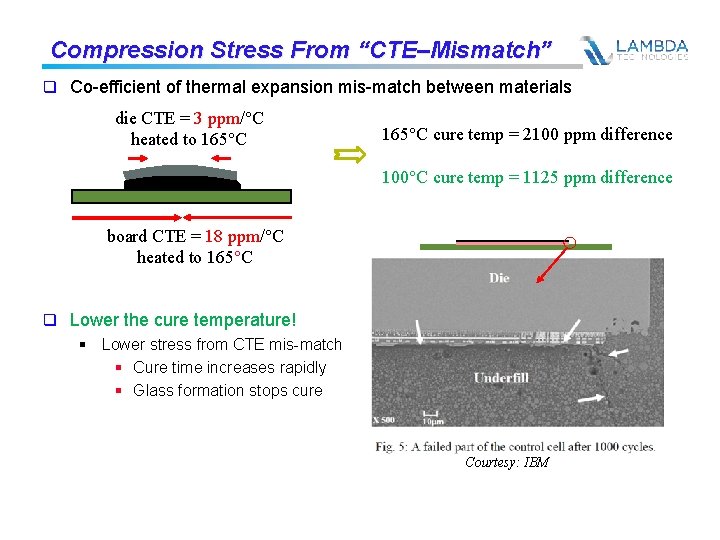
Compression Stress From “CTE–Mismatch” q Co-efficient of thermal expansion mis-match between materials die CTE = 3 ppm/°C heated to 165°C cure temp = 2100 ppm difference 100°C cure temp = 1125 ppm difference board CTE = 18 ppm/°C heated to 165°C q Lower the cure temperature! § Lower stress from CTE mis-match § Cure time increases rapidly § Glass formation stops cure Courtesy: IBM
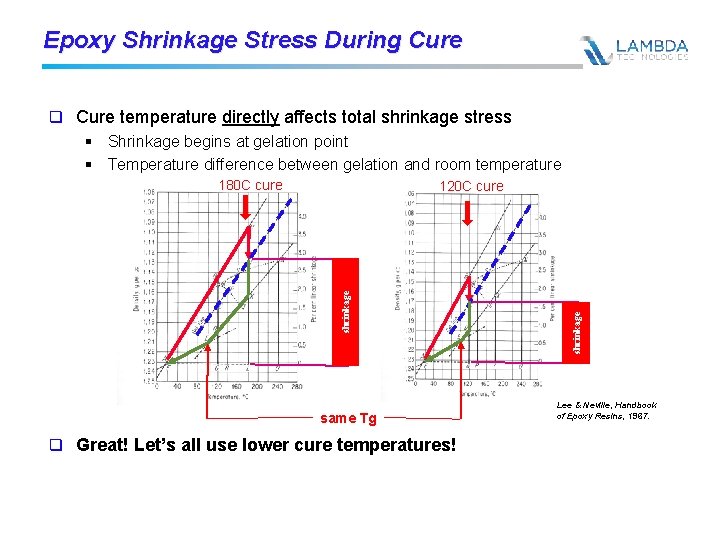
Epoxy Shrinkage Stress During Cure q Cure temperature directly affects total shrinkage stress § Shrinkage begins at gelation point § Temperature difference between gelation and room temperature 180 C cure same Tg q Great! Let’s all use lower cure temperatures! shrinkage 120 C cure Lee & Neville, Handbook of Epoxy Resins, 1967.
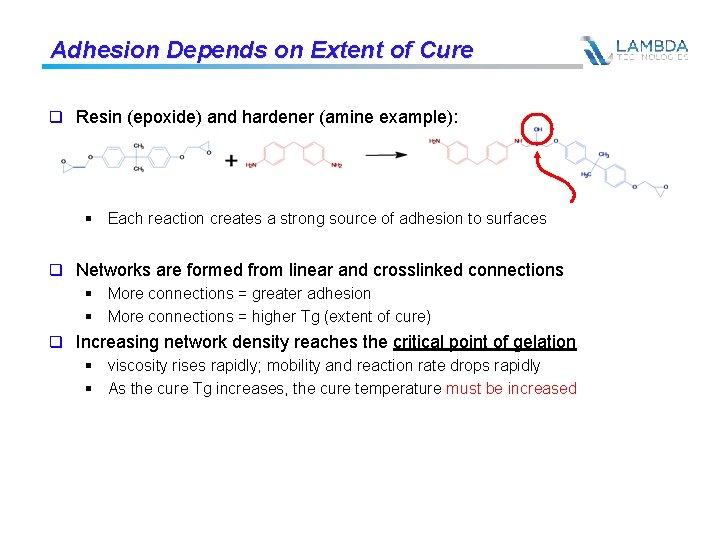
Adhesion Depends on Extent of Cure q Resin (epoxide) and hardener (amine example): § Each reaction creates a strong source of adhesion to surfaces q Networks are formed from linear and crosslinked connections § More connections = greater adhesion § More connections = higher Tg (extent of cure) q Increasing network density reaches the critical point of gelation § viscosity rises rapidly; mobility and reaction rate drops rapidly § As the cure Tg increases, the cure temperature must be increased
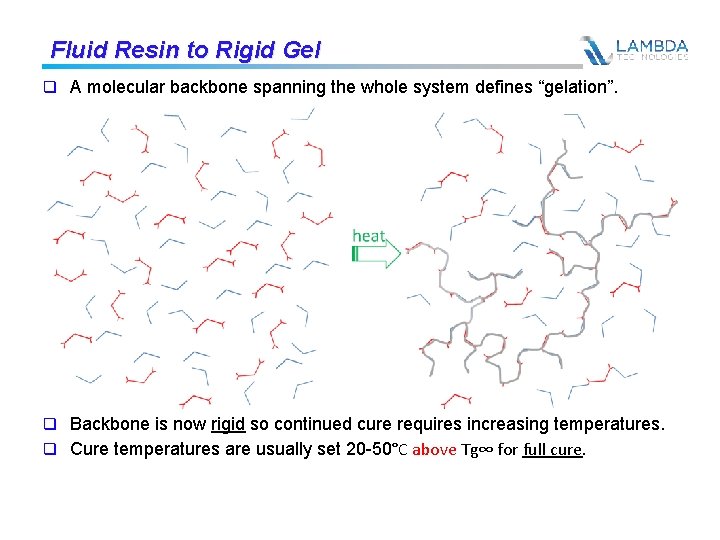
Fluid Resin to Rigid Gel q A molecular backbone spanning the whole system defines “gelation”. q Backbone is now rigid so continued cure requires increasing temperatures. q Cure temperatures are usually set 20 -50°C above Tg∞ for full cure.
Problems with Incomplete Cure Reactions q At the gel point the cure reaction may be only 30 -50% complete § As the temperature is raised the reaction (and adhesion) can continue § If temperature is not kept 10 -15°C above Tg, a glass (solid) forms § Time at a lower temperature must increase by 1000 X q Film adhesives are incompletely cured glasses (on purpose) 1. 2. 3. Adhesion will not increase without higher temperature The incompletely cured joint will soften at low temperatures If the joint temperature is raised above Tg at a later process step: The cure reaction will continue with: § Increased epoxy shrinkage § Decreased coefficient of thermal expansion § Potential movement and shifting of parts § Creation of voids and cracking in adhesive and between parts Back to high temperature curing, and high total stress!
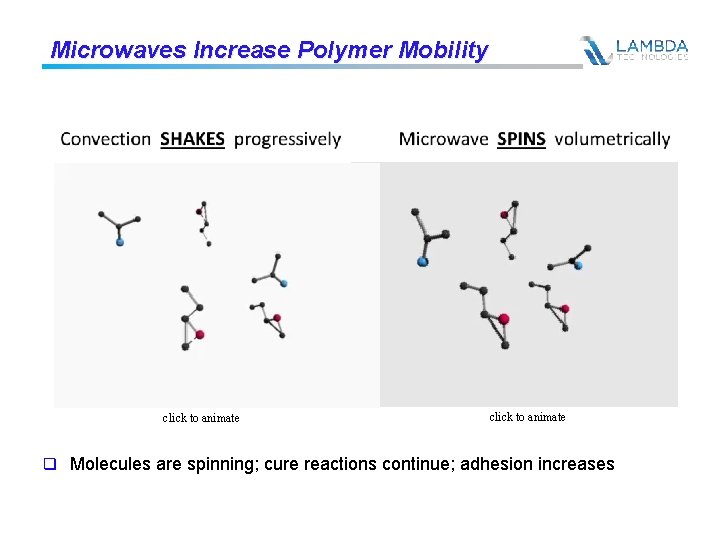
Microwaves Increase Polymer Mobility click to animate q Molecules are spinning; cure reactions continue; adhesion increases
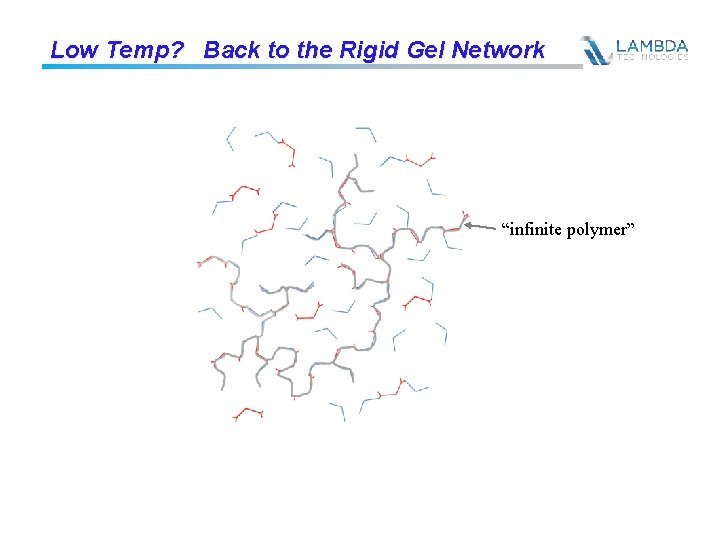
Low Temp? Back to the Rigid Gel Network “infinite polymer”
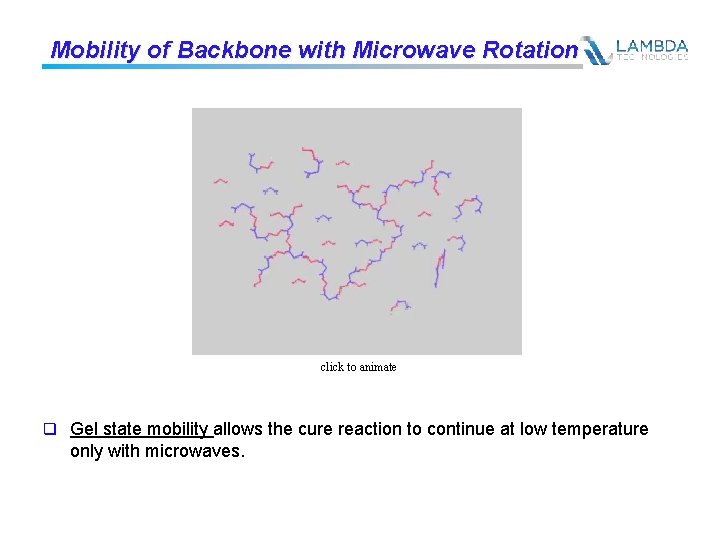
Mobility of Backbone with Microwave Rotation click to animate q Gel state mobility allows the cure reaction to continue at low temperature only with microwaves.
Applications for Adhesives and Molding
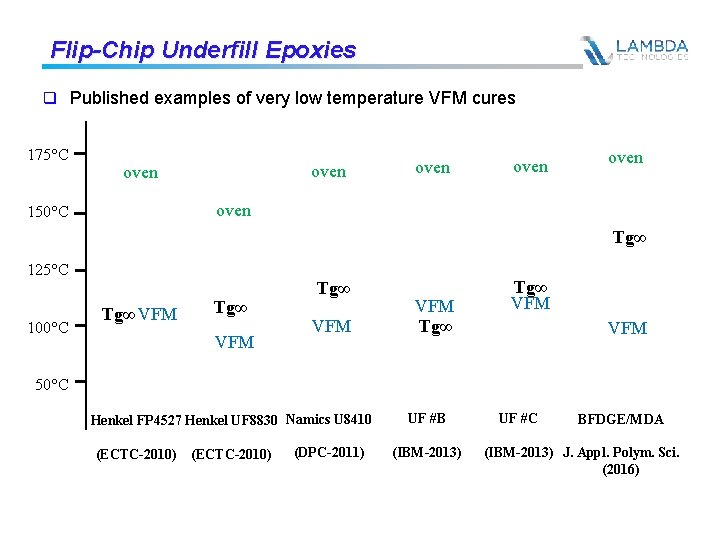
Flip-Chip Underfill Epoxies q Published examples of very low temperature VFM cures 175°C oven oven 150°C Tg∞ 125°C 100°C Tg∞ VFM Tg∞ VFM 50°C Henkel FP 4527 Henkel UF 8830 Namics U 8410 (ECTC-2010) (DPC-2011) UF #B (IBM-2013) UF #C BFDGE/MDA (IBM-2013) J. Appl. Polym. Sci. (2016)
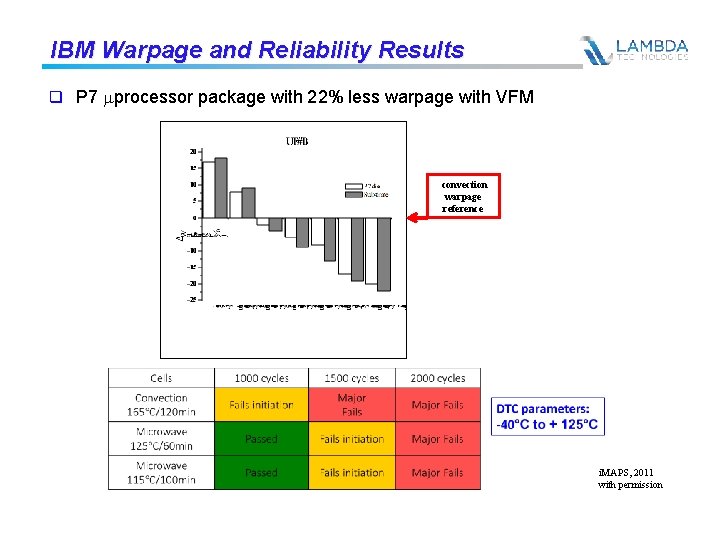
IBM Warpage and Reliability Results q P 7 mprocessor package with 22% less warpage with VFM convection warpage reference i. MAPS, 2011 with permission
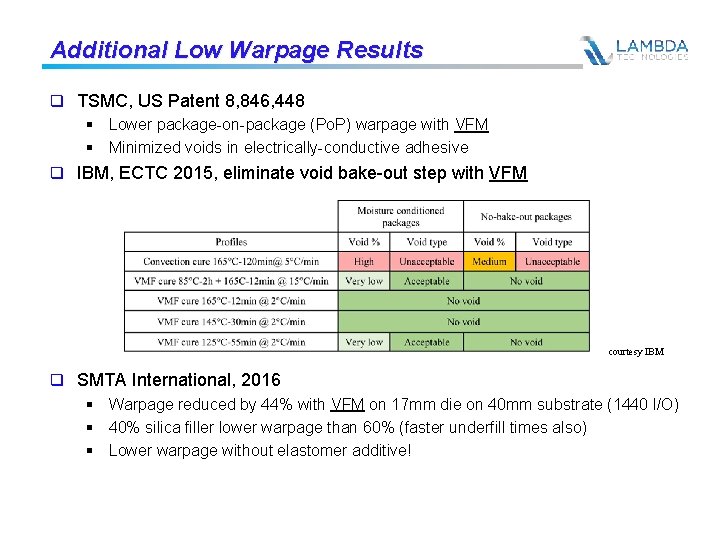
Additional Low Warpage Results q TSMC, US Patent 8, 846, 448 § Lower package-on-package (Po. P) warpage with VFM § Minimized voids in electrically-conductive adhesive q IBM, ECTC 2015, eliminate void bake-out step with VFM courtesy IBM q SMTA International, 2016 § Warpage reduced by 44% with VFM on 17 mm die on 40 mm substrate (1440 I/O) § 40% silica filler lower warpage than 60% (faster underfill times also) § Lower warpage without elastomer additive!
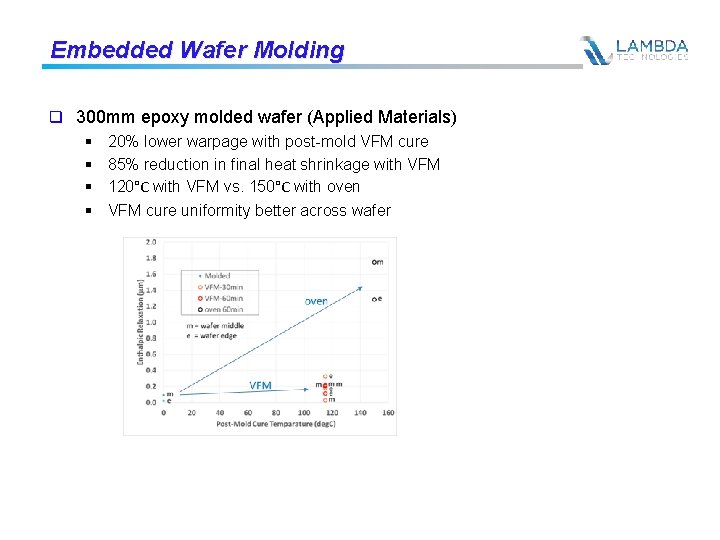
Embedded Wafer Molding q 300 mm epoxy molded wafer (Applied Materials) § § 20% lower warpage with post-mold VFM cure 85% reduction in final heat shrinkage with VFM 120°C with VFM vs. 150°C with oven VFM cure uniformity better across wafer
Low Temperature VFM Cure = Low Stress q Low temperature cure of epoxies (~50°C lower than oven) § Full extent of cure, full adhesion, and maximum Tg∞ § Cure well below Tg∞ temperature without forming a glass § Similar cure times or faster q Sources of stress in both assemblies and materials § Lowered thermal stress between CTE mis-matched materials (i. e. silicon/BT) § Lowered shrinkage stress from lower temperature cure § Reduced aggomerate thermal front stress in the epoxy material q Commonly used additives to modify epoxies; § Silica added (60 -90%) to lower CTE no longer necessary § Elastomers added to lower modulus no longer necessary § Faster dispense time; fewer reliability issues with additives q Othermosets show similar improvements (even vinyls and acrylates)
- Slides: 16