
WARNING This document contains technical data the export

- Slides: 32
WARNING -- This document contains technical data the export of which is or may be restricted by the Export Administration Act and the Export Administration Regulations (EAR), 15 C. F. R. parts 730 -774. Diversion contrary to U. S. law is prohibited. The export, re-export, transfer or re-transfer of this technical data to any other company, entity, person, or destination, or for any use or purpose other than that for which the technical data was originally provided by P&W, is prohibited without prior written approval from P&W and authorization under applicable export control laws. EAR Export Classification: ECCN EAR 99.
Organic Rankine Cycle (ORC) Solutions Pratt & Whitney Power Systems / Turboden ORC Solutions EAR Export Classification: ECCN EAR 99.
Agenda • About Pratt & Whitney Power Systems and Turboden • Thermodynamic Principle of Organic Rankine Cycle • ORC Applications • References • System Advantages EAR Export Classification: ECCN EAR 99. 3
About us – Pratt & Whitney Power Systems Turboden, a Pratt & Whitney Power Systems company, is a European leader in ORC technology for the generation and cogeneration of heat and power from renewable energy and heat recovery. Pratt & Whitney, a division of United Technologies Corporation (UTC), is a world leader in the design, manufacture and service of aircraft engines, industrial gas turbines and space propulsion systems. • revenues of $13. 4 billion • 36, 000 employees • more than 11, 000 customers • 195 countries Pratt & Whitney Power Systems (PWPS), the industrial gas turbine business of Pratt & Whitney, provides power generation and mechanical drive solutions for the electric generation, oil and gas markets, including service through the entire product life cycle. EAR Export Classification: ECCN EAR 99. 4
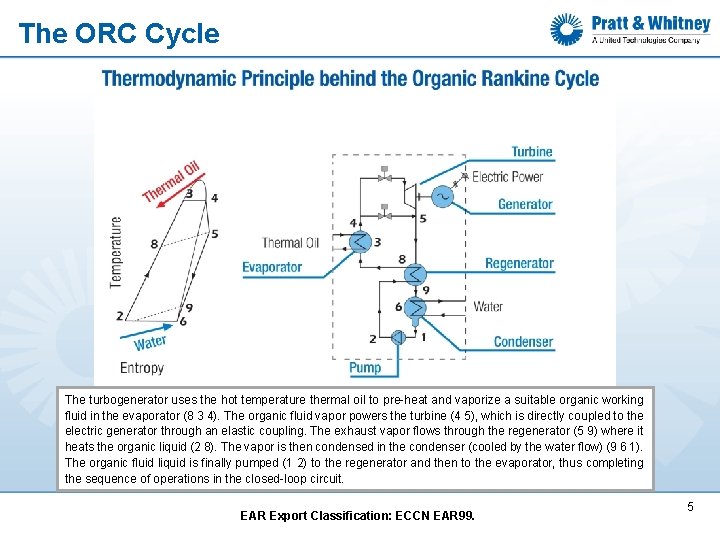
The ORC Cycle The turbogenerator uses the hot temperature thermal oil to pre-heat and vaporize a suitable organic working fluid in the evaporator (8 3 4). The organic fluid vapor powers the turbine (4 5), which is directly coupled to the electric generator through an elastic coupling. The exhaust vapor flows through the regenerator (5 9) where it heats the organic liquid (2 8). The vapor is then condensed in the condenser (cooled by the water flow) (9 6 1). The organic fluid liquid is finally pumped (1 2) to the regenerator and then to the evaporator, thus completing the sequence of operations in the closed-loop circuit. EAR Export Classification: ECCN EAR 99. 5
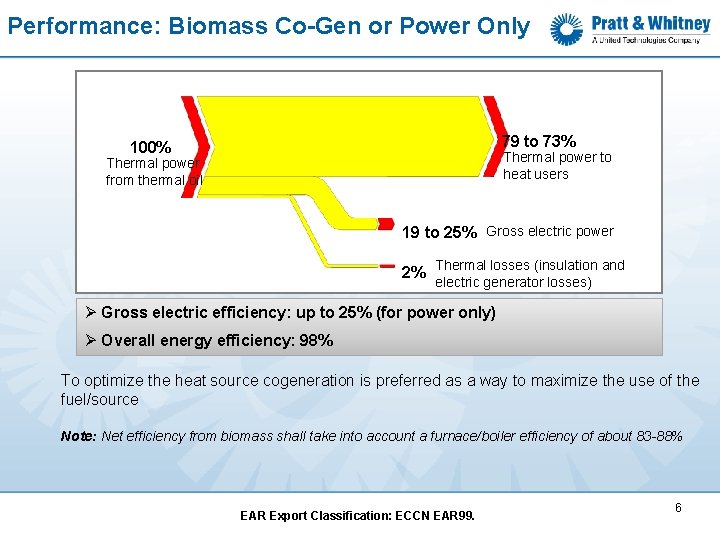
Performance: Biomass Co-Gen or Power Only 79 to 73% 100% Thermal power to heat users Thermal power from thermal oil 19 to 25% Gross electric power 2% Thermal losses (insulation and electric generator losses) Ø Gross electric efficiency: up to 25% (for power only) Ø Overall energy efficiency: 98% To optimize the heat source cogeneration is preferred as a way to maximize the use of the fuel/source Note: Net efficiency from biomass shall take into account a furnace/boiler efficiency of about 83 -88% EAR Export Classification: ECCN EAR 99. 6
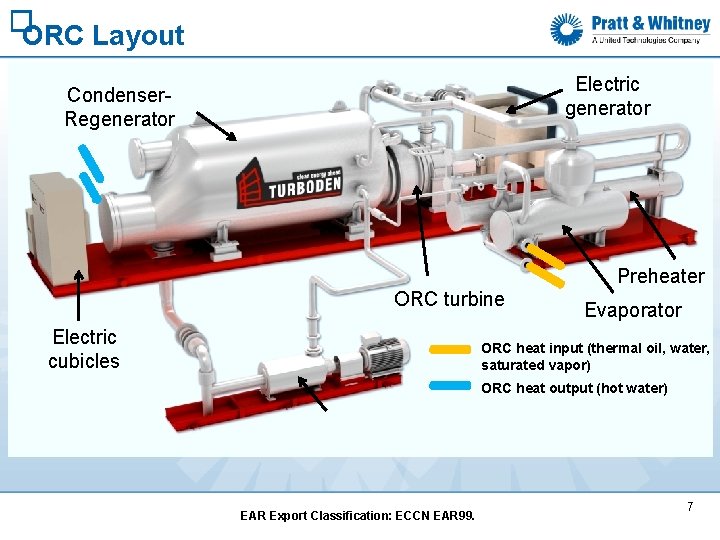
� ORC Layout Electric generator Condenser. Regenerator Preheater ORC turbine Electric cubicles Evaporator ORC heat input (thermal oil, water, saturated vapor) ORC heat output (hot water) EAR Export Classification: ECCN EAR 99. 7
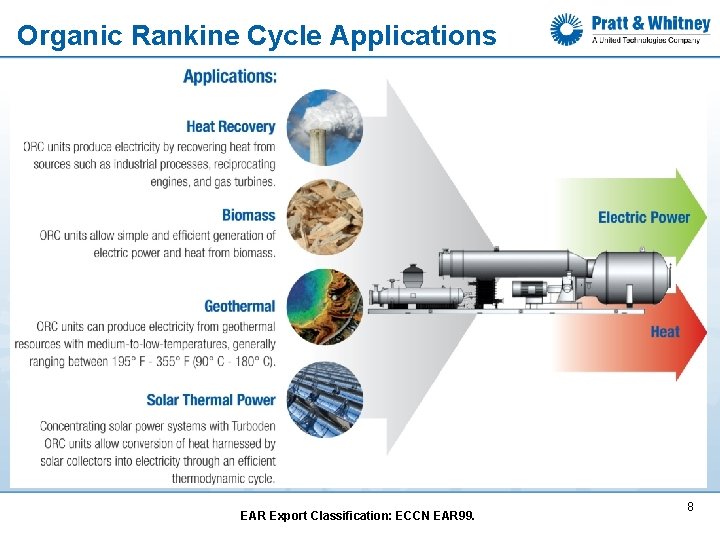
Organic Rankine Cycle Applications EAR Export Classification: ECCN EAR 99. 8
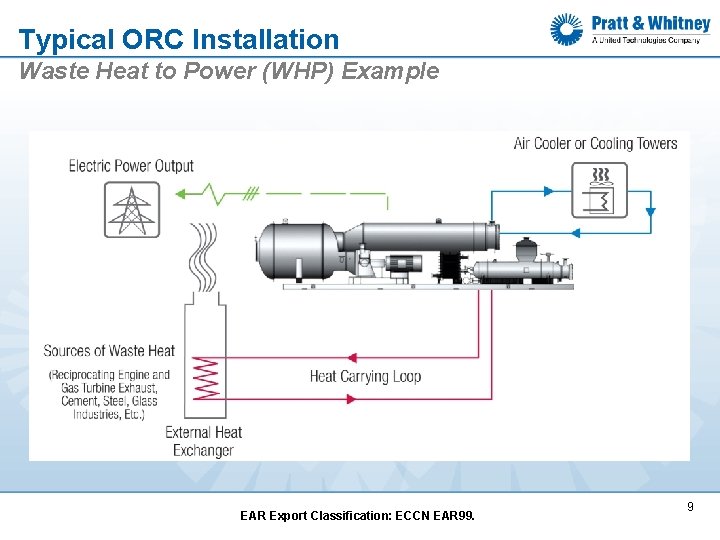
Typical ORC Installation Waste Heat to Power (WHP) Example EAR Export Classification: ECCN EAR 99. 9
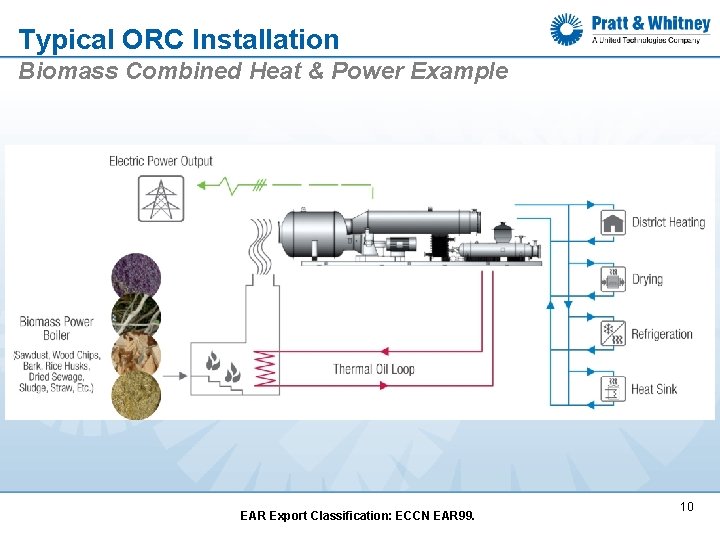
Typical ORC Installation Biomass Combined Heat & Power Example EAR Export Classification: ECCN EAR 99. 10
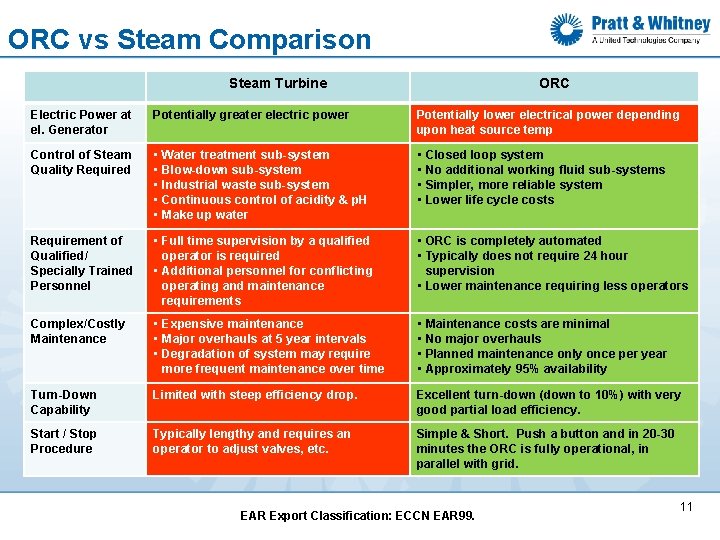
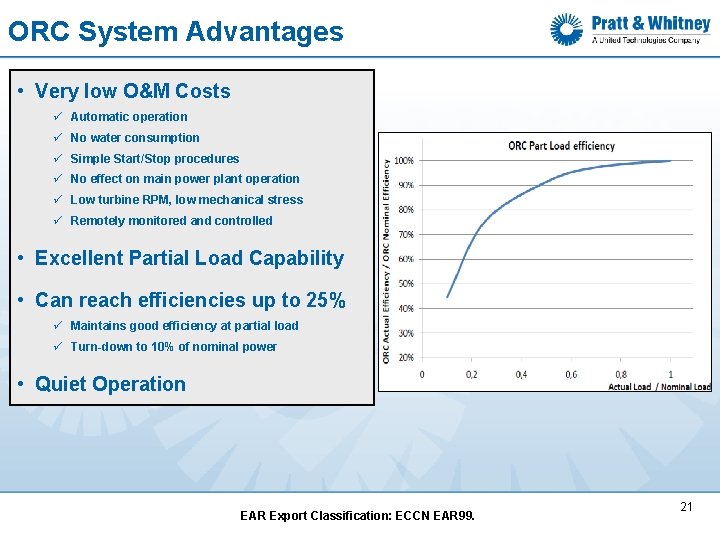
ORC vs Steam Comparison Steam Turbine ORC Electric Power at el. Generator Potentially greater electric power Potentially lower electrical power depending upon heat source temp Control of Steam Quality Required • • • Requirement of Qualified/ Specially Trained Personnel • Full time supervision by a qualified operator is required • Additional personnel for conflicting operating and maintenance requirements • ORC is completely automated • Typically does not require 24 hour supervision • Lower maintenance requiring less operators Complex/Costly Maintenance • Expensive maintenance • Major overhauls at 5 year intervals • Degradation of system may require more frequent maintenance over time • • Turn-Down Capability Limited with steep efficiency drop. Excellent turn-down (down to 10%) with very good partial load efficiency. Start / Stop Procedure Typically lengthy and requires an operator to adjust valves, etc. Simple & Short. Push a button and in 20 -30 minutes the ORC is fully operational, in parallel with grid. Water treatment sub-system Blow-down sub-system Industrial waste sub-system Continuous control of acidity & p. H Make up water Closed loop system No additional working fluid sub-systems Simpler, more reliable system Lower life cycle costs Maintenance costs are minimal No major overhauls Planned maintenance only once per year Approximately 95% availability EAR Export Classification: ECCN EAR 99. 11
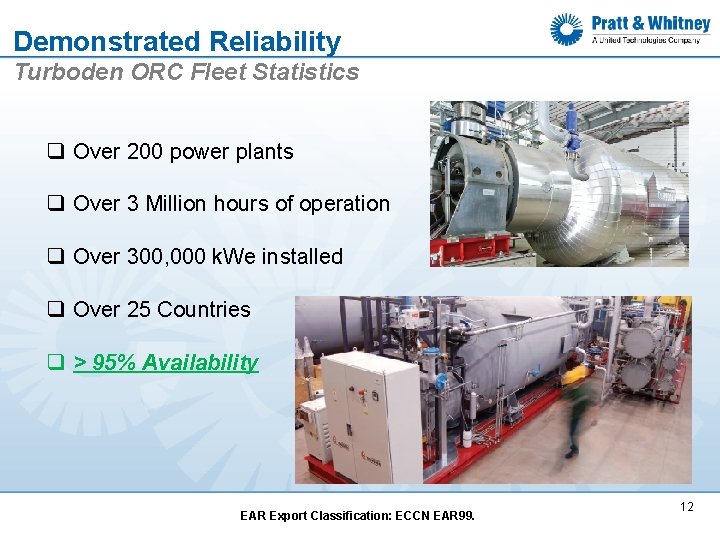
Demonstrated Reliability Turboden ORC Fleet Statistics q Over 200 power plants q Over 3 Million hours of operation q Over 300, 000 k. We installed q Over 25 Countries q > 95% Availability EAR Export Classification: ECCN EAR 99. 12
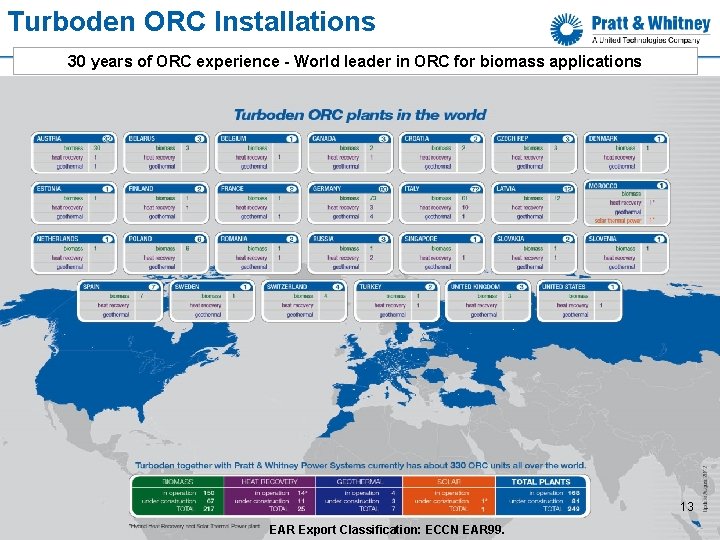
Turboden ORC Installations 30 years of ORC experience - World leader in ORC for biomass applications • >2000 Gas Turbines Sold Worldwide • >300 ORC Units, 26 Countries= ~300, 000 k. Wel 13 EAR Export Classification: ECCN EAR 99.
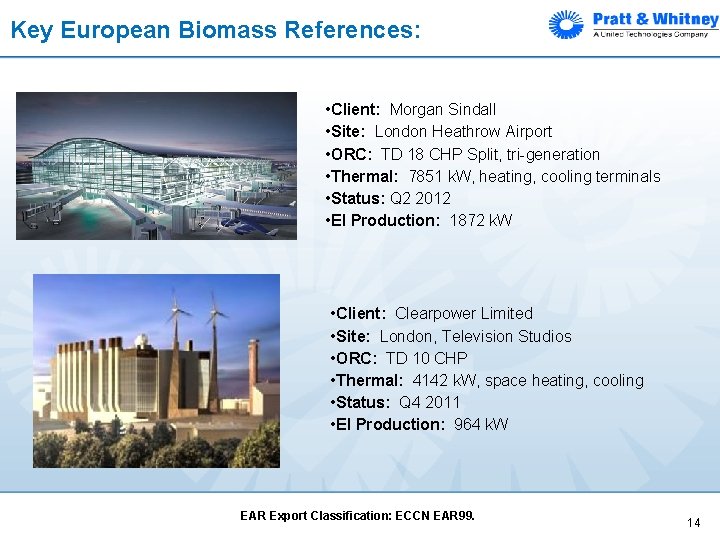
Key European Biomass References: • Client: Morgan Sindall • Site: London Heathrow Airport • ORC: TD 18 CHP Split, tri-generation • Thermal: 7851 k. W, heating, cooling terminals • Status: Q 2 2012 • El Production: 1872 k. W • Client: Clearpower Limited • Site: London, Television Studios • ORC: TD 10 CHP • Thermal: 4142 k. W, space heating, cooling • Status: Q 4 2011 • El Production: 964 k. W EAR Export Classification: ECCN EAR 99. 14
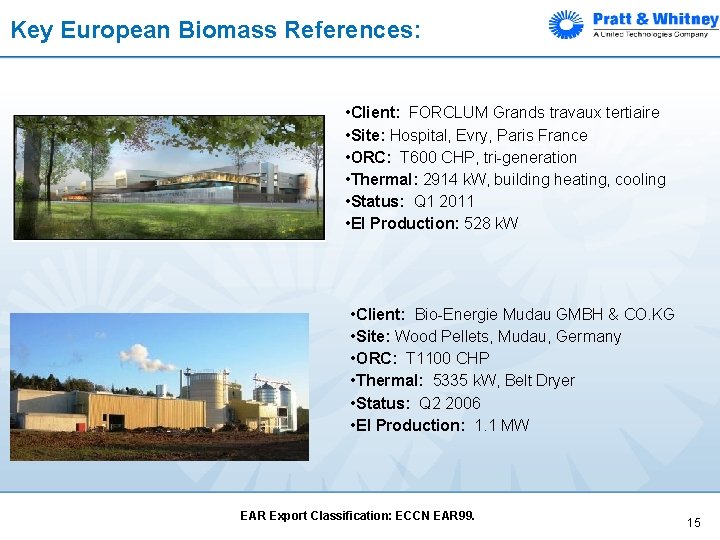
Key European Biomass References: • Client: FORCLUM Grands travaux tertiaire • Site: Hospital, Evry, Paris France • ORC: T 600 CHP, tri-generation • Thermal: 2914 k. W, building heating, cooling • Status: Q 1 2011 • El Production: 528 k. W • Client: Bio-Energie Mudau GMBH & CO. KG • Site: Wood Pellets, Mudau, Germany • ORC: T 1100 CHP • Thermal: 5335 k. W, Belt Dryer • Status: Q 2 2006 • El Production: 1. 1 MW EAR Export Classification: ECCN EAR 99. 15
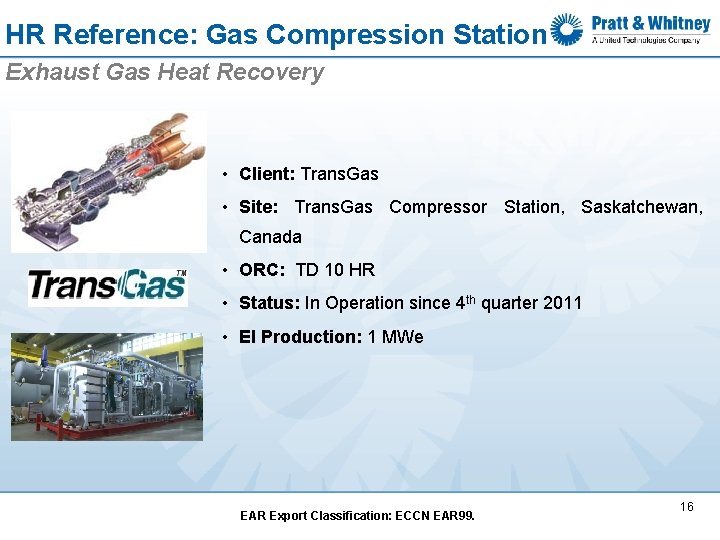
HR Reference: Gas Compression Station Exhaust Gas Heat Recovery • Client: Trans. Gas • Site: Trans. Gas Compressor Station, Saskatchewan, Canada • ORC: TD 10 HR • Status: In Operation since 4 th quarter 2011 • El Production: 1 MWe EAR Export Classification: ECCN EAR 99. 16
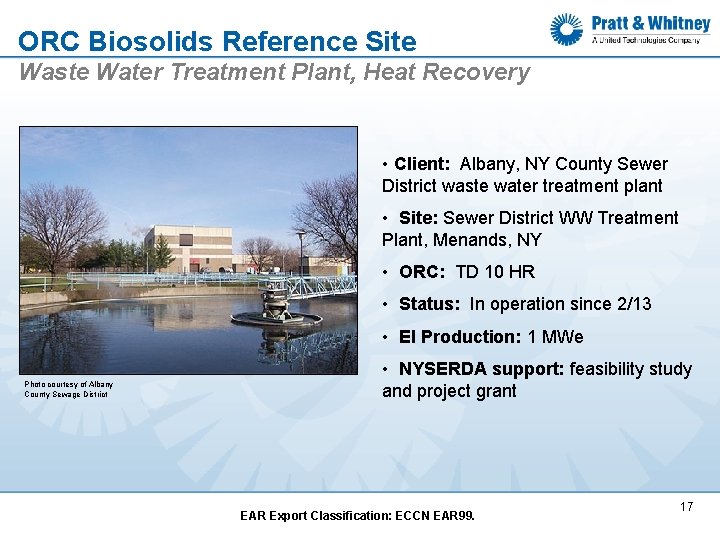
ORC Biosolids Reference Site Waste Water Treatment Plant, Heat Recovery • Client: Albany, NY County Sewer District waste water treatment plant • Site: Sewer District WW Treatment Plant, Menands, NY • ORC: TD 10 HR • Status: In operation since 2/13 • El Production: 1 MWe Photo courtesy of Albany County Sewage District • NYSERDA support: feasibility study and project grant EAR Export Classification: ECCN EAR 99. 17
ORC Biomass Reference: Sawmill Combined Heat & Power • Client: Nechako Green Energy (a subsidiary of Nechako Lumber) • ORC Unit: Turboden 22 CHP • Status: Under Construction • Start-up: 4 th quarter 2012 • Electric power generated: 1, 968 k. W • Thermal power application: Future heat or sawdust drying • Water temperature: 60 -90 °C (140195 F) EAR Export Classification: ECCN EAR 99. 18
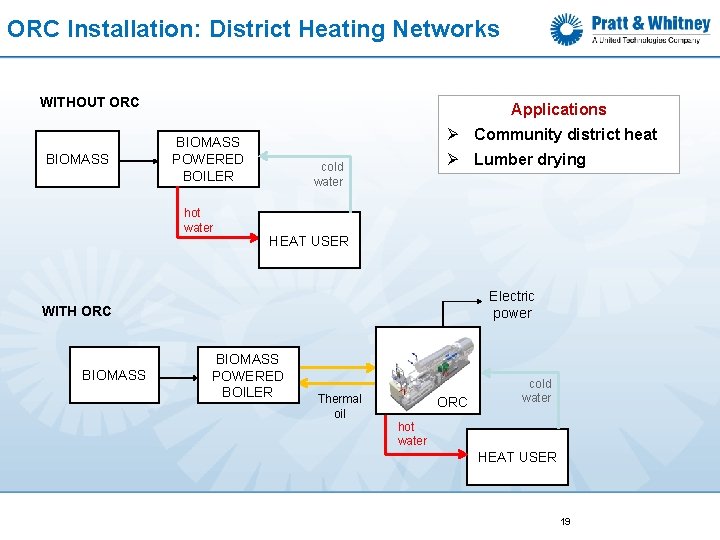
ORC Installation: District Heating Networks WITHOUT ORC BIOMASS Applications Ø Community district heat BIOMASS POWERED BOILER hot water Ø Lumber drying cold water HEAT USER Electric power WITH ORC BIOMASS POWERED BOILER Thermal oil ORC cold water hot water HEAT USER 19
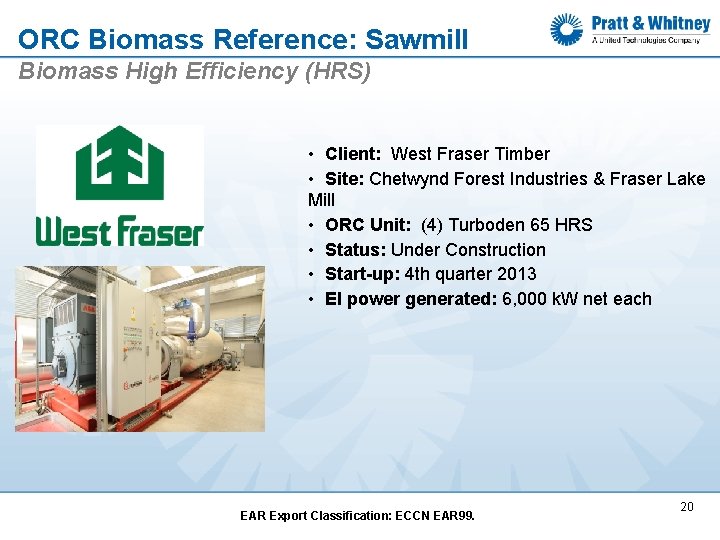
ORC Biomass Reference: Sawmill Biomass High Efficiency (HRS) • Client: West Fraser Timber • Site: Chetwynd Forest Industries & Fraser Lake Mill • ORC Unit: (4) Turboden 65 HRS • Status: Under Construction • Start-up: 4 th quarter 2013 • El power generated: 6, 000 k. W net each EAR Export Classification: ECCN EAR 99. 20
ORC System Advantages • Very low O&M Costs ü Automatic operation ü No water consumption ü Simple Start/Stop procedures ü No effect on main power plant operation ü Low turbine RPM, low mechanical stress ü Remotely monitored and controlled • Excellent Partial Load Capability • Can reach efficiencies up to 25% ü Maintains good efficiency at partial load ü Turn-down to 10% of nominal power • Quiet Operation EAR Export Classification: ECCN EAR 99. 21
Agenda Part 2 • ORC System Operation • ORC Canadian Installations • Key Highlights EAR Export Classification: ECCN EAR 99. 22
ORC System Operation • The ORC system will be capturing the waste heat from the plant process through a thermal oil loop utilizing a dedicated Waste Heat Oil Heater (WHOH), air to thermal oil exchanger. • The WHOH will be placed in a by-pass stack to avoid affecting the normal kiln operation, as well as provide somewhat independent operation (e. g. start up, inspection, maintenance, etc. ). – The thermal oil loop temperature is kept below the oil’s boiling point and therefore there is no phase change, and could be considered low pressure boiler or oil heater. (A boiler that is intended to be operated at a pressure of 160 psi or less where the water temperature at any boiler outlet is 250 F (121 C) or less) PWPS Proprietary – ECCN: EAR 99 23
ORC System Operation • Within the ORC system, thermal oil liquid flow maintains the design temperature of the heat exchangers and does not create any hot spots eliminating potential damage due to excessive heat. • The ORC power plant is controlled through a Programmable Logic Control (PLC) system which automates the control of the unit with properly trained personnel performing on-shift operation and inspections. • The Control system has no provision for manual operation. In the event of a control system fault or a potentially unsafe condition, the controller will shut down the system and prevent a restart until such time that the control system fault has been repaired or, the potentially unsafe condition has been addressed and all of the controller inputs indicate that the system is in a safe condition. PWPS Proprietary – ECCN: EAR 99 24
ORC System Operation • The ORC power plant inherently runs at lower operating temperatures and pressures and does not exhibit corrosion issues since non-corrosive process fluids are used and the ORC system is installed indoors in a temperature controlled environment. • The ORC system is protected from excursions utilizing: – High pressure limiting devices – Low power output shut off (equivalent to low thermal resource level or low water limiting device) – Failsafe protective devices that are independent of other control systems • The use of a working fluid eliminates problems associated with boiler turbine plants such as corrosion, burdensome water-conditioning, potential freezing, excessive pressures and operator oversight of water management. PWPS Proprietary – ECCN: EAR 99 25
ORC Canadian Installations • Pedigree of other Canadian Installations in other Provinces – Rosetown, Saskatchewan Compressor Station – 1 MW Waste Heat - Gas Turbine, 2010 - Trans. Gas – Long Lake, Alberta – 22. 2 MW Waste Heat (refining)- 2006, OPTI-Nexen J. V. – Gold Creek, Alberta – 6. 5 MW, Waste Heat, 1999, Trans Canada Pipeline – 150 Miles and Savona , British Columbia – 5. 1 MW, Waste Heat – 2008, En. Power – Lore. Burn, Almeda, Estlin and Kerrobert, Saskatchewan – 5 to 5. 8 MW, Waste Heat (LM 2200/2500 Gas Turbine, 930 F to 990 F) - 2006 to 2008, Alliance Pipeline and NR Green PWPS Proprietary – ECCN: EAR 99 26
Key Highlights Operation • • Lower operating temperatures and pressures Temperature control (Thermal Fluid system) vs pressure control (Steam) Automated control Plant safety protection Maintenance • • No Water treatment or level control required No water level or corrosion concerns No Blowdown No steam trap maintenance PWPS Proprietary – ECCN: EAR 99 27
Back Up Slides PWPS Proprietary – ECCN: EAR 99 28
Additional Discussion points • Our process fluids do not have the same properties as steam. There are no provisions in the regulatory language for process fluids other than steam. There is a high probability of not receiving consistent interpretations. • System Breach • Boiler (sudden pressure increase)– Specific volume change from liquid to vapor for thermal fluid is xx versus 6 times for steam. • Piping (Energy release) – Cyclopentane specific enthalpy is 4 times lower than that of steam at associated operating conditions. • Difference of direct fired (boiler) versus indirect “fired” (heat exchanger). ASME does not treat indirect unfired heat exchangers as boilers. • Based on the rules as written does the oil heater require an operator? • Does a gas fired air heater have an operator requirement? PWPS Proprietary – ECCN: EAR 99 29
Definitions Unattended operation: • Where unattended operation is permitted, a qualified operator is not a mandatory requirement. The boiler may be supervised by an appropriately trained "Responsible Person"; • The operator or responsible person may leave the site provided that he or she is available to respond to boiler outages. That is usually achieved by a pager or cellphone signal transmitted by the Control System (CS); • In many jurisdictions, unattended boilers may start up and shut down automatically under the control of the CS provided that they are suitably equipped to the satisfaction of an approved inspection body; • Boiler codes in most jurisdictions specifically forbid the provision for manual intervention in the operation of unattended boilers. They must at all times be under the control of the CS. That is, they may only be operated in unattended mode. They may not be operated in attended mode under any circumstances even for brief periods and even if a qualified operator is available. PWPS Proprietary – ECCN: EAR 99 30
Definitions • Boiler: a fired vessel in which gas or vapor may be generated or a gas, vapor or liquid may be put under pressure by heating • Fired Vessel: a vessel that is directly heated by • A flame or the hot gases of combustion • Electricity • Any means other than a thermal liquid • Low Pressure Boiler: • A boiler that is intended to generate steam or other vapour at a pressure of 15 psi or less • A boiler that is intended to be operated at a pressure of 160 psi or less where the water temperature at any boiler outlet is 250 F (121 C) or less • Pressure Vessel: any enclosed unfired vessel that contains gas, vapor or liquid under pressure PWPS Proprietary – ECCN: EAR 99 31
THANK YOU ! Kristen Cofrancesco Sales & Business Development Manager for North America EAR Export Classification: ECCN EAR 99.