
Warmup What is figurative language Why do authors
- Slides: 30
Warm-up • What is figurative language? Why do author’s use figurative language in their writing? • You need: – 1 colored pencil – Notebook – Sheet of notebook paper for your warm-up
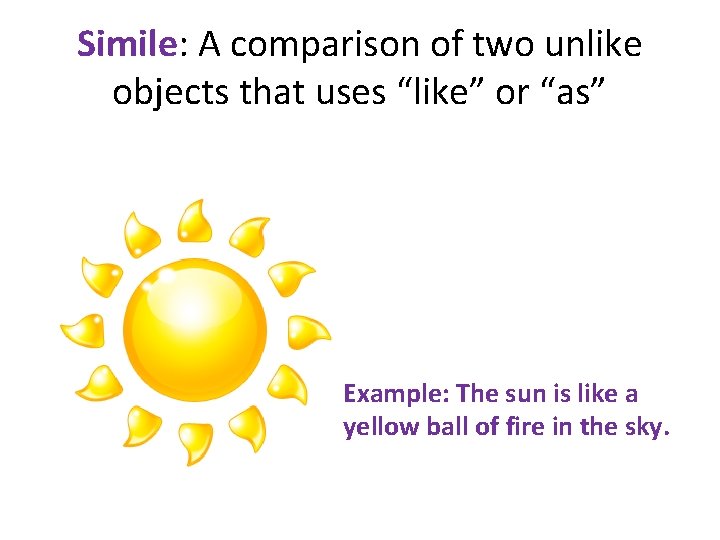
Simile: A comparison of two unlike objects that uses “like” or “as” Example: The sun is like a yellow ball of fire in the sky.
Make a list of 5 verbs. Next, write the phrase “like a” after each verb. Finish each simile phrase by adding a noun and specifying what is being compared. Example: My cousin sings like an angel.
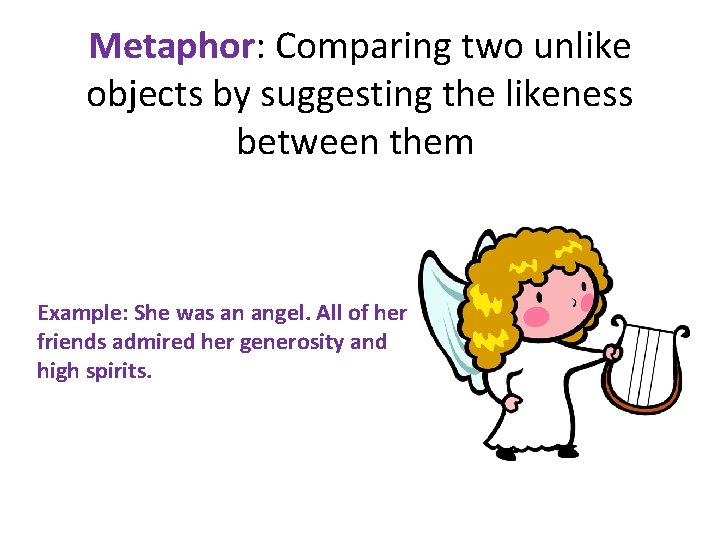
Metaphor: Comparing two unlike objects by suggesting the likeness between them Example: She was an angel. All of her friends admired her generosity and high spirits.
Choose six colors and create metaphors to explain what you think of when you see each color. Example: Yellow is a sunflower growing in a field.
Cliché: A word or phrase that has become overly familiar or overused. Example: No pain, No gain
“It was a dark and stormy night” is an overused way to begin a scary or suspenseful story. Put an interesting twist on this cliché by changing two of the words in the sentence. Write a short story that begins with your new sentence.
Warm-up 1. Grab your notebooks. 2. Sit in your assigned seats. We need to finish the words from yesterday and THEN we will talk about your grades. The longer it takes to finish the work from yesterday the less time we will have for make-up work.
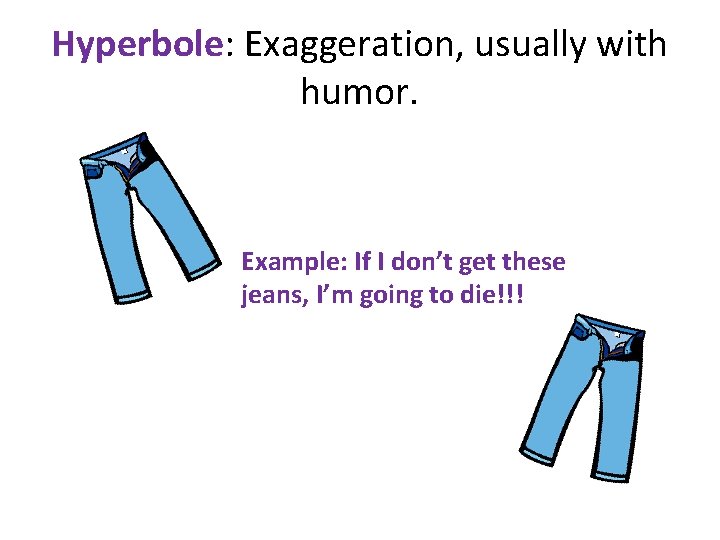
Hyperbole: Exaggeration, usually with humor. Example: If I don’t get these jeans, I’m going to die!!!
Another example of a hyperbole is, “I waited in line for a million years. ” What other examples of hyperbole can you think of. Why would using hyperbole be better than simply telling the truth.
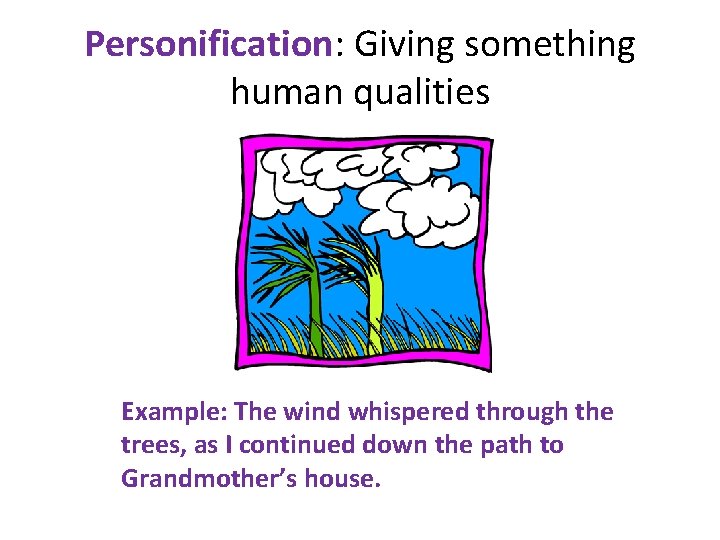
Personification: Giving something human qualities Example: The wind whispered through the trees, as I continued down the path to Grandmother’s house.
Choose One Option A: Imagine that your favorite toy from your childhood could talk. What memories does it have? What does it think about you? Option B: Explain a typical day from the point of view of the MTA bus.
READ ALL OF THE FOLLOWING BEFORE ASKING ME ANY QUESTIONS AND BEFORE DOING ANYTHING • Grab your notebook and stand towards the front of the room except for Ian, Emily H, Brice, Austin, Jacob, and Emily B. You six may take a seat. Each of you should be at a different group of desks. • Everyone: Hands to yourself and NO shouting! • DO NOT TOUCH ANYTHING ON MY DESK!
Warm-up • Create an example for each of the following: simile, metaphor, and personification. (Record your examples in your notebook. ) • SWBAT distinguish between alliteration and assonance in order to solve a crime and accurately use alliteration and assonance in your own writing.
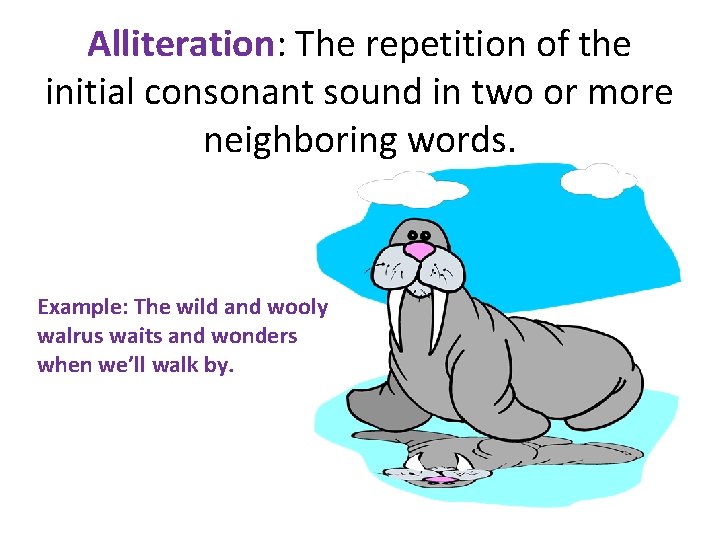
Alliteration: The repetition of the initial consonant sound in two or more neighboring words. Example: The wild and wooly walrus waits and wonders when we’ll walk by.
Choose a consonant and create a tongue twister that includes several words that begin with the letter’s sound. Do not simply write a tongue twister that the world has already heard of.
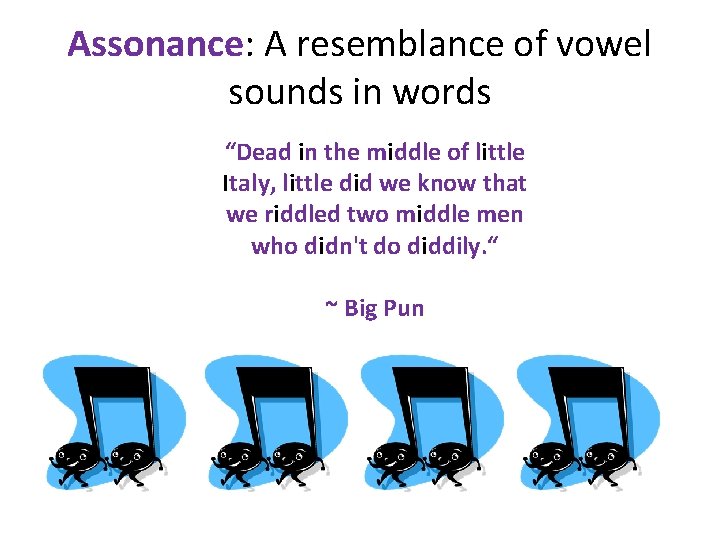
Assonance: A resemblance of vowel sounds in words “Dead in the middle of little Italy, little did we know that we riddled two middle men who didn't do diddily. “ ~ Big Pun
My Puppy Punched Me In the Eye My puppy punched me in the eye. My rabbit whacked my ear. My ferret gave a frightful cry and roundhouse kicked my rear. My lizard flipped me upside down. My kitten kicked my head. My hamster slammed me to the ground and left me nearly dead. So my advice? Avoid regrets; no matter what you do, don’t ever let your family pets take lessons in kung fu. –Kenn Nesbitt
Warm-up • What is the difference between alliteration and assonance? • Agenda – – – Warm-up Finish game Draw Finish Notes Musical Chairs
Choose a slip from the bucket in the front. Don’t simply copy off of your neighbor, because all of the phrases are different. Draw a picture that illustrates the visual image that comes to mind when you read the phrase. Then, write the literal meaning of the word below. Be sure the phrase is on the poster somewhere.
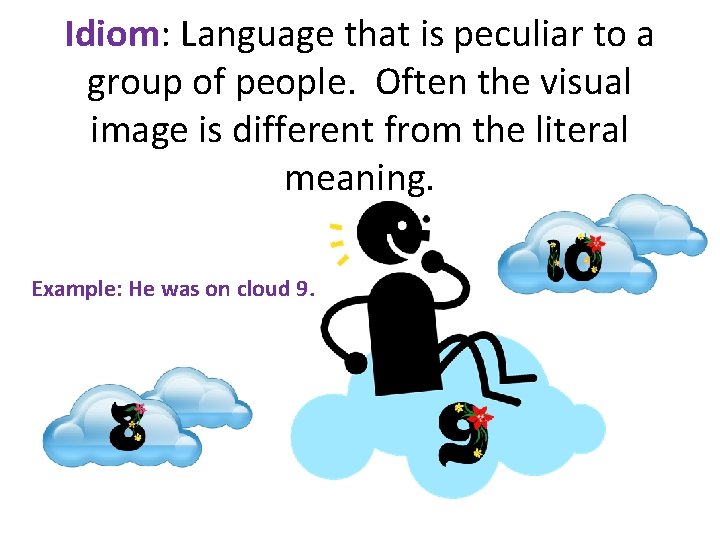
Idiom: Language that is peculiar to a group of people. Often the visual image is different from the literal meaning. Example: He was on cloud 9.
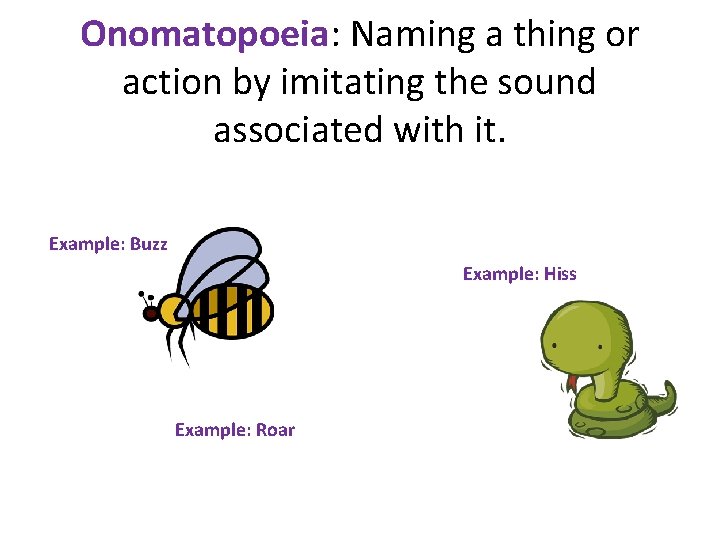
Onomatopoeia: Naming a thing or action by imitating the sound associated with it. Example: Buzz Example: Hiss Example: Roar
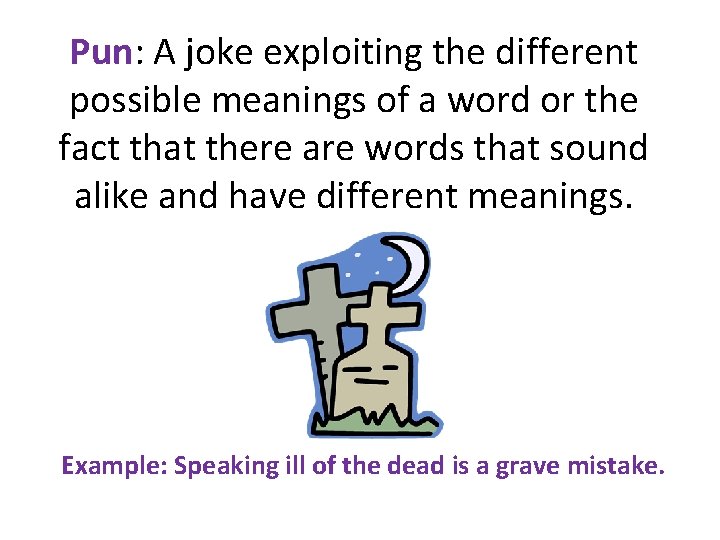
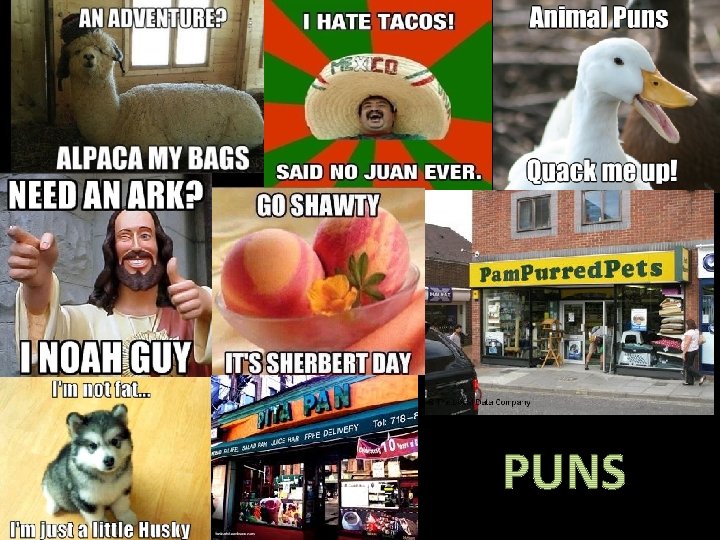
Pun: A joke exploiting the different possible meanings of a word or the fact that there are words that sound alike and have different meanings. Example: Speaking ill of the dead is a grave mistake.
Corny jokes are often puns. See if you can write a corny joke that involves food. Example: Mike: Shall we have a salad for lunch? Tammy: Yes, lettuce.
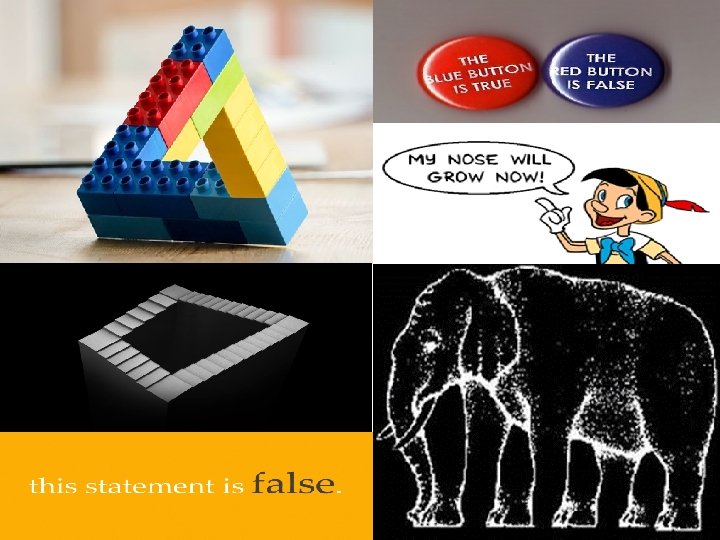
Paradox: a seemingly absurd or selfcontradictory statement or proposition that when investigated or explained may prove to be well founded or true. This is the beginning of the end. You can save money by spending it. Deep down, you’re really shallow.
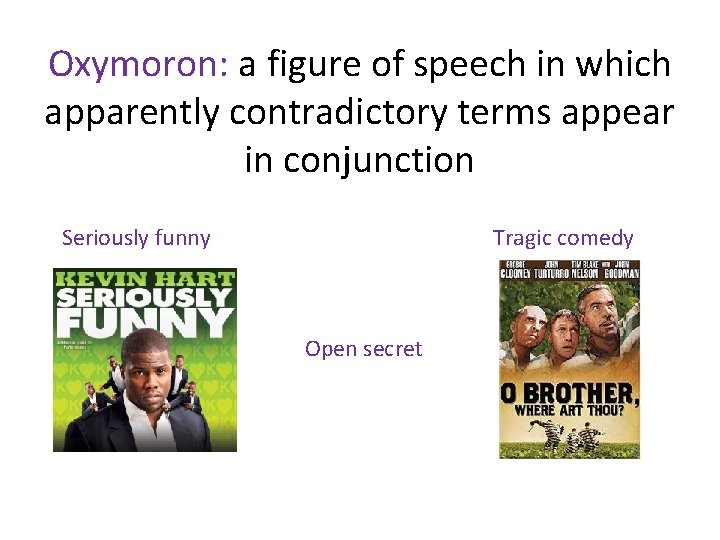
Oxymoron: a figure of speech in which apparently contradictory terms appear in conjunction Tragic comedy Seriously funny Open secret
What other examples of oxymoron can you think of? Example: Paid volunteers were working for the company.