
WarmUp What is a solution Very small particles
- Slides: 21
Warm-Up � What is a solution? ◦Very small particles ◦Evenly distributed ◦Do not separate
Solutions
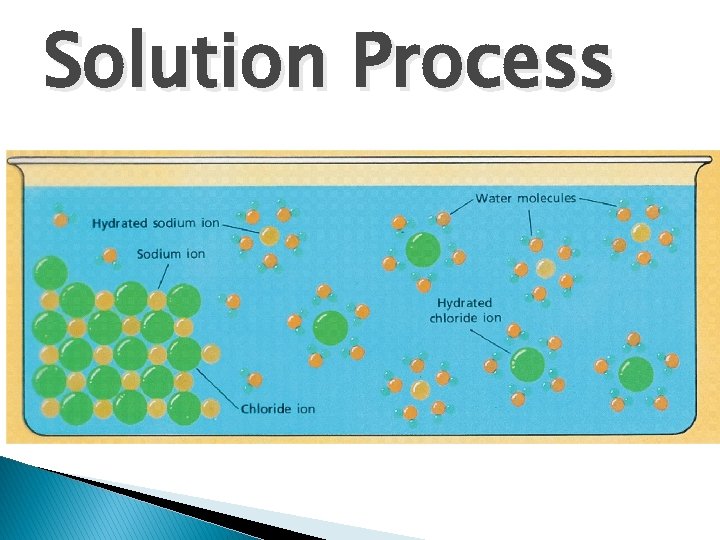
Solution Process
Solution Vocabulary �Solvent – liquid that is doing the dissolving �Solute – substance that dissolves in the liquid solvent ◦ Gas, liquid, or solid �Rate of dissolution will speed up by same factors that increase the rate of reaction: ◦ Higher temperature ◦ Increased surface area of solute ◦ Increased concentration of solute
Saturation �Saturated solutions contain as much solute as possible �Unsaturated solutions can dissolve more solute �Supersaturated solutions have dissolved more solute than is normally possible ◦ Formed by cooling down a saturated solution
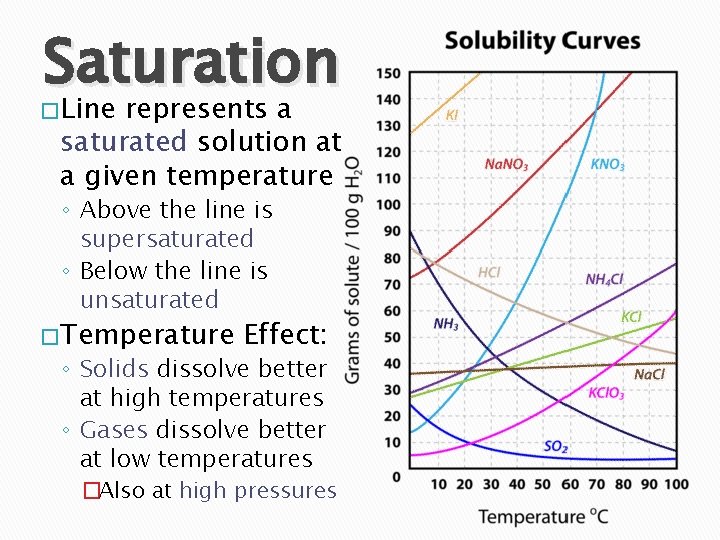
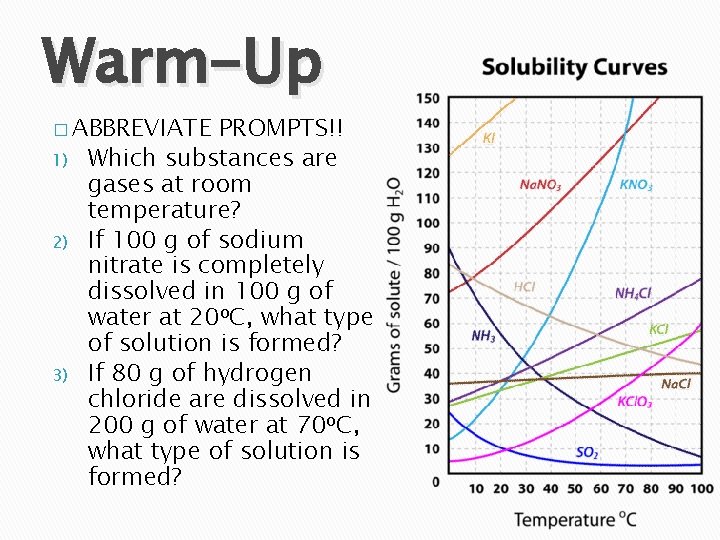
Saturation � Line represents a saturated solution at a given temperature ◦ Above the line is supersaturated ◦ Below the line is unsaturated � Temperature Effect: ◦ Solids dissolve better at high temperatures ◦ Gases dissolve better at low temperatures �Also at high pressures
Colligative Properties �When a solid dissolves in a liquid, it stabilizes the liquid phase! This effects 4 physical properties of the liquid: ◦ Boiling Point Elevation ◦ Freezing Point Depression ◦ Vapor Pressure Lowering ◦ Osmotic Pressure Increasing
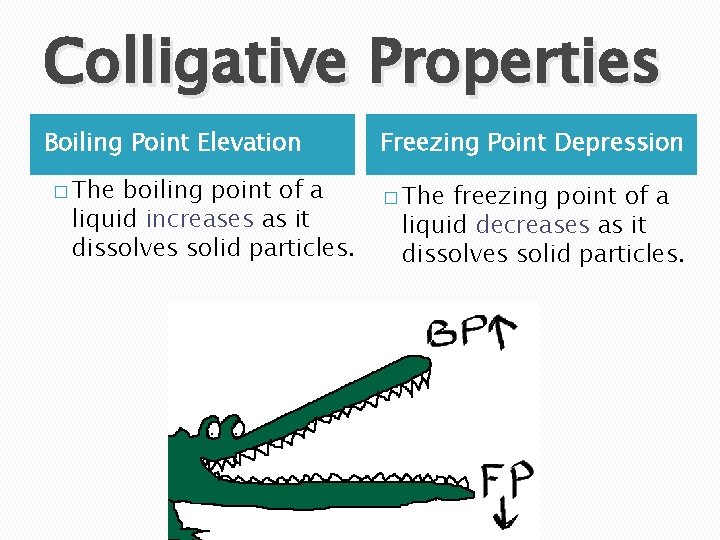
Colligative Properties Boiling Point Elevation � The boiling point of a liquid increases as it dissolves solid particles. Freezing Point Depression � The freezing point of a liquid decreases as it dissolves solid particles.
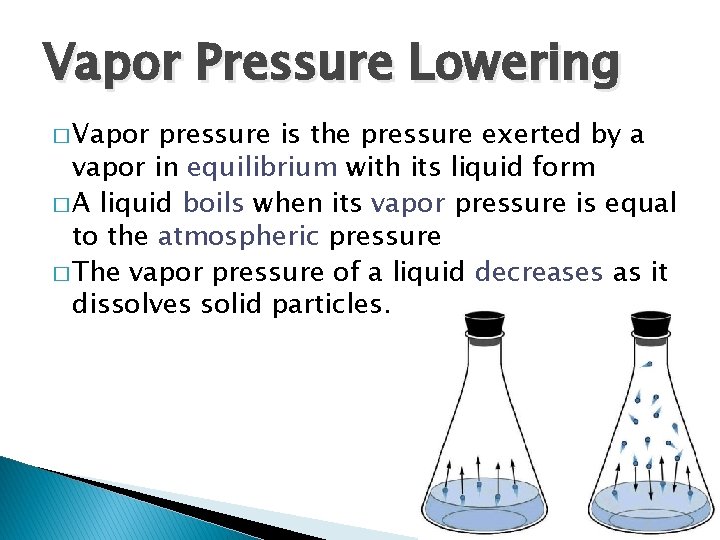
Vapor Pressure Lowering � Vapor pressure is the pressure exerted by a vapor in equilibrium with its liquid form � A liquid boils when its vapor pressure is equal to the atmospheric pressure � The vapor pressure of a liquid decreases as it dissolves solid particles.
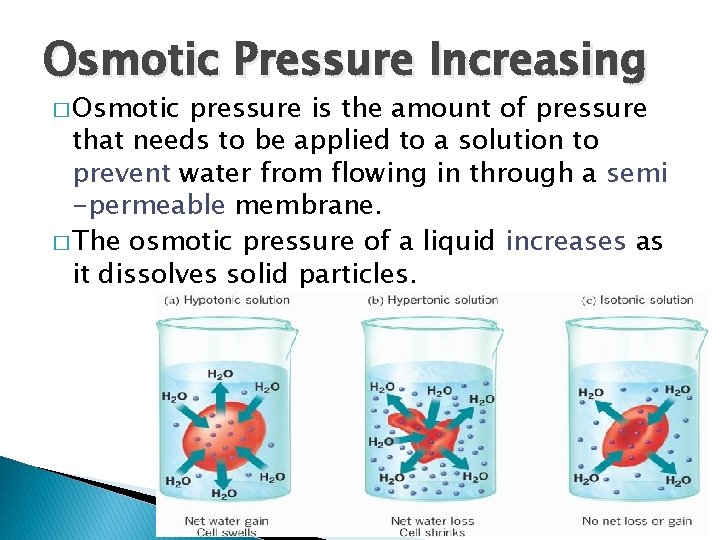
Osmotic Pressure Increasing � Osmotic pressure is the amount of pressure that needs to be applied to a solution to prevent water from flowing in through a semi -permeable membrane. � The osmotic pressure of a liquid increases as it dissolves solid particles.
Warm-Up � ABBREVIATE 1) 2) 3) PROMPTS!! Which substances are gases at room temperature? If 100 g of sodium nitrate is completely dissolved in 100 g of water at 20 o. C, what type of solution is formed? If 80 g of hydrogen chloride are dissolved in 200 g of water at 70 o. C, what type of solution is formed?
Warm-Up �Define “Molarity” in your own words.
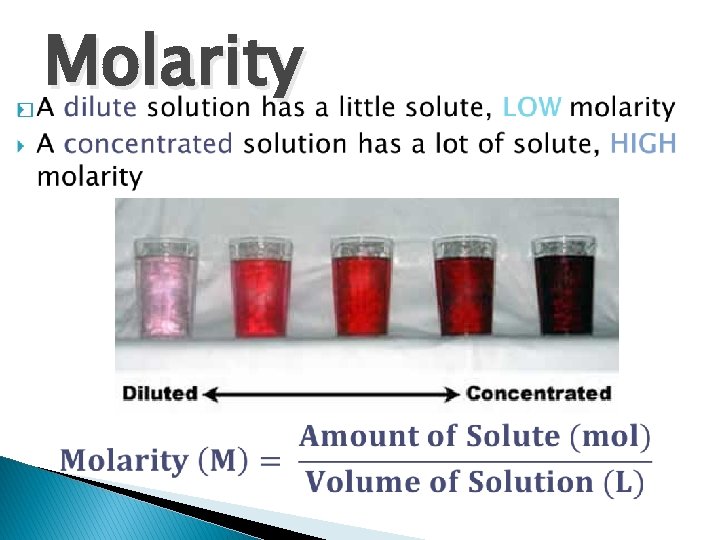
� Molarity
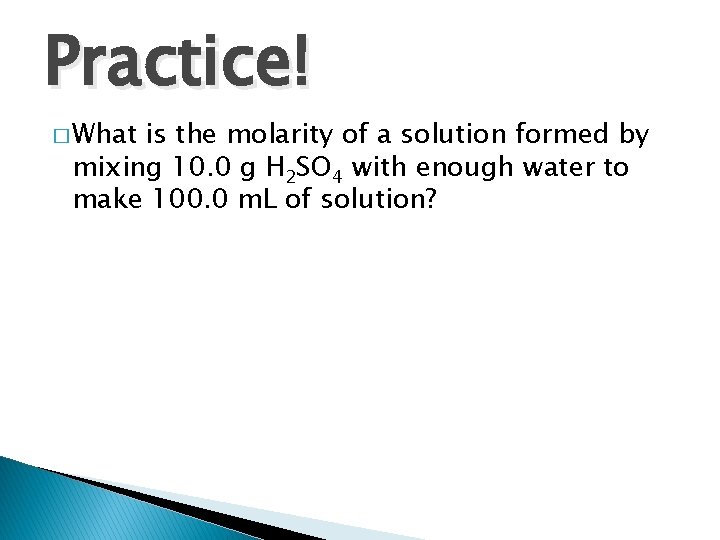
Practice! � What is the molarity of a solution formed by mixing 10. 0 g H 2 SO 4 with enough water to make 100. 0 m. L of solution?
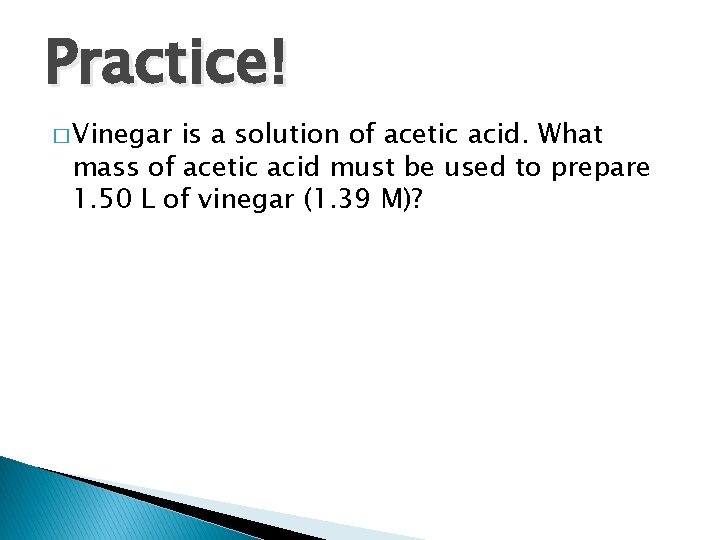
Practice! � Vinegar is a solution of acetic acid. What mass of acetic acid must be used to prepare 1. 50 L of vinegar (1. 39 M)?
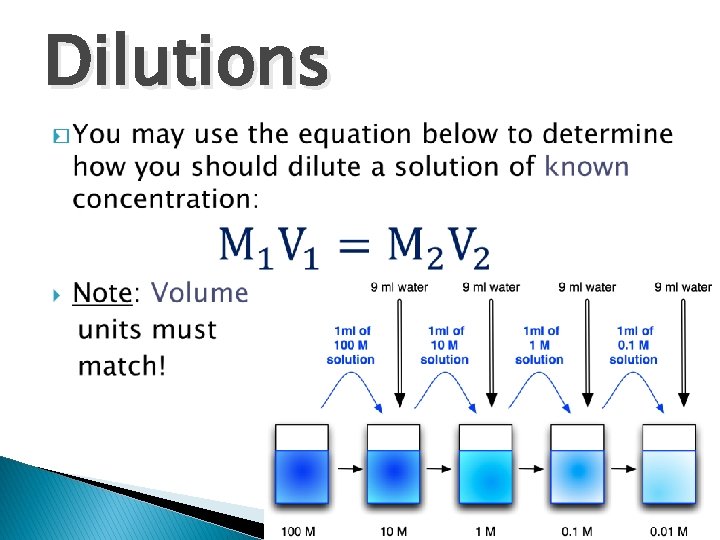
Dilutions �
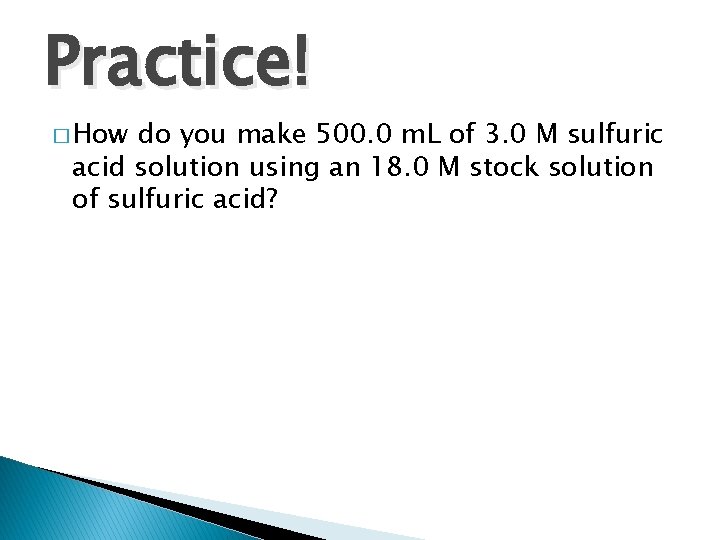
Practice! � How do you make 500. 0 m. L of 3. 0 M sulfuric acid solution using an 18. 0 M stock solution of sulfuric acid?
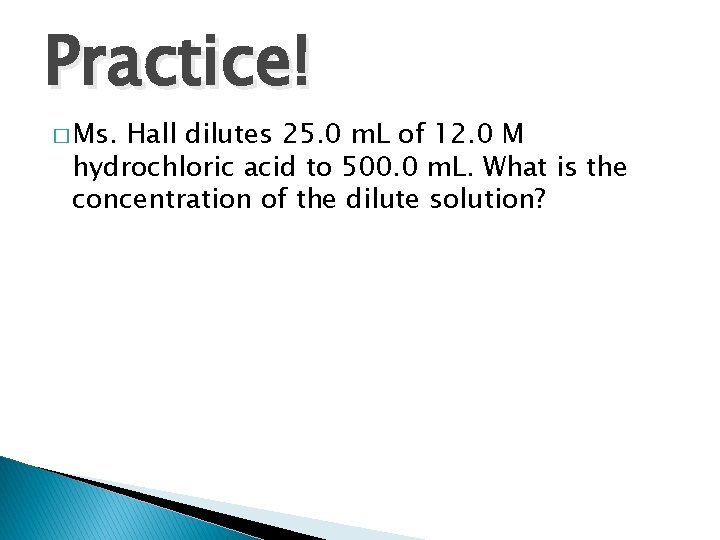
Practice! � Ms. Hall dilutes 25. 0 m. L of 12. 0 M hydrochloric acid to 500. 0 m. L. What is the concentration of the dilute solution?
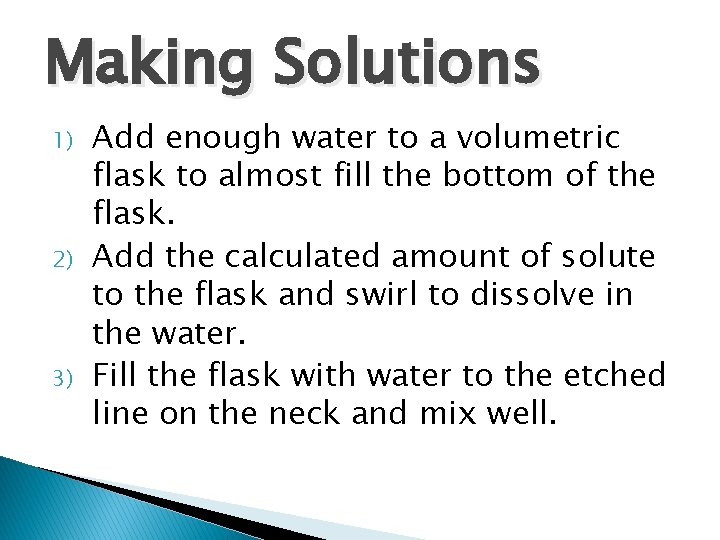
Making Solutions 1) 2) 3) Add enough water to a volumetric flask to almost fill the bottom of the flask. Add the calculated amount of solute to the flask and swirl to dissolve in the water. Fill the flask with water to the etched line on the neck and mix well.
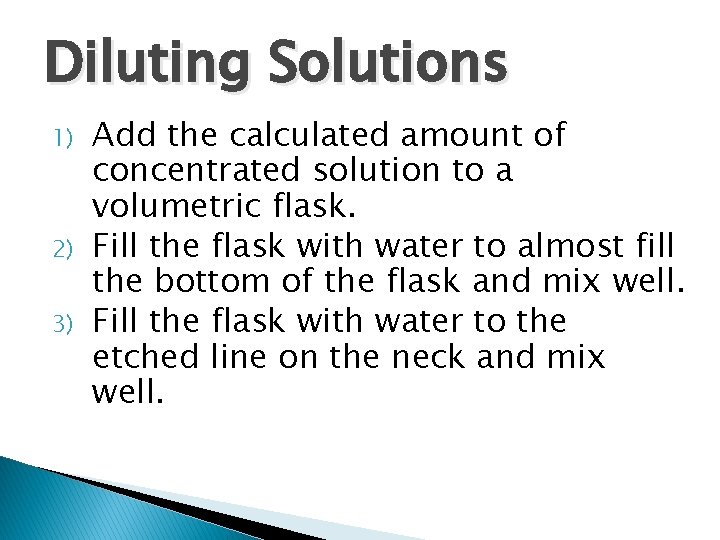
Diluting Solutions 1) 2) 3) Add the calculated amount of concentrated solution to a volumetric flask. Fill the flask with water to almost fill the bottom of the flask and mix well. Fill the flask with water to the etched line on the neck and mix well.
Diluting Solutions Practice! 1) Write a detailed procedure that describes how you would create one of the solutions on the front of the notes.