
Warmup Questions z What are the key differences
- Slides: 24
Warm-up Questions z What are the key differences between the “categorical” and “dimensional” models of identifying reading difficulties? z What are the components of the “Simple View of Reading” and how can this model of reading be used to differentiate poor readers? Week Three
Formal Assessment z. What are the defining features of formal assessment? z. For what purpose(s) are formal assessments appropriate? z. How is the technical adequacy of formal measures determined? Week Three
Formal Assessment (cont’d) z Different types of formal assessment: survey vs. diagnostic tests. z Formal assessment measures of reading tend to over-estimate reading ability and skills. z Formal assessment as part of a comprehensive assessment of reading. Week Three
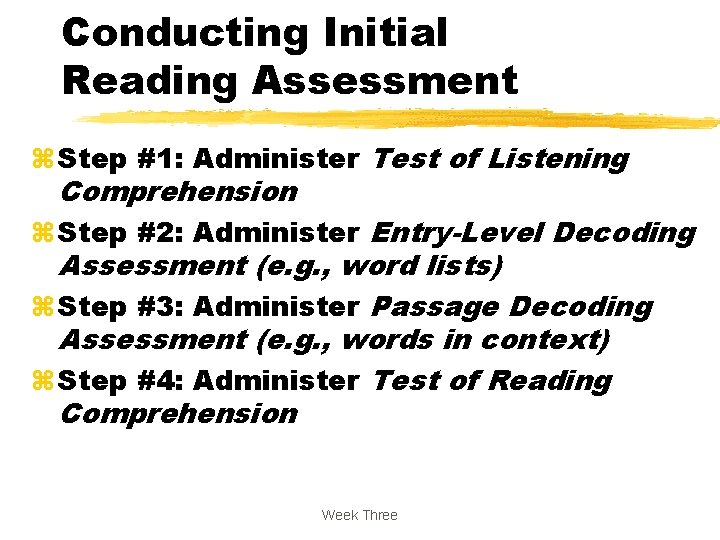
Conducting Initial Reading Assessment z Step #1: Administer Test of Listening Comprehension z Step #2: Administer Entry-Level Decoding Assessment (e. g. , word lists) z Step #3: Administer Passage Decoding Assessment (e. g. , words in context) z Step #4: Administer Test of Reading Comprehension Week Three
Using the QRI - 3 to Conduct Initial Reading Assessment z. The Word Lists z. The Passages z Readability Levels z Narrative and Expository Week Three
Finding reading levels z. Independent level z. Instructional level z. Frustration level Week Three
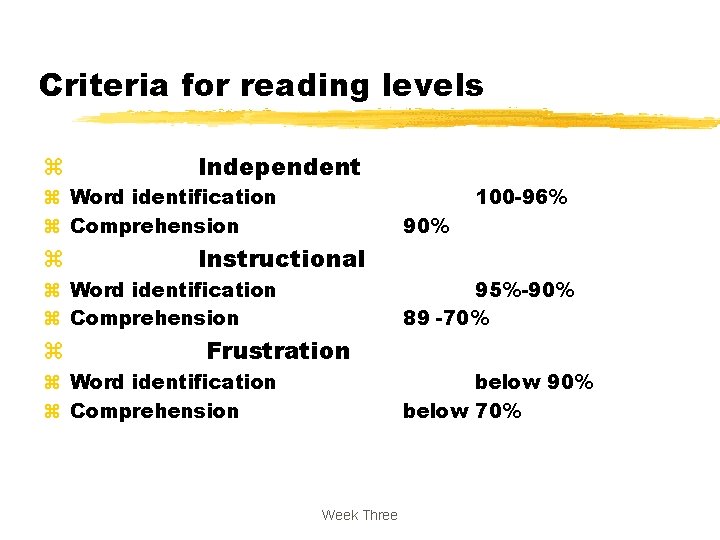
Criteria for reading levels z Independent z Word identification z Comprehension z 100 -96% 90% Instructional z Word identification z Comprehension z 95%-90% 89 -70% Frustration z Word identification z Comprehension below 90% below 70% Week Three
Step #1: Administer Test of Listening Comprehension z Using the Qualitative Reading Inventory-3 (QRI-3), assess student’s prior knowledge, read passages to student, and determine listening level in familiar narrative text (70% instructional level). Week Three
Assessment of Prior Knowledge z. The QRT-3 provides two methods of assessing prior knowledge: conceptual questions and predictions. z. Students may be assessed in both areas to determine his/her familiarity with the topic. Week Three
Conceptual-Questions z Each question is scored according to a 3 -2 -1 -0 system, where 3 is the best score. z Interpretation: students who score at least 55% of the points possible on the concept task, have sufficient background knowledge to comprehend passage Week Three
Prediction Task z “Given that the title of the passage is ______, and it includes the ideas _____, ______, and ______, what do you think the passage will be about? I want you to take a guess or make a prediction about what you think the passage will be about. ” z Interpretation is qualitative. Week Three
Practice Listening Test z. Ask Concept Questions z. Ask for a Prediction z. Read passage (Amelia Earhart) z. Ask Comprehension questions z. Score responses Week Three
Step #2 Administer Entry-Level Decoding Assessment(e. g. , word lists) z Estimate starting point for passages z Estimate automatic word identification z Estimate knowledge of letter-sound correspondences z Analyze differences between word identification in isolation and in context Week Three
Instructions to the student z “I have some lists of words that I want you to read one at a time. Some of the words will be easy for you, and some I expect to be very hard. Don’t worry. You are not expected to know all of them. If you don’t know a word right away, try to figure it out. I cannot help you in any way, and I cannot tell you whether you are right or wrong. Just do your very best. Are you ready? ” (page 39) Week Three
Practice Word Lists z. Present lists of words z. Score as Identified Automatically or as Identified z. Total Automatic and Identified z. Determine level for word identification Week Three
Criteria for word lists Week Three
Steps #3 and #4: Administer Passages z. Begin with the highest independent or lowest instructional level from word lists z. Find the instructional level in familiar text Week Three
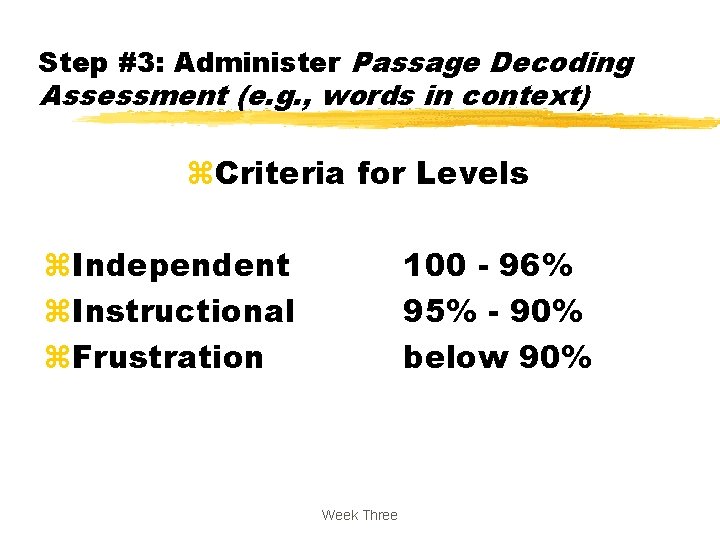
Step #3: Administer Passage Decoding Assessment (e. g. , words in context) z. Criteria for Levels z. Independent z. Instructional z. Frustration 100 - 96% 95% - 90% below 90% Week Three
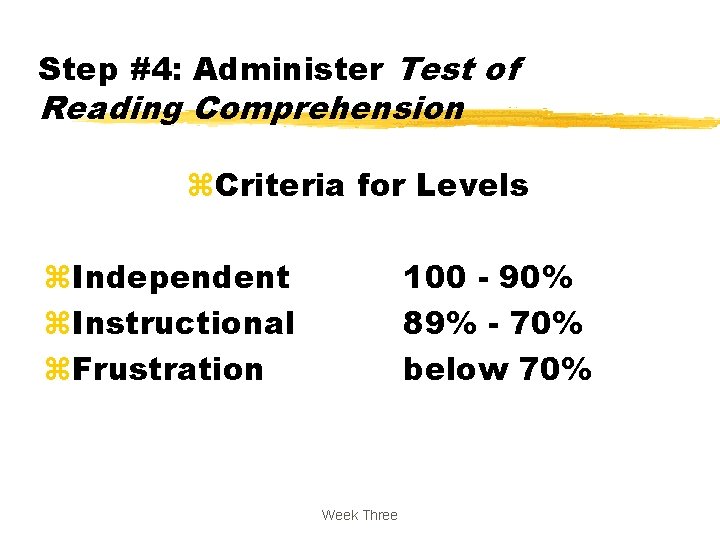
Step #4: Administer Test of Reading Comprehension z. Criteria for Levels z. Independent z. Instructional z. Frustration 100 - 90% 89% - 70% below 70% Week Three
Practice reading passages z. Determine familiarity z. Mark miscues z. Ask comprehension questions z. Score responses Week Three
Counting Miscues z. Total Accuracy y. Insertions y. Omissions y. Substitutions y. Reversals y. Self-corrections Week Three
Counting Miscues z. Total Acceptability y. Insertions y. Omissions y. Substitutions Week Three
QRI - 3 Results z. Listening Comprehension z. Word Lists z. Words in context z Accuracy z Acceptability z. Reading Comprehension - Week Three
Application of the Simple View z. Listening Comprehension = “C” z. Word Lists = “D” z. Passage Reading = “R” Week Three