
WarmUp n Describe your personality Why do you

Warm-Up n Describe your personality. Why do you think you are this way? OBJ: SWBAT identify and describe aspects of Freud’s structure of personality and theory of psychosexual development. Relevance: Today we are learning about this because Freud’s theories are widely used by psychologists exploring human personality.
Personality Unique, relatively consistent pattern of thinking, feeling and behaving n n Preferences – for how you handle situations, your sense of humor, or your expectations of others “You have a strong need for other people to like & admire you. You have a tendency to be critical of yourself. You have a great deal of unused capacity, which you have not turned to your advantage…disciplined & controlled on the outside, you tend to be worrisome & insecure inside…at times, you’re extraverted, affable, & sociable; at other times, you’re introverted, wary, & reserved”
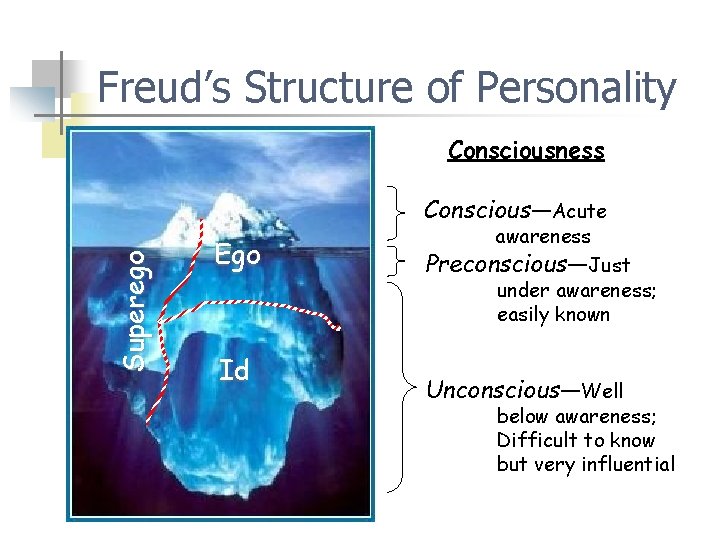
Freud’s Structure of Personality Consciousness Superego Conscious—Acute Ego Id awareness Preconscious—Just under awareness; easily known Unconscious—Well below awareness; Difficult to know but very influential
Id, Ego, and Superego n Watch this short video on Freud’s structure of personality. n n Write down 3 interesting facts as we are watching the movie. http: //www. youtube. com/watch? v=i 7 Dvpn. OHl. M
How the iceberg works n Id n n n Functions on ‘pleasure principle’ Immediate gratification of needs to reduce tension & discomfort regardless of consequences Superego n n Functions on ‘idealistic principle’ Our moral guide/conscience Influenced by internalizing our parents’ values & the voice of society Works against the Id by inflicting guilt
How the iceberg works (cont. ) n Ego n n n Functions on ‘reality principle’ Serves to balance the demands the Id and the Superego Assesses what is realistically possible in satisfying the Id and/or Superego (i. e. , what society will deem acceptable) Ego uses defense mechanisms to protect itself Personality is result of the battle for control between id, ego & superego
Defense Mechanisms n Denial n n Repression n n Denying the anxiety outright Blocking out/prevention of anxiety – forcing anxiety back into unconscious Rationalization n Creating false reasons or explanations for anxiety in the form of a shortcoming
Defense Mechanisms (cont. ) n Projection n n Seeing in others unacceptable feelings that reside in one’s own unconscious Displacement n n Acting out your anxiety on an innocent party Scapegoating
Defense Mechanisms (cont. ) n Reaction formation n Reversing the nature of the anxiety so that it feels like its opposite nature Exaggerated love for someone you unconsciously hate Sublimation n n Channeling anxiety into socially-acceptable activities Focusing sexual energy into art, music, etc.
Freud’s Psychosexual Stages n Periods of development n n Oral (Birth to 1½ yrs) n n Sexual focus Implications for adult personality Fixation Gratification is centered around the mouth (e. g. , breast-feeding, sucking, biting) Anal (1½ to 3 yrs) n Gratification is centered around the pleasure of defecation; toilet-training is issue for resolution and development
Freud’s Psychoanalytic Stages n Phallic (3 to 6) n n Gratification manifests itself through masturbation; resolution for development lies in identification w/ same-sex parent Oedipus Complex n n n Boys have unconscious jealous love for mother and desire to kill the father; fear of castration by father leads to resolution with acceptance of/identification with father and internalization of father’s values Strong superego results in this resolution Electra Complex n n Girls discover that they do not have a penis and desire one (“penis envy”); they direct their anger toward the mother for not providing a penis; jealous of mother forefather Gradual realization that these desires are self-defeating; identification with mother results
Freud’s Psychoanalytic Stages n Latency (6 to puberty) n n Sexual urges are repressed and transformed into socially acceptable activities, such as schoolwork and peer activities Genital (puberty – adulthood) n n Successful resolution and development into a mature sexual relationship How to remember: http: //www. youtube. com/watch? v=jfk. SSr. Hw --Y#aid=P 9 T_HFCkj. KQ (start at 1: 00)
Criticisms of Freud n Sexist n n Description rather than prediction n Subjective description, solely by Freud, and “after the fact” on a relatively small sample of patients, including himself! His patients were mostly females from upper classes Unverifiable concepts n n n Freud’s theory was thought to be sexist against women (e. g. , “penis envy”, underdeveloped superego) How the heck can you directly confirm, disconfirm, or even observe the Oedipus Complex? ! Feels more mythical than scientific Too many hypotheses for reactions to anxiety
But… n Freud’s theory…. n n Was rich and comprehensive in description st comprehensive theory of personality: every personality n 1 theory since can be seen as a reaction to Freud Sparked psychoanalysis n n n Many still believe that psychoanalysis is the best treatment for mental illness Was controversial and stretched the boundaries for creativity n Freud: “I am actually not a man of science, not an observer, not an experimenter, not a thinker. I am by temperament nothing but a conquistador—an adventurer…with all the curiosity, daring, and tenacity characteristic of a man of this sort. ” Why do you think his theory is still popular today? What do you like about it and why?
DOL n Given and exit card, SWBAT: n n Write 3 -5 sentences describing the structure of personality. Write a definition for 3 of the 5 stages of psychosexual development.
- Slides: 15