
Warmup Make a list of how you resemble
Warm-up: Make a list of how you resemble your parents, brothers, and sisters.
Now… • Consider how the culture influences you. • Do your parents dislike the music you listen to? • Do you like a certain style of dress because it’s the trend? • You are all the products of both hereditary and culture.
Culture
The Basis of Culture defines how people in a society behave in relation to others and to physical objects. Although most behavior among animals is instinctual, human behavior is learned. Even reflexes and drives do not completely determine how humans will behave, because people are heavily influenced by culture.
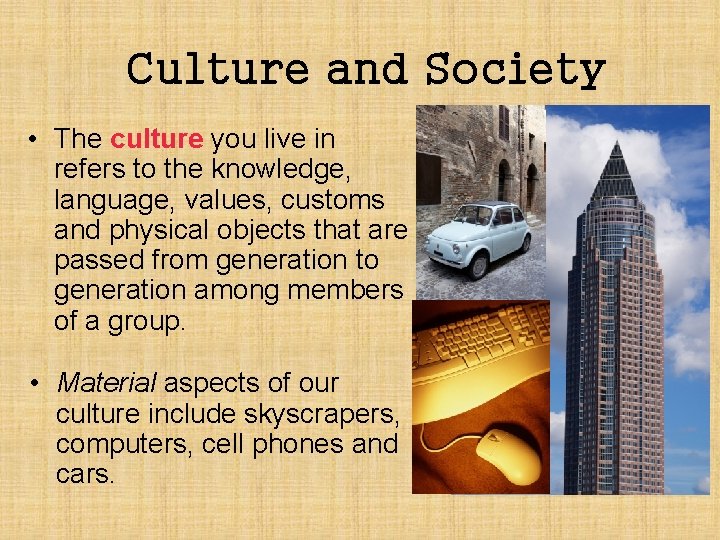
Culture and Society • The culture you live in refers to the knowledge, language, values, customs and physical objects that are passed from generation to generation among members of a group. • Material aspects of our culture include skyscrapers, computers, cell phones and cars.
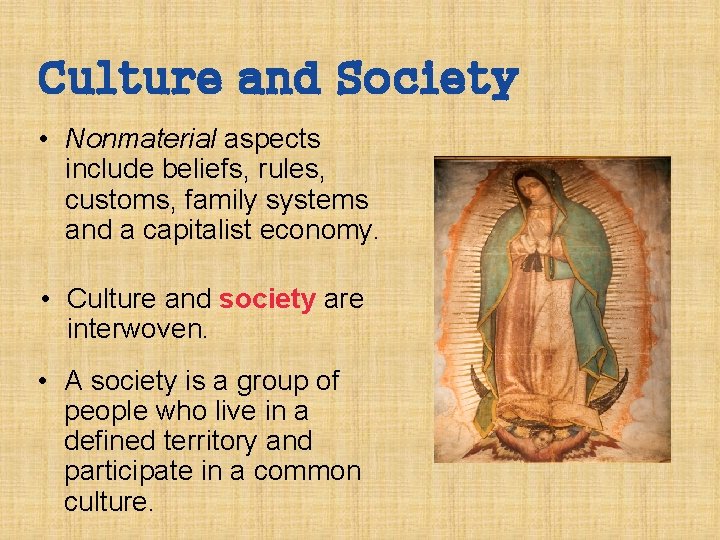
Culture and Society • Nonmaterial aspects include beliefs, rules, customs, family systems and a capitalist economy. • Culture and society are interwoven. • A society is a group of people who live in a defined territory and participate in a common culture.
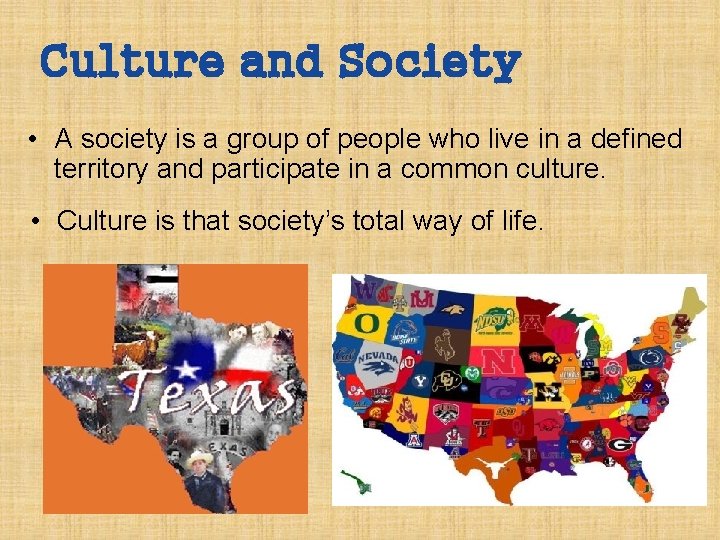
Culture and Society • A society is a group of people who live in a defined territory and participate in a common culture. • Culture is that society’s total way of life.
Culture and Heredity • Instincts are genetically inherited patterns of behavior. Humans, unlike animals, cannot rely on instinct alone for survival, so we rely on our culture. • Examples of human instincts? • http: //www. youtube. com/watch? v= Pxb. Pw. WEQFjs • However, culture is not the only influence on our behavior.
Culture and Heredity • Other factors include: – Heredity—genetically inherited traits – Reflexes—simple, biologically inherited automatic reactions to physical stimuli. – What is the difference between an instinct and a reflex? – Drives—impulses • These expressions of such biological factors can vary depending on the culture. • How do different cultures have different drives/reflexes?
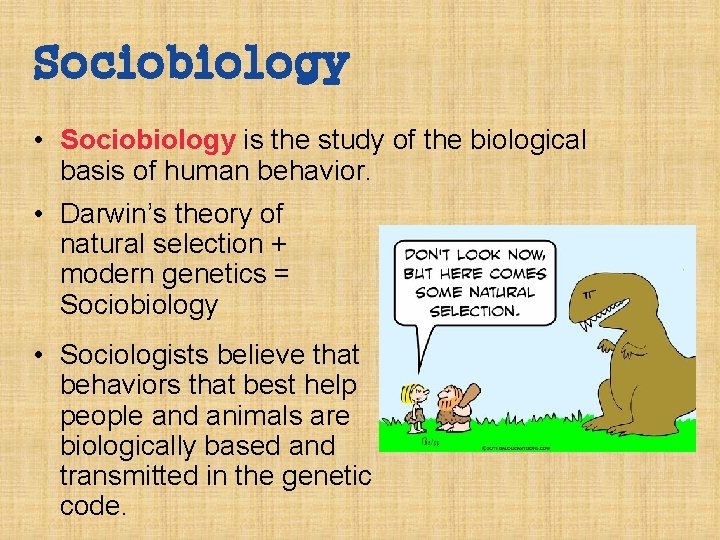
Sociobiology • Sociobiology is the study of the biological basis of human behavior. • Darwin’s theory of natural selection + modern genetics = Sociobiology • Sociologists believe that behaviors that best help people and animals are biologically based and transmitted in the genetic code.
Sociobiology • Some criticisms of sociobiology: – Certain races could be labeled as inferior or superior. – What races are seen as superior? Inferior? – There is too much variation in societies for human behavior to be based on biology alone.
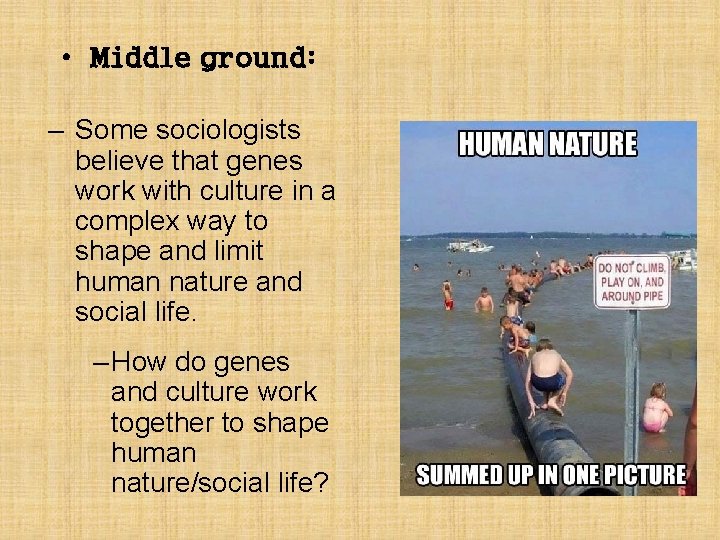
• Middle ground: – Some sociologists believe that genes work with culture in a complex way to shape and limit human nature and social life. – How do genes and culture work together to shape human nature/social life?
What environments would favor… • 1. a darker skin • 2. blonde hair color • 3. a stocky body size – 1. hot, dry climate favors the development of dark skin – 2. Scandinavia; a climate with less sun – 3. climate where conserving heat and building up layers of fat provides edge for survival
So… • Who we are physically is partially the result of nature’s need to prepare us for the elements
Assignment • Read the Aggie Culture article (whoop!) • Write a 1 -2 page essay on why culture is important to you for the college of YOUR choice.

Warm-up: Finish college culture essay (10 minutes-turn into box when done)
Through the Wormhole: Is There a Superior Race? http: //www. youtube. com/watch? v=fdti 5 Rr 8 rhs
Video Questions-Elaborate 1. ) Do you believe races are different on the inside as well as the outside? How so? Please explain. 2. ) Could advances in technology create a superior race? How so? Please explain. 3. ) Some breeds of dogs are more intelligent than other breeds of dogs, and some scientists believe that some races of people are more intelligent than other races of people. Do you think the two are comparable? How so? 4. ) Superior is defined as higher in rank or status, better in quality or ability, and greater in amount or power. By this definition, are there “superior” races? If so, which races? What makes them superior? 5. ) Do you think the concept of “superior” and “inferior” races will cause problems in future society? What kind of problems? 6. ) In what ways do I. Q. scores have an effect on our perceptions of certain
Warm-up Read “The Mysterious Fall of Nacirema” on page 76 Answer the 2 questions.
The Mysterious Fall of Nacirema • What culture is the article really about? • In what ways are we self-destructing our own culture? – What are some of our strange customs?
Language and Culture Section 2
Knowing Your Culture: Proverbs • What are proverbs? ? – Brief but pithy sayings that express commonly held ideas and beliefs
The pen is mightier than ______ the sword.
Better safe than ______ sorry.
Its always darkest before ______ the dawn.
Don’t bite the hand that ______ feeds you.
No news is ______ good news.

If you lie down with dogs, you’ll ______ get fleas.
A penny saved is a ______ penny earned.
Children should be seen and ______ not heard.
Better late than ______ never.
The importance of language
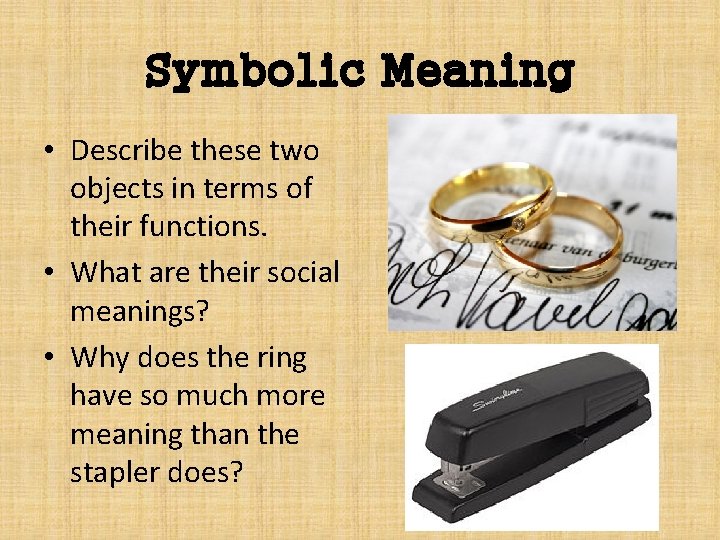
Symbolic Meaning • Describe these two objects in terms of their functions. • What are their social meanings? • Why does the ring have so much more meaning than the stapler does?
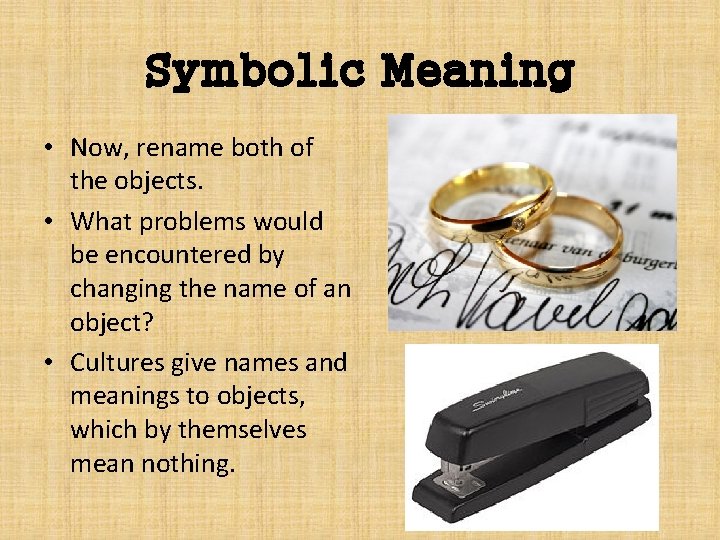
Symbolic Meaning • Now, rename both of the objects. • What problems would be encountered by changing the name of an object? • Cultures give names and meanings to objects, which by themselves mean nothing.
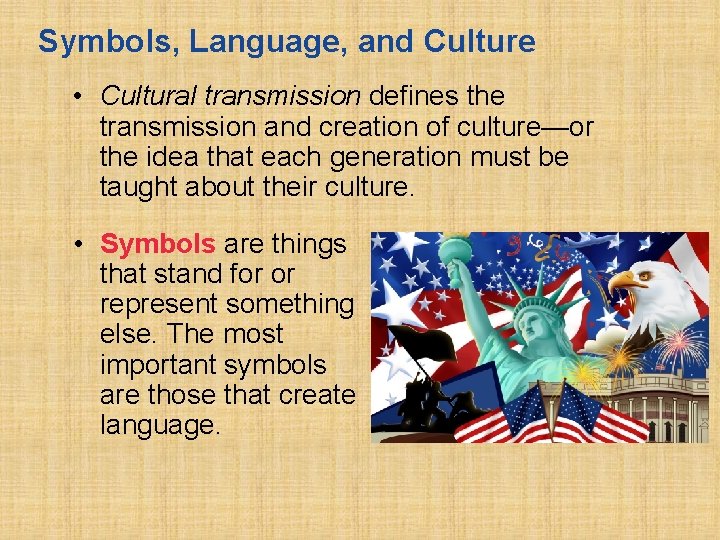
Symbols, Language, and Culture • Cultural transmission defines the transmission and creation of culture—or the idea that each generation must be taught about their culture. • Symbols are things that stand for or represent something else. The most important symbols are those that create language.
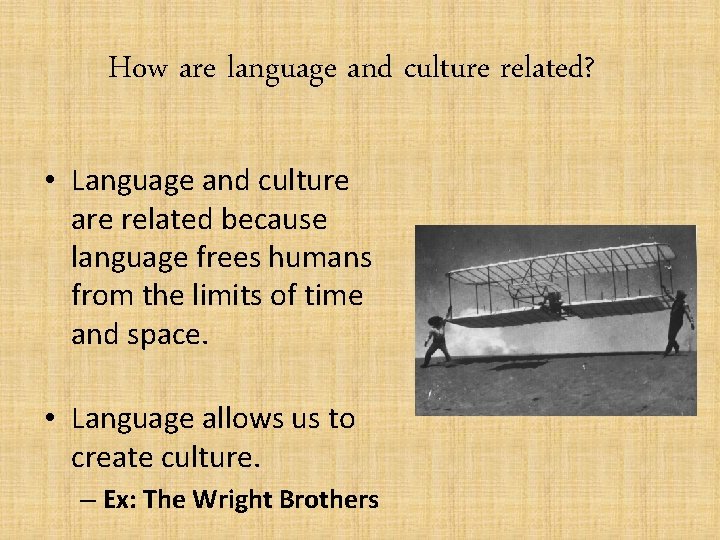
How are language and culture related? • Language and culture are related because language frees humans from the limits of time and space. • Language allows us to create culture. – Ex: The Wright Brothers
The Sapir-Whorf Hypothesis • The Sapir-Whorf Hypothesis or the hypothesis of linguistic relativity— Edward Sapir and Benjamin Whorf believe that our perceptions of the world depend in part on the particular language we have learned. • For example, when something is important to a society, its language will have many words to describe it. • We can learn other languages, or learn more about our own, to expand our view of the world.
A Show of Hands Native American languages that are spoken in the Arctic Circle most likely include many words describing which of the following? 1. Money 2. Snow 3. Oil 4. Trees
Is all communication verbal? • What are some examples of nonverbal communication? – http: //www. youtube. com/watch? v=7 cg 192 c. QYUA – http: //www. youtube. com/watch? v=swp. Fzla. SAd. I – http: //www. youtube. com/watch? v=Kc 2 y. Rqat 7 q 8
Demonstration • To reinforce how we rely on language… • Form a line in the front of the room according to your birthdays (month and date). – Your task: arrange yourselves in order, but without talking – I’ll give you a few minutes at your desk to think about how you will go about this.
Warm-up: Why do some cultures clash?
Making Connections to Other Cultures
God Grew Tired of Us • In 1987, Sudan's Muslim government declared death to all males who were Christian living in the south. – 27, 000 boys fled to Ethiopia on foot. – In 1991, they were forced to flee to Kenya – 12, 000 survived to live in a U. N. camp in Kakuma • Four boys from Sudan embark on a journey to America after years of wandering Sub-Saharan Africa in search of safety
Warm-up: What has impacted you most about God Grew Tired of Us thus far?
No warm-up today… Just prepare for your 2 -5 min. presentation! (if you need to load onto my computer, go ahead and do so)
Cultural Clash Articles 1. Cultural Clash Fuels Muslims Angry at Online Video: 1. 2. 3. What 2 cultures are clashing? What caused them to clash? Why is it that Ismail Mohamed said “The West has to understand the ideology of the people”? 2. A Situation Emerges in Florence, as TV Brings an Altered Reality: 1. 2. 3. What 2 cultures are clashing? What caused them to clash? Why is it that Mr. da Empoli said he was “not especially honored by their being here”? -In regards to these 2 articles, how are the opposing cultures alike? Different? -What ideologies do the cultures in the articles have of one another? -Do you think they will ever get over their differences?
Warm-up What are some things that are considered “normal” in our society?
A Show of Hands In your opinion, which of the following values most closely identifies with American culture? 1. Belief in God 2. Achievement and success 3. Democracy 4. Equality
Norms: The Rules We Live By • Norms are rules defining appropriate and inappropriate behavior. Norms are so engrained in humans that they guide behavior without awareness. • Norms also help to define a culture’s perception of beauty for both males and females. • What are some norms that shape the American ideal of beauty? • Who do you think set the standards for what Americans think is “beautiful”?
Cultural Artifacts • What might happen when one culture comes into contact with an artifact of a different culture? – http: //www. youtube. com/watch? v=g. CQIGi. Xf 0 JA – http: //www. youtube. com/watch? v=Ul. BL 9 ckk. B 4 E
Folkways, Mores, and Laws • There are three types of norms: – Folkways—rules that cover customary ways of thinking, feeling and behaving but lack moral overtones. – Ex: sleeping on a bed instead of on a floor – Folkways are not considered vital to a group’s existence, so disapproval of those who break folkways is not very great – http: //www. youtube. com/watch? v=Bk. RTnu. Jy. PQ
Folkway Activity • Folkways are so ingrained into everyday behavior, that they might be hard to distinguish as folkways. • They may just seem to be “just the way we do things” – Ex: men used to always take off their hats when they entered a home or building, but not so much today • Work in pairs to identify common folkways • Do you agree that the behavior described was, in fact, a folkway?
Types of Norms – Mores—norms of great moral significance. – Related to what is right or wrong – Vital to the well-being of a society – Conformity to mores draws strong social approval; violation of this type of norm brings disapproval • Ex: Americans believe that able-bodies men should work for a living. Able-bodied men who do not work are scorned
Mores Discussion • Do you agree with the example about able-bodied men being scorned for not working? • Describe how men who choose not to work are treated. • How do you feel about able-bodies women without children to care for who do not work outside the home? • Are your attitudes about unemployed women the same as unemployed men? • What cultural traditions are at work here? • Are some of these traditions changing?
Warm-up What do you value most in life?
Types of Norms • Taboo—a norm so strong that its violation demands punishment by the group. – The most serious types of mores • Ex: In India, followers of Hinduism have a taboo forbidding the killing of cows • Ex: Incest • Ex: The mother-in-law taboo existing in some societies prohibits social contact between a husband his wife’s mother • http: //www. youtube. com/watch? v=1 JZQu 8 CPPv. U • National geographic: Taboo – Laws are norms that are formally defined and enforced by officials.
Bodily-Kinesthetic • Distinguishing between the 3 norms: – Folkways – Mores – Laws • Split up into groups of 4 – Wait for instructions 1. As a group, decide what type of norm was enacted. 2. Was that norm acceptable or not? 3. Is a consequence needed?
Enforcing the Rules • Sanctions are rewards and punishments used to encourage conformity to norms, either formally or informally. • Formal sanctions are sanctions that may be applied, for positive or negative reasons, only by officially designated persons, such as judges and teachers. • Informal sanctions can be applied by most members of a group, also for positive or negative reasons.
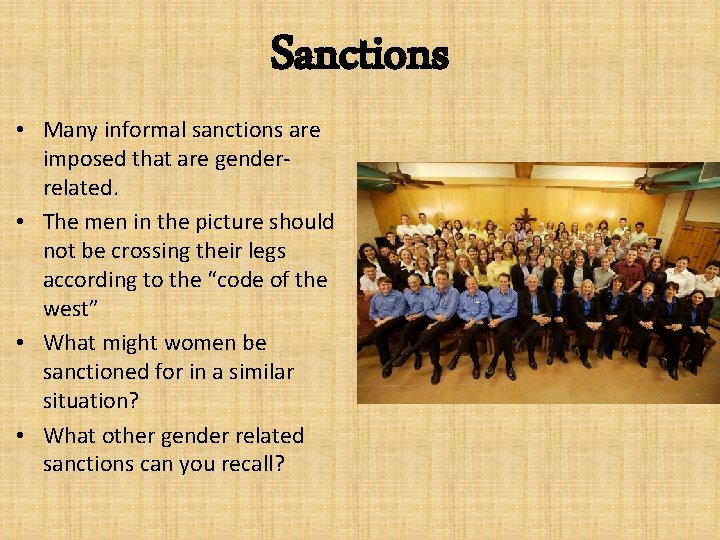
Sanctions • Many informal sanctions are imposed that are genderrelated. • The men in the picture should not be crossing their legs according to the “code of the west” • What might women be sanctioned for in a similar situation? • What other gender related sanctions can you recall?
Sanctions Recap • Mechanism of social control for enforcing a society’s standards. • You can sanction both positively (to reward) and negatively (to punish)
Values—The Basis for Norms • Values are broad ideas about what most people in a society consider to be desirable. • Different groups in the same society can have different norms based on the same value. • Values have a tremendous influence on human social behavior because they form the basis for norms.
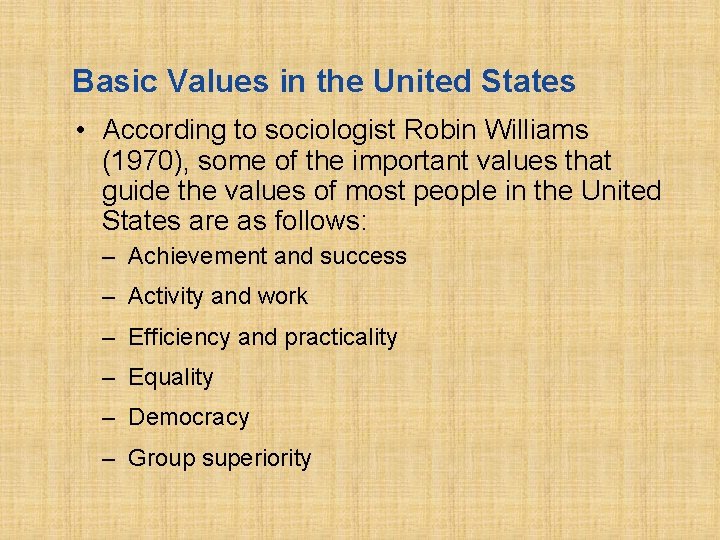
Basic Values in the United States • According to sociologist Robin Williams (1970), some of the important values that guide the values of most people in the United States are as follows: – Achievement and success – Activity and work – Efficiency and practicality – Equality – Democracy – Group superiority
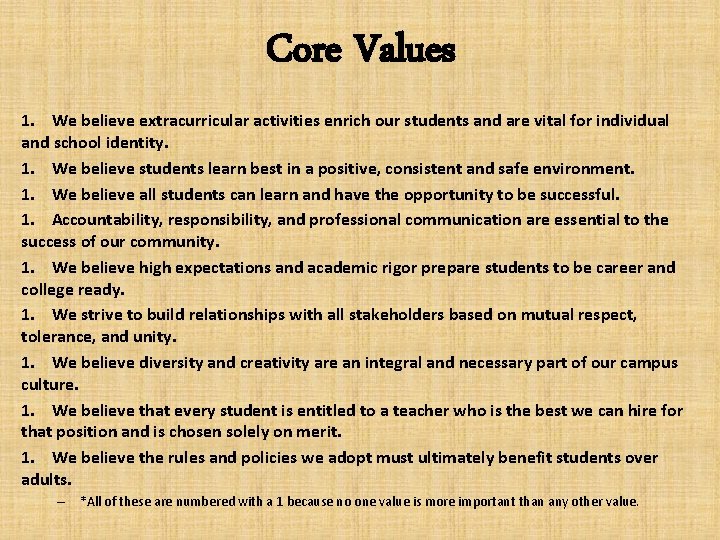
Core Values 1. We believe extracurricular activities enrich our students and are vital for individual and school identity. 1. We believe students learn best in a positive, consistent and safe environment. 1. We believe all students can learn and have the opportunity to be successful. 1. Accountability, responsibility, and professional communication are essential to the success of our community. 1. We believe high expectations and academic rigor prepare students to be career and college ready. 1. We strive to build relationships with all stakeholders based on mutual respect, tolerance, and unity. 1. We believe diversity and creativity are an integral and necessary part of our campus culture. 1. We believe that every student is entitled to a teacher who is the best we can hire for that position and is chosen solely on merit. 1. We believe the rules and policies we adopt must ultimately benefit students over adults. – *All of these are numbered with a 1 because no one value is more important than any other value.
Values • American Values seen in film: – http: //www. youtube. com/watch? v=dxdpql. EWH_k • American values vs. Chinese values: – Are they different? • http: //www. youtube. com/watch? v=WHf 05 Tvi. Fm. U
Values Clarification • Make a list of 15 things, both material and non -material, that you value • When you are done with your list, rank them by the value you place on each (most important being #1) • Now, say I was to give each of you $1000. 00 to spend on each of your values. – Decide how much you would be willing to spend on each item, based on how important they are to you
Values Activity: • As I read each statement, go to the sign that reflects how you feel about the statement. 1. Although we should not be unnecessarily cruel to animals, they were put on earth to serve the needs of human beings 2. the death penalty should be abolished because it is inherently racist in its application 3. men and women are not politically or intellectually equal because they are biologically different 4. there is too much violence and sex in the media, especially on tv 5. there is too much freedom given to young, unmarried boys and girls.
Sanctions Article • 1. Is this article an example of a positive sanction or negative sanction? How so? • 2. What is the U. S. trying to control or enforce upon Syria? • 3. Do you think there is a better way to go about this action? Why or why not?
Ideal & Real Culture
Beliefs and Physical Objects • The nonmaterial culture involves beliefs, ideas, and knowledge. • The material culture is about how we relate to physical objects. It consists of the concrete, tangible objects within a culture.
Paired Learning Activity • In pairs, select an activity that y’all enjoy (i. e. sport or hobby). • Analyze activity in terms of its cultural components. – So… make a list of all material and nonmaterial culture associated with activity.
Beliefs and Physical Objects (cont. ) • Beliefs are ideas about the nature of reality. • People base their behavior on what they believe, even if their belief might not be true. • The uses and meanings of physical objects can vary among societies depending on the beliefs, norms and values people hold with regard to the object.
A Show of Hands All of the following are representative of material culture EXCEPT 1. Books 2. Art 3. Religion 4. Cars
Ideal and Real Culture • A gap exists between cultural guidelines and actual behavior, captured by the following two concepts: – Ideal culture refers to cultural guidelines publicly embraced by members of a society. – Real culture refers to actual behavior patterns, which often conflict with these guidelines.
Ideal and Real Culture • Question: Have any of y’all ever cheated on a test, no matter how long ago? • Why, if everyone knows cheating is wrong, do so many people do it anyway?
Cultural Change • Culture changes for three reasons: – Discovery—the process of finding something that already exists. – Invention—the creation of something new. – Diffusion—the borrowing of aspects of culture from other cultures.
A Show of Hands Finding hamburgers on a menu in Japan is an example of 1. Discovery 2. Invention 3. Diffusion 4. Culture
Cultural Diversity • Cultural diversity exists in all societies. • Social categories are groups that share a social characteristic such as age, gender, or religion. • Subculture is part of the dominant culture but differs from it in some important respects. • Ex: Chinatown in San Francisco • Counterculture is a subculture deliberately and consciously opposed to certain beliefs or attitudes of the dominant culture. • Ex: “goth” and “punk” scenes
Ethnocentrism • Ethnocentrism is the practice of judging others in terms of one’s own cultural standards. • Advantages: – People feel good about themselves and others. – Stability is promoted. • Disadvantage: – Inflexibility
Cultural Universals • Cultural universals are traits that exist in all cultures, such as sports, cooking, and education. • Ex: http: //www. youtube. com/watch? v=s 7 Ep. Wh B 0 Qk 0 • Cultural particulars are the ways that each culture expresses the universals. • Ex: in the U. S. , women have traditionally cared for the children, while in New Guinea among the Manu tribe, the men care for the children
Cultural Universals (cont. ) • Cultural universals exist for three main reasons: – The biological similarity shared by all human beings. – The physical environment affecting all human beings. – Many countries face the same social problems.
Counter Culture Documentary • Part One: – http: //www. youtube. com/watch? v=Mlzo. Q 1 Wv. V 9 o • Part Two: – http: //www. youtube. com/watch? v=vr. C 56 o. Y 6 Ur 0
Chapter 3 Test Review • • • Know ALL vocab How is society different from culture? The Sapir-Whorf Hypothesis How does language affect culture? Folkways, Mores, Laws, Taboos – Examples of each • How are norms and values different? • How is material culture influenced by nonmaterial culture? • Why do cultural universals exist?
- Slides: 83