
WARMUP FORM GROUPS OF 3 Objective What We
WARM-UP: FORM GROUPS OF 3 • Objective • What - We will design a solution to slow heat transfer • Why - TBD. • How – By insulating a cup under specific time and financial restraints.
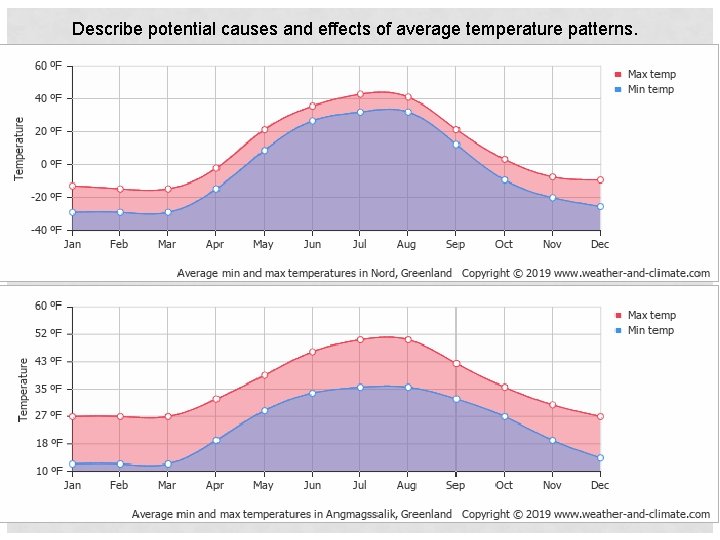
Describe potential causes and effects of average temperature patterns.
CAN YOU KEEP THE HEAT FROM TRANSFERRING? 1. Goal: Insulate the cup to retain as much heat as possible 2. Task 1. 2. 3. 4. Form groups of 3. Time starts. Buy materials and get cup. Remember to allow room for thermometer. Get hot water and thermometer from Ms. Findlay 3. Each Trial 1. 2. Record initial temperature (was at least 100 o. C when poured) Record temperature in o. C every 60 seconds. Trial 1 • 50 science dollars • 15 minutes Trial 2 • 20 science dollars • 5 minutes Trial 3 • 10 science dollars • 5 minutes
PRICES SIZE/QUANTITY MATERIAL COST Yarn 30 cm 4 Masking Tape 30 cm 11 Duct Tape 30 cm 8 Felt 11. 5 cm x 15 cm 10 Aluminum Foil 30 cm x 30 cm 12 Popsicle Sticks 10 14 Cotton Balls 5 12 White Paper 1 sheet 5

COMPLETE LAB REFLECTIONS
CONCLUSION: • Use evidence to explain the temperature pattern you observed during each trial for every group. • Why did this happen?
CONCLUSION: • Use evidence to explain the temperature pattern you observed during each trial for every group. • In every trial, the temperatures decreased. The more insulators added to the set-up, the closer the water stayed to 100 o. C. • Why did this happen? • We cannot stop heat from transferring to surrounding area. Insulators slowed the heat transfer, but it cannot stop it completely. • Think about a Yeti Tumbler, a hot drink can only stay warm for 5 -6 hours.
OBJECTIVE • What – We will review the three types of heat transfer • Why – To demonstrate that heat in one area will move to another. • How – Through Melting Chocolate Bunnies Demo.
MELTING (CHOCOLATE) BUNNIES • During the Video: From the video, explain how the bunnies were melted through the three different ways. • Iron • Heat Bulb • Hair Dryer • After the Video: Explain how all three methods melted the bunnies.
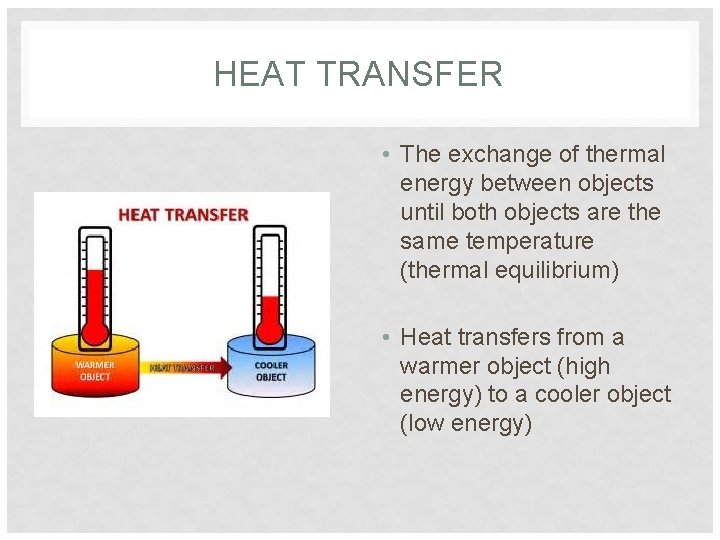
HEAT TRANSFER • The exchange of thermal energy between objects until both objects are the same temperature (thermal equilibrium) • Heat transfers from a warmer object (high energy) to a cooler object (low energy)

THREE TYPES OF HEAT TRANSFER COPY DEFINITIONS

GREENLAND CONNECTION • In the video, we learned that the average sea temperatures are rising. Explain how this demonstrates heat transfer. • Then, explain… • Where did the heat come from? • How did it get to Greenland (keeping in mind that Greenland has a high latitude)?
- Slides: 12