
WarmUp 1 Exercises EXAMPLE Solve a realworld problem
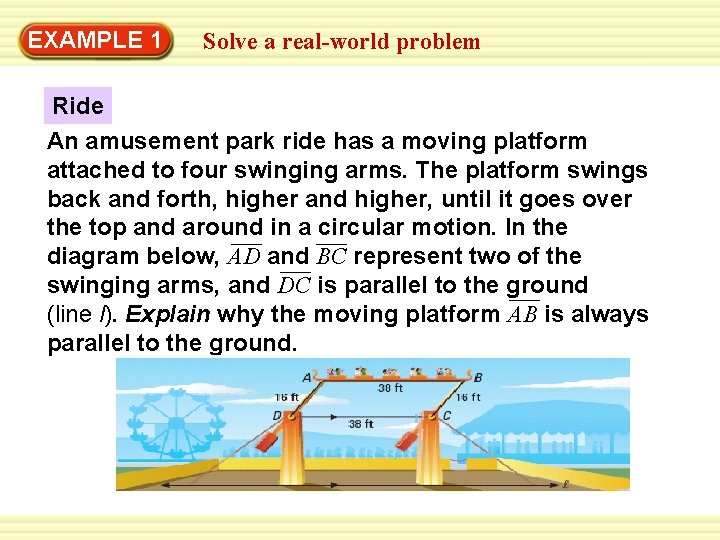
Warm-Up 1 Exercises EXAMPLE Solve a real-world problem Ride An amusement park ride has a moving platform attached to four swinging arms. The platform swings back and forth, higher and higher, until it goes over the top and around in a circular motion. In the diagram below, AD and BC represent two of the swinging arms, and DC is parallel to the ground (line l). Explain why the moving platform AB is always parallel to the ground.
Warm-Up 1 Exercises EXAMPLE Solve a real-world problem SOLUTION The shape of quadrilateral ABCD changes as the moving platform swings around, but its side lengths do not change. Both pairs of opposite sides are congruent, so ABCD is a parallelogram by Theorem 8. 7. By the definition of a parallelogram, AB DC. Because DC is parallel to line l, AB is also parallel to line l by the Transitive Property of Parallel Lines. So, the moving platform is parallel to the ground.
Warm-Up Exercises GUIDED PRACTICE for Example 1 1. In quadrilateral WXYZ, m W = 42°, m X =138°, m Y = 42°. Find m Z. Is WXYZ a parallelogram? Explain your reasoning.
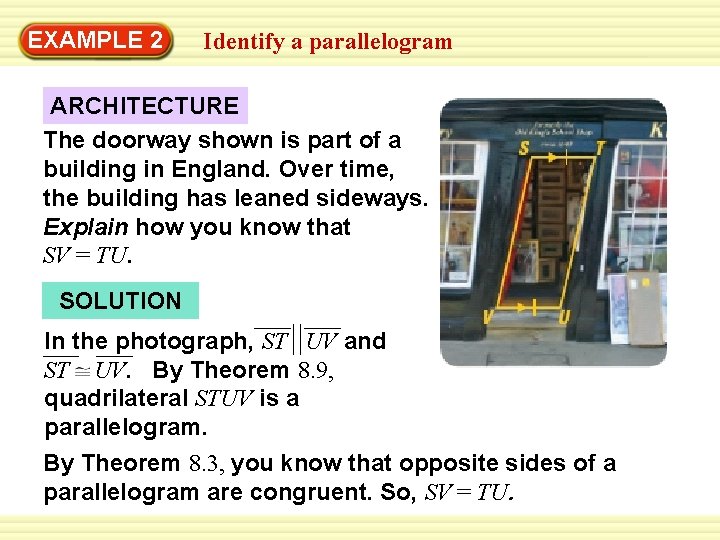
Warm-Up 2 Exercises EXAMPLE Identify a parallelogram ARCHITECTURE The doorway shown is part of a building in England. Over time, the building has leaned sideways. Explain how you know that SV = TU. SOLUTION In the photograph, ST UV and ST UV. By Theorem 8. 9, quadrilateral STUV is a parallelogram. By Theorem 8. 3, you know that opposite sides of a parallelogram are congruent. So, SV = TU.
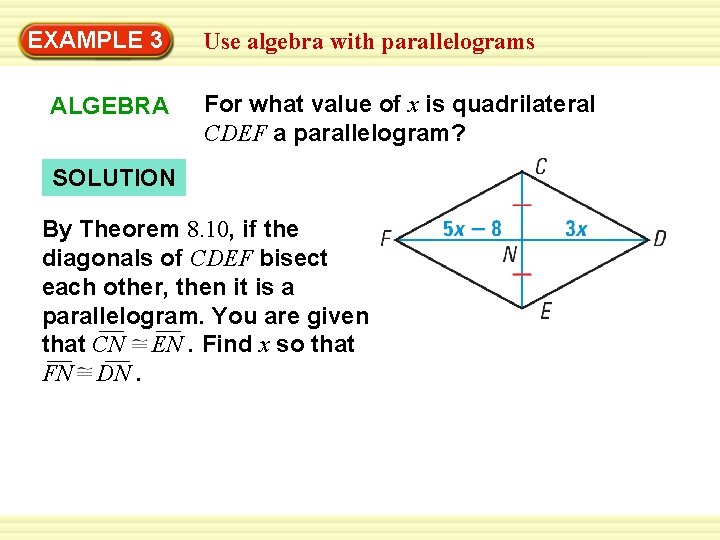
Warm-Up 3 Exercises EXAMPLE Use algebra with parallelograms ALGEBRA For what value of x is quadrilateral CDEF a parallelogram? SOLUTION By Theorem 8. 10, if the diagonals of CDEF bisect each other, then it is a parallelogram. You are given that CN EN. Find x so that FN DN.
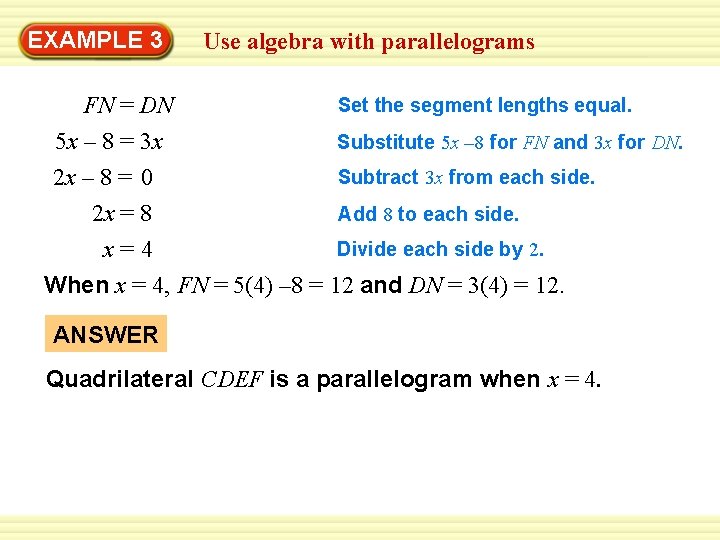
Warm-Up 3 Exercises EXAMPLE Use algebra with parallelograms FN = DN 5 x – 8 = 3 x 2 x – 8 = 0 2 x = 8 x= 4 Set the segment lengths equal. Substitute 5 x – 8 for FN and 3 x for DN. Subtract 3 x from each side. Add 8 to each side. Divide each side by 2. When x = 4, FN = 5(4) – 8 = 12 and DN = 3(4) = 12. ANSWER Quadrilateral CDEF is a parallelogram when x = 4.
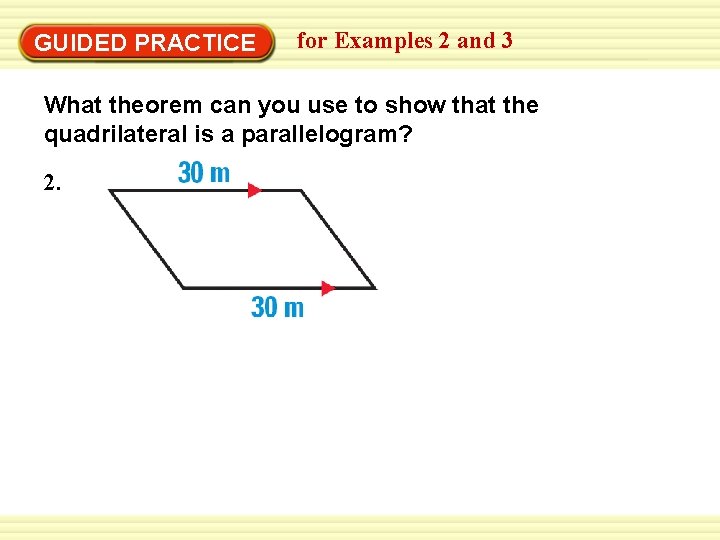
Warm-Up Exercises GUIDED PRACTICE for Examples 2 and 3 What theorem can you use to show that the quadrilateral is a parallelogram? 2.
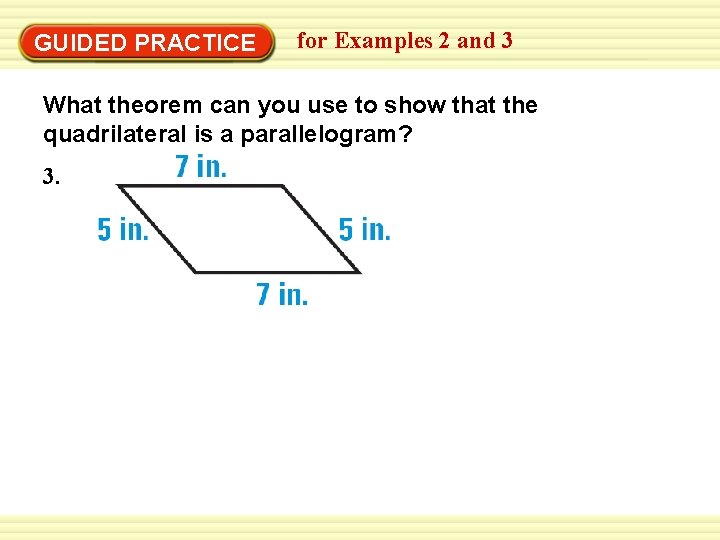
Warm-Up Exercises GUIDED PRACTICE for Examples 2 and 3 What theorem can you use to show that the quadrilateral is a parallelogram? 3.
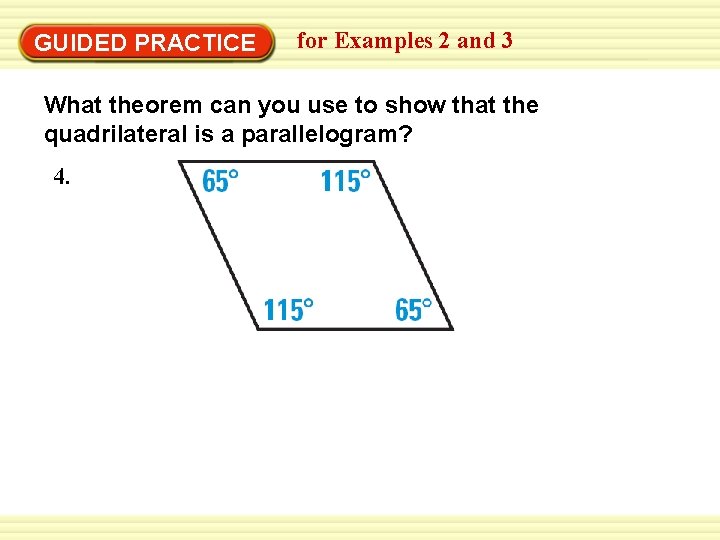
Warm-Up Exercises GUIDED PRACTICE for Examples 2 and 3 What theorem can you use to show that the quadrilateral is a parallelogram? 4.
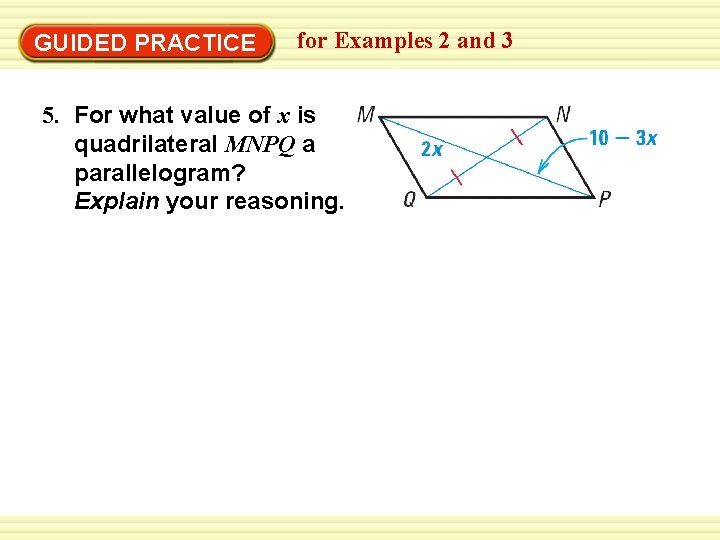
Warm-Up Exercises GUIDED PRACTICE for Examples 2 and 3 5. For what value of x is quadrilateral MNPQ a parallelogram? Explain your reasoning.
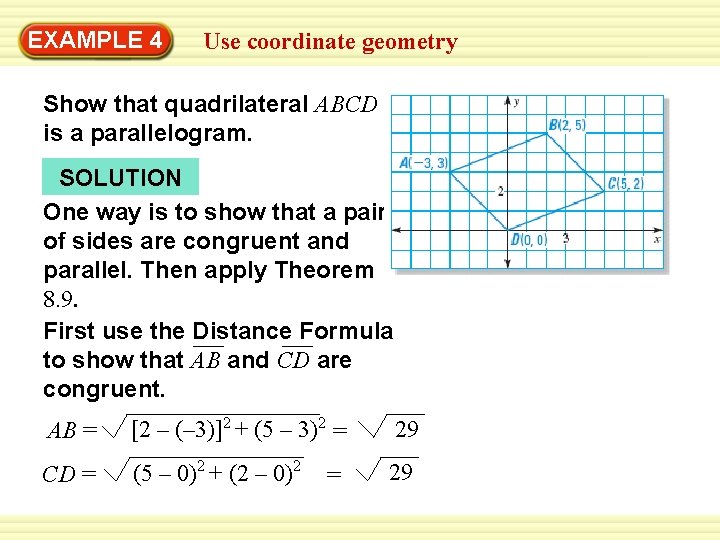
Warm-Up 4 Exercises EXAMPLE Use coordinate geometry Show that quadrilateral ABCD is a parallelogram. SOLUTION One way is to show that a pair of sides are congruent and parallel. Then apply Theorem 8. 9. First use the Distance Formula to show that AB and CD are congruent. AB = [2 – (– 3)]2 + (5 – 3)2 = 29 CD = (5 – 0)2 + (2 – 0)2 29 =
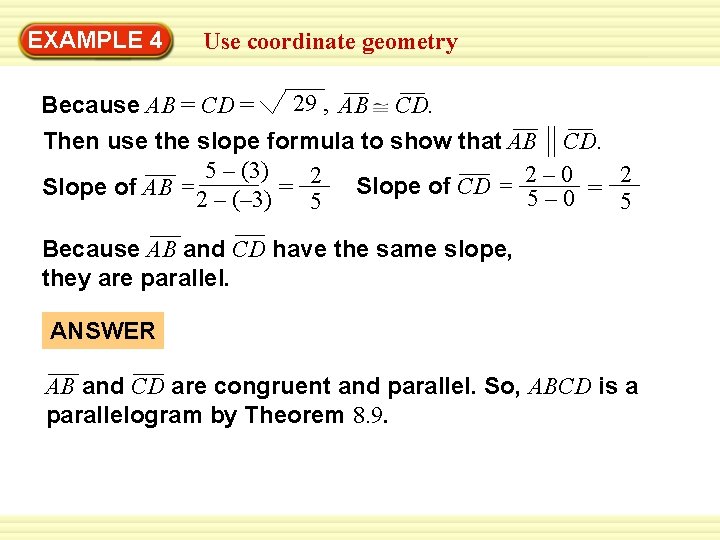
Warm-Up 4 Exercises EXAMPLE Use coordinate geometry Because AB = CD = 29 , AB CD. Then use the slope formula to show that AB CD. 5 – (3) 2 2 Slope of CD = 2 – 0 Slope of AB = 2 – (– 3) = = 5– 0 5 5 Because AB and CD have the same slope, they are parallel. ANSWER AB and CD are congruent and parallel. So, ABCD is a parallelogram by Theorem 8. 9.
Warm-Up EXAMPLE 4 Exercises GUIDED PRACTICE for Example 4 6. Refer to the Concept Summary. Explain how other methods can be used to show that quadrilateral ABCD in Example 4 is a parallelogram.
- Slides: 13