
Warm up Thin Lens Equations There are two

- Slides: 12
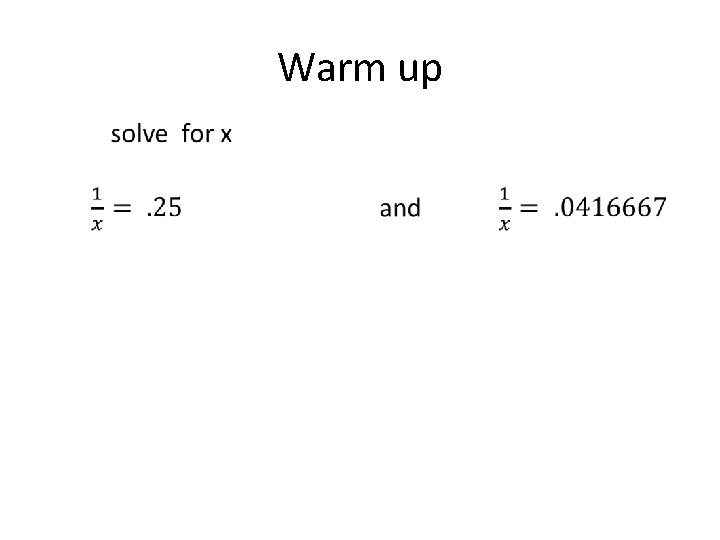
Warm up •
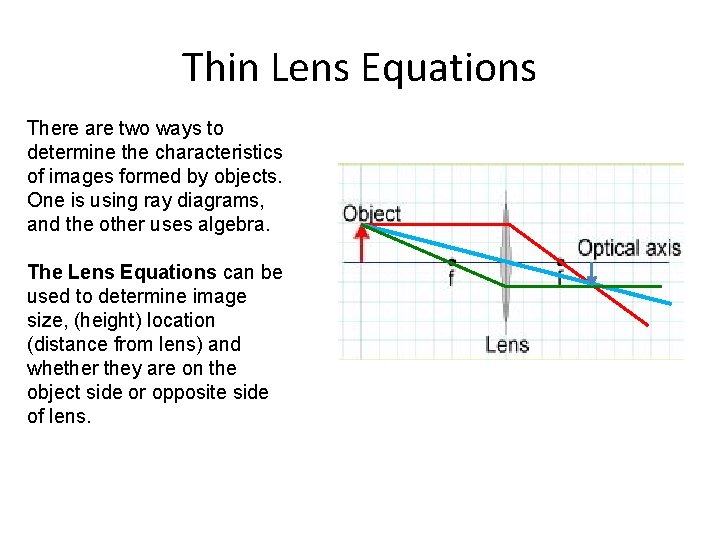
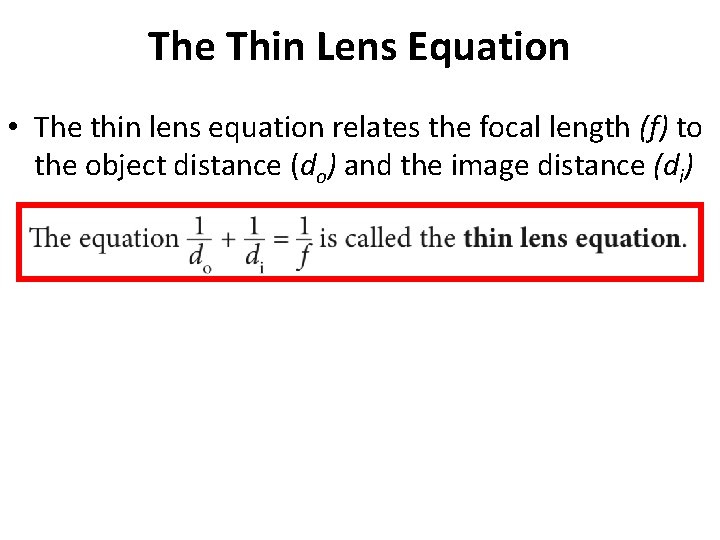
Thin Lens Equations There are two ways to determine the characteristics of images formed by objects. One is using ray diagrams, and the other uses algebra. The Lens Equations can be used to determine image size, (height) location (distance from lens) and whether they are on the object side or opposite side of lens.
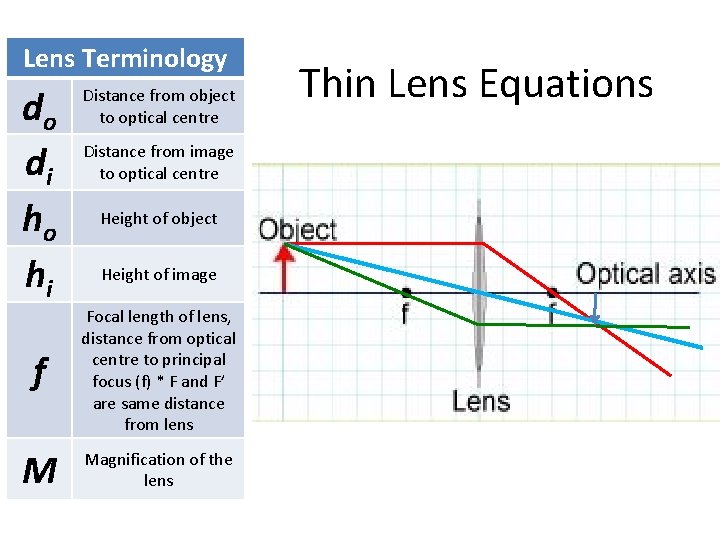
Lens Terminology do di ho hi Distance from object to optical centre Distance from image to optical centre Height of object Height of image f Focal length of lens, distance from optical centre to principal focus (f) * F and F’ are same distance from lens M Magnification of the lens Thin Lens Equations
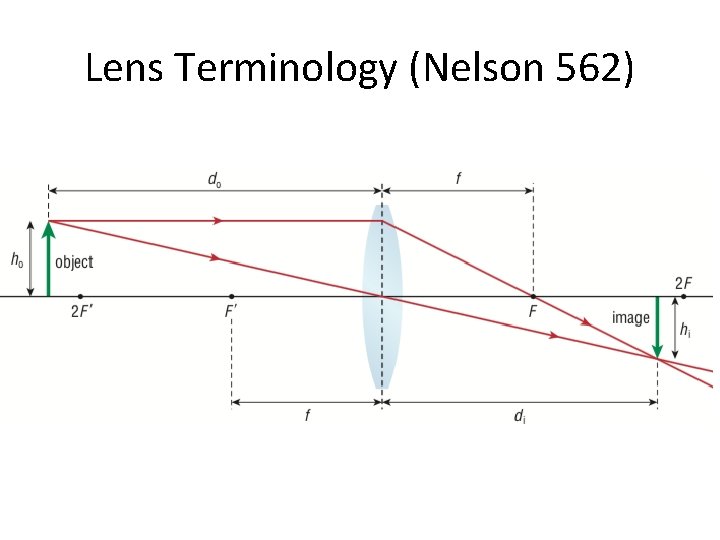
Lens Terminology (Nelson 562)
The Thin Lens Equation • The thin lens equation relates the focal length (f) to the object distance (do) and the image distance (di)
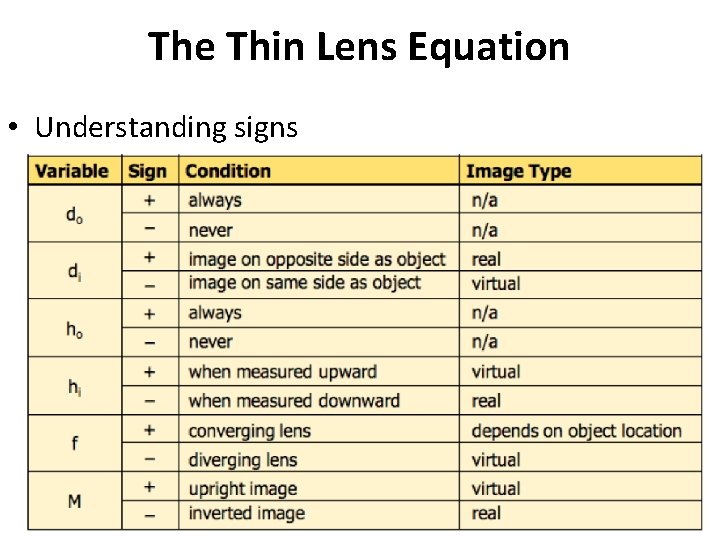
The Thin Lens Equation • Understanding signs
Example 1 • A converging lens has a focal length of +17 cm. A candle is located +48 cm from the lens. What type of image will be formed, and where will it be located? (real, +26 cm) • f = +17 cm • Do = +48 cm
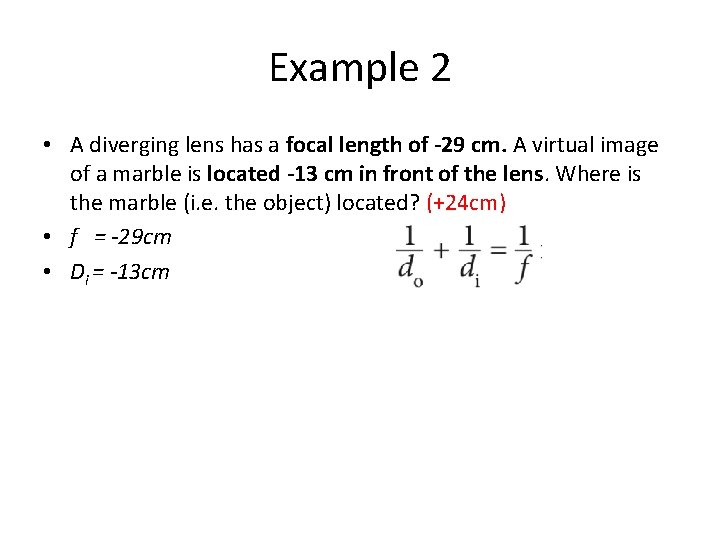
Example 2 • A diverging lens has a focal length of -29 cm. A virtual image of a marble is located -13 cm in front of the lens. Where is the marble (i. e. the object) located? (+24 cm) • f = -29 cm • Di = -13 cm
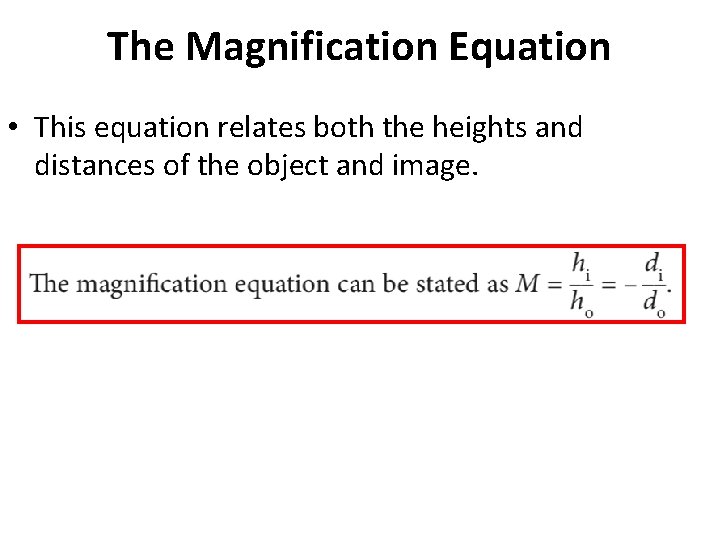
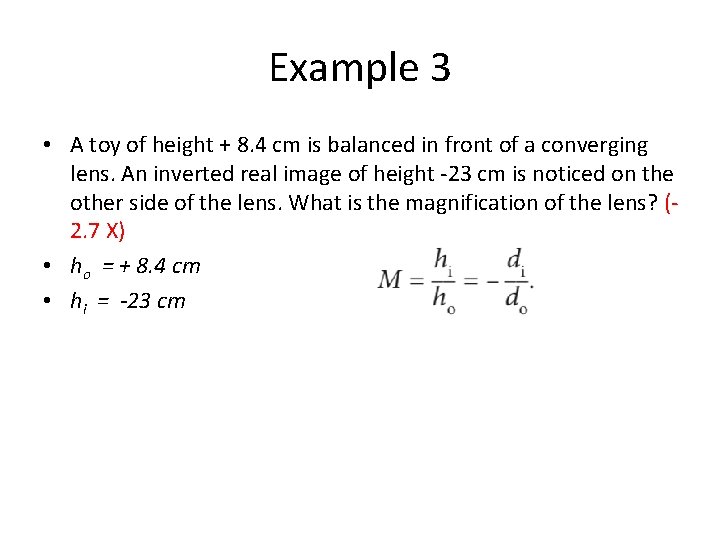
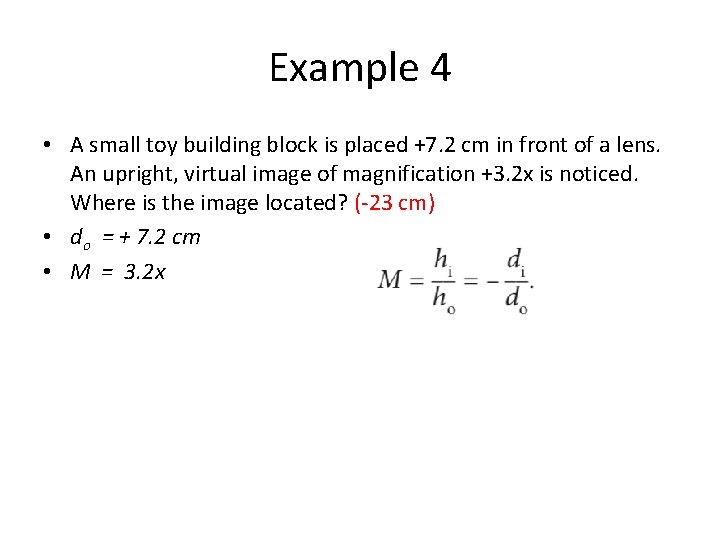
The Magnification Equation • This equation relates both the heights and distances of the object and image.
Example 3 • A toy of height + 8. 4 cm is balanced in front of a converging lens. An inverted real image of height -23 cm is noticed on the other side of the lens. What is the magnification of the lens? (2. 7 X) • ho = + 8. 4 cm • hi = -23 cm
Example 4 • A small toy building block is placed +7. 2 cm in front of a lens. An upright, virtual image of magnification +3. 2 x is noticed. Where is the image located? (-23 cm) • do = + 7. 2 cm • M = 3. 2 x
PRACTICE • Worksheet • Prac Q's Page 566 1, 2, 4, 5, 8