
Warm Up The three groups of rocks are


- Slides: 20
Warm Up The three groups of rocks are classified by ____. a. how they formed c. color b. grain size d. chemical composition 2) Which of the following is true about rocks? a. Rocks do not contain any nonmineral matter. b. Rocks are composed of only one mineral. c. Coal is not considered a true rock. d. Most rocks are a mixture of minerals. 3) What type of rocks are formed by processes powered by the sun? a. No rocks are formed by energy from the sun. b. sedimentary rocks c. igneous rocks d. metamorphic rocks Answers: 1) a. 2) d. 3) b. 1)
Igneous Rocks Chapter 3, Section 2
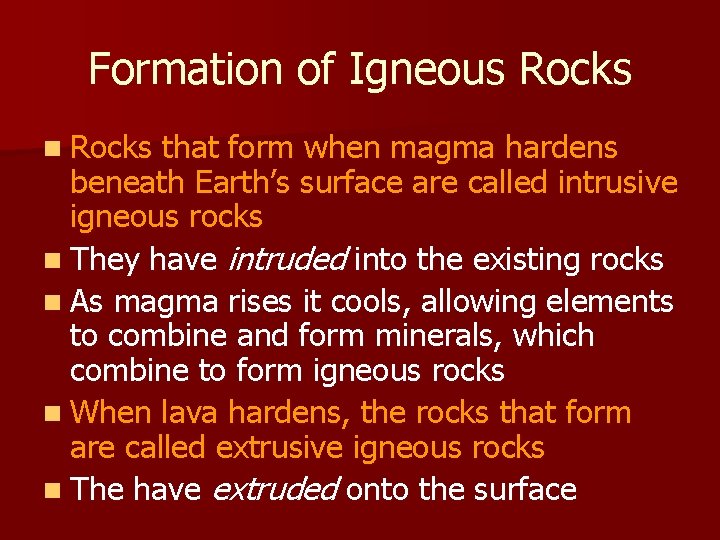
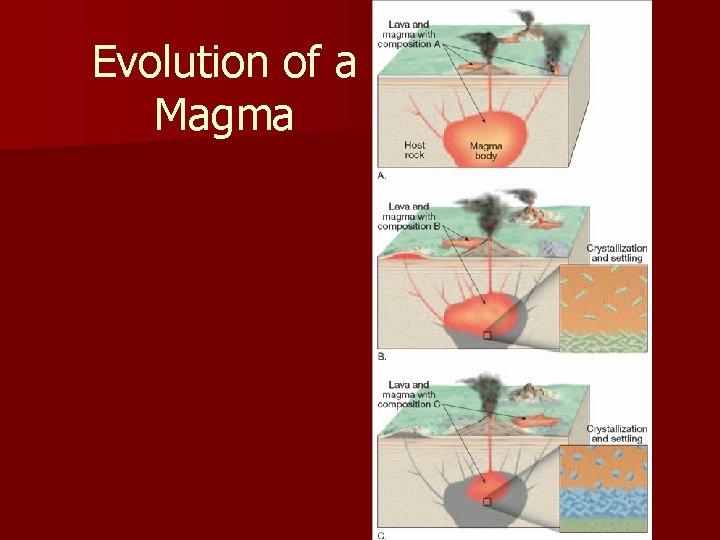
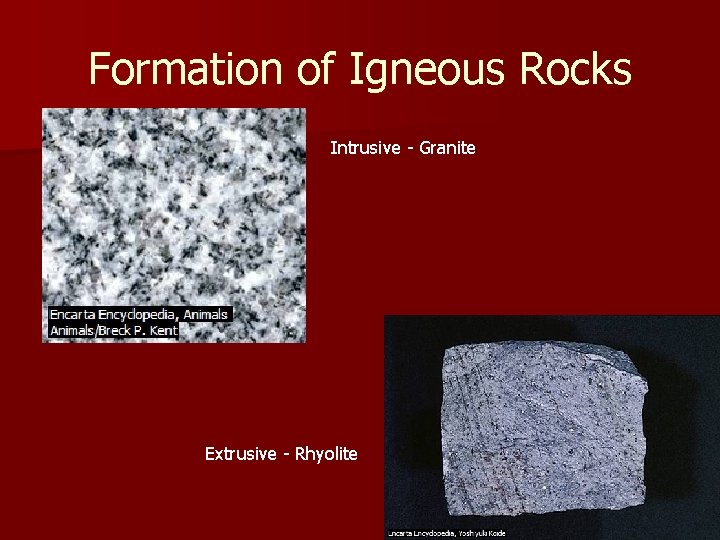
Formation of Igneous Rocks n Rocks that form when magma hardens beneath Earth’s surface are called intrusive igneous rocks n They have intruded into the existing rocks n As magma rises it cools, allowing elements to combine and form minerals, which combine to form igneous rocks n When lava hardens, the rocks that form are called extrusive igneous rocks n The have extruded onto the surface
Evolution of a Magma
Formation of Igneous Rocks Intrusive - Granite Extrusive - Rhyolite
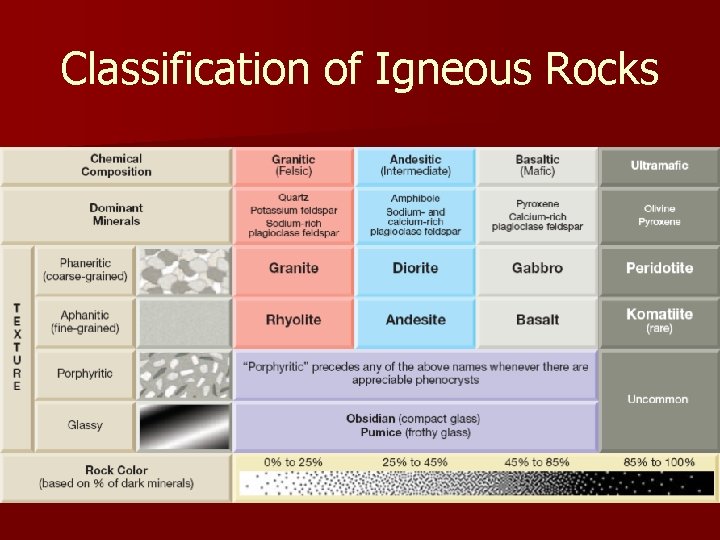
Classification of Igneous Rocks n Texture and composition are two characteristics used to classify igneous rocks n Texture describes the appearance of an igneous rock based on its size, shape, and arrangement of interlocking crystals n Composition describes the proportions of light and dark minerals in the rock
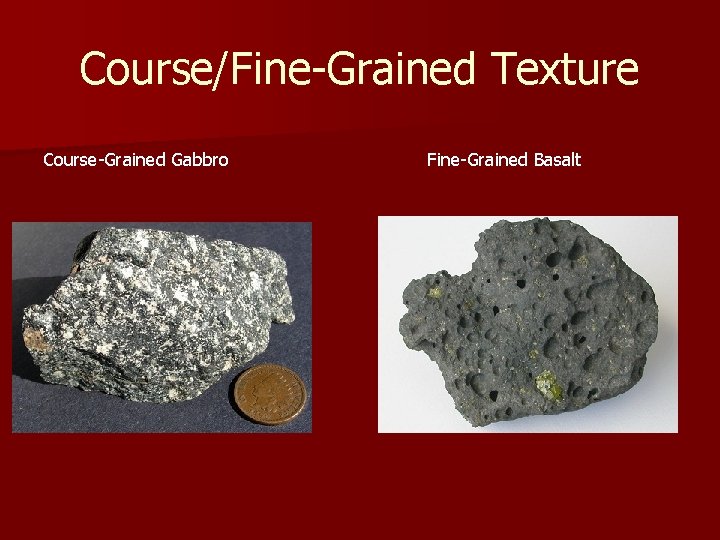
Course/Fine-Grained Texture n If the magma cools slowly, it will have only have a few centers of crystal growth n Slow cooling results in the formation of large crystals (course-grained) n If magma or lava cools rapidly, a large number of tiny crystals compete for available ions n Rapid cooling of magma or lava results in rocks with small, interconnected mineral grains (fine-grained)
Course/Fine-Grained Texture Course-Grained Gabbro Fine-Grained Basalt
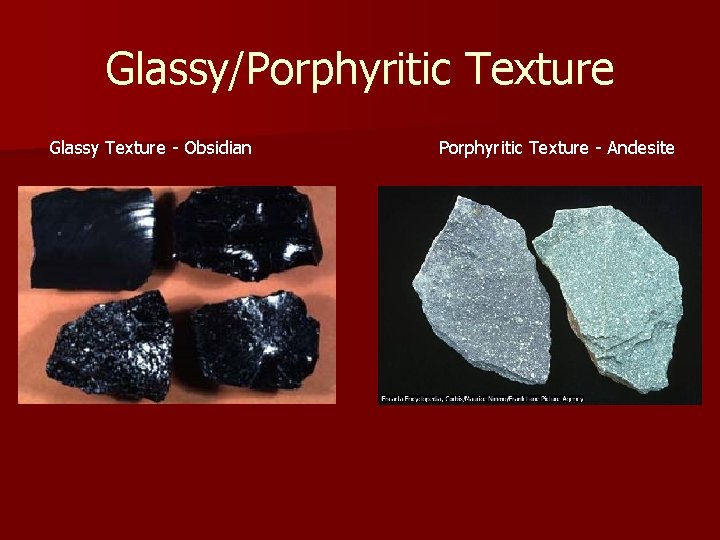
Glassy/Porphyritic Texture n Glassy Texture – solids produced so quickly that the ions are not able to align n Porphyritic Texture – rocks that have different size minerals, a result of different rates of cooling
Glassy/Porphyritic Texture Glassy Texture - Obsidian Porphyritic Texture - Andesite
Concept Check n How does the rate of cooling of magma or lava affect the texture of igneous rocks? n A slowly cooling magma or lava will produce rocks in which the mineral grains are relatively large. Quickly cooling molten material will result in rocks with small mineral grains. Lava that cools rapidly will produce a glassy rock. Rocks that form as a result of different cooling rates will have both large and small mineral grains.
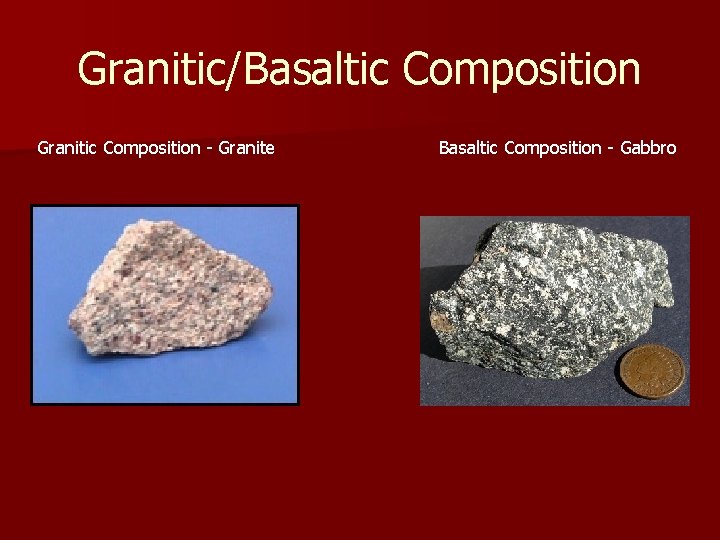
Granitic/Basaltic Composition n Granitic Composition – Igneous rocks in which quartz and feldspar are the dominant minerals n Most granitic rocks also contain about 10% dark silicate minerals and 70% light silicate minerals n Basaltic Composition – rocks that contain many dark silicate minerals n Basaltic rocks are rich in iron and magnesium
Granitic/Basaltic Composition Granitic Composition - Granite Basaltic Composition - Gabbro
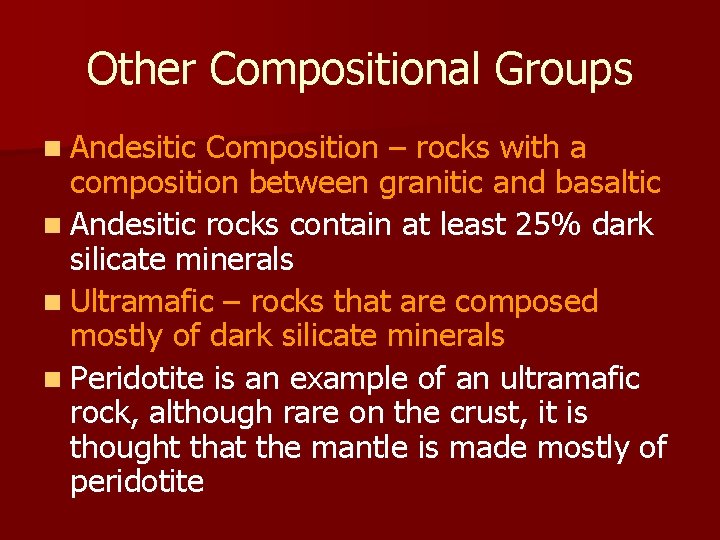
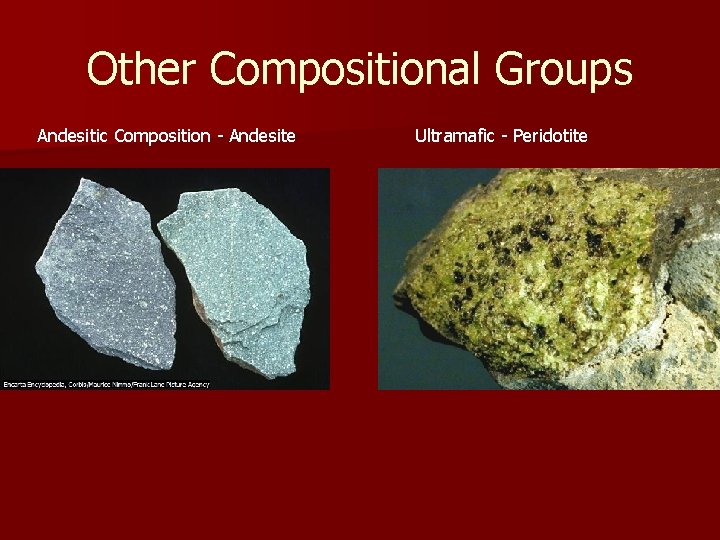
Other Compositional Groups n Andesitic Composition – rocks with a composition between granitic and basaltic n Andesitic rocks contain at least 25% dark silicate minerals n Ultramafic – rocks that are composed mostly of dark silicate minerals n Peridotite is an example of an ultramafic rock, although rare on the crust, it is thought that the mantle is made mostly of peridotite
Other Compositional Groups Andesitic Composition - Andesite Ultramafic - Peridotite
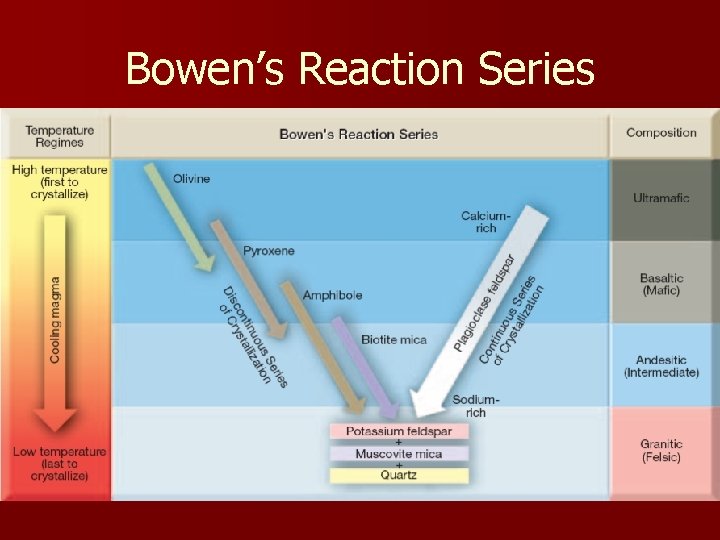
Bowen’s Reaction Series
Classification of Igneous Rocks
Concept Check n Describe the main differences between granitic and basaltic rocks? n Granitic rocks contain mostly quartz and feldspar and thus are light-colored. Basaltic rocks are rich in iron and thus are dark-colored and more dense.
Homework n Read Chapter 3, Section 2 (pg. 70 -74) n Do Chapter 3 Assessment #1 -36 (pg. 8990) n For Section 2: Do #’s 5, 12 -14, 23, & 35
Class Assignment n n 1. 2. 3. 4. Draw and Label the Rock Cycle. (p. 67) Include: Formation of Sedimentary rocks (5 pts) – Weathering – Sediment Formation of Igneous rocks (5 pts) – Cooling Magma Formation of Metamorphic rocks (5 pts) – Heat & Pressure Effort (5 pts)