
Warm Up Solve each equation for x 1
- Slides: 28
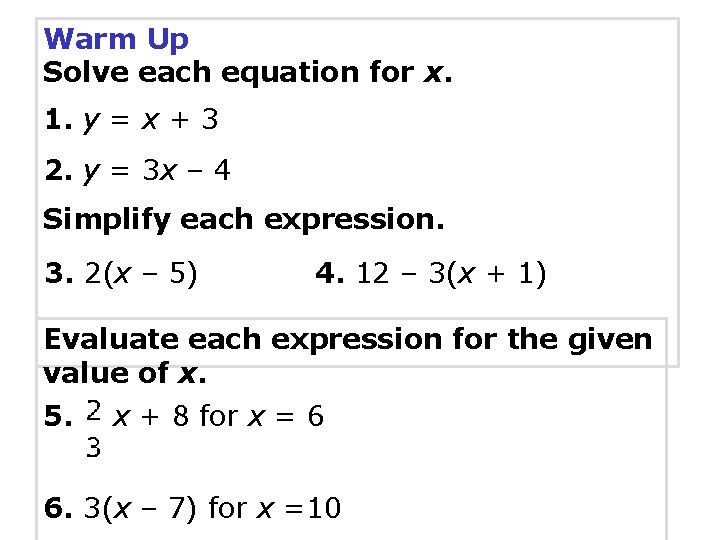
Warm Up Solve each equation for x. 1. y = x + 3 2. y = 3 x – 4 Simplify each expression. 3. 2(x – 5) 4. 12 – 3(x + 1) Evaluate each expression for the given value of x. 5. x + 8 for x = 6 6. 3(x – 7) for x =10
Objective Solve linear equations in two variables by substitution.
Sometimes it is difficult to identify the exact solution to a system by graphing. In this case, you can use a method called substitution. The goal when using substitution is to reduce the system to one equation that has only one variable. Then you can solve this equation by the methods taught in Chapter 2.
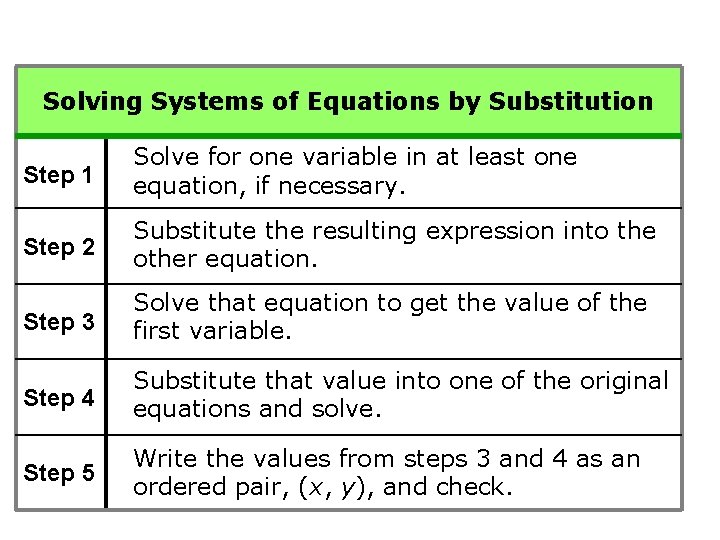
Solving Systems of Equations by Substitution Step 1 Solve for one variable in at least one equation, if necessary. Step 2 Substitute the resulting expression into the other equation. Step 3 Solve that equation to get the value of the first variable. Step 4 Substitute that value into one of the original equations and solve. Step 5 Write the values from steps 3 and 4 as an ordered pair, (x, y), and check.
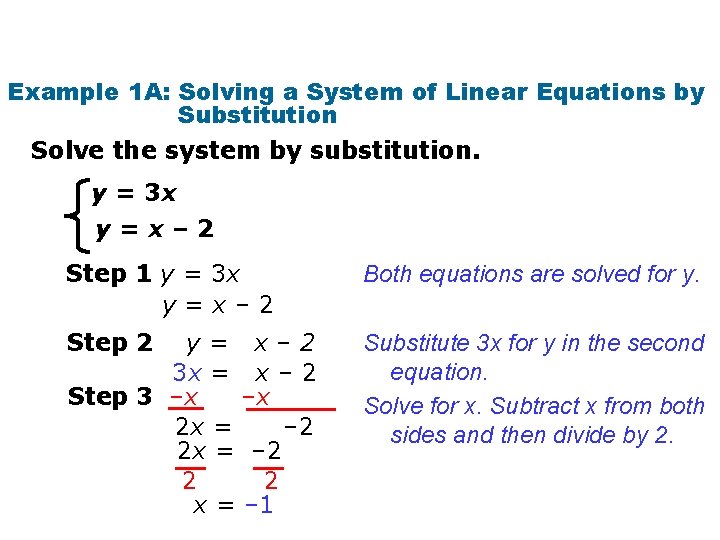
Example 1 A: Solving a System of Linear Equations by Substitution Solve the system by substitution. y = 3 x y=x– 2 Step 1 y = 3 x y=x– 2 Both equations are solved for y. Step 2 Substitute 3 x for y in the second equation. Solve for x. Subtract x from both sides and then divide by 2. y= x– 2 3 x = x – 2 Step 3 –x –x 2 x = – 2 2 2 x = – 1
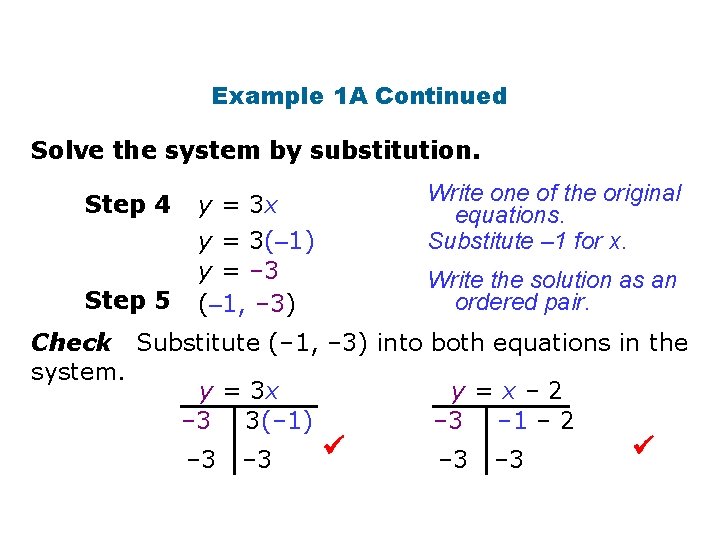
Example 1 A Continued Solve the system by substitution. Step 4 Step 5 Write one of the original equations. Substitute – 1 for x. y = 3 x y = 3(– 1) y = – 3 (– 1, – 3) Write the solution as an ordered pair. Check Substitute (– 1, – 3) into both equations in the system. y=x– 2 y = 3 x – 3 3(– 1) – 3 – 1 – 2 – 3 – 3
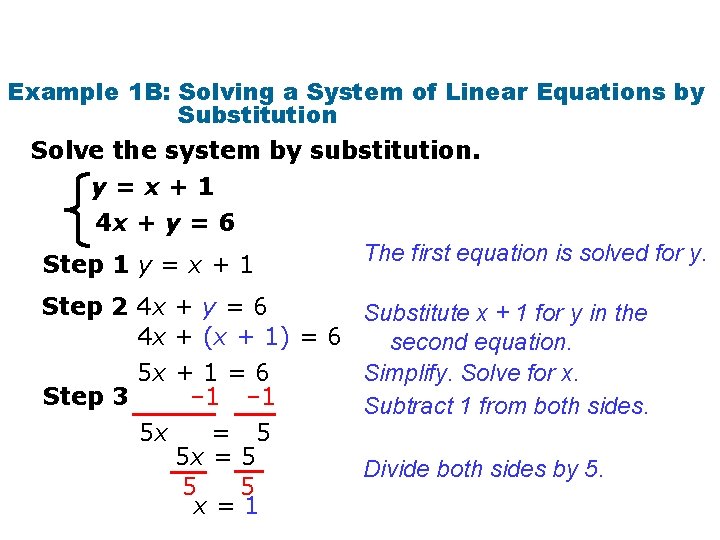
Example 1 B: Solving a System of Linear Equations by Substitution Solve the system by substitution. y=x+1 4 x + y = 6 The first equation is solved for y. Step 1 y = x + 1 Step 2 4 x + y = 6 Substitute x + 1 for y in the 4 x + (x + 1) = 6 second equation. Simplify. Solve for x. 5 x + 1 = 6 Step 3 – 1 Subtract 1 from both sides. 5 x = 5 Divide both sides by 5. 5 5 x=1
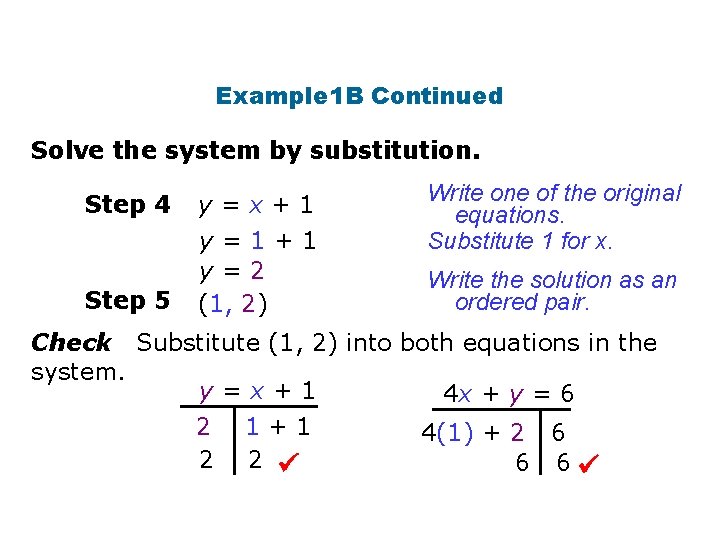
Example 1 B Continued Solve the system by substitution. Step 4 Step 5 y=x+1 y=1+1 y=2 (1, 2) Write one of the original equations. Substitute 1 for x. Write the solution as an ordered pair. Check Substitute (1, 2) into both equations in the system. y=x+1 4 x + y = 6 2 1+1 4(1) + 2 6 2 2 6 6
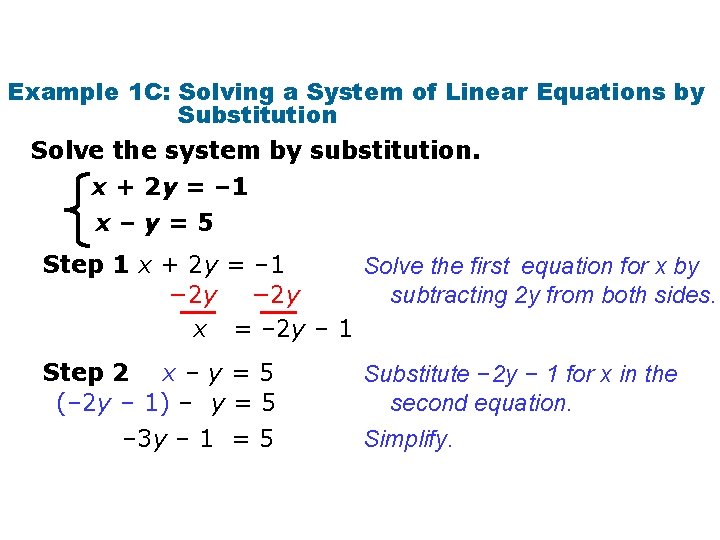
Example 1 C: Solving a System of Linear Equations by Substitution Solve the system by substitution. x + 2 y = – 1 x–y=5 Step 1 x + 2 y = – 1 Solve the first equation for x by subtracting 2 y from both sides. − 2 y x = – 2 y – 1 Step 2 x – y = 5 (– 2 y – 1) – y = 5 – 3 y – 1 = 5 Substitute – 2 y – 1 for x in the second equation. Simplify.
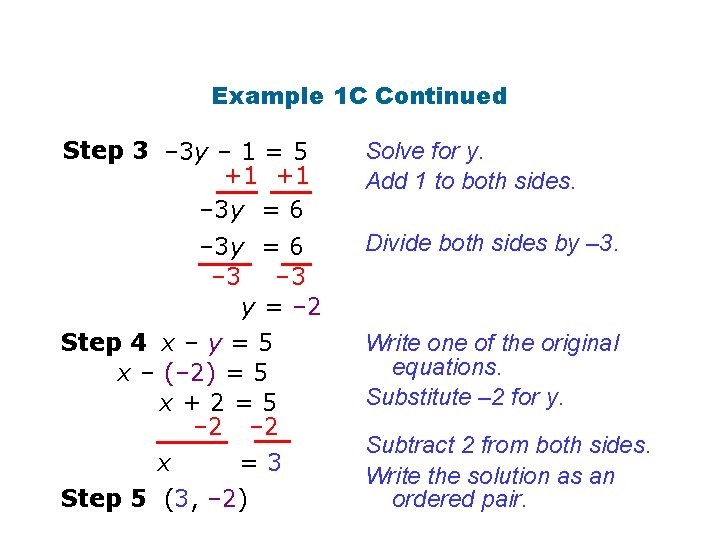
Example 1 C Continued Step 3 – 3 y – 1 = 5 +1 +1 – 3 y = 6 – 3 y = – 2 Step 4 x – y = 5 x – (– 2) = 5 x+2=5 – 2 x =3 Step 5 (3, – 2) Solve for y. Add 1 to both sides. Divide both sides by – 3. Write one of the original equations. Substitute – 2 for y. Subtract 2 from both sides. Write the solution as an ordered pair.
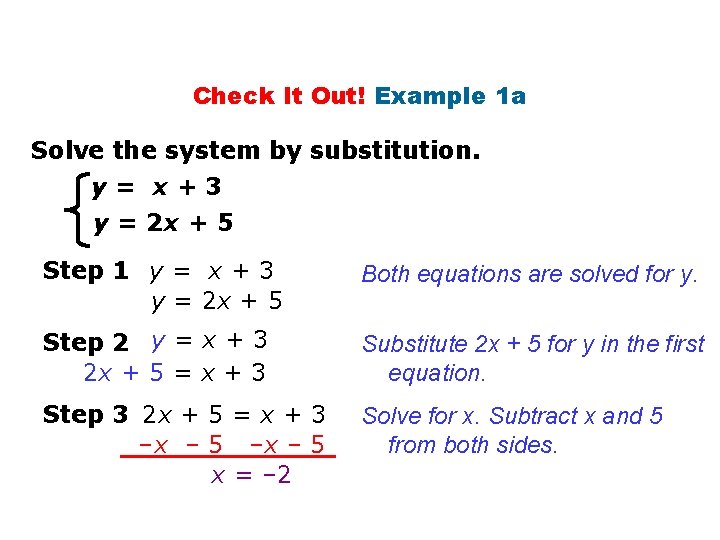
Check It Out! Example 1 a Solve the system by substitution. y= x+3 y = 2 x + 5 Step 1 y = x + 3 y = 2 x + 5 Both equations are solved for y. Step 2 y = x + 3 2 x + 5 = x + 3 Substitute 2 x + 5 for y in the first equation. Step 3 2 x + 5 = x + 3 –x – 5 x = – 2 Solve for x. Subtract x and 5 from both sides.
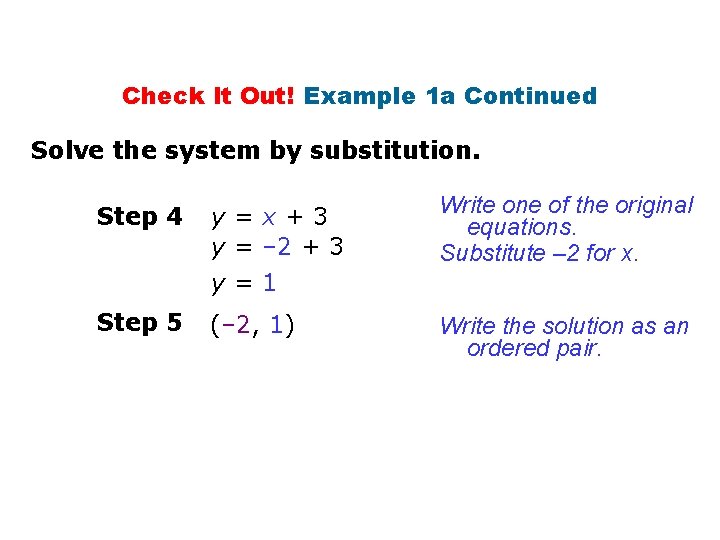
Check It Out! Example 1 a Continued Solve the system by substitution. Step 4 y=x+3 y = – 2 + 3 Write one of the original equations. Substitute – 2 for x. y=1 Step 5 (– 2, 1) Write the solution as an ordered pair.
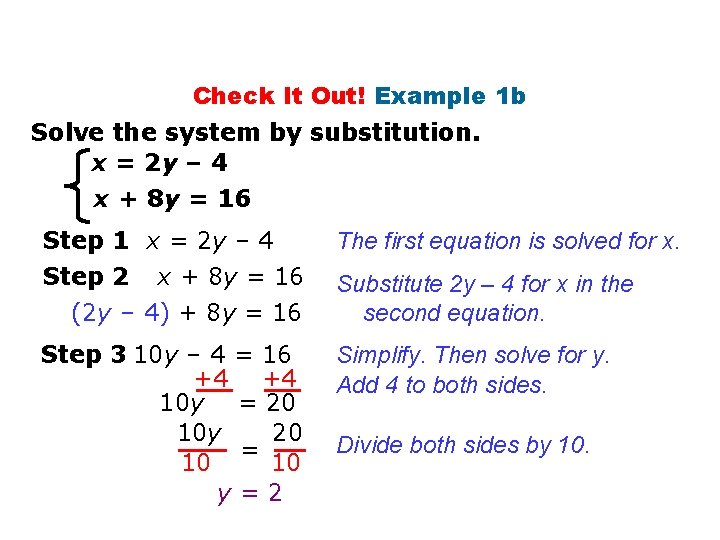
Check It Out! Example 1 b Solve the system by substitution. x = 2 y – 4 x + 8 y = 16 Step 1 x = 2 y – 4 The first equation is solved for x. Step 2 x + 8 y = 16 (2 y – 4) + 8 y = 16 Substitute 2 y – 4 for x in the second equation. Step 3 10 y – 4 = 16 +4 +4 10 y = 20 10 y 20 = 10 10 y=2 Simplify. Then solve for y. Add 4 to both sides. Divide both sides by 10.
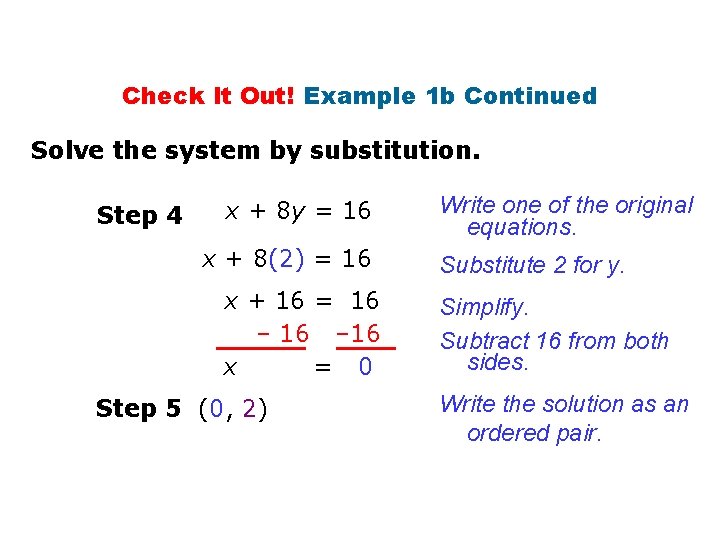
Check It Out! Example 1 b Continued Solve the system by substitution. Step 4 x + 8 y = 16 x + 8(2) = 16 x + 16 = 16 – 16 x = 0 Step 5 (0, 2) Write one of the original equations. Substitute 2 for y. Simplify. Subtract 16 from both sides. Write the solution as an ordered pair.
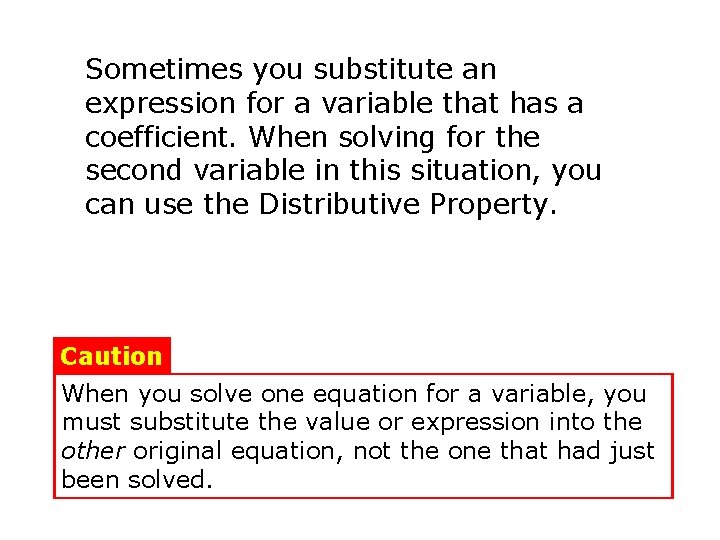
Sometimes you substitute an expression for a variable that has a coefficient. When solving for the second variable in this situation, you can use the Distributive Property. Caution When you solve one equation for a variable, you must substitute the value or expression into the other original equation, not the one that had just been solved.
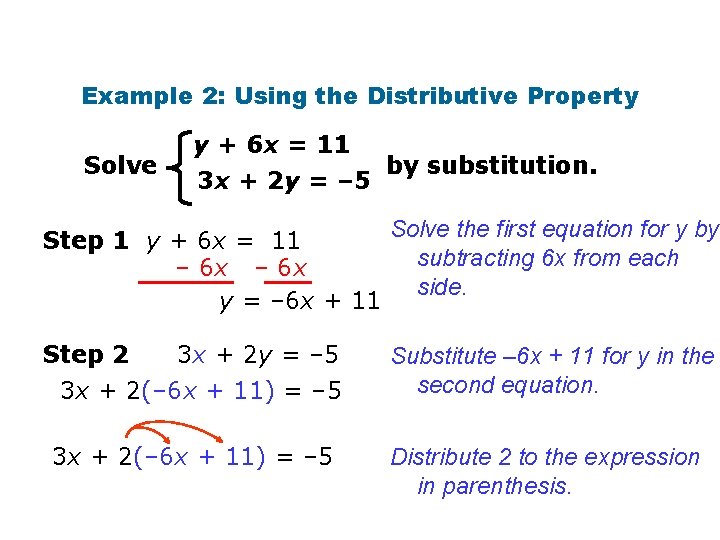
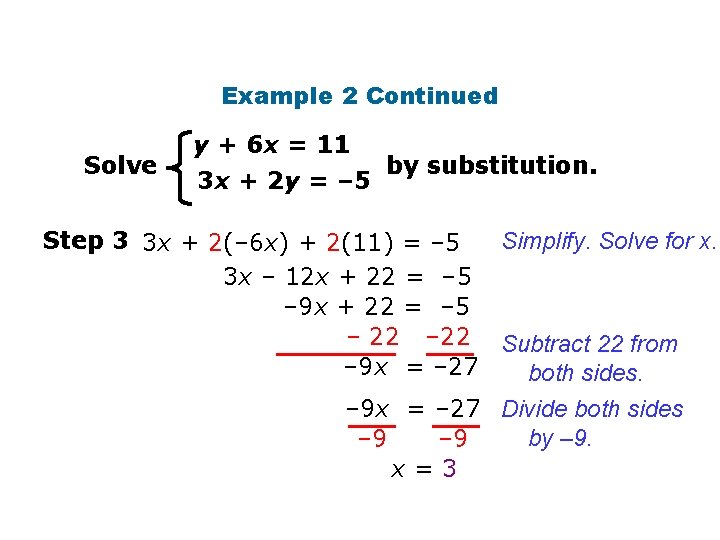
Example 2: Using the Distributive Property Solve y + 6 x = 11 by substitution. 3 x + 2 y = – 5 Step 1 y + 6 x = 11 – 6 x y = – 6 x + 11 Solve the first equation for y by subtracting 6 x from each side. Step 2 3 x + 2 y = – 5 3 x + 2(– 6 x + 11) = – 5 Substitute – 6 x + 11 for y in the second equation. 3 x + 2(– 6 x + 11) = – 5 Distribute 2 to the expression in parenthesis.
Example 2 Continued Solve y + 6 x = 11 by substitution. 3 x + 2 y = – 5 Simplify. Solve for x. Step 3 3 x + 2(– 6 x) + 2(11) = – 5 3 x – 12 x + 22 = – 5 – 9 x + 22 = – 5 – 22 Subtract 22 from – 9 x = – 27 both sides. – 9 x = – 27 Divide both sides by – 9 x=3
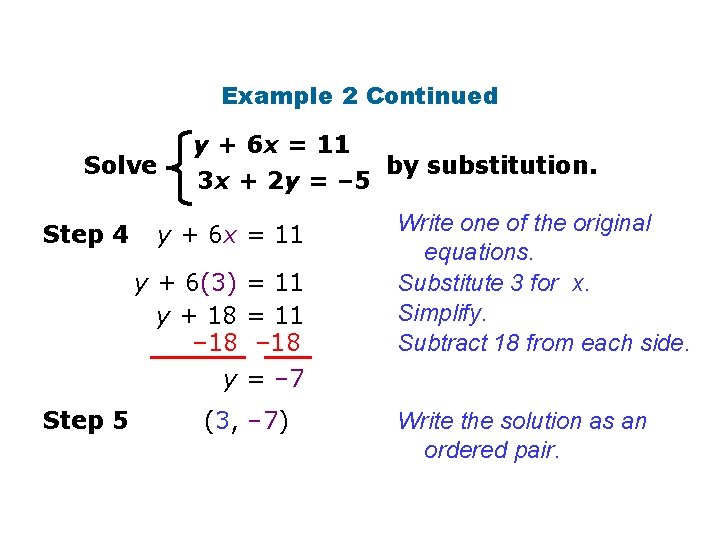
Example 2 Continued Solve Step 4 y + 6 x = 11 by substitution. 3 x + 2 y = – 5 y + 6 x = 11 y + 6(3) = 11 y + 18 = 11 – 18 Write one of the original equations. Substitute 3 for x. Simplify. Subtract 18 from each side. y = – 7 Step 5 (3, – 7) Write the solution as an ordered pair.
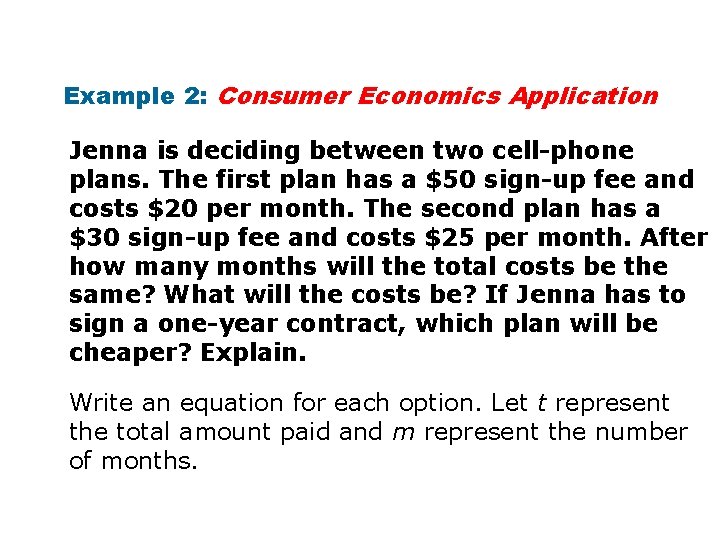
Example 2: Consumer Economics Application Jenna is deciding between two cell-phone plans. The first plan has a $50 sign-up fee and costs $20 per month. The second plan has a $30 sign-up fee and costs $25 per month. After how many months will the total costs be the same? What will the costs be? If Jenna has to sign a one-year contract, which plan will be cheaper? Explain. Write an equation for each option. Let t represent the total amount paid and m represent the number of months.
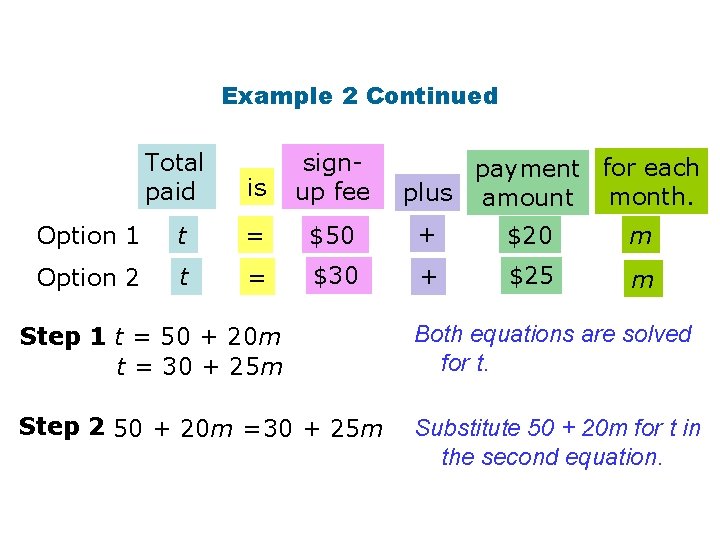
Example 2 Continued Total paid is signup fee Option 1 t = $50 + $20 m Option 2 t = $30 + $25 m payment for each plus amount month. Step 1 t = 50 + 20 m t = 30 + 25 m Both equations are solved for t. Step 2 50 + 20 m = 30 + 25 m Substitute 50 + 20 m for t in the second equation.
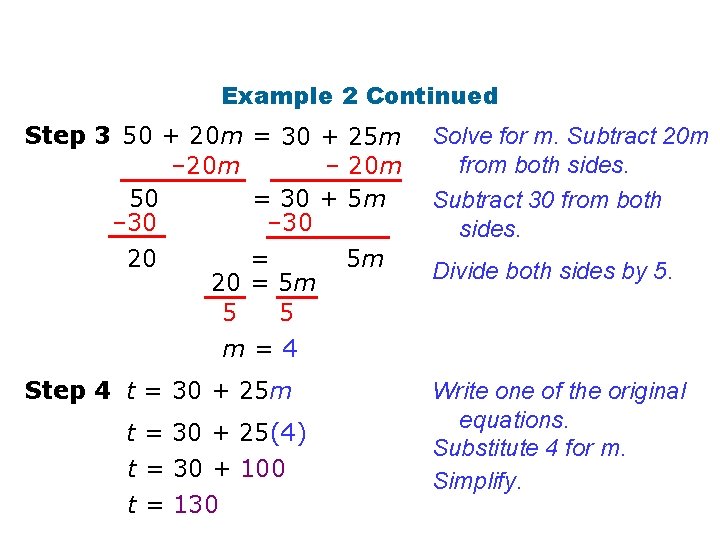
Example 2 Continued Step 3 50 + 20 m = 30 + 25 m – 20 m 50 = 30 + 5 m – 30 20 = 5 m 5 5 m=4 Step 4 t = 30 + 25 m t = 30 + 25(4) t = 30 + 100 t = 130 5 m Solve for m. Subtract 20 m from both sides. Subtract 30 from both sides. Divide both sides by 5. Write one of the original equations. Substitute 4 for m. Simplify.
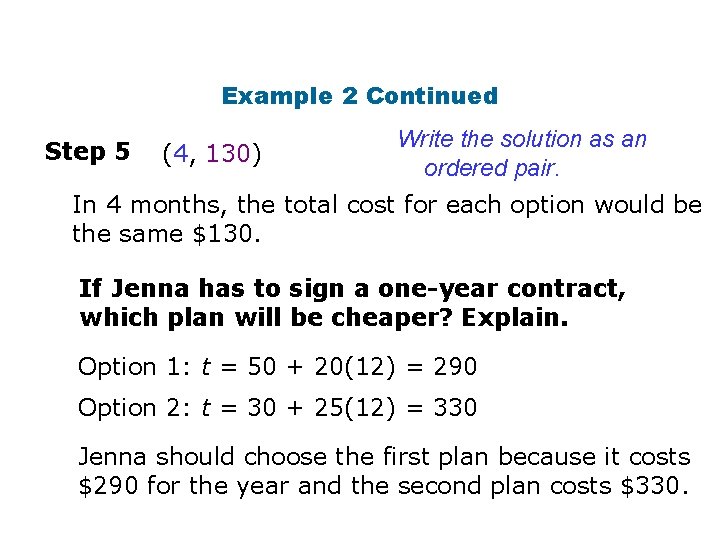
Example 2 Continued Step 5 (4, 130) Write the solution as an ordered pair. In 4 months, the total cost for each option would be the same $130. If Jenna has to sign a one-year contract, which plan will be cheaper? Explain. Option 1: t = 50 + 20(12) = 290 Option 2: t = 30 + 25(12) = 330 Jenna should choose the first plan because it costs $290 for the year and the second plan costs $330.
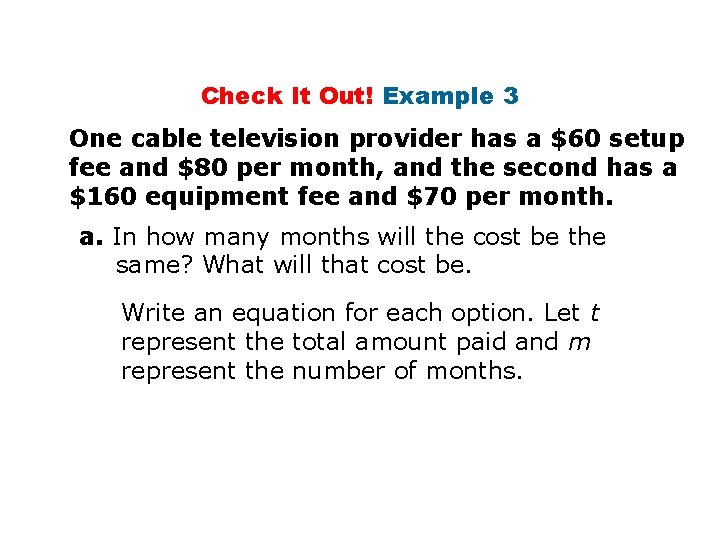
Check It Out! Example 3 One cable television provider has a $60 setup fee and $80 per month, and the second has a $160 equipment fee and $70 per month. a. In how many months will the cost be the same? What will that cost be. Write an equation for each option. Let t represent the total amount paid and m represent the number of months.
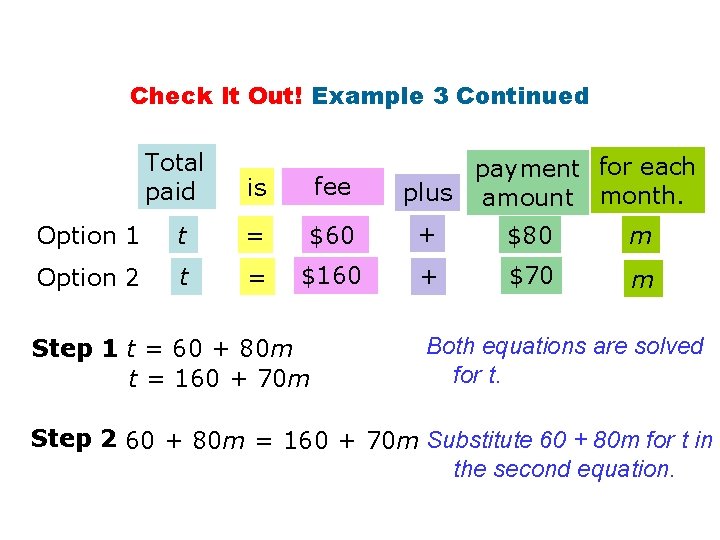
Check It Out! Example 3 Continued Total paid is fee Option 1 t = $60 + $80 m Option 2 t = $160 + $70 m Step 1 t = 60 + 80 m t = 160 + 70 m payment for each plus amount month. Both equations are solved for t. Step 2 60 + 80 m = 160 + 70 m Substitute 60 + 80 m for t in the second equation.
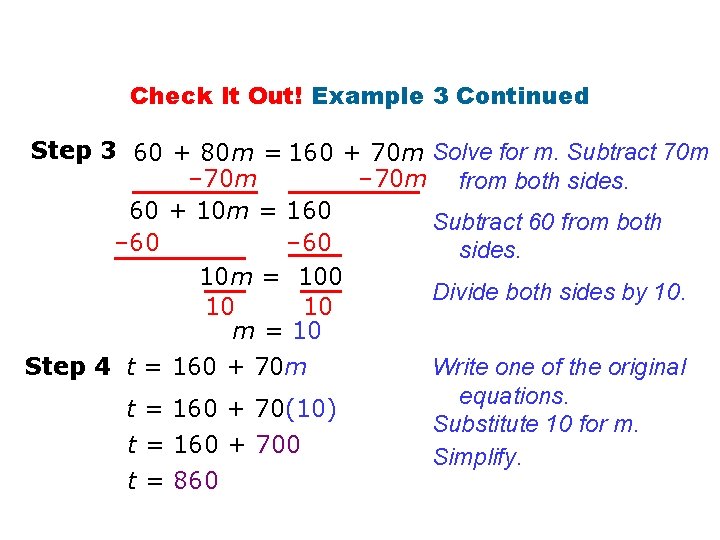
Check It Out! Example 3 Continued Step 3 60 + 80 m = 160 + 70 m Solve for m. Subtract 70 m – 70 m from both sides. 60 + 10 m = 160 Subtract 60 from both – 60 sides. 10 m = 100 Divide both sides by 10. 10 10 m = 10 Write one of the original Step 4 t = 160 + 70 m equations. t = 160 + 70(10) Substitute 10 for m. t = 160 + 700 Simplify. t = 860
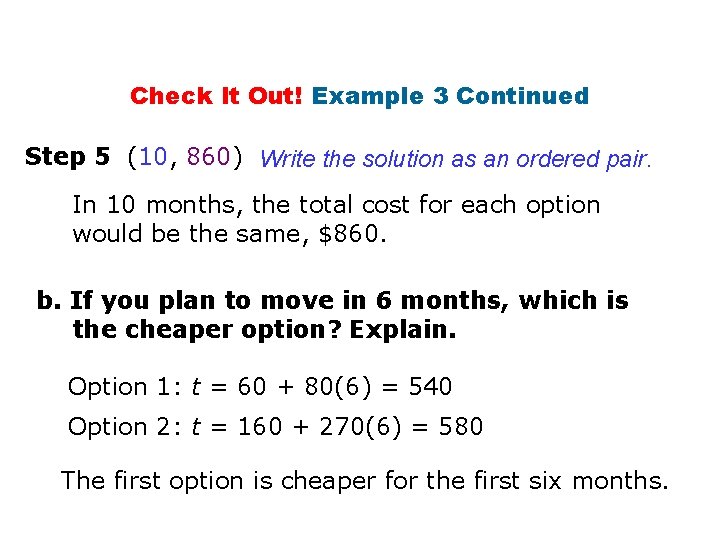
Check It Out! Example 3 Continued Step 5 (10, 860) Write the solution as an ordered pair. In 10 months, the total cost for each option would be the same, $860. b. If you plan to move in 6 months, which is the cheaper option? Explain. Option 1: t = 60 + 80(6) = 540 Option 2: t = 160 + 270(6) = 580 The first option is cheaper for the first six months.
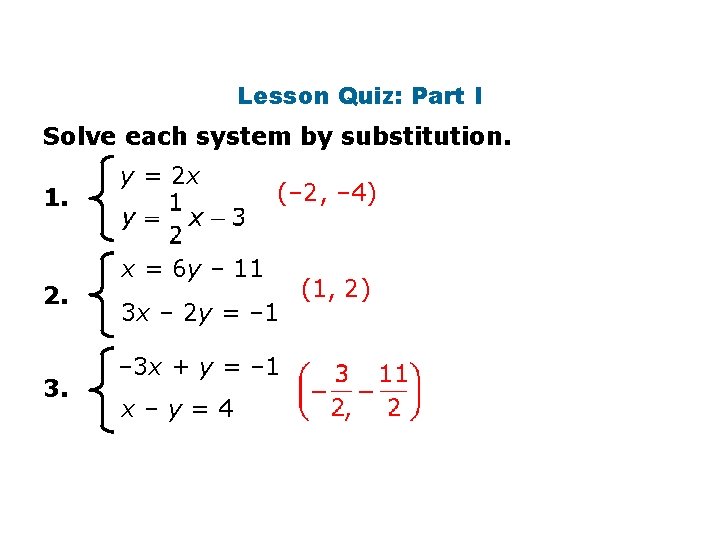
Lesson Quiz: Part I Solve each system by substitution. 1. 2. 3. y = 2 x (– 2, – 4) x = 6 y – 11 3 x – 2 y = – 1 – 3 x + y = – 1 x–y=4 (1, 2)
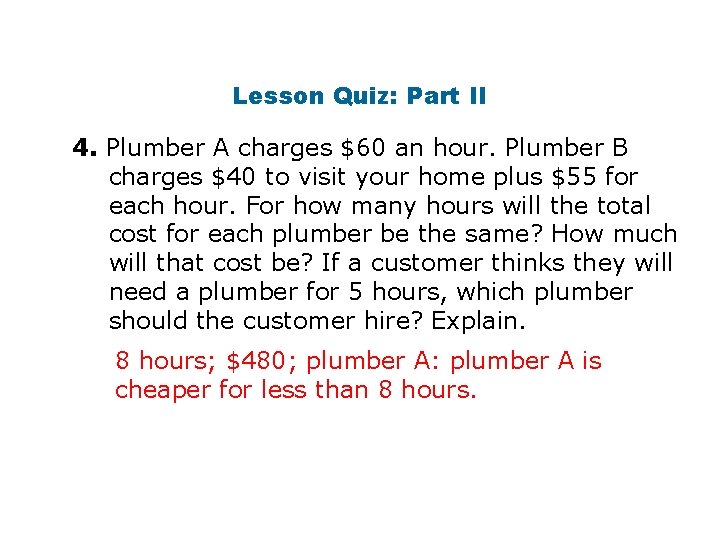
Lesson Quiz: Part II 4. Plumber A charges $60 an hour. Plumber B charges $40 to visit your home plus $55 for each hour. For how many hours will the total cost for each plumber be the same? How much will that cost be? If a customer thinks they will need a plumber for 5 hours, which plumber should the customer hire? Explain. 8 hours; $480; plumber A: plumber A is cheaper for less than 8 hours.