
WARM UP October 9 2019 New Handout Page
WARM UP – October 9, 2019 New Handout = Page 43 objective copy the following: I can use the terms ‘polymer’ and ‘monomer’ to describe macromolecules. This will help me to later describe polymer digestion and how monomers are used in cellular respiration. do now answer the following (HINT: Use p. 42): 1. Describe the difference between cells and tissues. 2. Provide an example of BOTH an organ and organ system. 3. Why do humans need to eat?
WARM UP – October 9, 2019 homework -Study for Chem quiz (reviews due on this day also) – Will be Mon. 10/14 -Finish Endo/exothermic lab- Due tomorrow, 10/10 -E. C. tissue boxes agenda -Reminder: Office hours/Grades posted! -Endo/exothermic lab make-ups -Quiz makeups/revisions - Turn in Endo/exothermic lab - Notes: Digestion & Macromolecules - Video: Monomers vs. Polymers objective I can explain how a polymer relates to a monomer.
Large Digestion & Macromolecules Copy the RED on --- PAGE 43 ---
Why do we need to eat? Our body is mostly water, but we cannot survive off just water and vitamins. We need to eat FOOD for ENERGY (used for growing, healing, and daily functions)
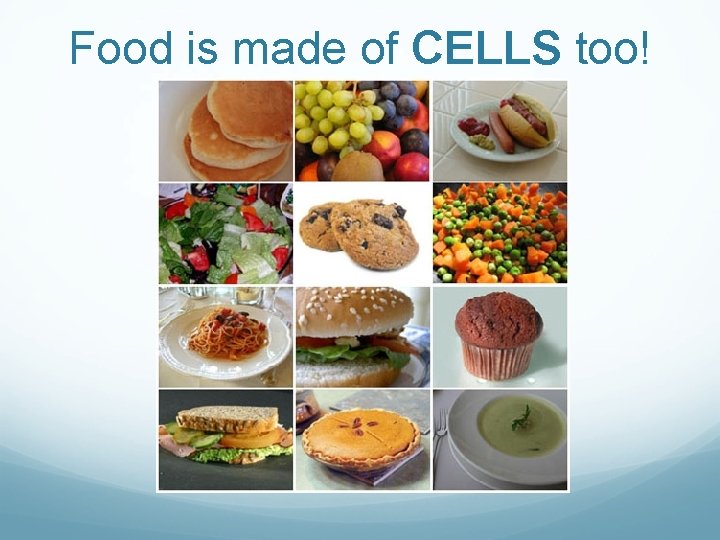
Food is made of CELLS too!
Digesting… When we digest food, we break it down into smaller parts. Our body rebuilds those smaller parts into the kinds of cells and things WE need. This can easily be done because all living things are made of only four types of macromolecules!
Digesting… The four macromolecules of all living things are made of mostly these atoms: C = O = H = P = N = S =
Remember, In Biology, all things are made from smaller parts. The science word for something made of many small repeating parts is called a POLYMER. The science word for the single small part in a polymer is called a MONOMER.
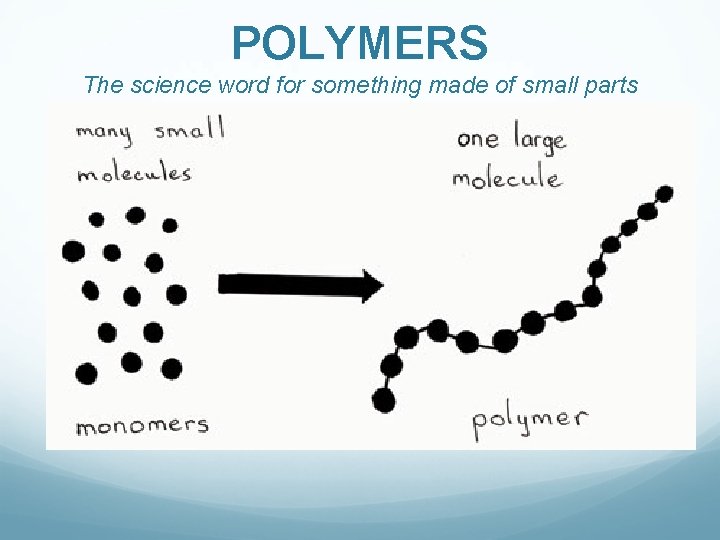
POLYMERS The science word for something made of small parts
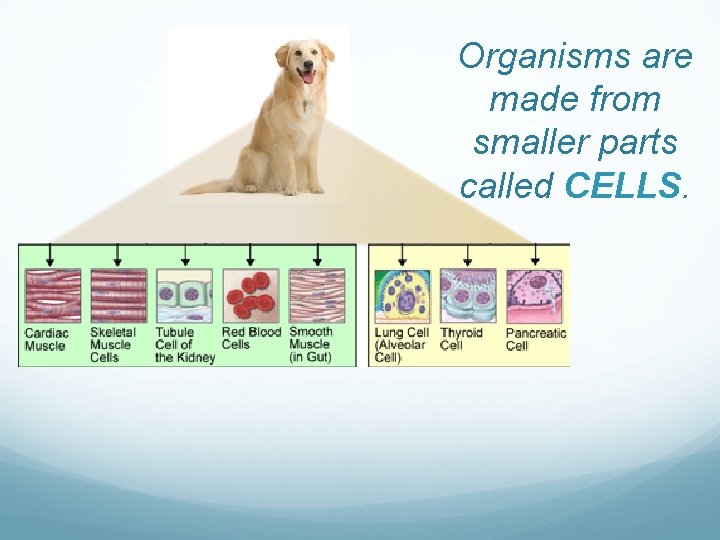
Organisms are made from smaller parts called CELLS.
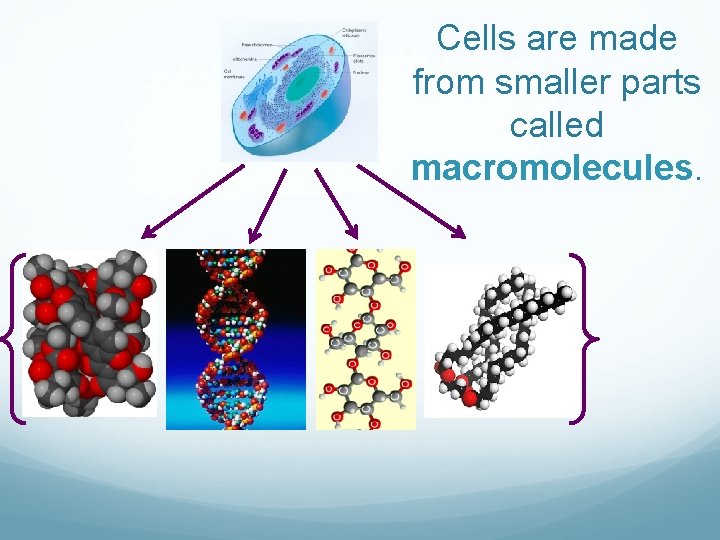
Cells are made from smaller parts called macromolecules.
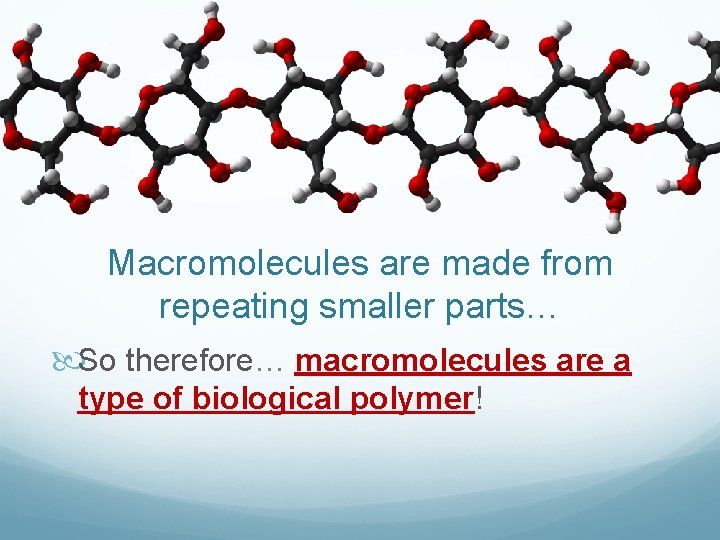
Macromolecules are made from repeating smaller parts… So therefore… macromolecules are a type of biological polymer!
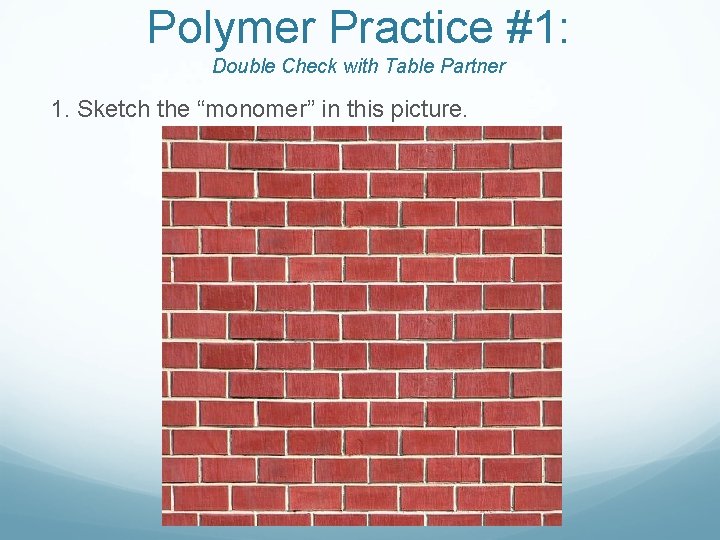
Polymer Practice #1: Double Check with Table Partner 1. Sketch the “monomer” in this picture.
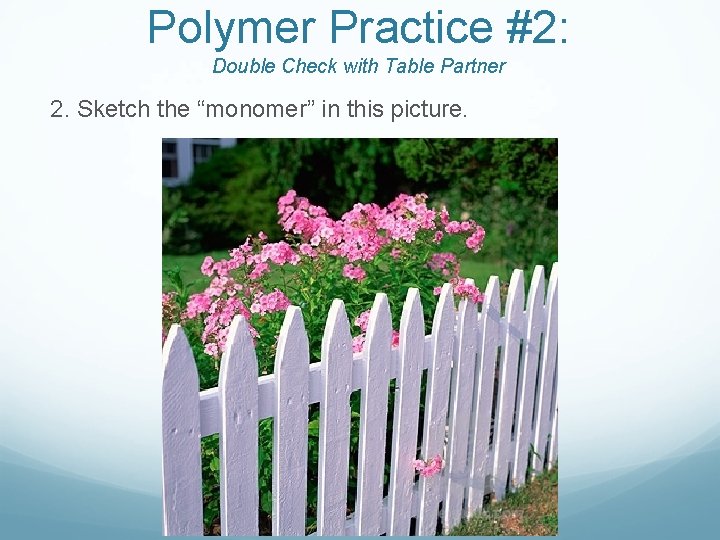
Polymer Practice #2: Double Check with Table Partner 2. Sketch the “monomer” in this picture.
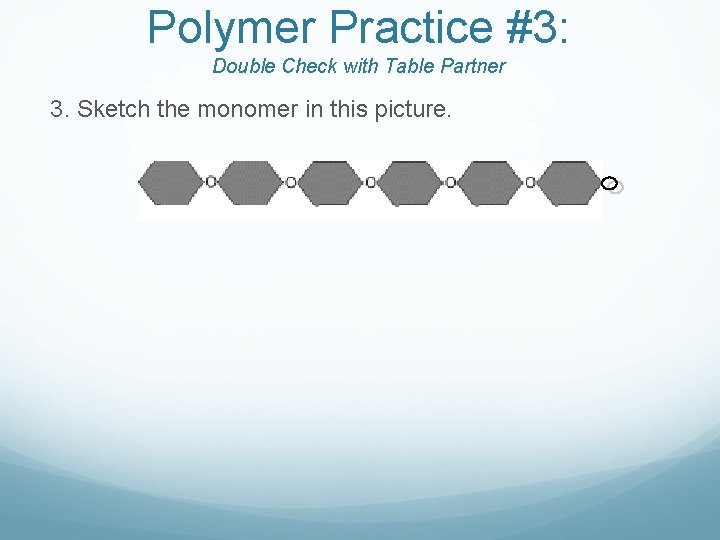
Polymer Practice #3: Double Check with Table Partner 3. Sketch the monomer in this picture.
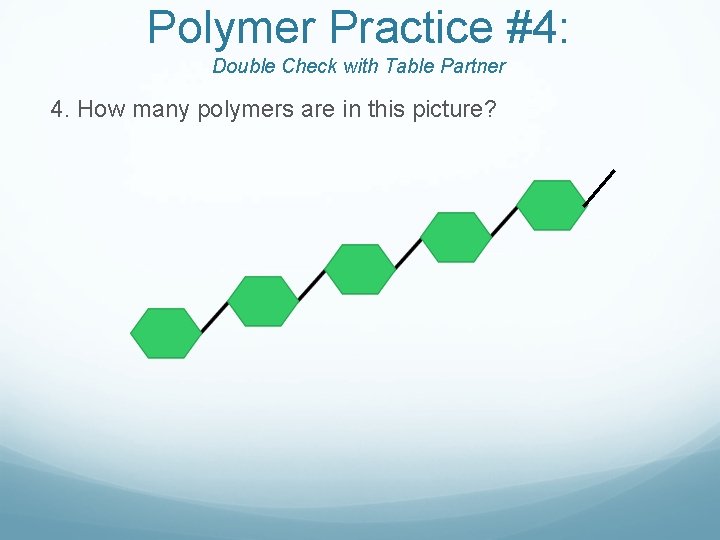
Polymer Practice #4: Double Check with Table Partner 4. How many polymers are in this picture?
Think-Write-Pair-Share How does this video relate to our notes? Can you think of any other examples of polymers?
WARM UP – October 10, 2019 objective copy the following: I can identify the 4 macromolecules that comprise living things, and describe their identifying characteristics. do now answer the following (p. 43): 1. Why do we need to eat? 2. Why do we need to digest, or break down, the food we eat? 3. Provide one NEW real-life or science example of a monomer/polymer relationship.
WARM UP – October 10, 2019 homework -Review for Chemistry quiz – Will be Monday 10/14 -Organize binders!! -E. C. tissue boxes agenda - BESS Passive Consent forms - Macromolecules Jigsaw! - Begin Concept maps? objective I can identify the 4 macromolecules that comprise living things, and describe their identifying characteristics.
WARM UP – October 11, 2019 New sheet: Page 44 objective copy the following: I can sketch a logical and accurate macromolecule concept map do now answer the following (HINT: Use p. 43!): 1. List the 4 macromolecules found in living things. 2. If a protein monomer (amino acid) looks like this --> sketch out what the protein polymer would look like. 3. How are simple and complex carbs different from each other? Think about whether they are made of monomers or polymers, and the foods they are found in.
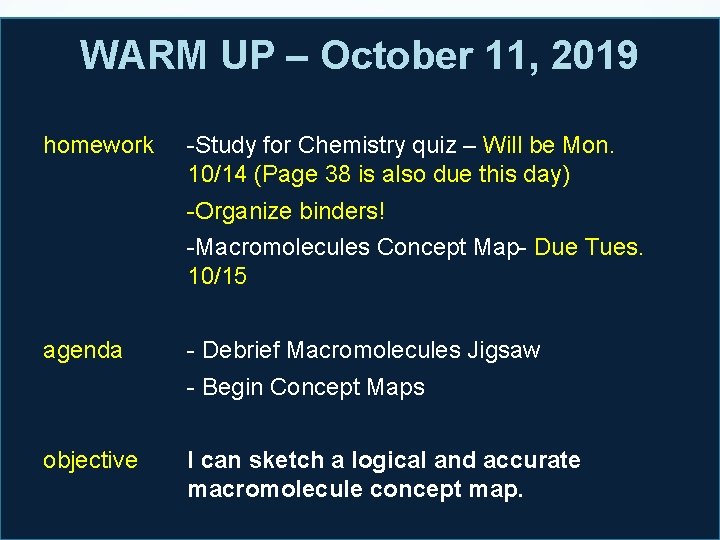
WARM UP – October 11, 2019 homework -Study for Chemistry quiz – Will be Mon. 10/14 (Page 38 is also due this day) -Organize binders! -Macromolecules Concept Map- Due Tues. 10/15 agenda - Debrief Macromolecules Jigsaw - Begin Concept Maps objective I can sketch a logical and accurate macromolecule concept map.
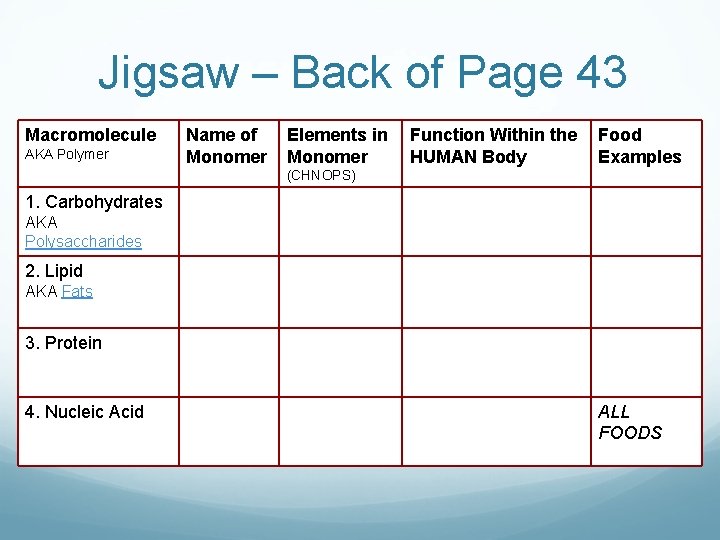
Jigsaw – Back of Page 43 Macromolecule AKA Polymer Name of Monomer Elements in Monomer Function Within the HUMAN Body Food Examples (CHNOPS) 1. Carbohydrates AKA Polysaccharides 2. Lipid AKA Fats 3. Protein 4. Nucleic Acid ALL FOODS
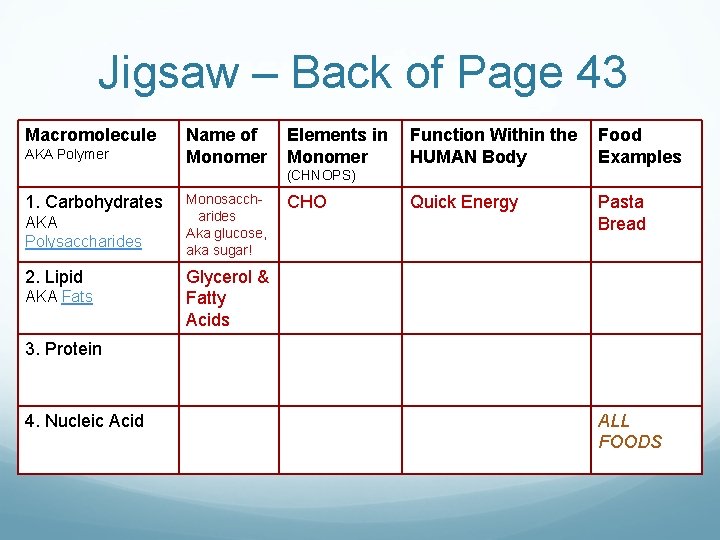
Jigsaw – Back of Page 43 Macromolecule AKA Polymer Name of Monomer Elements in Monomer Function Within the HUMAN Body Food Examples Quick Energy Pasta Bread (CHNOPS) 1. Carbohydrates AKA Polysaccharides 2. Lipid AKA Fats Monosaccharides Aka glucose, aka sugar! CHO Glycerol & Fatty Acids 3. Protein 4. Nucleic Acid ALL FOODS
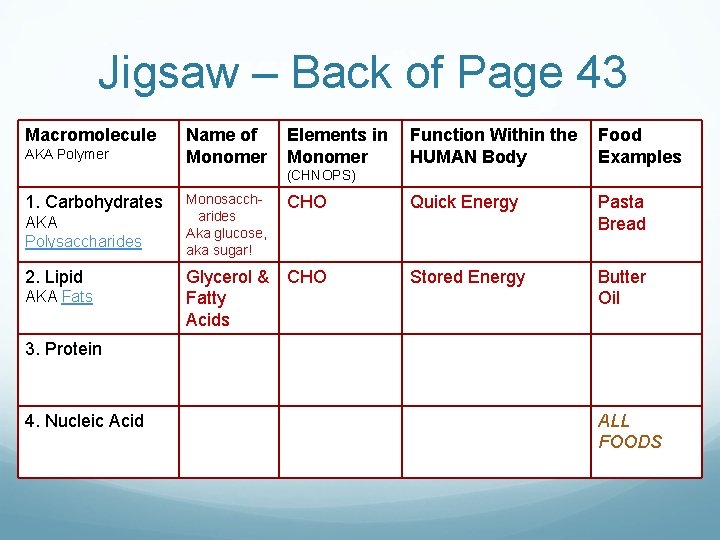
Jigsaw – Back of Page 43 Macromolecule AKA Polymer Name of Monomer Elements in Monomer Function Within the HUMAN Body Food Examples Quick Energy Pasta Bread Stored Energy Butter Oil (CHNOPS) 1. Carbohydrates AKA Polysaccharides 2. Lipid AKA Fats Monosaccharides Aka glucose, aka sugar! CHO Glycerol & CHO Fatty Acids 3. Protein 4. Nucleic Acid ALL FOODS
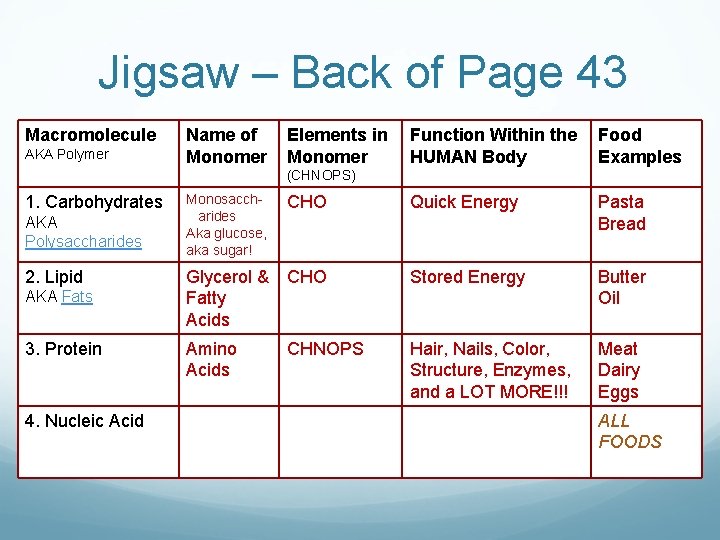
Jigsaw – Back of Page 43 Macromolecule AKA Polymer Name of Monomer Elements in Monomer Function Within the HUMAN Body Food Examples Quick Energy Pasta Bread Glycerol & CHO Fatty Acids Stored Energy Butter Oil Amino Acids Hair, Nails, Color, Structure, Enzymes, and a LOT MORE!!! Meat Dairy Eggs (CHNOPS) 1. Carbohydrates AKA Polysaccharides 2. Lipid AKA Fats 3. Protein 4. Nucleic Acid Monosaccharides Aka glucose, aka sugar! CHO CHNOPS ALL FOODS
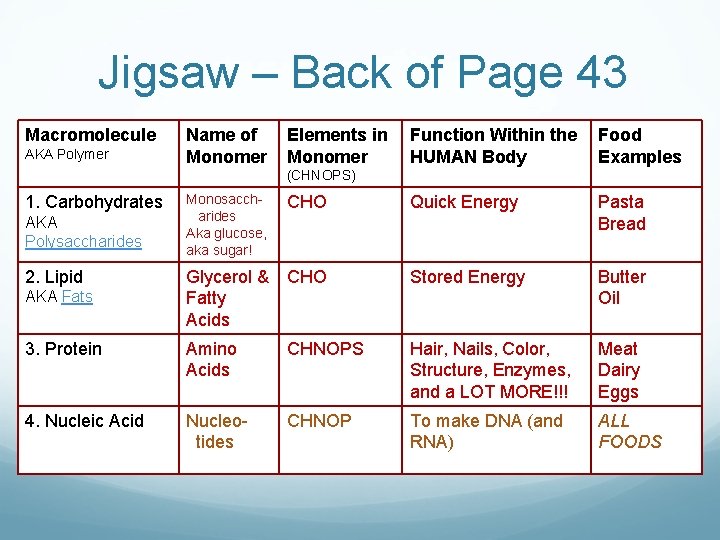
Jigsaw – Back of Page 43 Macromolecule Function Within the HUMAN Body Food Examples Quick Energy Pasta Bread Glycerol & CHO Fatty Acids Stored Energy Butter Oil 3. Protein Amino Acids CHNOPS Hair, Nails, Color, Structure, Enzymes, and a LOT MORE!!! Meat Dairy Eggs 4. Nucleic Acid Nucleotides CHNOP To make DNA (and RNA) ALL FOODS AKA Polymer Name of Monomer Elements in Monomer (CHNOPS) 1. Carbohydrates AKA Polysaccharides 2. Lipid AKA Fats Monosaccharides Aka glucose, aka sugar! CHO
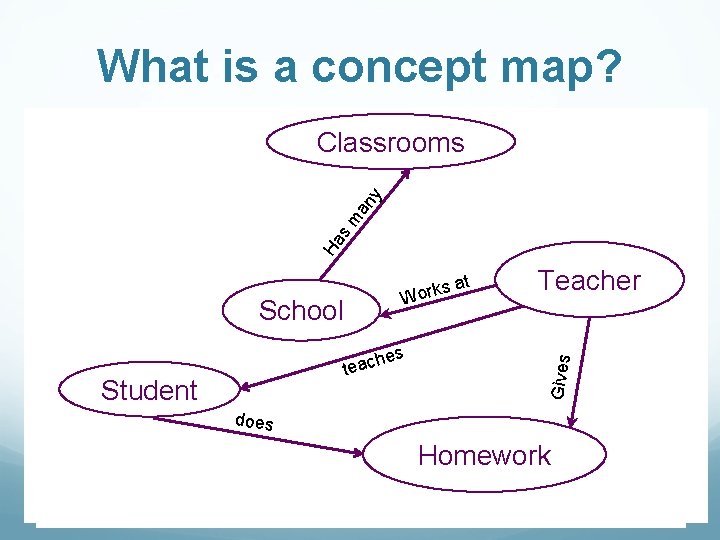
What is a concept map? an y A concept map can Classrooms Ha sm show concepts (ideas) are connected hes teac Student Gives help you review by making connections between key t Teacher sa k r o ideas and vocab W School does Homework
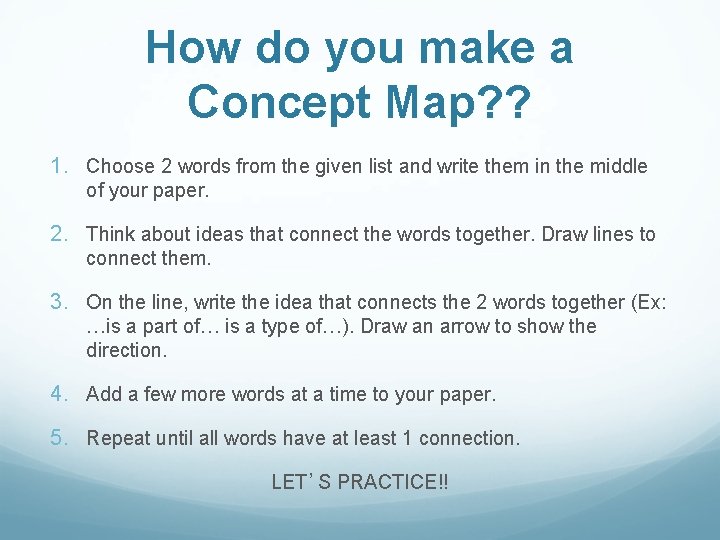
How do you make a Concept Map? ? 1. Choose 2 words from the given list and write them in the middle of your paper. 2. Think about ideas that connect the words together. Draw lines to connect them. 3. On the line, write the idea that connects the 2 words together (Ex: …is a part of… is a type of…). Draw an arrow to show the direction. 4. Add a few more words at a time to your paper. 5. Repeat until all words have at least 1 connection. LET’S PRACTICE!!
WARM UP – October 14, 2019 objective copy the following: I can sketch a logical and accurate macromolecule concept map. do now answer the following (HINT: p. 43 back): 1. Does protein provide us with energy? Explain. 2. Describe the structure of a protein polymer. 3. Your uncle tells you that he needs more protein in his diet. What foods would you suggest he eat?
WARM UP – October 14, 2019 homework -Macromolecules Concept Map- Due tomorrow, Tues. 10/15 -Organize binders! agenda -Chemistry quiz - Final concept map work time objective I can sketch a logical and accurate macromolecule concept map.
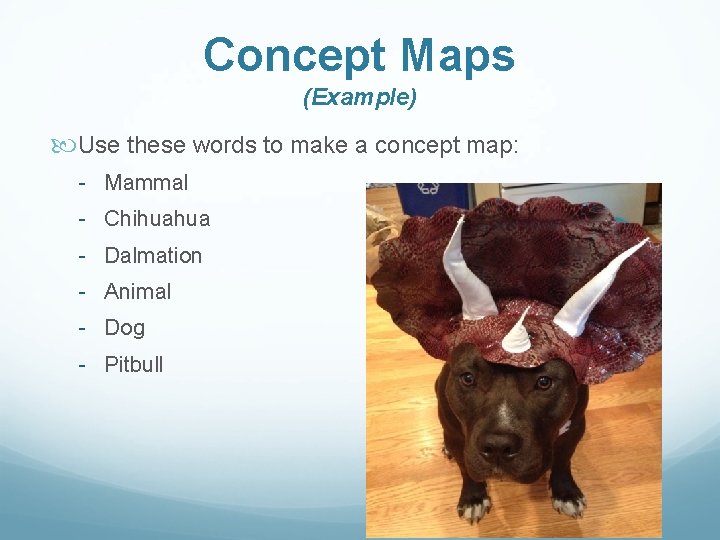
Concept Maps (Example) Use these words to make a concept map: - Mammal Chihuahua Dalmation Animal Dog Pitbull
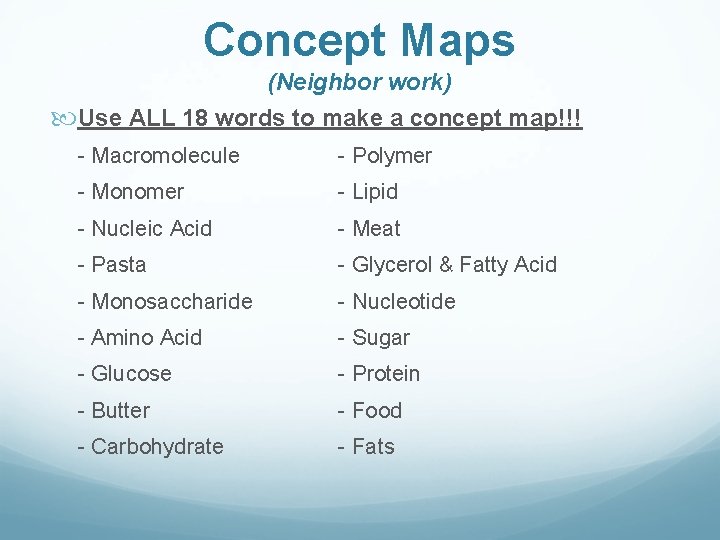
Concept Maps (Neighbor work) Use ALL 18 words to make a concept map!!! - Macromolecule - Polymer - Monomer - Lipid - Nucleic Acid - Meat - Pasta - Glycerol & Fatty Acid - Monosaccharide - Nucleotide - Amino Acid - Sugar - Glucose - Protein - Butter - Food - Carbohydrate - Fats
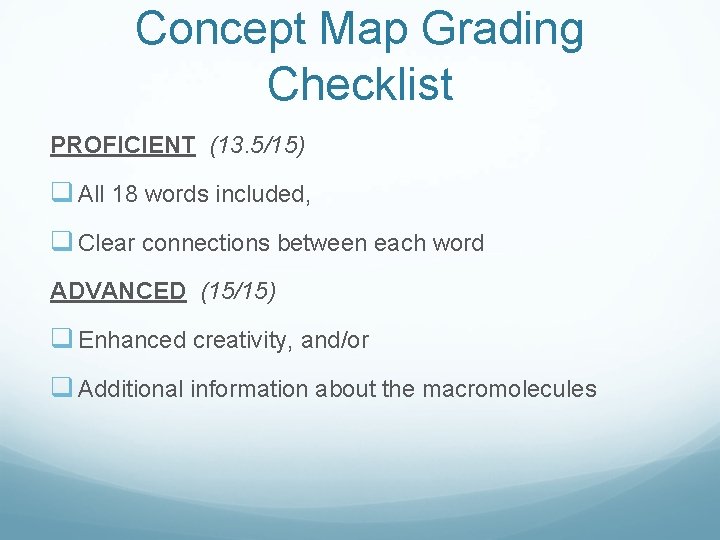
Concept Map Grading Checklist PROFICIENT (13. 5/15) q All 18 words included, q Clear connections between each word ADVANCED (15/15) q Enhanced creativity, and/or q Additional information about the macromolecules
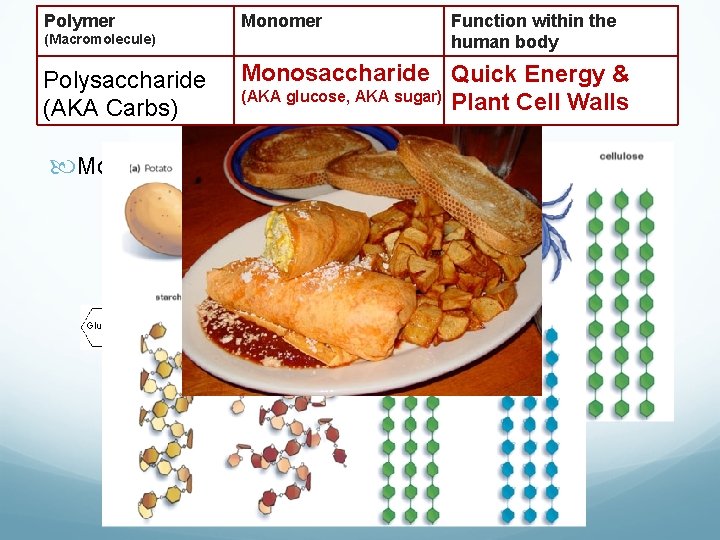
Polymer Monomer Function within the human body (Macromolecule) Monosaccharide Quick Energy & (AKA glucose, AKA sugar) Plant Cell Walls Polysaccharide (AKA Carbs) Monomer = Monosaccharides (AKA Glucose… AKA sugar) Glucose Glucose Glucose
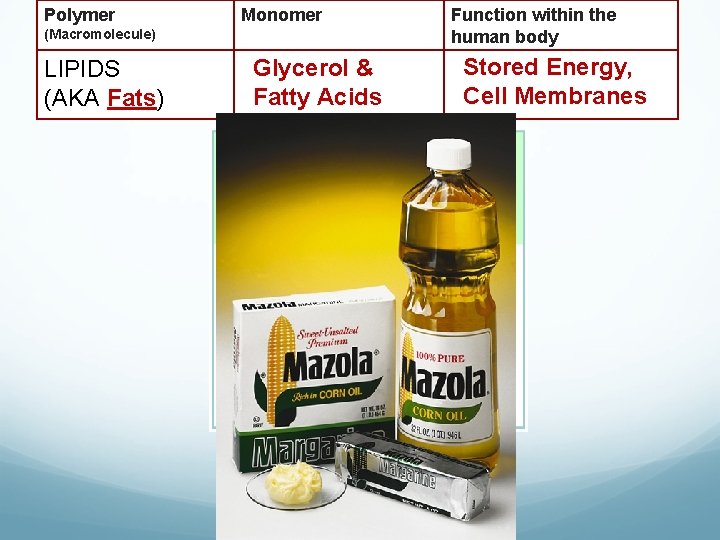
Polymer Monomer (Macromolecule) LIPIDS (AKA Fats) Glycerol & Fatty Acids Function within the human body Stored Energy, Cell Membranes
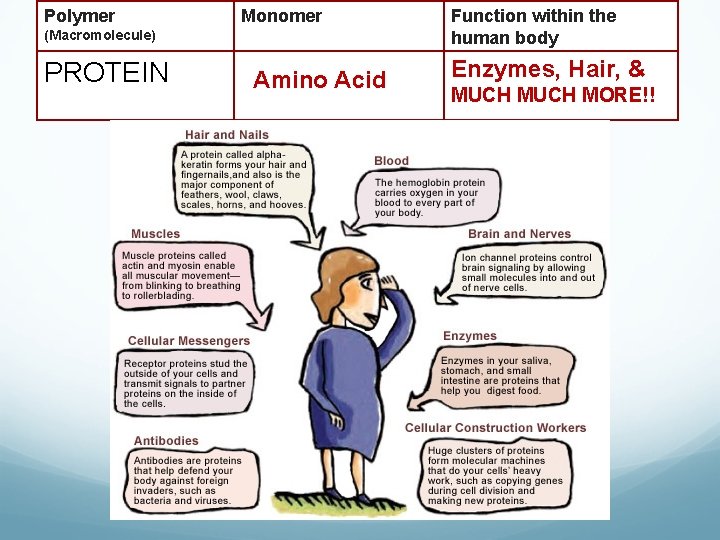
Polymer Monomer (Macromolecule) PROTEIN Amino Acid Function within the human body Enzymes, Hair, & MUCH MORE!!
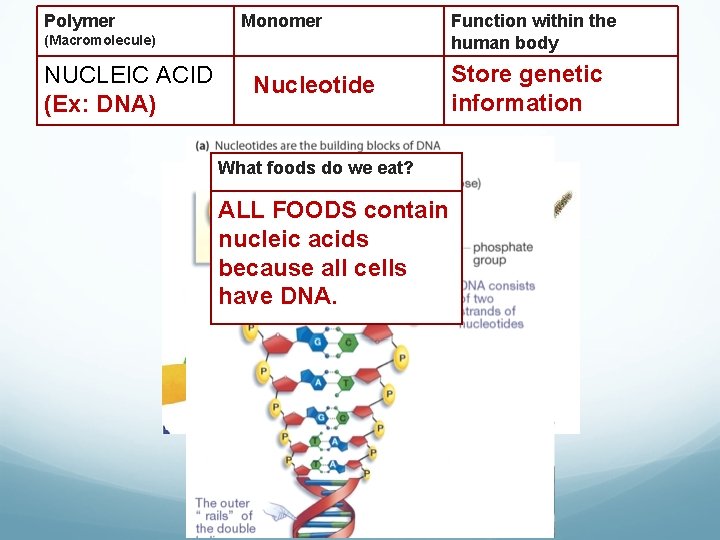
Polymer Monomer (Macromolecule) NUCLEIC ACID (Ex: DNA) Nucleotide What foods do we eat? ALL FOODS contain nucleic acids because all cells have DNA. Function within the human body Store genetic information
WARM UP – October 10, 2018 objective copy the following: I can describe the health benefits of a plant-based food diet, in compared with other diets. do now answer the following (HINT: p. 34 back): 1. What is the monomer for nucleic acids? 2. Identify the elements found in nucleic acids. 3. How is it that nucleic acids are found in all foods? Explain.
WARM UP – October 10, 2018 homework -Macromolecules Concept Map- Due tomorrow, Thurs. 10/11 -Study for Macromolecules quiz – Will be Monday 10/15 agenda - Reminder: Office Hrs today!! - New seats - Macromolecules debrief - Finish viewing: Forks Over Knives objective
Macromolecules Debrief
- Slides: 40