
Warm Up n Draw and label the parts
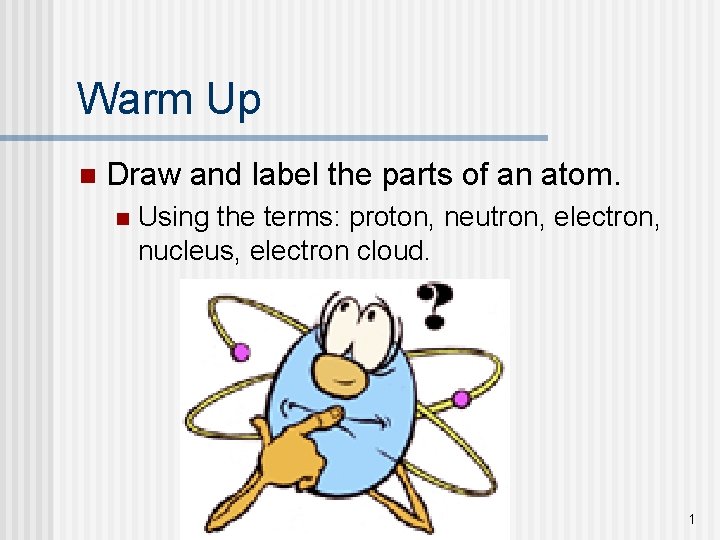
Warm Up n Draw and label the parts of an atom. n Using the terms: proton, neutron, electron, nucleus, electron cloud. 1
Biochemistry Chapters 2 & 3 2
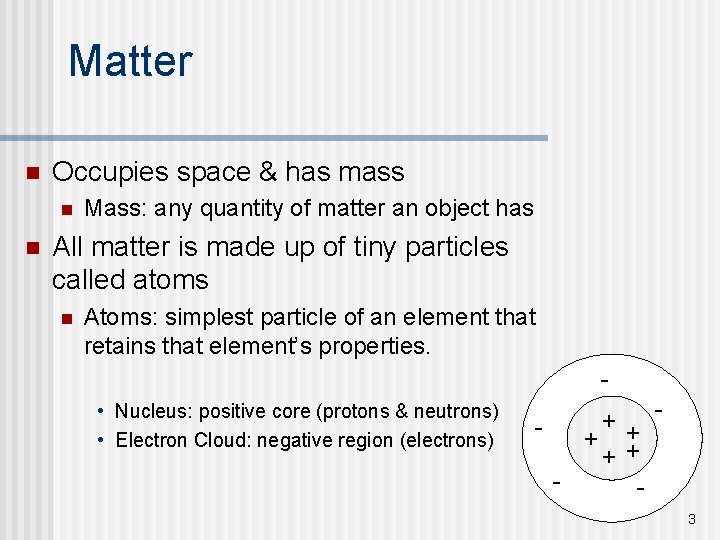
Matter n Occupies space & has mass n n Mass: any quantity of matter an object has All matter is made up of tiny particles called atoms n Atoms: simplest particle of an element that retains that element’s properties. • Nucleus: positive core (protons & neutrons) • Electron Cloud: negative region (electrons) + + + 3
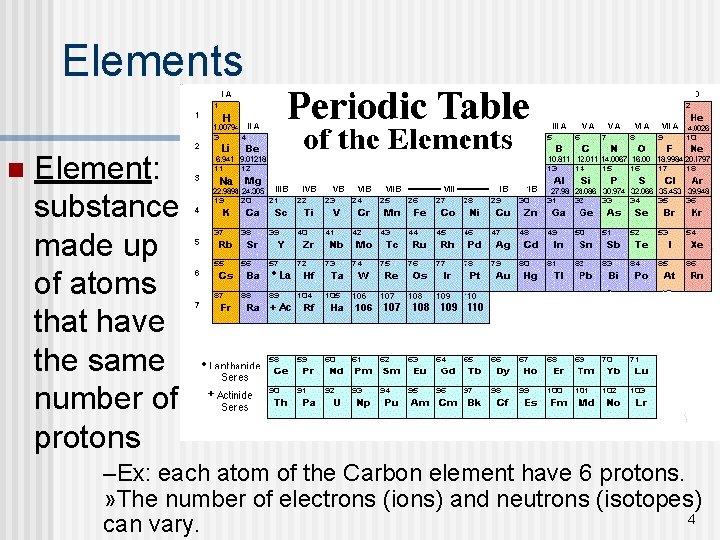
Elements n Element: substance made up of atoms that have the same number of protons –Ex: each atom of the Carbon element have 6 protons. » The number of electrons (ions) and neutrons (isotopes) 4 can vary.

Electrons Negatively charged n Located in orbitals (in electron cloud) around nucleus n Orbital 1 holds 2 electrons n Orbital 2 (and ↑) hold 8 electrons n Valance Electrons: electrons in outermost orbital n Atoms want to be stable…stable means 8 (except for H and He…stable means 2). 5 n
Chemical Bonding Atoms bond with other atoms to fill the outermost orbital n When atoms combine, a chemical bond holds them together n Chemical bond: attractive forces that hold atoms together n n Covalent (non-metal/non-metal only) or Ionic (all other types of bonds) 6
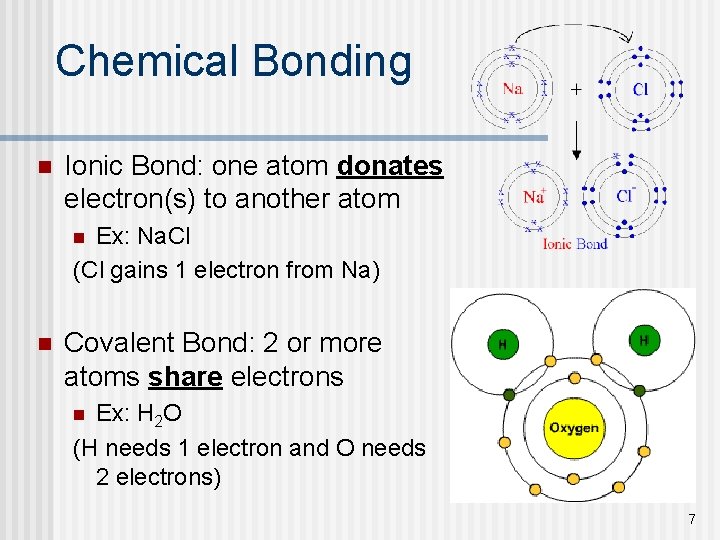
Chemical Bonding n Ionic Bond: one atom donates electron(s) to another atom Ex: Na. Cl (Cl gains 1 electron from Na) n n Covalent Bond: 2 or more atoms share electrons Ex: H 2 O (H needs 1 electron and O needs 2 electrons) n 7
Compounds n Made up of atoms of 2 or more elements bonded to one another n Most atoms are not stable alone…so • React with one another to become stable n 6 most common elements found in living things: n N-CHOPS (Nitrogen, Carbon, Hydrogen, Oxygen, Phosphorus, Sulfur) • all non-metals…covalent bonding…share e 8
Covalent Bond Modeling 1. Write symbol for each element. n 2. Cover symbol with correct color atom. n • C - Black, H - Yellow, O - Red, Cl - Blue n 3. Use Froot. Loop to represent valance e-. • Be sure to pencil in e- before removing Froot. Loop 4. Rearrange e- to pair up e- from each atom. n 5. Draw circles to show sharing of e-. n 6. Draw bond structure using symbols and line n 7. Use atom and wooden pegs to represent drawing from step #6. n 9
Warm Up n How many valance electrons does Carbon have? How many bonds can Carbon form? 10
Carbon Bonding n 2 categories of compounds: Organic: primarily made of Carbon atoms n Inorganic: do not contain Carbon atoms n n Carbon Atoms: 4 e- in outer orbital (needs 4 e-) n Readily forms 4 covalent bonds with other atoms n Unique: Carbon atoms bond with other Carbon atoms n • Forming straight chains, branched chains, and rings 11

Carbon Bonding 12

Large Carbon Molecules n Monomer: small, simple Carbon molecule Building blocks n 6 carbon rings n Polymer: repeated, linked monomers n Macromolecule: large polymer n n Ex: carbohydrates, nucleic acids, lipids, proteins. 13
Dehydration & Hydrolysis n Dehydration: water molecule is released when a monomer bonds to another monomer (or polymer) • When building bonds • Also called condensation reactions n Hydrolysis: water molecules are used to break down a polymer • When breaking bonds • Energy is released when breaking bonds 14
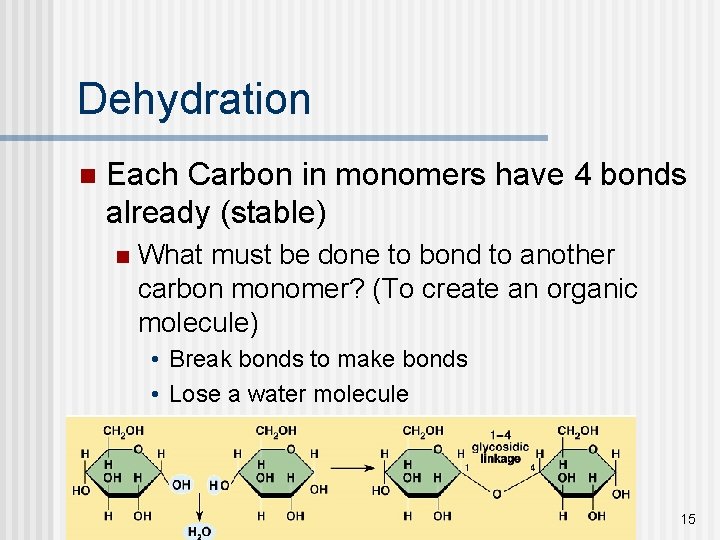
Dehydration n Each Carbon in monomers have 4 bonds already (stable) n What must be done to bond to another carbon monomer? (To create an organic molecule) • Break bonds to make bonds • Lose a water molecule 15
Dehydration Models Collect Materials n Complete condensation/dehydration reactions n Cut and tape carbon molecule (monomers) together n Cut water drop and glue/tape O, H, H into it n Answer questions. n Save macromolecule in notes. n 16
Warm Up n How are dehydration and hydrolysis reactions related to organic molecules? 17
Macromolecules Formed via dehydration reactions n Monomers bond together form polymers n Monomers bonded to polymers to form macromolecules n 4 types: n Carbohydrates n Proteins n Lipids n Nucleic Acids n 18
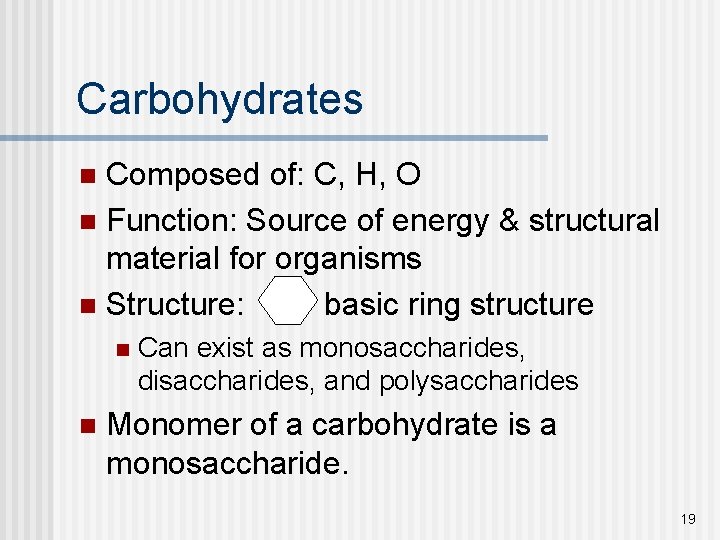
Carbohydrates Composed of: C, H, O n Function: Source of energy & structural material for organisms n Structure: basic ring structure n n n Can exist as monosaccharides, disaccharides, and polysaccharides Monomer of a carbohydrate is a monosaccharide. 19
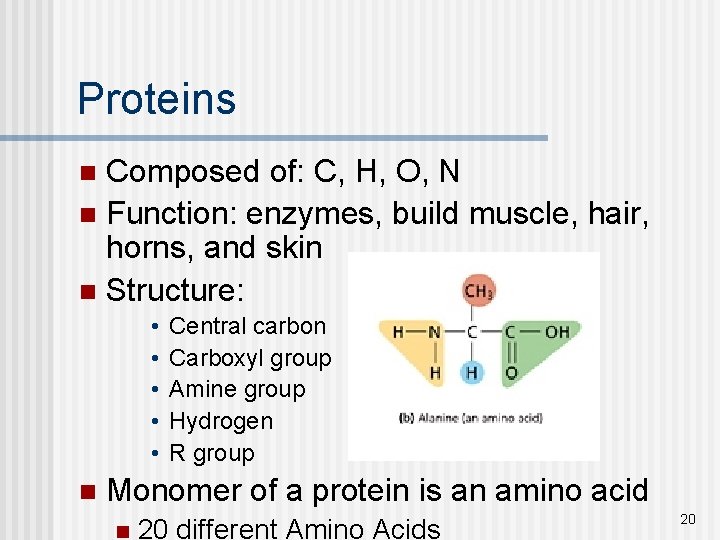
Proteins Composed of: C, H, O, N n Function: enzymes, build muscle, hair, horns, and skin n Structure: n • • • n Central carbon Carboxyl group Amine group Hydrogen R group Monomer of a protein is an amino acid n 20 different Amino Acids 20
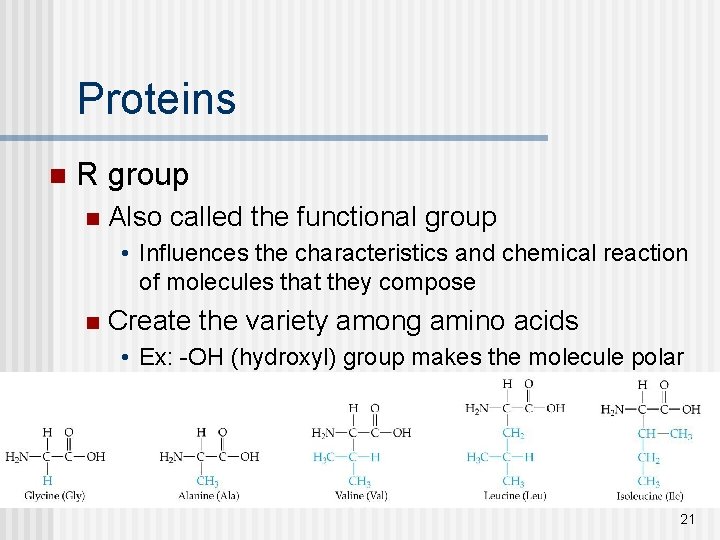
Proteins n R group n Also called the functional group • Influences the characteristics and chemical reaction of molecules that they compose n Create the variety among amino acids • Ex: -OH (hydroxyl) group makes the molecule polar 21
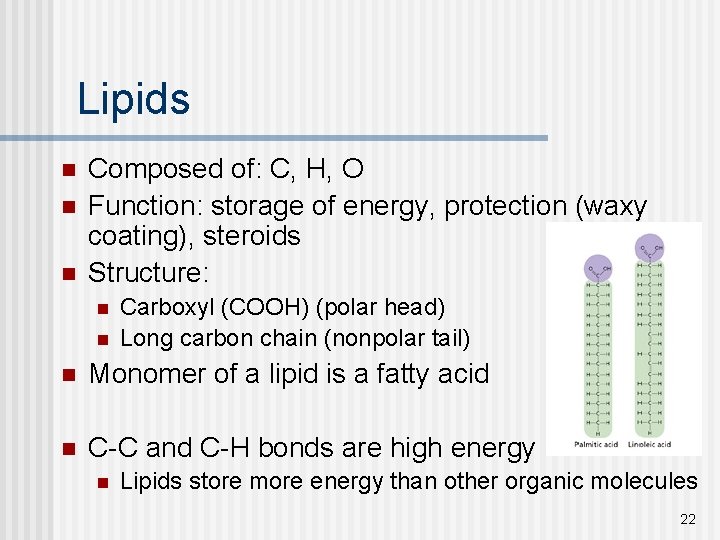
Lipids n n n Composed of: C, H, O Function: storage of energy, protection (waxy coating), steroids Structure: n n Carboxyl (COOH) (polar head) Long carbon chain (nonpolar tail) n Monomer of a lipid is a fatty acid n C-C and C-H bonds are high energy n Lipids store more energy than other organic molecules 22
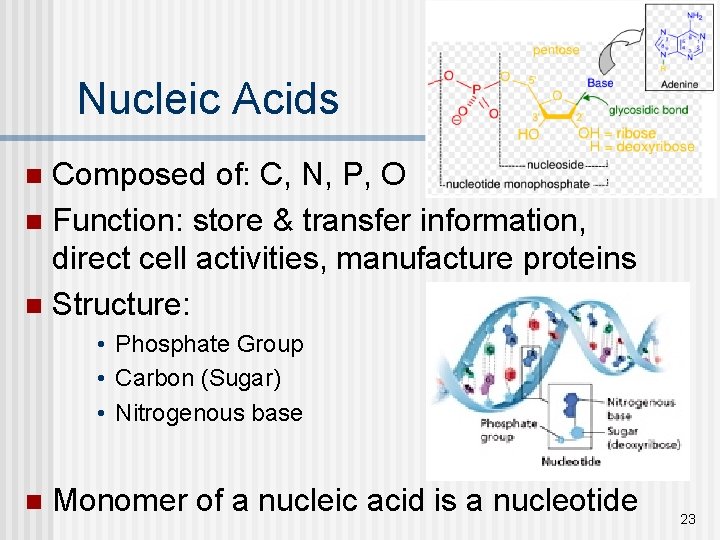
Nucleic Acids Composed of: C, N, P, O n Function: store & transfer information, direct cell activities, manufacture proteins n Structure: n • Phosphate Group • Carbon (Sugar) • Nitrogenous base n Monomer of a nucleic acid is a nucleotide 23
Warm Up 24
Macromolecule Project n n n Collect materials Use colored pencils, markers, or crayons Include: Composition, Structure (include labels), Function, and example(s). n n and any fun fact you find Be consistent with colors • Ex: make all Hydrogen Red, and all Carbons Black, etc. n n n Be neat and creative! If you don’t finish in class, it’s homework! Due tomorrow! 25
Warm Up 26
Mc. Mush Lab 27
Warm Up 28
Enzymes Most made of protein n Acts as biological catalyst: n • Accelerates chemical reaction Active site-specific for substrate n Reactions break substrate down n Very common in human body n • Hemoglobin binds with oxygen • Enzymes in stomach aid breakdown of food for digestion 29
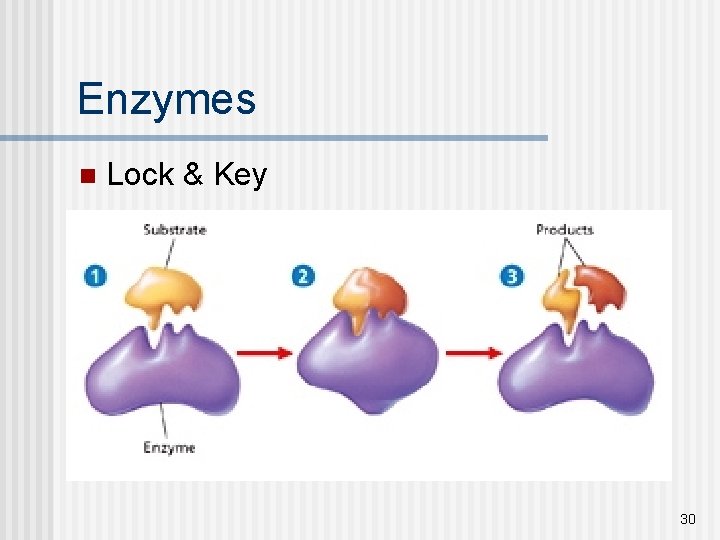
Enzymes n Lock & Key 30
Mello Jell-O Lab 31
- Slides: 31