
Warm Up Label the parts of a microscope
Warm Up: • Label the parts of a microscope that you remember! • Hint: Use the terms on the other side of the paper!
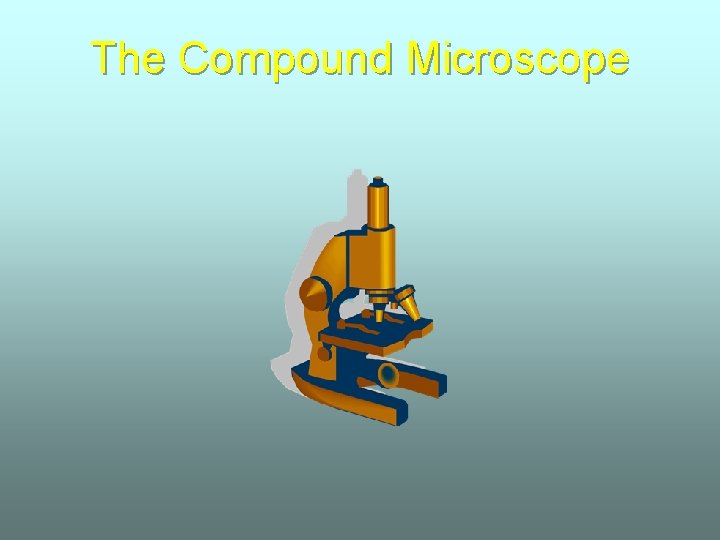
The Compound Microscope
Why is it called a compound microscope? …because they are designed with a compound lens system. The objective lens provides the primary magnification which is compounded (multiplied) by the eyepiece.
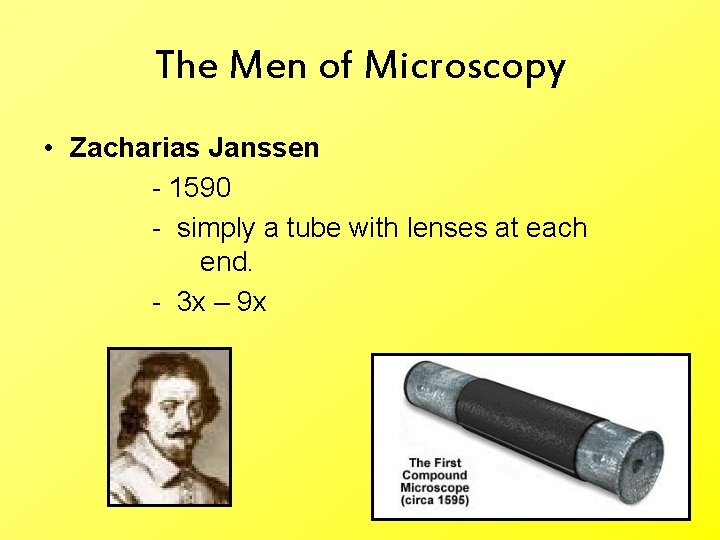
The Men of Microscopy • Zacharias Janssen - 1590 - simply a tube with lenses at each end. - 3 x – 9 x
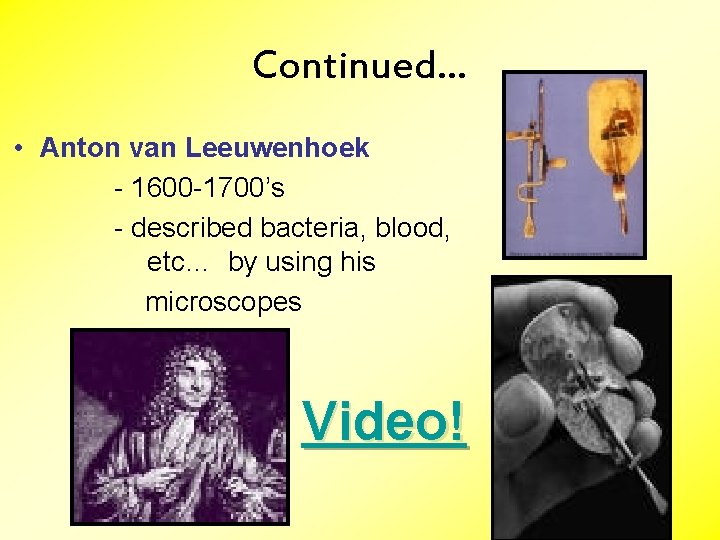
Continued… • Anton van Leeuwenhoek - 1600 -1700’s - described bacteria, blood, etc… by using his microscopes Video!
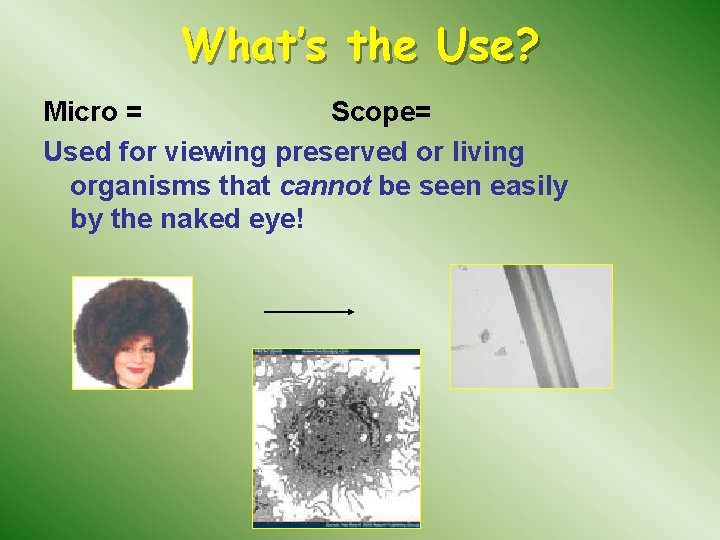
What’s the Use? Micro = Scope= Used for viewing preserved or living organisms that cannot be seen easily by the naked eye!
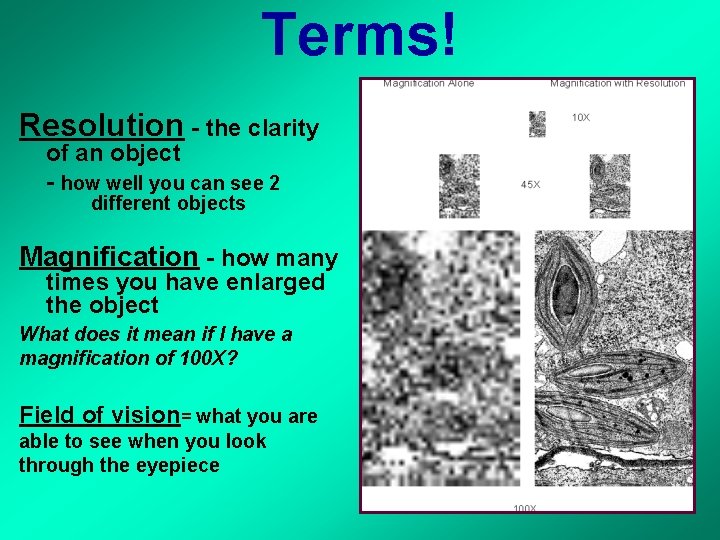
Terms! Resolution - the clarity of an object - how well you can see 2 different objects Magnification - how many times you have enlarged the object What does it mean if I have a magnification of 100 X? Field of vision= what you are able to see when you look through the eyepiece
Calculation of Magnification • Always multiply the eye piece by the objective magnification (x). • Ex. #1: Eyepiece = 10 X (constant) Objective = 40 X (10) x (40) = 400 x Ex. #2: I have a total magnification of 40 X. What objective am I using? the 4 x objective
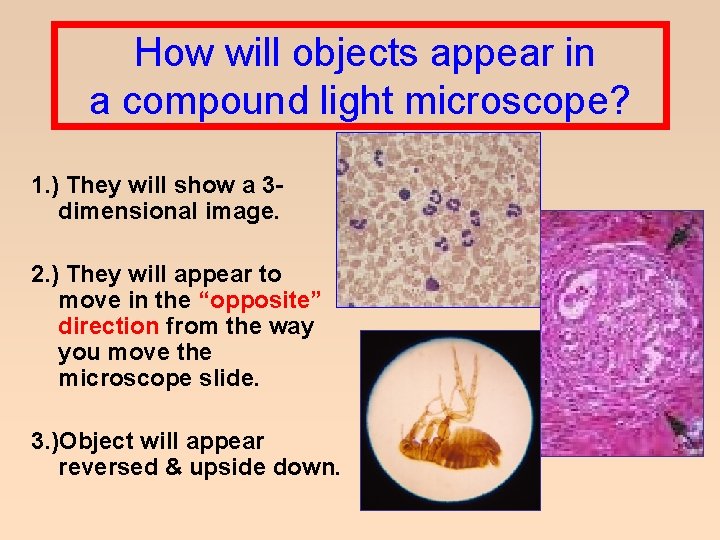
How will objects appear in a compound light microscope? 1. ) They will show a 3 dimensional image. 2. ) They will appear to move in the “opposite” direction from the way you move the microscope slide. 3. )Object will appear reversed & upside down.
Limitations of compound light microscopes • It can magnify an object up to 1000 times the original size • The object must be “thin” so that light rays may pass through it! • Higher magnification may result in poorer resolution (clarity).
Microscope Rules: • Almost always begin on scanning power objective, then move to low and later to high power. • Be sure to always center the object in the “field of vision” before changing objective. What you are able to see when you look through the eyepiece • Watch the tip of the objective as you change it: do not look through the microscope! Why? • Do NOT turn coarse adjustment knob up several times before moving to the next power. Why? • Turn coarse adjustment knob, then fine, BUT ONLY use the FINE adjustment knob on high power! Why? • ALWAYS carry the microscope by the arm & base!
The Proper Storage Steps 1. ) Gently wipe glass lenses with “lens tissue paper. ” See me if lenses appear stained 2. ) Neatly wrap electrical cord around the base of the microscope. 3. ) Add protective cover. 4. ) Always store microscope away in the cupboard on scanning power!
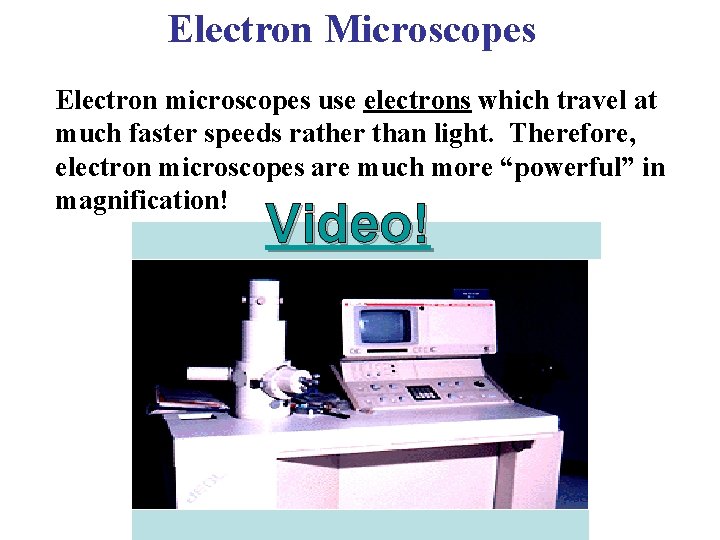
Electron Microscopes Electron microscopes use electrons which travel at much faster speeds rather than light. Therefore, electron microscopes are much more “powerful” in magnification! Video!
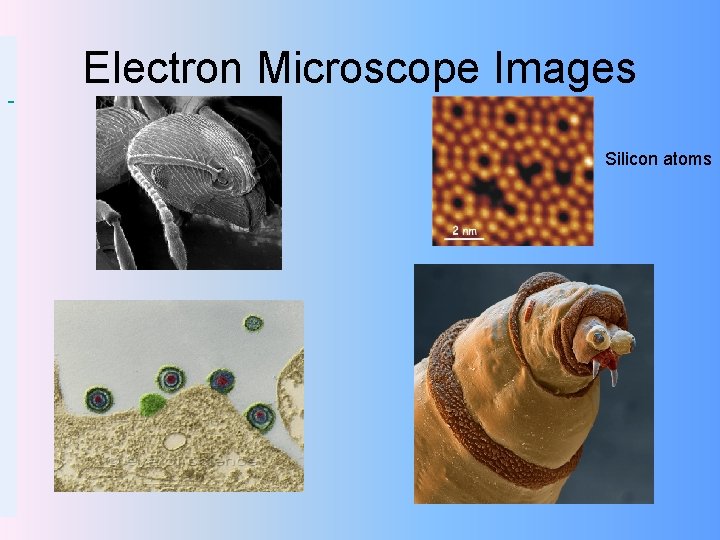
Electron Microscope Images Silicon atoms
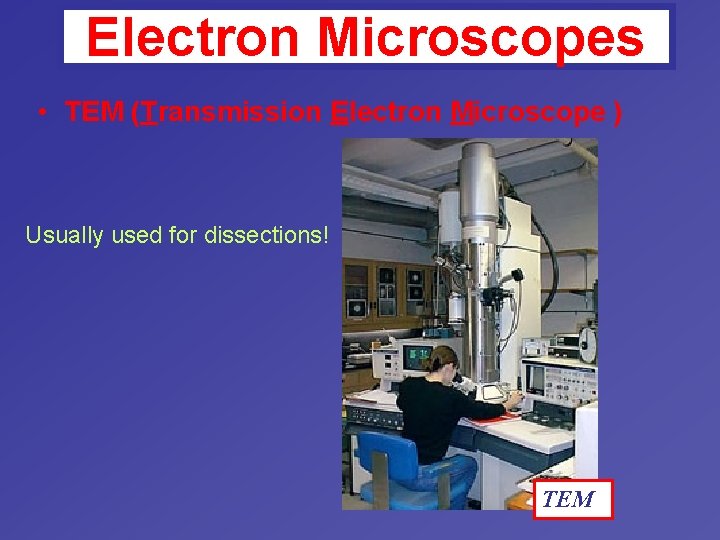
Electron Microscopes • TEM (Transmission Electron Microscope ) Usually used for dissections! TEM
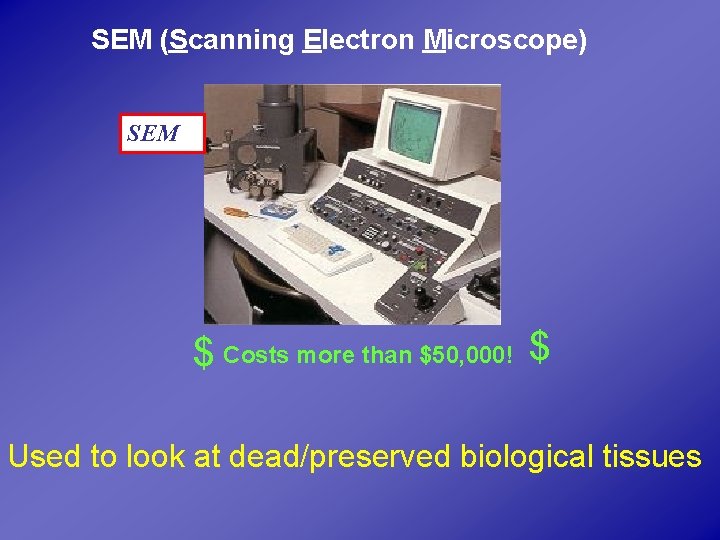
SEM (Scanning Electron Microscope) SEM $ Costs more than $50, 000! $ Used to look at dead/preserved biological tissues
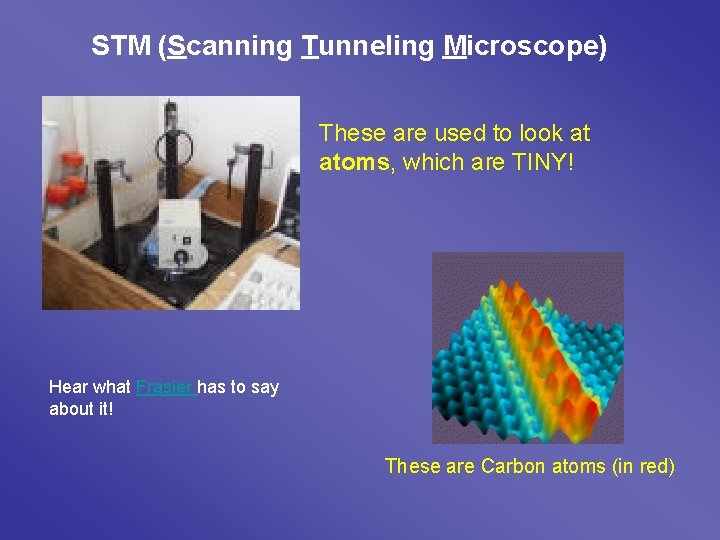
STM (Scanning Tunneling Microscope) These are used to look at atoms, which are TINY! Hear what Frasier has to say about it! These are Carbon atoms (in red)

If we finish early… • Work on your survival words • Work on your study guide
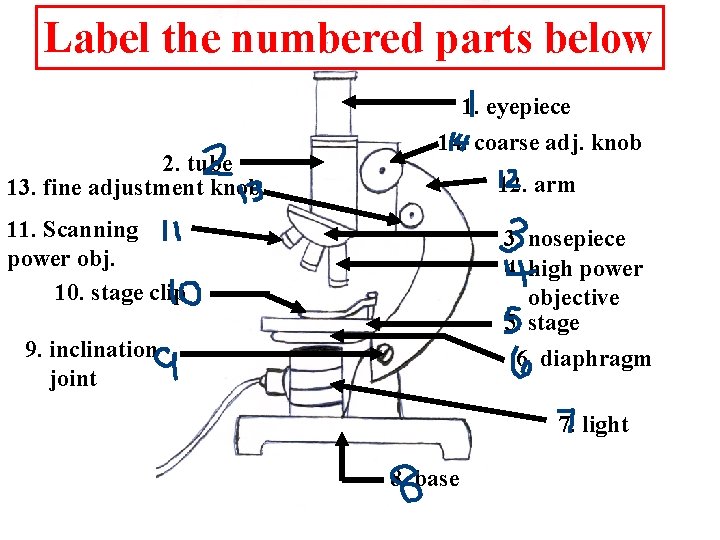
Label the numbered parts below 2. tube 13. fine adjustment knob 1. eyepiece 14. coarse adj. knob 12. arm 11. Scanning power obj. 10. stage clip 3. nosepiece 4. high power objective 5. stage 6. diaphragm 9. inclination joint 7. light 8. base
- Slides: 19