
Warm UP l Set up title page chapters
- Slides: 47
Warm UP- l Set up title page- chapters 3 and 4 l Pick up and READ the article located on the overhead l Think about 3 things about yourself that you believe are influenced by nature and 3 that are influences by nurture
Chapter 3: Nature and Nurture of Behavior
Nature
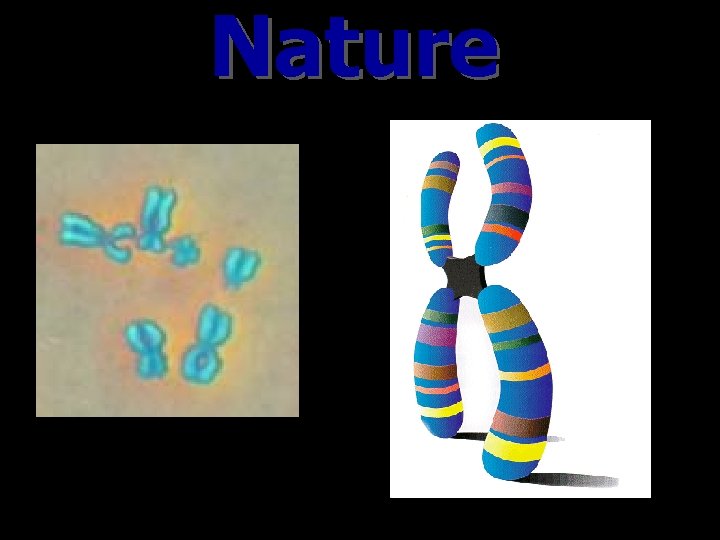
Genes l Chromosomes l threadlike structures made of DNA that contain the genes l Total of 46… 23 from Mom, 23 from Dad. l DNA (deoxyribonucleic acid) l complex molecule containing the genetic information that makes up the chromosomes l has two strands-forming a “double helix”- held together by bonds between pairs of nucleotides
Genes l Small segments of your chromosomes l Have about 30, 000 l a segment of DNA capable of synthesizing a protein l
Genes l Nucleotides: biochemical letters that make up genes. Some 3 billion paired nucleotides define the genes that determine your individual biological development. Letters: A T C and G. l Sequence of nucleotides is what makes humans, human…pigs, etc.
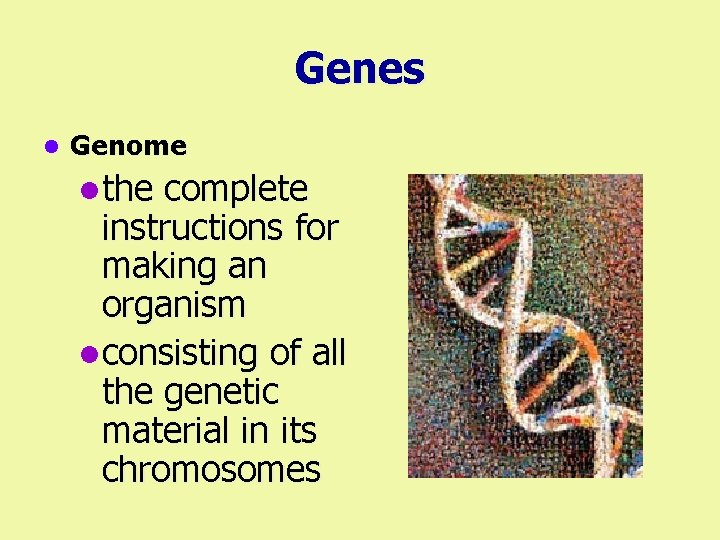
Genes l Genome lthe complete instructions for making an organism lconsisting of all the genetic material in its chromosomes
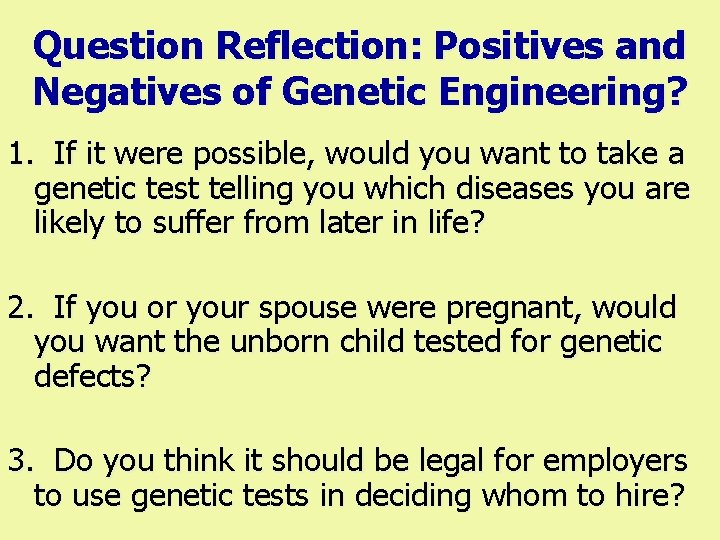
Positives and Negatives of Genetic Engineering? l Human Genome Project: goal is to map the human genome down to the nucleotide and identify all the genes present in it. l Reflect on Questions given for a few minutes.
Question Reflection: Positives and Negatives of Genetic Engineering? 1. If it were possible, would you want to take a genetic test telling you which diseases you are likely to suffer from later in life? 2. If you or your spouse were pregnant, would you want the unborn child tested for genetic defects? 3. Do you think it should be legal for employers to use genetic tests in deciding whom to hire?
Evolutionary Psychology l Based on the ideas of Charles Darwin and natural selection: the principle that, among the range of inherited trait variations, those contributing to survival will most likely be passed on to succeeding generations l Mutations l random errors in gene replication that lead to a change in the sequence of nucleotides l the source of all genetic diversity
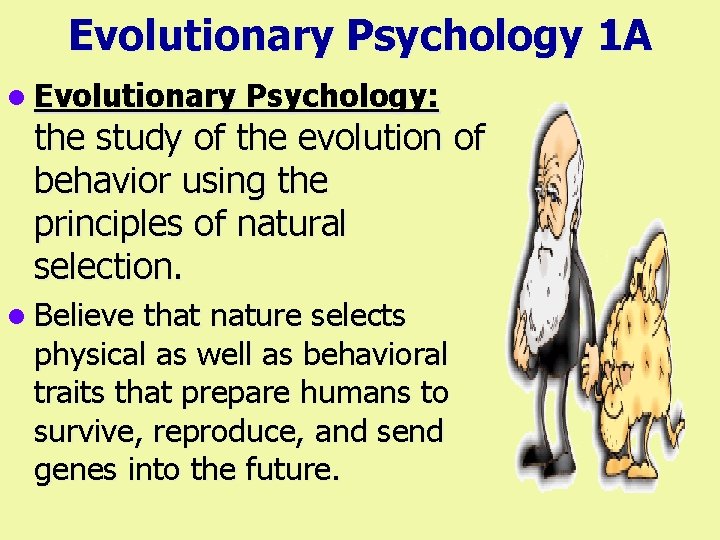
Evolutionary Psychology 1 A l Evolutionary Psychology: the study of the evolution of behavior using the principles of natural selection. l Believe that nature selects physical as well as behavioral traits that prepare humans to survive, reproduce, and send genes into the future.
Evolutionary Example l Evolutionary Psychologists believe we favor sweets and fats now since in the prehistoric era these were harder to come by and allowed ancestors to survive famine. l Problem today? l Complete Handout 3. 2 concerning Evolutionary Psychology.
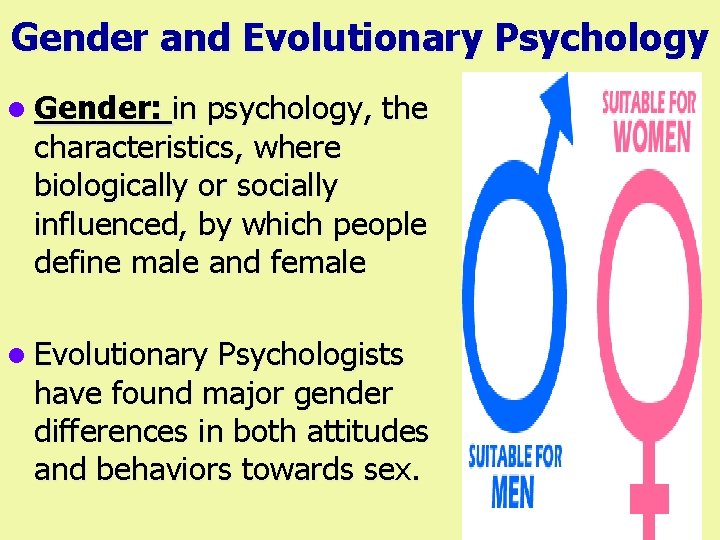
Gender and Evolutionary Psychology l Gender: in psychology, the characteristics, where biologically or socially influenced, by which people define male and female l Evolutionary Psychologists have found major gender differences in both attitudes and behaviors towards sex.
Gender Differences in Attitudes and Behaviors (#2) l Attitudes: Males tend to have a much more recreational approach to sex vs. women’s relational approach. l Behavior: Males are more likely to be promiscuous and aggressive towards sex than females. l. Florida State Example l Men tend to perceive a women’s friendliness as a sexual come-on
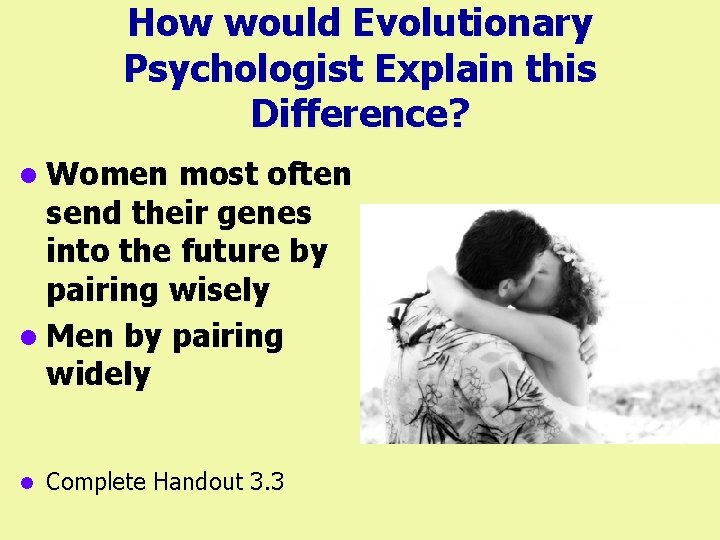
How would Evolutionary Psychologist Explain this Difference? l Women most often send their genes into the future by pairing wisely l Men by pairing widely l Complete Handout 3. 3
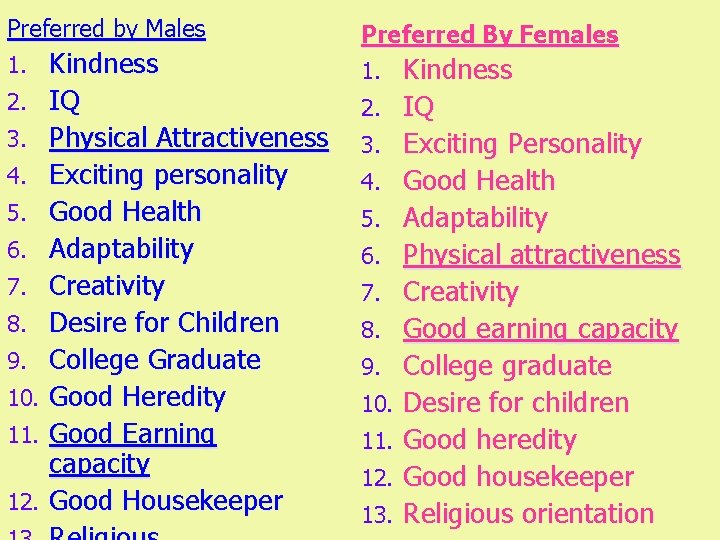
Mate Selection l Both men and women rated mutual attraction-love, dependable character, emotional stability, maturity and pleasing disposition as most important l Least important- chastity, similar religious backgrounds and similar political backgrounds l More Important to Males- good looks and chastity (1 C) l More Important to Females- financial security and ambitious (1 B)
Preferred by Males 1. Kindness 2. 3. 4. 5. 6. 7. 8. 9. 10. 11. 12. IQ Physical Attractiveness Exciting personality Good Health Adaptability Creativity Desire for Children College Graduate Good Heredity Good Earning capacity Good Housekeeper Preferred By Females 1. Kindness 2. 3. 4. 5. 6. 7. 8. 9. 10. 11. 12. 13. IQ Exciting Personality Good Health Adaptability Physical attractiveness Creativity Good earning capacity College graduate Desire for children Good heredity Good housekeeper Religious orientation
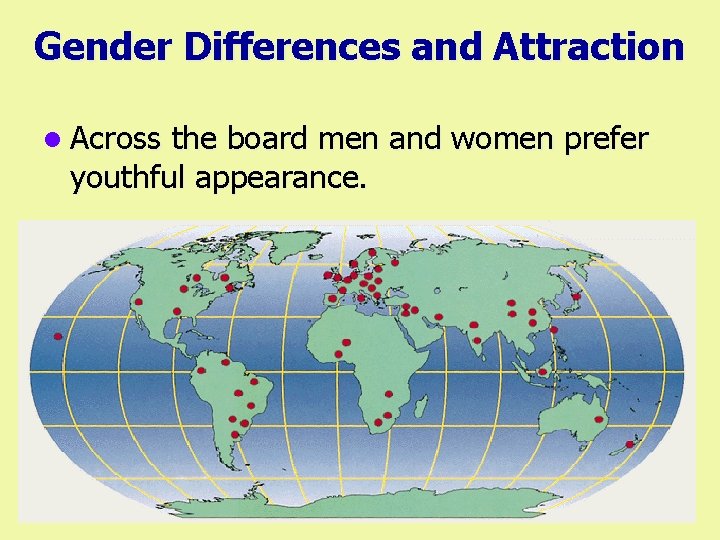
Gender Differences and Attraction l Across the board men and women prefer youthful appearance.
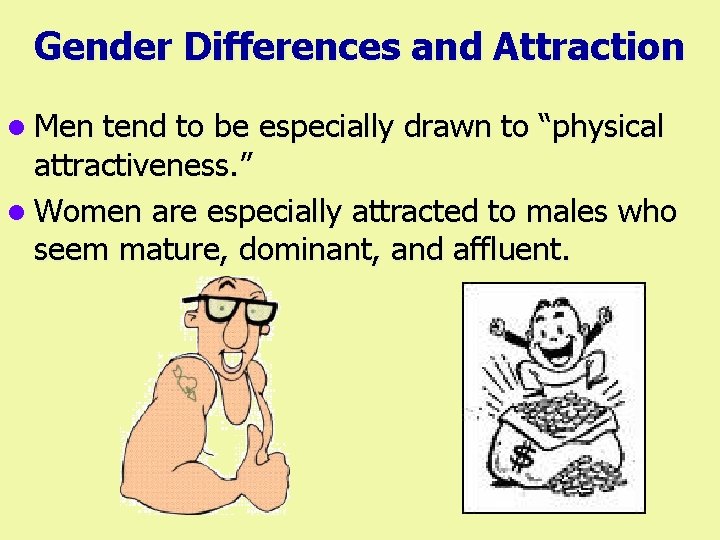
Gender Differences and Attraction l Men tend to be especially drawn to “physical attractiveness. ” l Women are especially attracted to males who seem mature, dominant, and affluent.
Gender Differences and Attraction How would Evolutionary Psychologist Explain this? l Men look for youth b/c young women have more childbearing years and men just want to send their genes into the future l Men prefer women who’s waists are 1/3 narrower than their hips, a sign of future fertility
How would Evolutionary Psychologist Explain this? l Women prefer mature, dominant and affluent men b/c they are more able to protect and provide for the family l Men tend to be risk takers ( or stupid) b/c they need to show their women “ look at me! I have so much strength and skill that I am fearless. I will survive no matter how much I drink or how fast I drive. ” l Women spend more time on appearance and money l Men spend more time on status and dominance l Men are constantly trying to out do other men to compete for fertile women
Criticisms of Evolutionary Approach: Do you Buy It? 1 D l Men and women are a lot more similar l Want single, long term partners l Evolutionaries focus too much on nature
Behavior Genetics l study of the power and limits of genetic and environmental influences on behavior l Environment l every non-genetic influence, from prenatal nutrition to the people and things around us
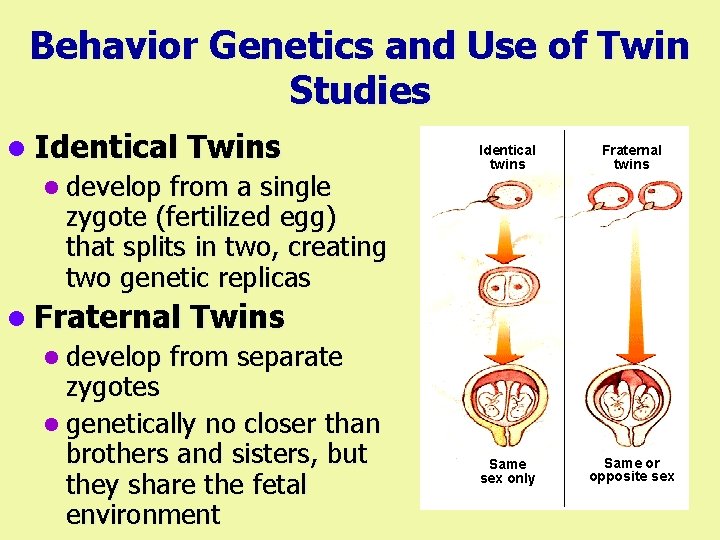
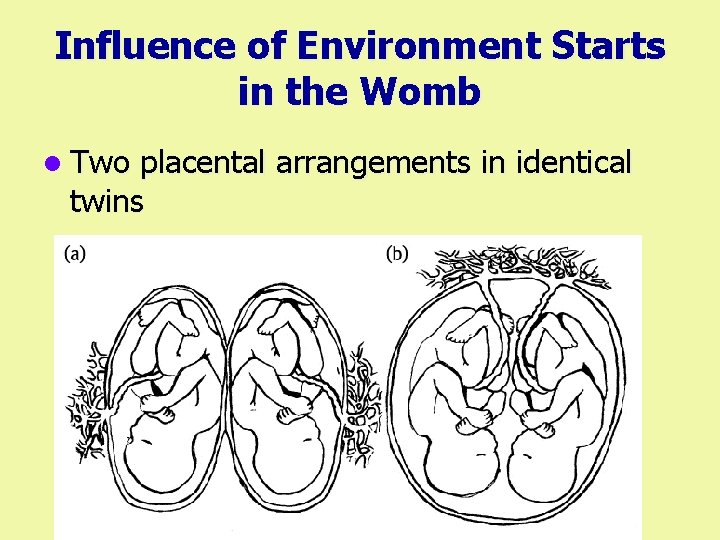
Behavior Genetics and Use of Twin Studies l Identical Twins l develop from a single Identical twins Fraternal twins Same sex only Same or opposite sex zygote (fertilized egg) that splits in two, creating two genetic replicas l Fraternal Twins l develop from separate zygotes l genetically no closer than brothers and sisters, but they share the fetal environment
What’s the Value of Twin Studies to Behavior Geneticists? #3 l. Genes Matter l Extraversion and neuroticism in identical twins is more similar than in fraternal twins l Identical twins are more similar in abilities, personalities and interests l Identical twins raised apart are still very similar l. Example- Jim twins
How Have Psychologists Used Adoption Studies? #4 l Genes Matter l Adopted children are more similar to their biological parents than their adoptive parents l. Especially in personality l Parents do have an influence on values, manners , faith and politics
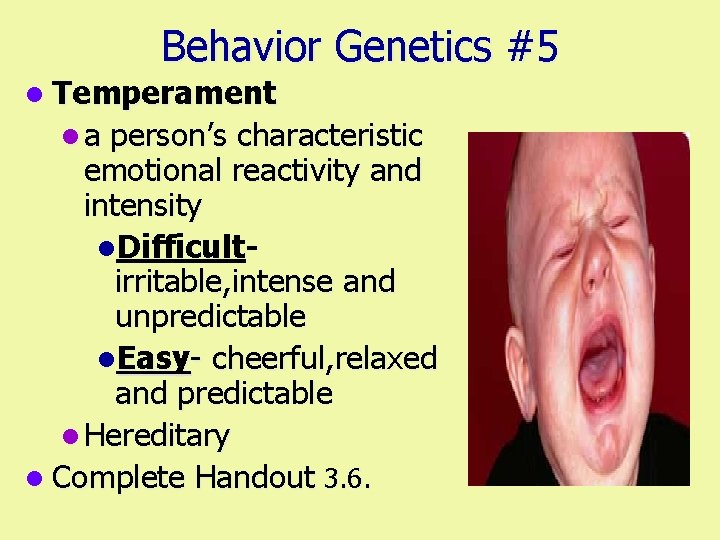
Behavior Genetics #5 l Temperament l a person’s characteristic emotional reactivity and intensity l. Difficult- irritable, intense and unpredictable l. Easy- cheerful, relaxed and predictable l Hereditary l Complete Handout 3. 6.
Temperament l 3 Temperaments l. Activity- High-busybodies, like action l. Emotionality- High-frightened angry easy. Quick tempered l. Sociability – High- seek out others, enjoy company
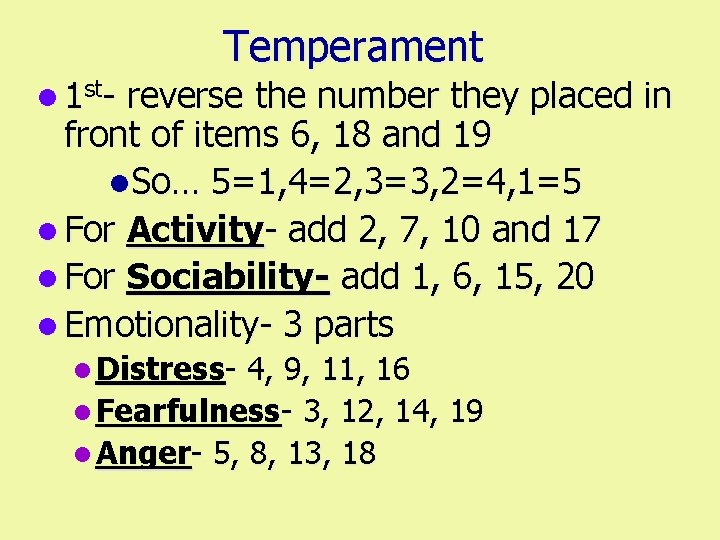
Temperament l 1 st- reverse the number they placed in front of items 6, 18 and 19 l. So… 5=1, 4=2, 3=3, 2=4, 1=5 l For Activity- add 2, 7, 10 and 17 l For Sociability- add 1, 6, 15, 20 l Emotionality- 3 parts l Distress- 4, 9, 11, 16 l Fearfulness- 3, 12, 14, 19 l Anger- 5, 8, 13, 18
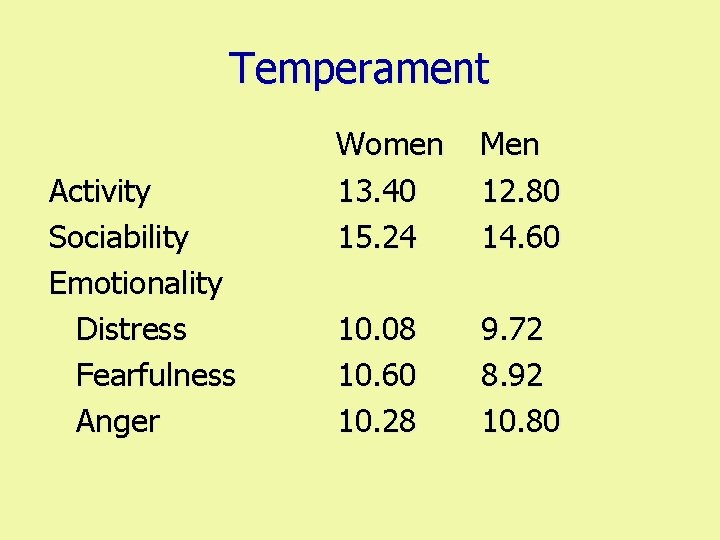
Temperament Activity Sociability Emotionality Distress Fearfulness Anger Women 13. 40 15. 24 Men 12. 80 14. 60 10. 08 10. 60 10. 28 9. 72 8. 92 10. 80
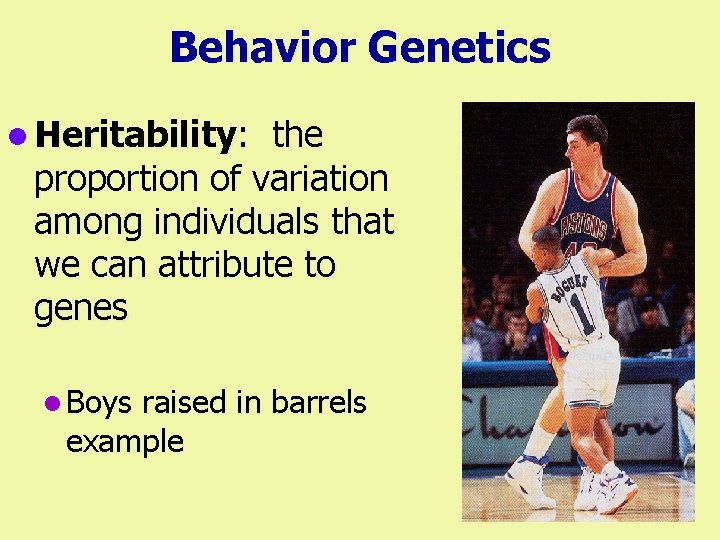
Behavior Genetics l Heritability: the proportion of variation among individuals that we can attribute to genes l Boys raised in barrels example
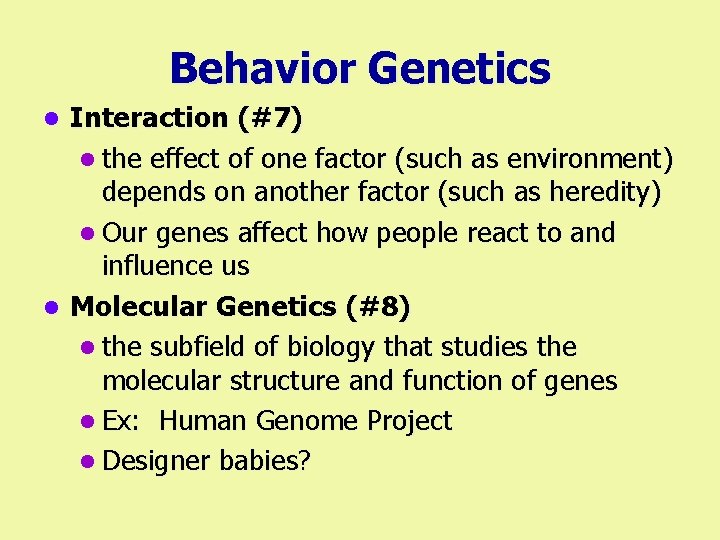
Behavior Genetics Interaction (#7) l the effect of one factor (such as environment) depends on another factor (such as heredity) l Our genes affect how people react to and influence us l Molecular Genetics (#8) l the subfield of biology that studies the molecular structure and function of genes l Ex: Human Genome Project l Designer babies? l
Warm Up – page 3 l 1. What is the nature/nurture debate? l 2. What is an evolutionary psychologist? l 3. How do men and women differ in their mate selection? l 4. What do behavioral geneticists study? l 5. What is the Human Genome Project?
Nurture l
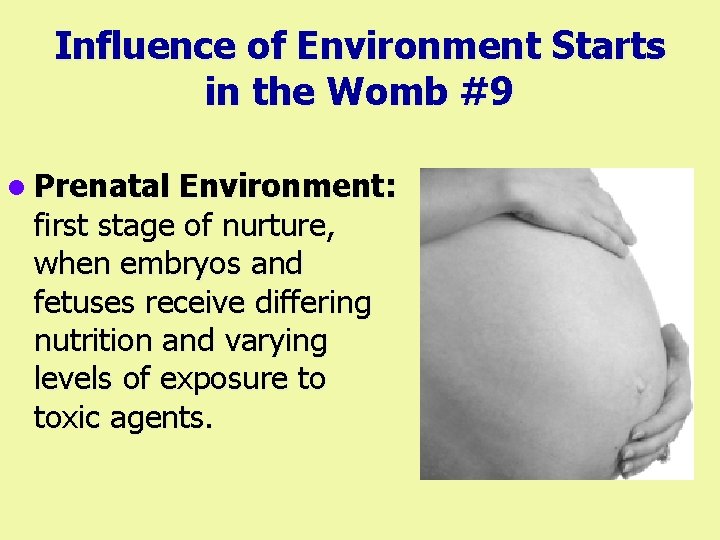
Influence of Environment Starts in the Womb #9 l Prenatal Environment: first stage of nurture, when embryos and fetuses receive differing nutrition and varying levels of exposure to toxic agents.
Influence of Environment Starts in the Womb l Two placental arrangements in identical twins
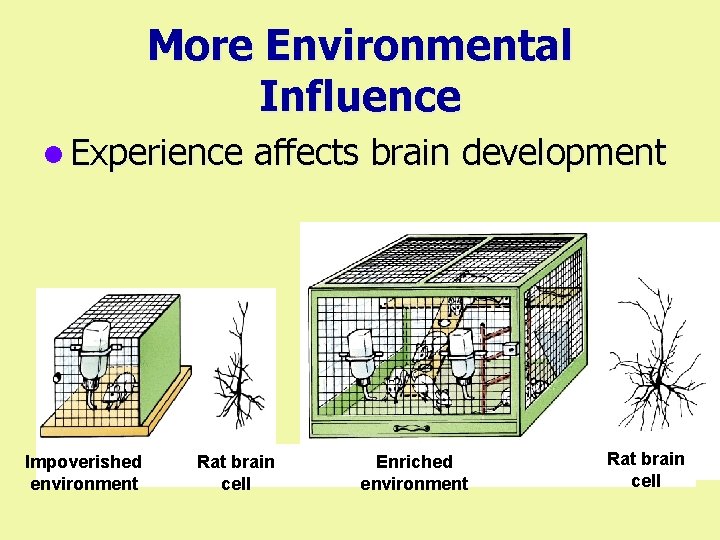
More Environmental Influence l Experience affects brain development Impoverished environment Rat brain cell Enriched environment Rat brain cell
Experience and Brain Development #9 l More stimulation= better brain development l Stimulation and touch can help premature babies l Language development in children before age 8 l Don’t use it, you lose it
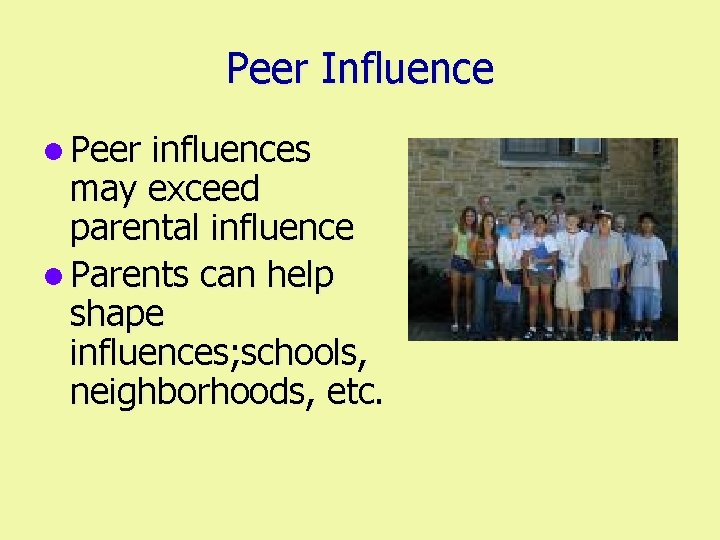
Peer Influence l Peer influences may exceed parental influence l Parents can help shape influences; schools, neighborhoods, etc.
Environmental Influences l Culture l the enduring behaviors, ideas, attitudes, and traditions shared by a large group of people and transmitted from one generation to the next l Norm l an understood rule for accepted and expected behavior l. Personal Space #10 l. Expressions
Environmental Influences l Memes l self-replicating ideas, fashions, and innovation passed from person to person.
Culture and Child Rearing #11 l Western cultures like independent children l Asian and African cultures focus on emotional closeness l
The Nature of Gender #12 l. X Chromosome l the sex chromosome found in both men and women l females have two; males have one l an X chromosome from each parent produces a female l. Y Chromosome l the sex chromosome found only in men l when paired with an X chromosome from the mother, it produces a male child
Nature of Gender #13 l Testosterone lthe most important of the male sex hormones lboth males and females have it ladditional testosterone in males stimulates lgrowth of male sex organs in the fetus ldevelopment of male sex characteristics during puberty
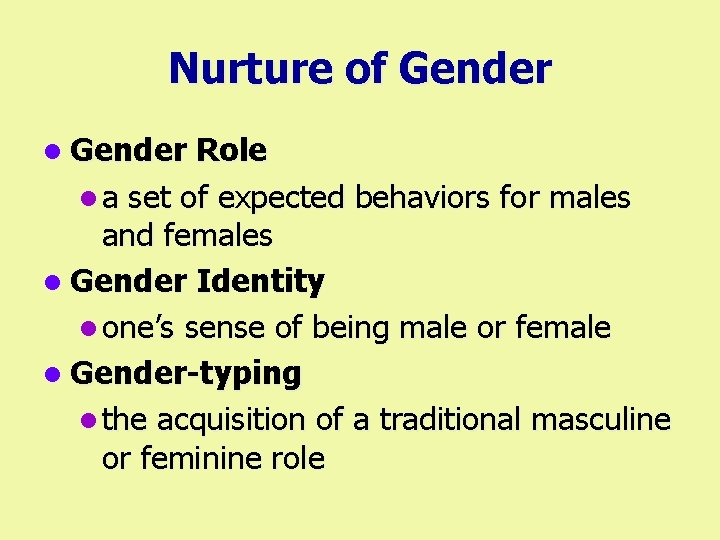
Nurture of Gender l Gender Role l a set of expected behaviors for males and females l Gender Identity l one’s sense of being male or female l Gender-typing l the acquisition of a traditional masculine or feminine role
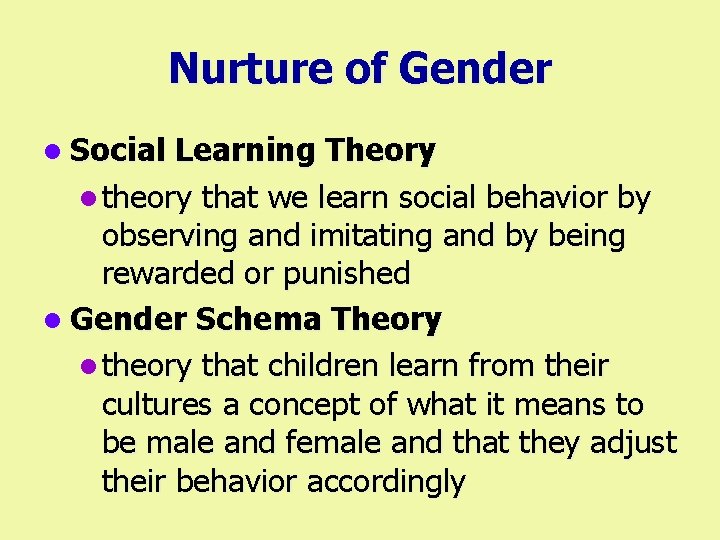
Nurture of Gender l Social Learning Theory l theory that we learn social behavior by observing and imitating and by being rewarded or punished l Gender Schema Theory l theory that children learn from their cultures a concept of what it means to be male and female and that they adjust their behavior accordingly
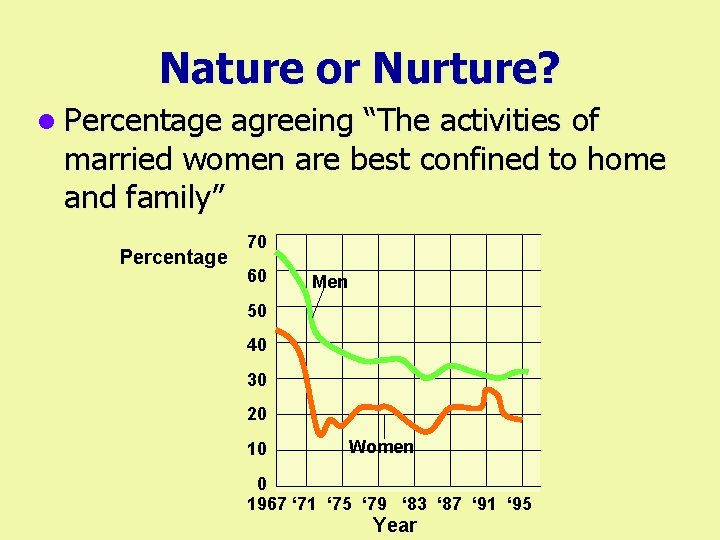
Nature or Nurture? l Percentage agreeing “The activities of married women are best confined to home and family” Percentage 70 60 Men 50 40 30 20 10 Women 0 1967 ‘ 71 ‘ 75 ‘ 79 ‘ 83 ‘ 87 ‘ 91 ‘ 95 Year