
Warm Up HW 179 184 Complete Yellow Source
- Slides: 29
Warm Up • HW: 179 -184. Complete Yellow Source Analysis Questions.
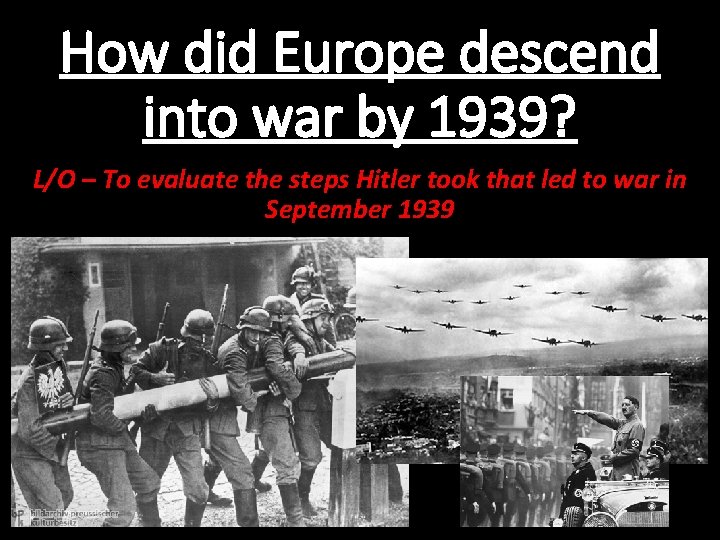
How did Europe descend into war by 1939? L/O – To evaluate the steps Hitler took that led to war in September 1939
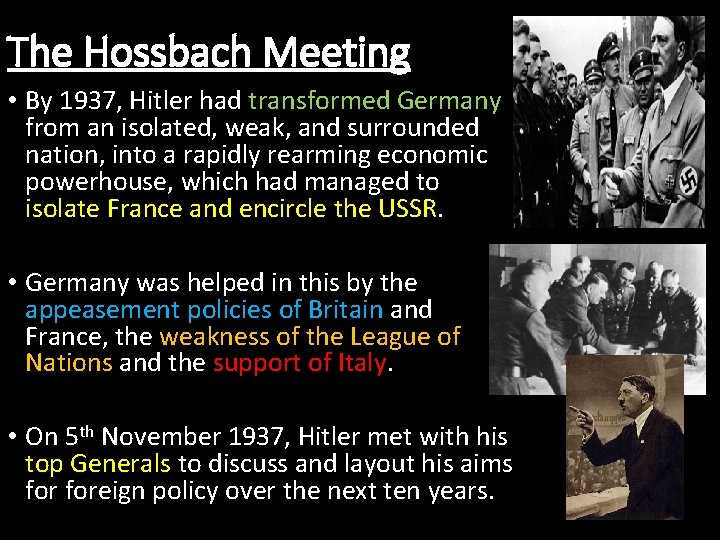
The Hossbach Meeting • By 1937, Hitler had transformed Germany from an isolated, weak, and surrounded nation, into a rapidly rearming economic powerhouse, which had managed to isolate France and encircle the USSR. • Germany was helped in this by the appeasement policies of Britain and France, the weakness of the League of Nations and the support of Italy. • On 5 th November 1937, Hitler met with his top Generals to discuss and layout his aims foreign policy over the next ten years.
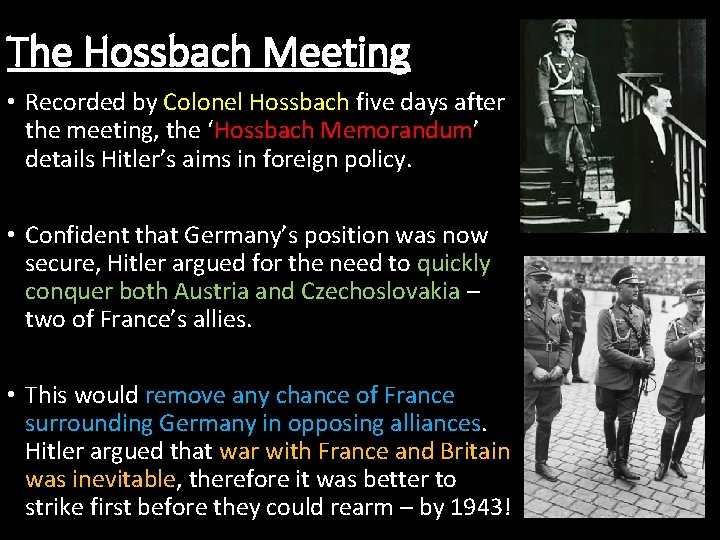
The Hossbach Meeting • Recorded by Colonel Hossbach five days after the meeting, the ‘Hossbach Memorandum’ details Hitler’s aims in foreign policy. • Confident that Germany’s position was now secure, Hitler argued for the need to quickly conquer both Austria and Czechoslovakia – two of France’s allies. • This would remove any chance of France surrounding Germany in opposing alliances. Hitler argued that war with France and Britain was inevitable, therefore it was better to strike first before they could rearm – by 1943!
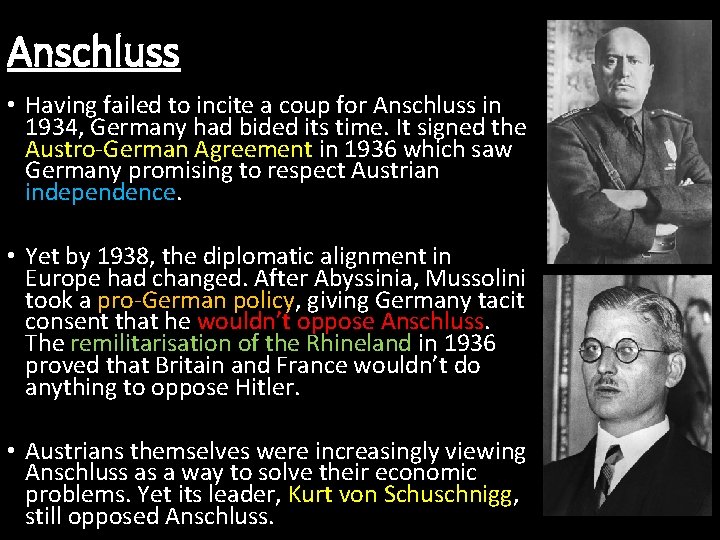
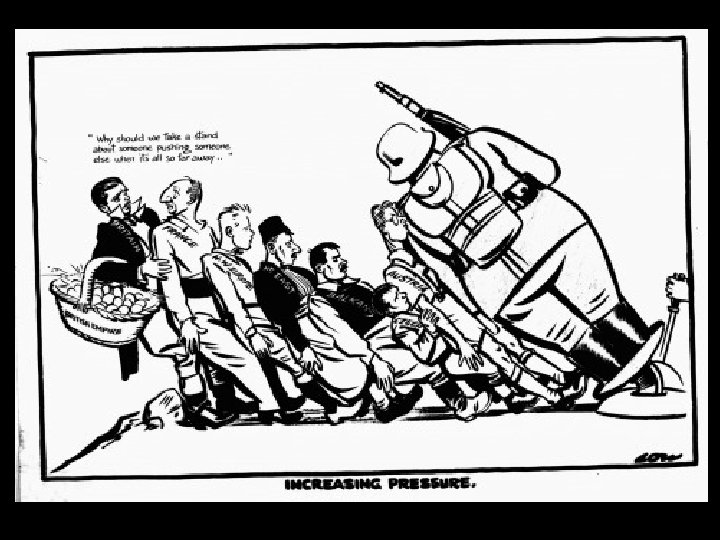
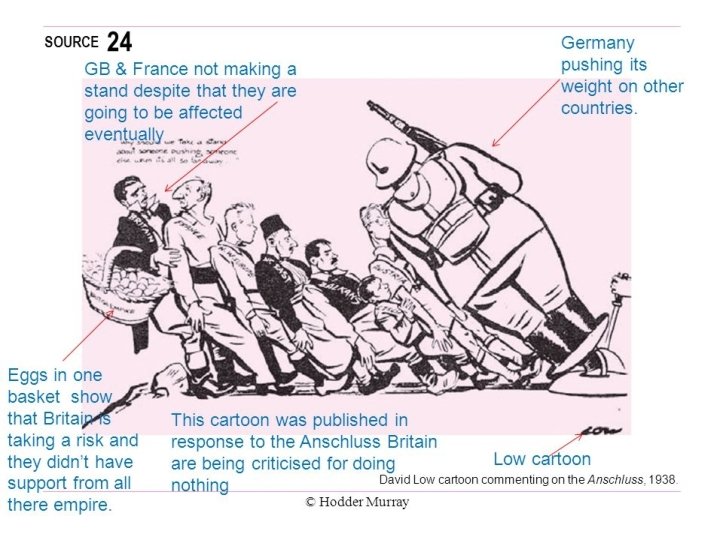
Anschluss • Having failed to incite a coup for Anschluss in 1934, Germany had bided its time. It signed the Austro-German Agreement in 1936 which saw Germany promising to respect Austrian independence. • Yet by 1938, the diplomatic alignment in Europe had changed. After Abyssinia, Mussolini took a pro-German policy, giving Germany tacit consent that he wouldn’t oppose Anschluss. The remilitarisation of the Rhineland in 1936 proved that Britain and France wouldn’t do anything to oppose Hitler. • Austrians themselves were increasingly viewing Anschluss as a way to solve their economic problems. Yet its leader, Kurt von Schuschnigg, still opposed Anschluss.
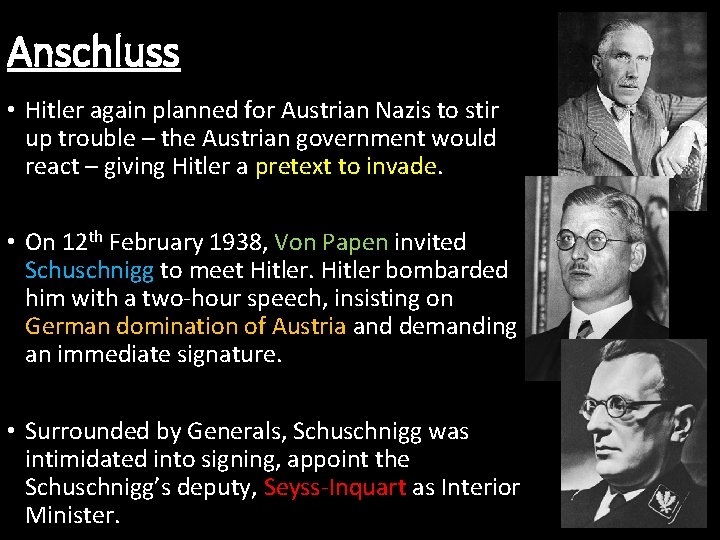
Anschluss • Hitler again planned for Austrian Nazis to stir up trouble – the Austrian government would react – giving Hitler a pretext to invade. • On 12 th February 1938, Von Papen invited Schuschnigg to meet Hitler bombarded him with a two-hour speech, insisting on German domination of Austria and demanding an immediate signature. • Surrounded by Generals, Schuschnigg was intimidated into signing, appoint the Schuschnigg’s deputy, Seyss-Inquart as Interior Minister.
Warm Up • Classwork: 185 -191. Complete Yellow and DARK purple source analysis. • HW: Read 192 -199 -Yellow Source Analysis Questions.
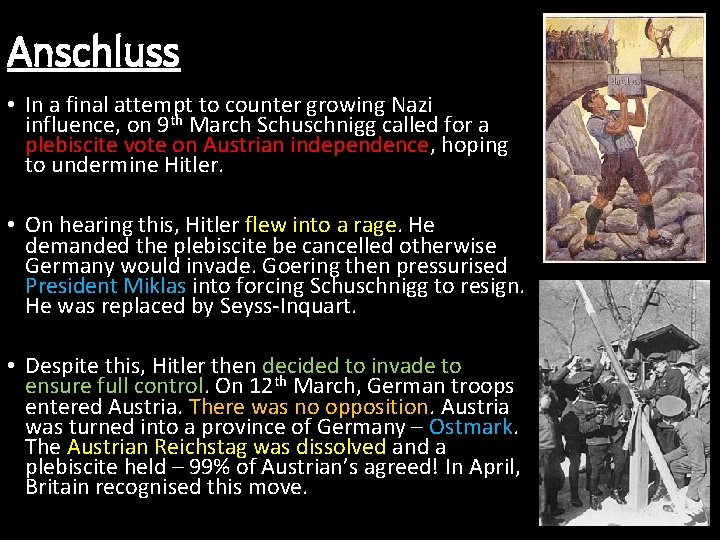
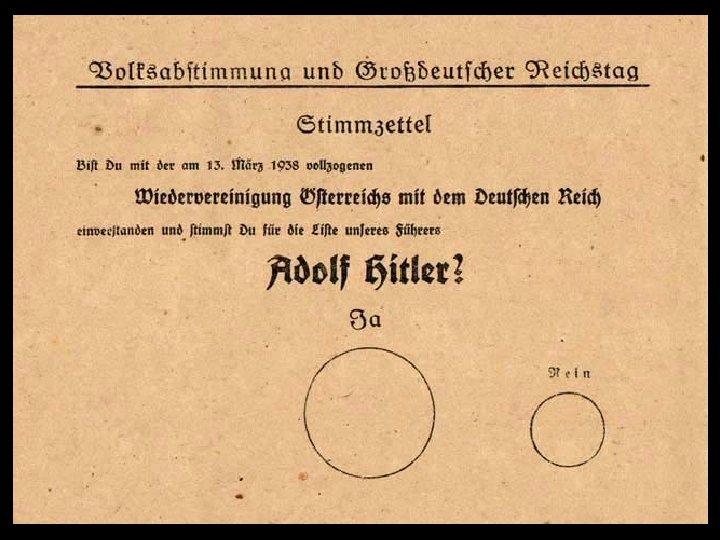
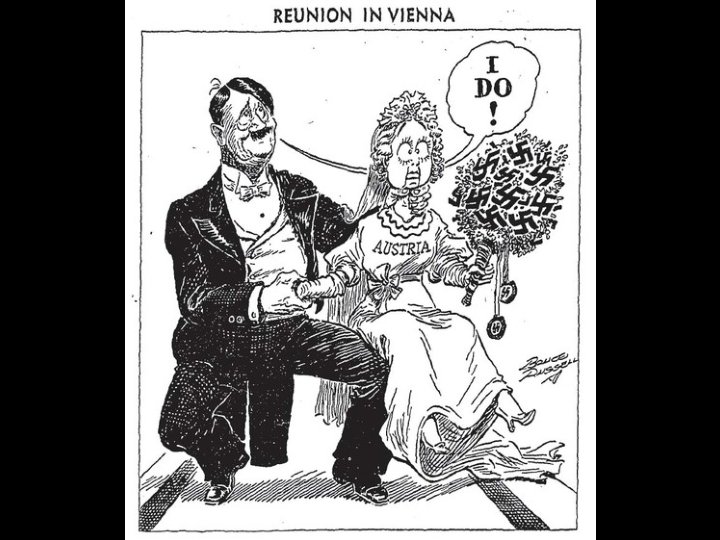
Anschluss • In a final attempt to counter growing Nazi influence, on 9 th March Schuschnigg called for a plebiscite vote on Austrian independence, hoping to undermine Hitler. • On hearing this, Hitler flew into a rage. He demanded the plebiscite be cancelled otherwise Germany would invade. Goering then pressurised President Miklas into forcing Schuschnigg to resign. He was replaced by Seyss-Inquart. • Despite this, Hitler then decided to invade to ensure full control. On 12 th March, German troops entered Austria. There was no opposition. Austria was turned into a province of Germany – Ostmark. The Austrian Reichstag was dissolved and a plebiscite held – 99% of Austrian’s agreed! In April, Britain recognised this move.
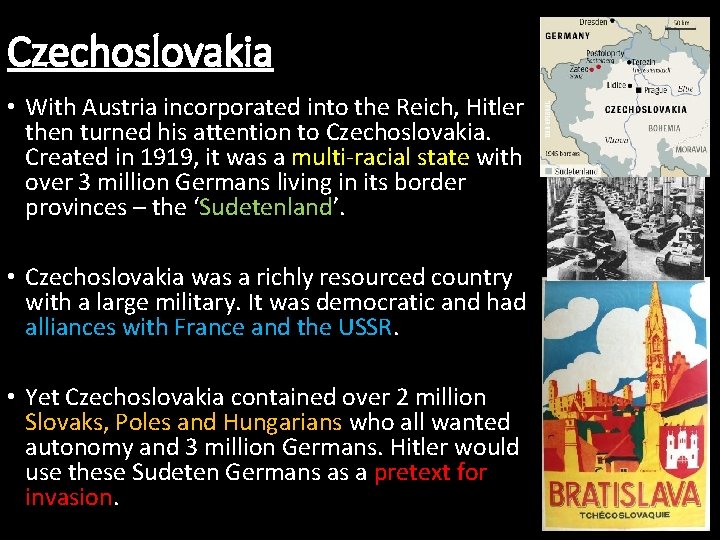
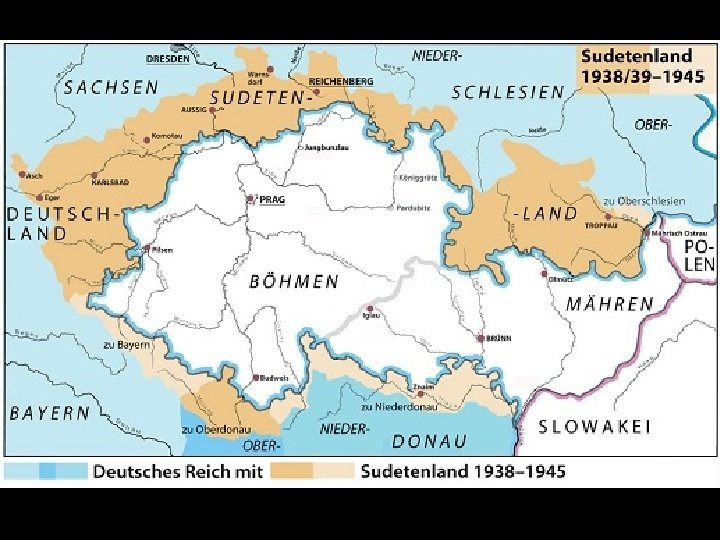
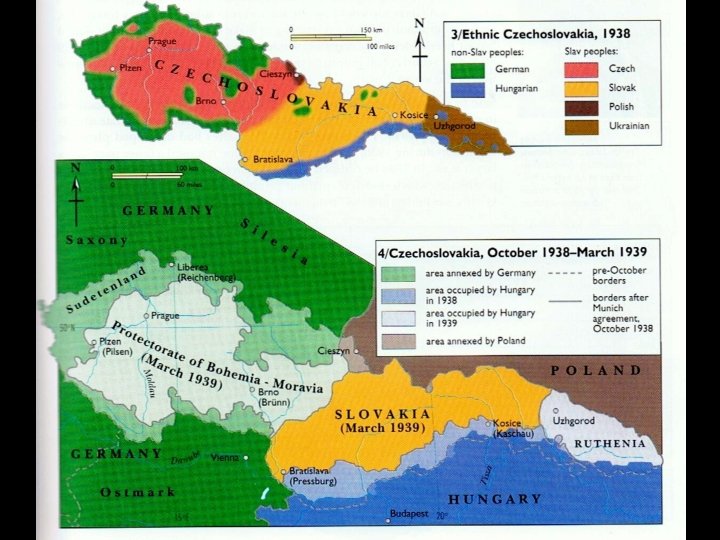
Czechoslovakia • With Austria incorporated into the Reich, Hitler then turned his attention to Czechoslovakia. Created in 1919, it was a multi-racial state with over 3 million Germans living in its border provinces – the ‘Sudetenland’. • Czechoslovakia was a richly resourced country with a large military. It was democratic and had alliances with France and the USSR. • Yet Czechoslovakia contained over 2 million Slovaks, Poles and Hungarians who all wanted autonomy and 3 million Germans. Hitler would use these Sudeten Germans as a pretext for invasion.
Warm Up • HW: Read 200 -207. Complete Yellow Source Analysis.
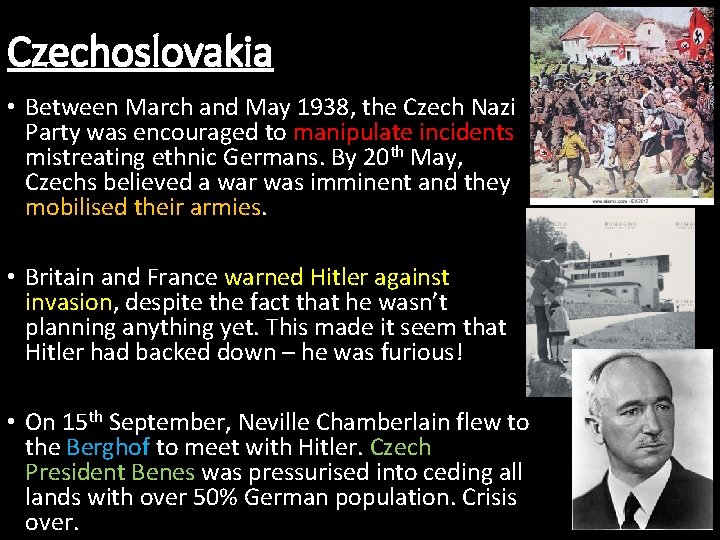
Czechoslovakia • Between March and May 1938, the Czech Nazi Party was encouraged to manipulate incidents mistreating ethnic Germans. By 20 th May, Czechs believed a war was imminent and they mobilised their armies. • Britain and France warned Hitler against invasion, despite the fact that he wasn’t planning anything yet. This made it seem that Hitler had backed down – he was furious! • On 15 th September, Neville Chamberlain flew to the Berghof to meet with Hitler. Czech President Benes was pressurised into ceding all lands with over 50% German population. Crisis over.
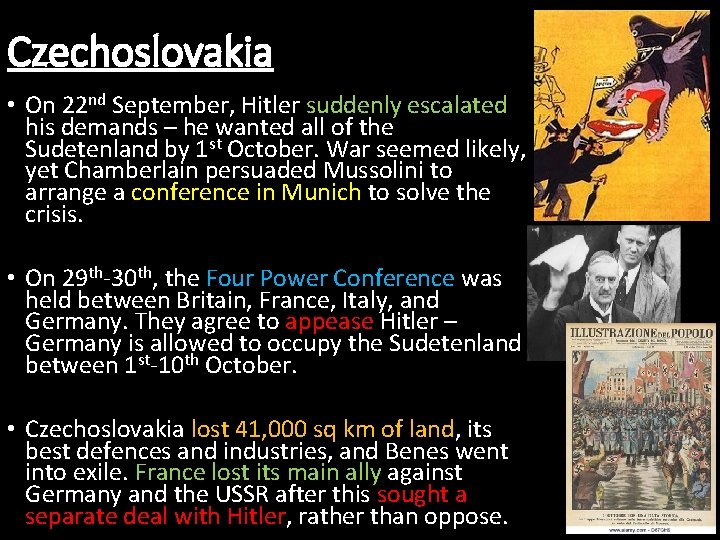
Czechoslovakia • On 22 nd September, Hitler suddenly escalated his demands – he wanted all of the Sudetenland by 1 st October. War seemed likely, yet Chamberlain persuaded Mussolini to arrange a conference in Munich to solve the crisis. • On 29 th-30 th, the Four Power Conference was held between Britain, France, Italy, and Germany. They agree to appease Hitler – Germany is allowed to occupy the Sudetenland between 1 st-10 th October. • Czechoslovakia lost 41, 000 sq km of land, its best defences and industries, and Benes went into exile. France lost its main ally against Germany and the USSR after this sought a separate deal with Hitler, rather than oppose.
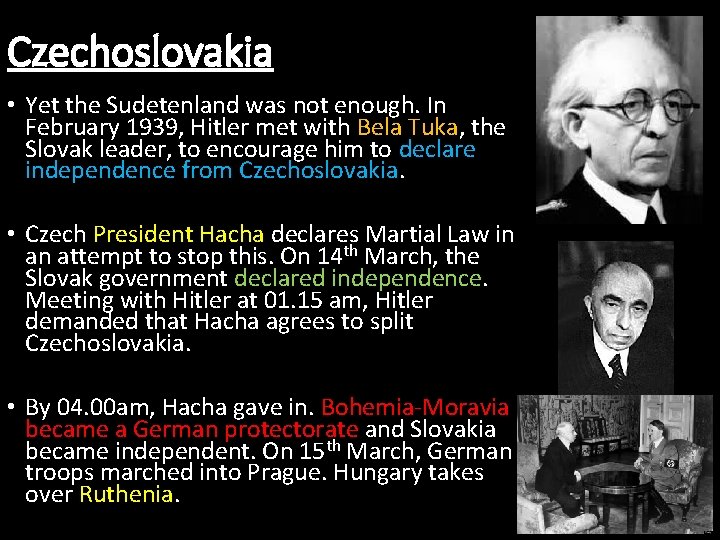
Czechoslovakia • Yet the Sudetenland was not enough. In February 1939, Hitler met with Bela Tuka, the Slovak leader, to encourage him to declare independence from Czechoslovakia. • Czech President Hacha declares Martial Law in an attempt to stop this. On 14 th March, the Slovak government declared independence. Meeting with Hitler at 01. 15 am, Hitler demanded that Hacha agrees to split Czechoslovakia. • By 04. 00 am, Hacha gave in. Bohemia-Moravia became a German protectorate and Slovakia became independent. On 15 th March, German troops marched into Prague. Hungary takes over Ruthenia.
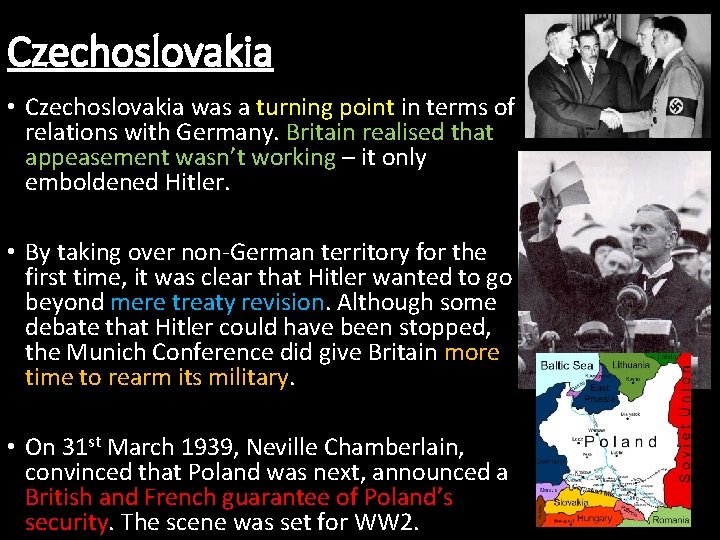
Czechoslovakia • Czechoslovakia was a turning point in terms of relations with Germany. Britain realised that appeasement wasn’t working – it only emboldened Hitler. • By taking over non-German territory for the first time, it was clear that Hitler wanted to go beyond mere treaty revision. Although some debate that Hitler could have been stopped, the Munich Conference did give Britain more time to rearm its military. • On 31 st March 1939, Neville Chamberlain, convinced that Poland was next, announced a British and French guarantee of Poland’s security. The scene was set for WW 2.
Classwork • Pg. 208 -211. Complete Dark Purple Source Analysis
Warm Up • HW: Pg. 213 -221. Complete Yellow Source Analysis.
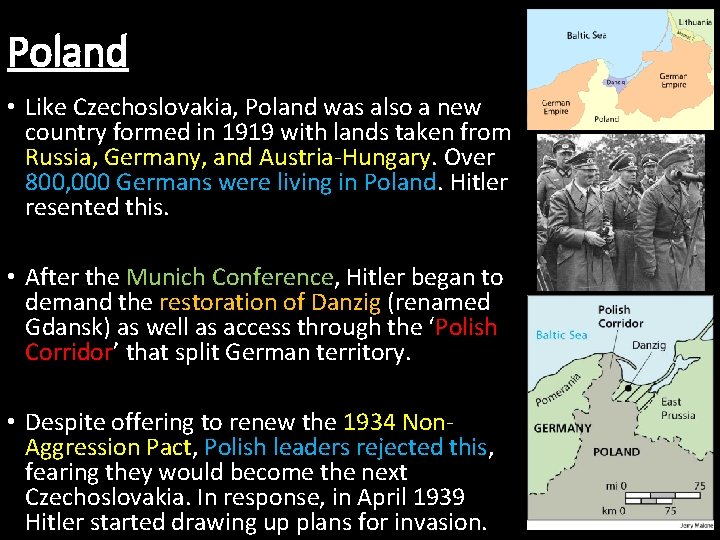
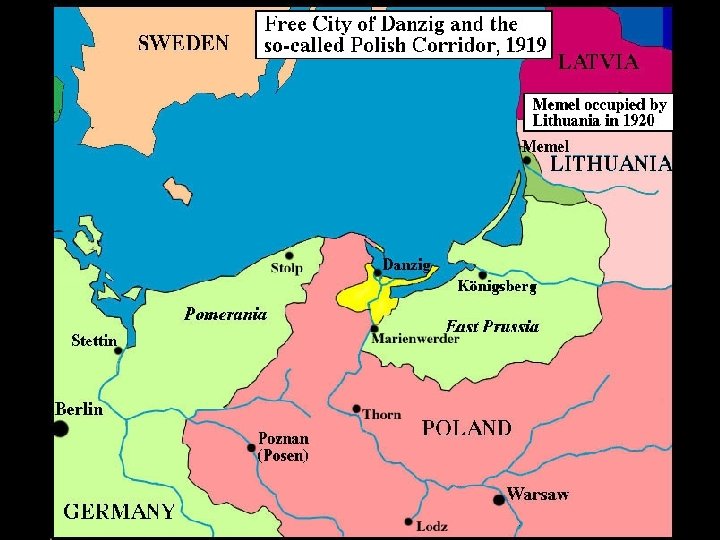
Poland • Like Czechoslovakia, Poland was also a new country formed in 1919 with lands taken from Russia, Germany, and Austria-Hungary. Over 800, 000 Germans were living in Poland. Hitler resented this. • After the Munich Conference, Hitler began to demand the restoration of Danzig (renamed Gdansk) as well as access through the ‘Polish Corridor’ that split German territory. • Despite offering to renew the 1934 Non. Aggression Pact, Polish leaders rejected this, fearing they would become the next Czechoslovakia. In response, in April 1939 Hitler started drawing up plans for invasion.
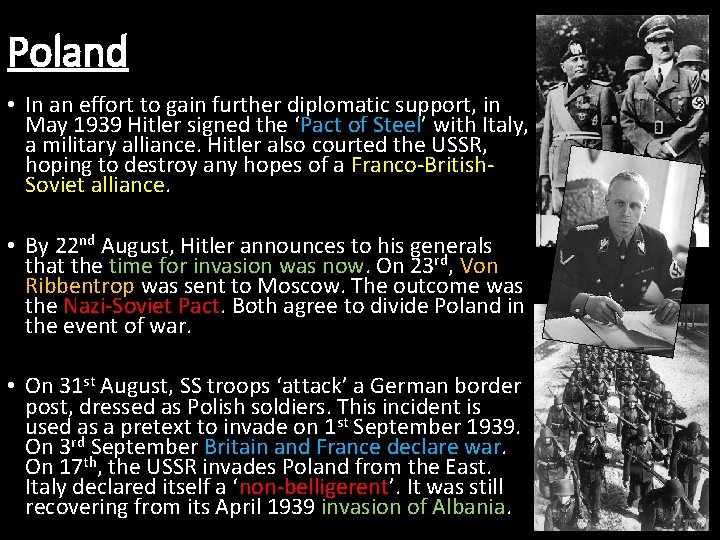
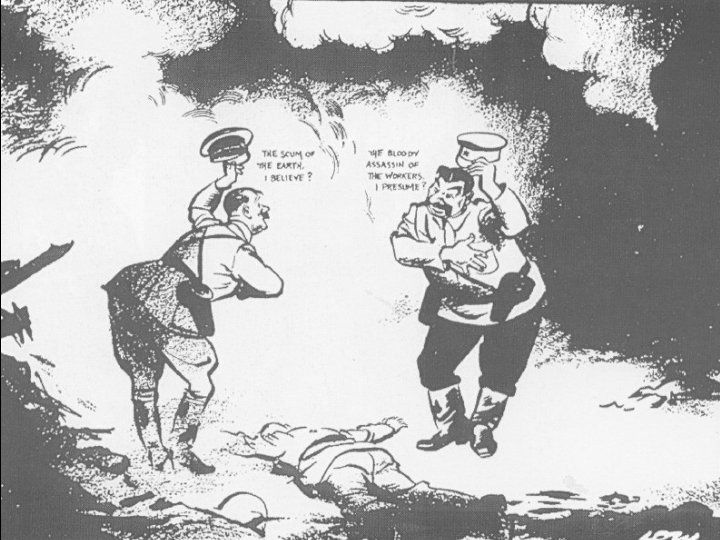
Poland • In an effort to gain further diplomatic support, in May 1939 Hitler signed the ‘Pact of Steel’ with Italy, a military alliance. Hitler also courted the USSR, hoping to destroy any hopes of a Franco-British. Soviet alliance. • By 22 nd August, Hitler announces to his generals that the time for invasion was now. On 23 rd, Von Ribbentrop was sent to Moscow. The outcome was the Nazi-Soviet Pact. Both agree to divide Poland in the event of war. • On 31 st August, SS troops ‘attack’ a German border post, dressed as Polish soldiers. This incident is used as a pretext to invade on 1 st September 1939. On 3 rd September Britain and France declare war. On 17 th, the USSR invades Poland from the East. Italy declared itself a ‘non-belligerent’. It was still recovering from its April 1939 invasion of Albania.
Classwork • HW: Read 222 -228. Complete Yellow Source Analysis.
Classwork • Source D and E Practice paper-Timed. • HW: Corfu Practice Test.
Classwork • 229 -231 -Complete Practice Test. (Timed) • HW: Locarno Treaty Practice Test • Test next class.