
Warm Up Find a f0 b f2 c
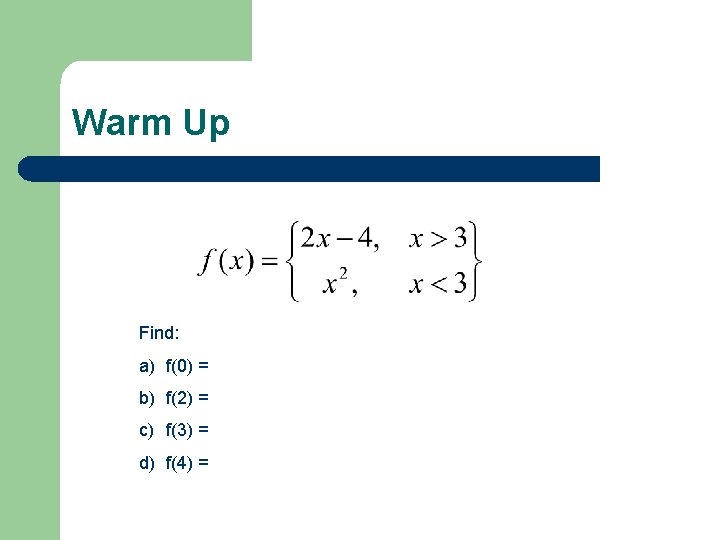
Warm Up Find: a) f(0) = b) f(2) = c) f(3) = d) f(4) =
Writing Absolute Value Functions as Piecewise Functions

Writing Absolute Value Functions as Piecewise Functions The easiest absolute value equation is just which looks like a ‘V’. Think about graphing it like it has two parts, one with a positive slope and one with a negative slope. As a piecewise function, it would look like f(x) = -x when x is negative. f(x) = x when x is positive.
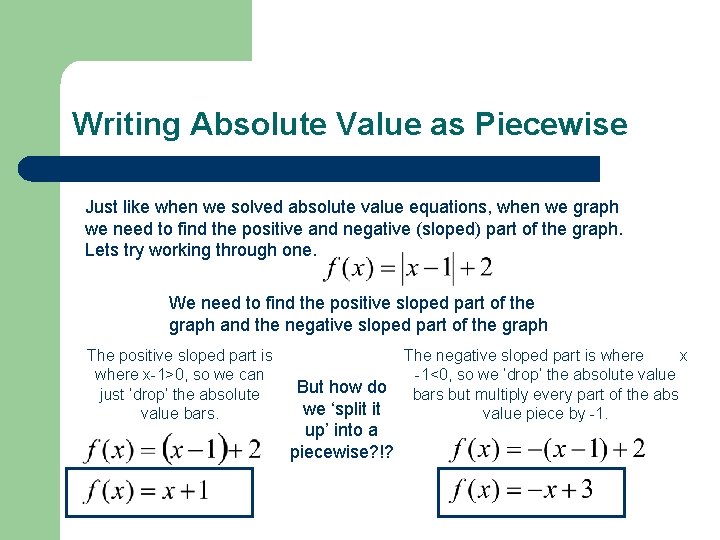
Writing Absolute Value as Piecewise Just like when we solved absolute value equations, when we graph we need to find the positive and negative (sloped) part of the graph. Lets try working through one. We need to find the positive sloped part of the graph and the negative sloped part of the graph The positive sloped part is where x-1>0, so we can just ‘drop’ the absolute value bars. But how do we ‘split it up’ into a piecewise? !? The negative sloped part is where x -1<0, so we ‘drop’ the absolute value bars but multiply every part of the abs value piece by -1.
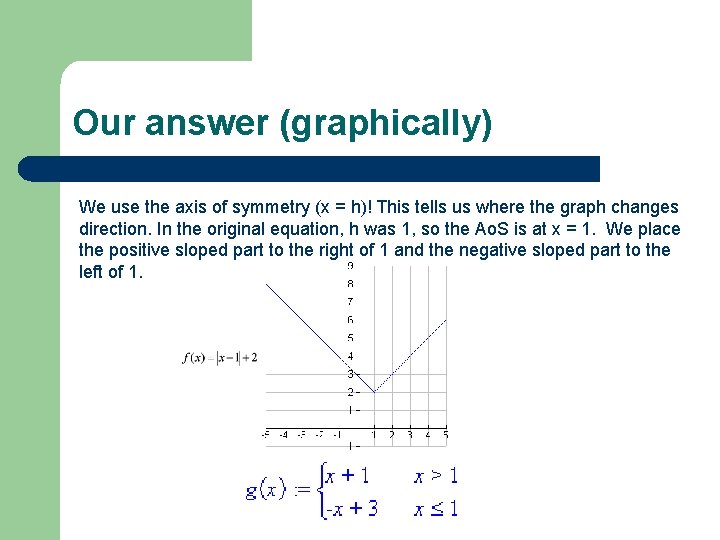
Our answer (graphically) We use the axis of symmetry (x = h)! This tells us where the graph changes direction. In the original equation, h was 1, so the Ao. S is at x = 1. We place the positive sloped part to the right of 1 and the negative sloped part to the left of 1.
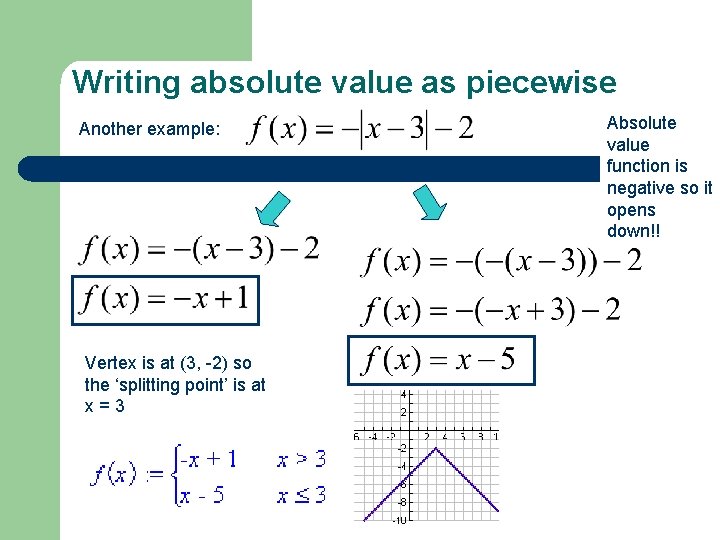
Writing absolute value as piecewise Another example: Vertex is at (3, -2) so the ‘splitting point’ is at x=3 Absolute value function is negative so it opens down!!
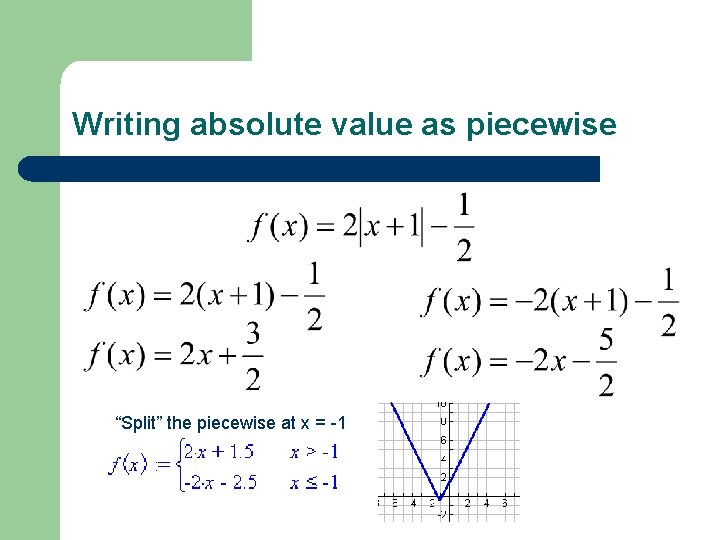
Writing absolute value as piecewise “Split” the piecewise at x = -1
- Slides: 7