
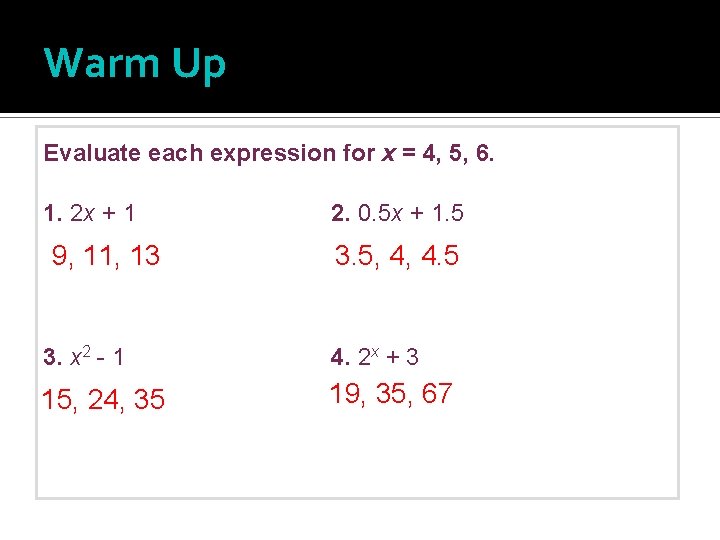
Warm Up Evaluate each expression for x 4


- Slides: 24
Warm Up Evaluate each expression for x = 4, 5, 6. 1. 2 x + 1 9, 11, 13 2. 0. 5 x + 1. 5 3. 5, 4, 4. 5 3. x 2 - 1 4. 2 x + 3 15, 24, 35 19, 35, 67
Section 9. 4 Sequences & Series Day 1 WHY? Infinite sequences, especially those with finite limits are involved in some key concepts in calculus.
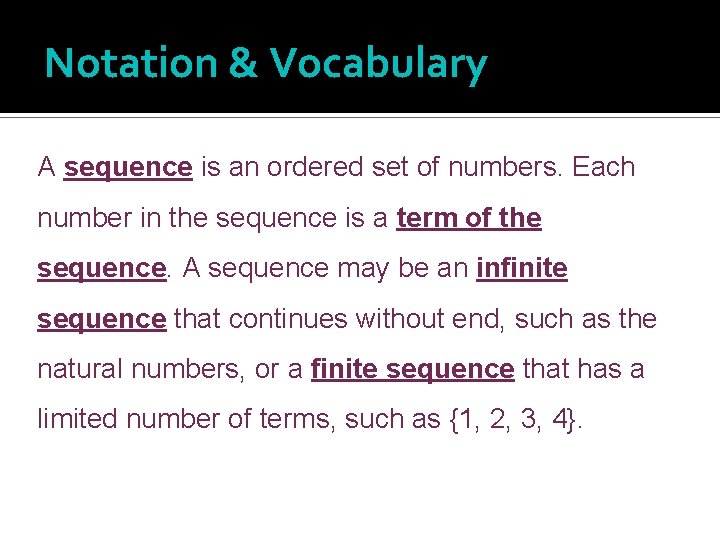
Notation & Vocabulary A sequence is an ordered set of numbers. Each number in the sequence is a term of the sequence. A sequence may be an infinite sequence that continues without end, such as the natural numbers, or a finite sequence that has a limited number of terms, such as {1, 2, 3, 4}.
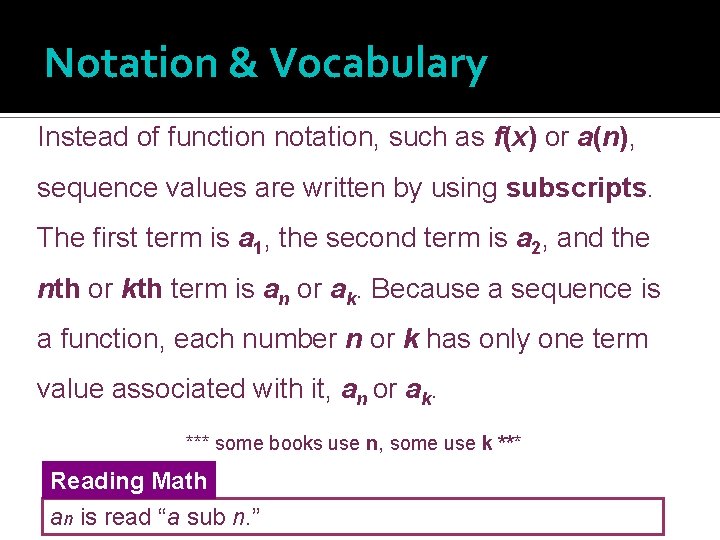
Notation & Vocabulary Instead of function notation, such as f(x) or a(n), sequence values are written by using subscripts. The first term is a 1, the second term is a 2, and the nth or kth term is an or ak. Because a sequence is a function, each number n or k has only one term value associated with it, an or ak. *** some books use n, some use k *** Reading Math an is read “a sub n. ”
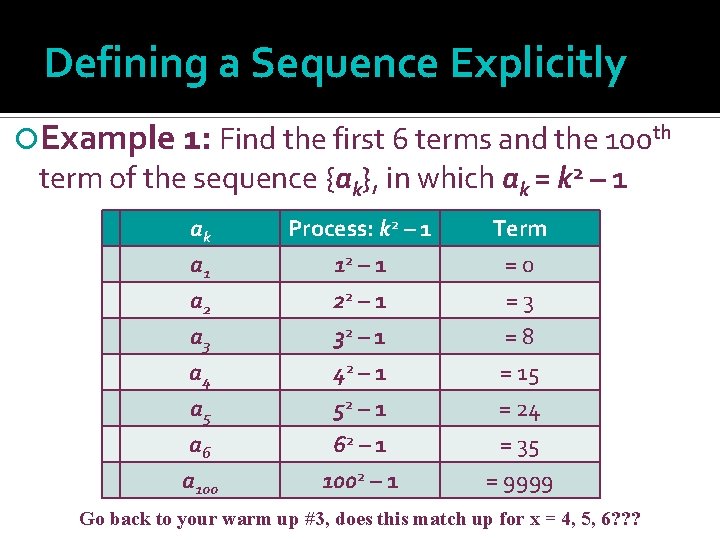
Defining a Sequence Explicitly Example 1: Find the first 6 terms and the 100 th term of the sequence {ak}, in which ak = k 2 – 1 akak a 1 a 1 a 2 a 2 a 3 a 3 a 4 a 4 a 5 a 5 a 6 a 6 a 100 Process: k 2 k– 2 1– 1 12 – 1 22 – 1 32 – 1 42 – 1 52 – 1 62 – 1 1002 – 1 Term =0 =3 =8 = 15 = 24 = 35 = 9999 Go back to your warm up #3, does this match up for x = 4, 5, 6? ? ?
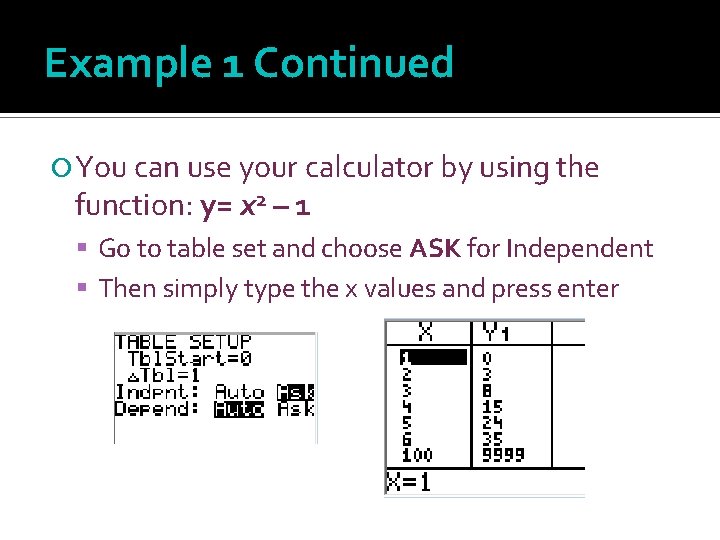
Example 1 Continued You can use your calculator by using the function: y= x 2 – 1 Go to table set and choose ASK for Independent Then simply type the x values and press enter
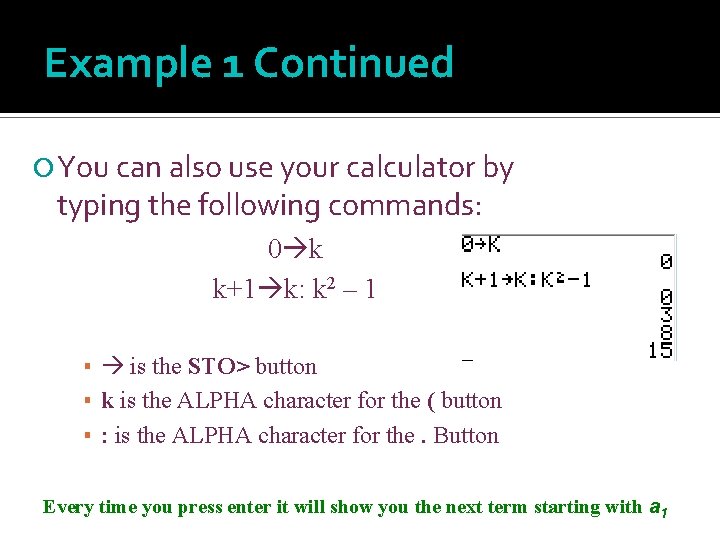
Example 1 Continued You can also use your calculator by typing the following commands: 0 k k+1 k: k 2 – 1 ▪ is the STO> button ▪ k is the ALPHA character for the ( button ▪ : is the ALPHA character for the. Button Every time you press enter it will show you the next term starting with a 1
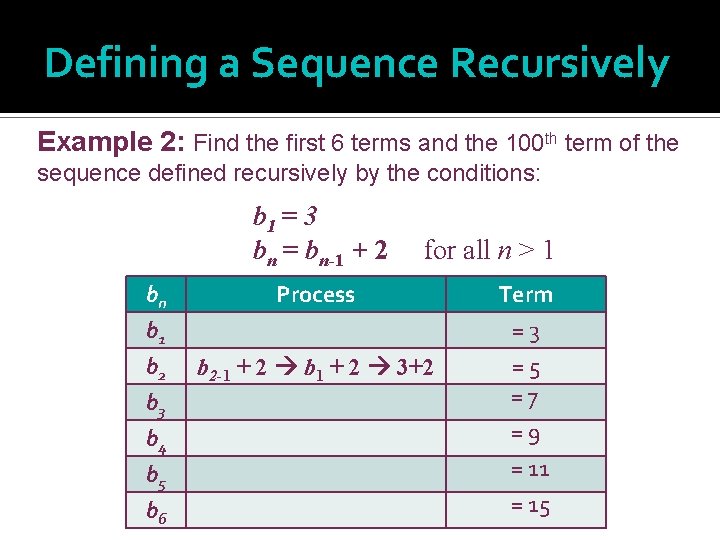
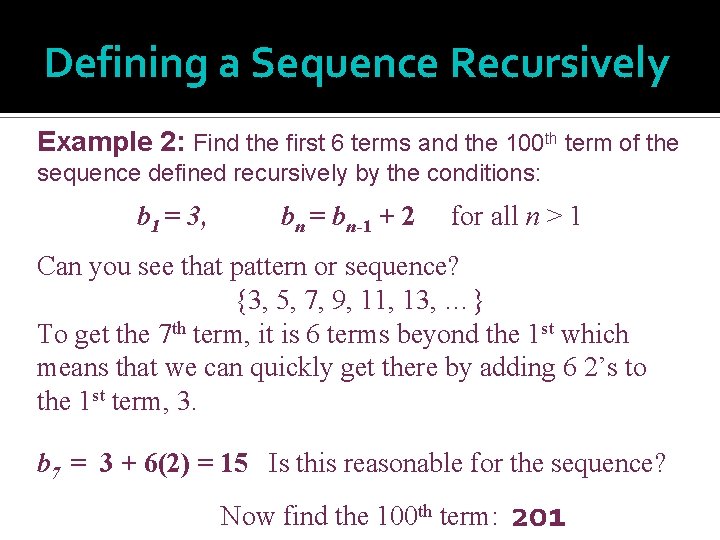
Defining a Sequence Recursively Example 2: Find the first 6 terms and the 100 th term of the sequence defined recursively by the conditions: b 1 = 3 bn = bn-1 + 2 bn b 1 b 2 b 3 b 4 b 5 b 6 for all n > 1 Process b 2 -1 + 2 b 1 + 2 3+2 Term =3 =5 =7 =9 = 11 = 15
Defining a Sequence Recursively Example 2: Find the first 6 terms and the 100 th term of the sequence defined recursively by the conditions: b 1 = 3, bn = bn-1 + 2 for all n > 1 Can you see that pattern or sequence? {3, 5, 7, 9, 11, 13, …} To get the 7 th term, it is 6 terms beyond the 1 st which means that we can quickly get there by adding 6 2’s to the 1 st term, 3. b 7 = 3 + 6(2) = 15 Is this reasonable for the sequence? Now find the 100 th term: 201
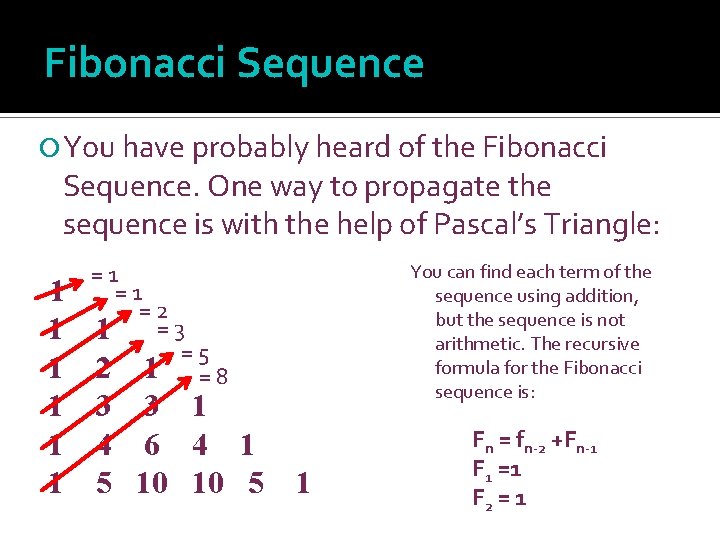
Fibonacci Sequence You have probably heard of the Fibonacci Sequence. One way to propagate the sequence is with the help of Pascal’s Triangle: You can find each term of the sequence using addition, but the sequence is not arithmetic. The recursive formula for the Fibonacci sequence is: =1 =1 =2 1 =3 =5 2 1 =8 1 1 3 3 1 1 4 6 4 1 1 5 10 10 5 1 Fn = fn-2 +Fn-1 F 1 =1 F 2 = 1
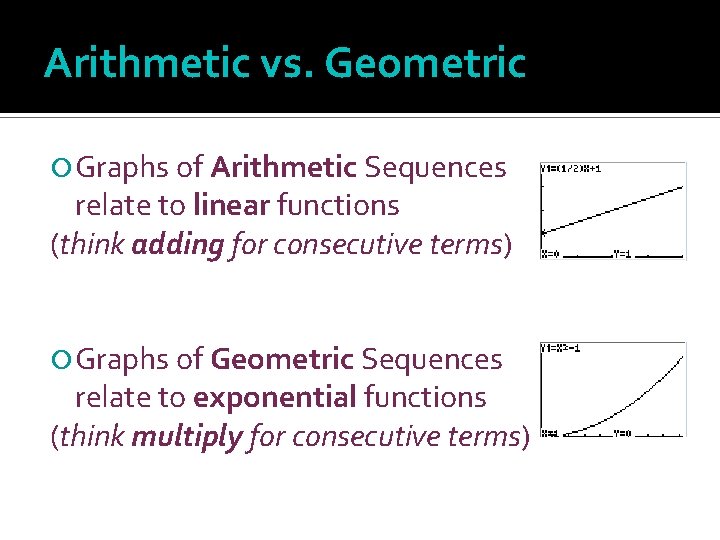
Arithmetic vs. Geometric Graphs of Arithmetic Sequences relate to linear functions (think adding for consecutive terms) Graphs of Geometric Sequences relate to exponential functions (think multiply for consecutive terms)
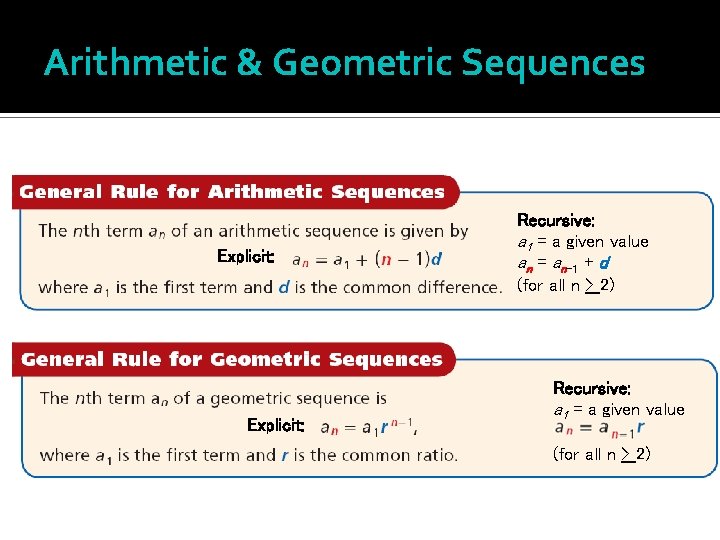
Arithmetic & Geometric Sequences Explicit: Recursive: a 1 = a given value an = an-1 + d (for all n > 2) Recursive: a 1 = a given value (for all n > 2)
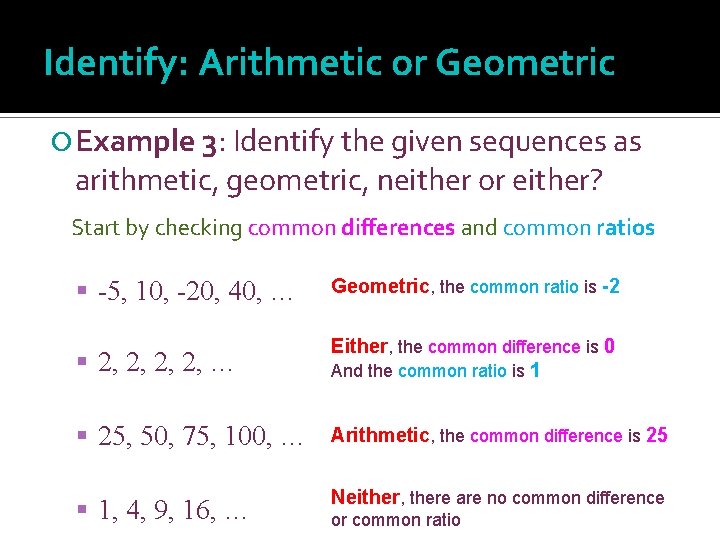
Identify: Arithmetic or Geometric Example 3: Identify the given sequences as arithmetic, geometric, neither or either? Start by checking common differences and common ratios -5, 10, -20, 40, … Geometric, the common ratio is -2 2, 2, … Either, the common difference is 0 And the common ratio is 1 25, 50, 75, 100, … Arithmetic, the common difference is 25 1, 4, 9, 16, … Neither, there are no common difference or common ratio
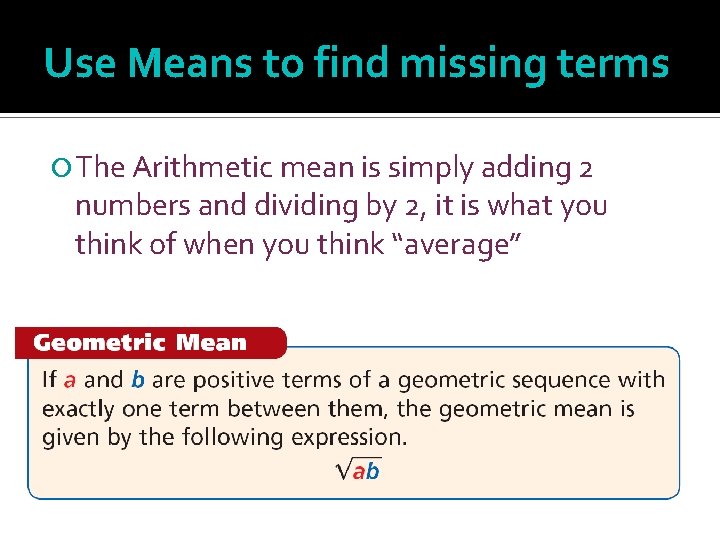
Use Means to find missing terms The Arithmetic mean is simply adding 2 numbers and dividing by 2, it is what you think of when you think “average”
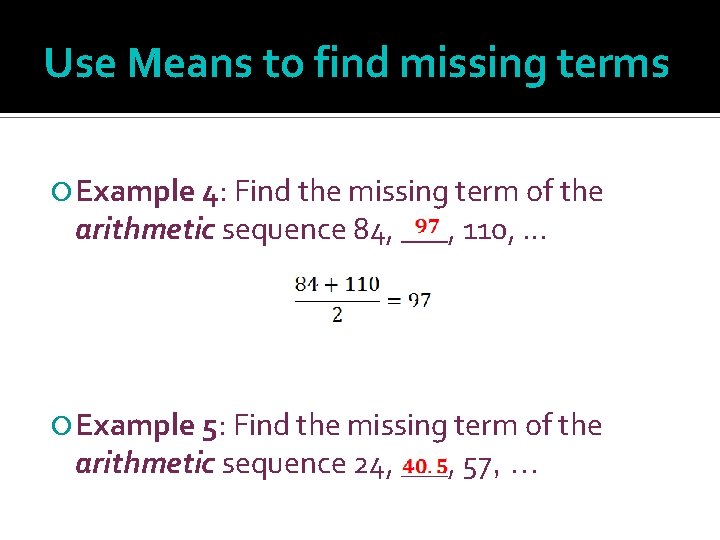
Use Means to find missing terms Example 4: Find the missing term of the arithmetic sequence 84, ___, 110, … Example 5: Find the missing term of the arithmetic sequence 24, ___, 57, …
Use Means to find missing terms Example 6: Find the missing term of the geometric sequence 3, ___, 18. 75, … Example 7: Find the missing term of the geometric sequence 9180 , ___, 255, …
Writing Arithmetic Formulas Example 8: Write a recursive and an explicit formula for the given arithmetic sequence: -32, -20, -8, 4, 16 d, (common difference) = 12, Explicit: an = a 1 + (n-1)d an = -32 + (n-1)12 a 1, (1 st term) = -32 Recursive: a 1 = the first term an = an-1 + d (for all n > 2) a 1 = -32 an = an-1 + 12, (for all n > 2)
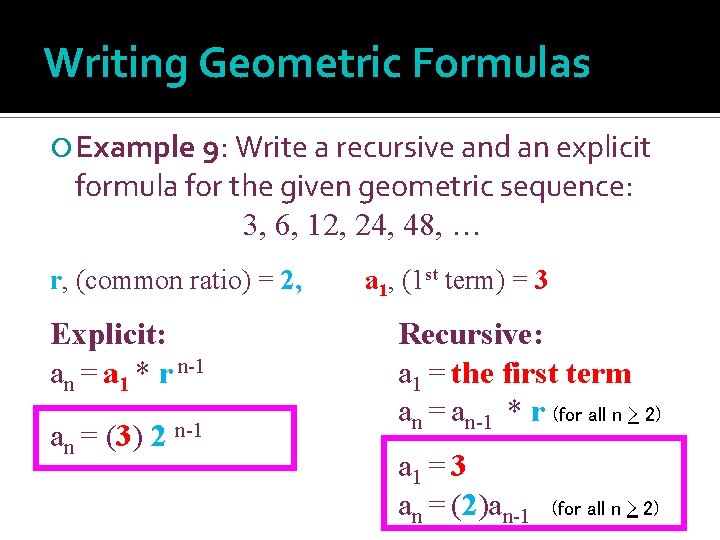
Writing Geometric Formulas Example 9: Write a recursive and an explicit formula for the given geometric sequence: 3, 6, 12, 24, 48, … r, (common ratio) = 2, Explicit: an = a 1 * r n-1 an = (3) 2 n-1 a 1, (1 st term) = 3 Recursive: a 1 = the first term an = an-1 * r (for all n > 2) a 1 = 3 an = (2)an-1 (for all n > 2)
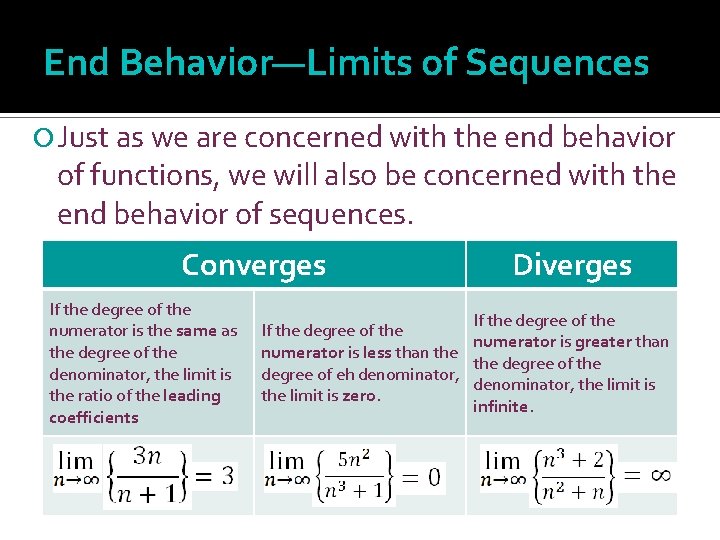
End Behavior—Limits of Sequences Just as we are concerned with the end behavior of functions, we will also be concerned with the end behavior of sequences. Converges If the degree of the numerator is the same as the degree of the denominator, the limit is the ratio of the leading coefficients Diverges If the degree of the numerator is greater than numerator is less than the degree of eh denominator, the limit is zero. infinite.
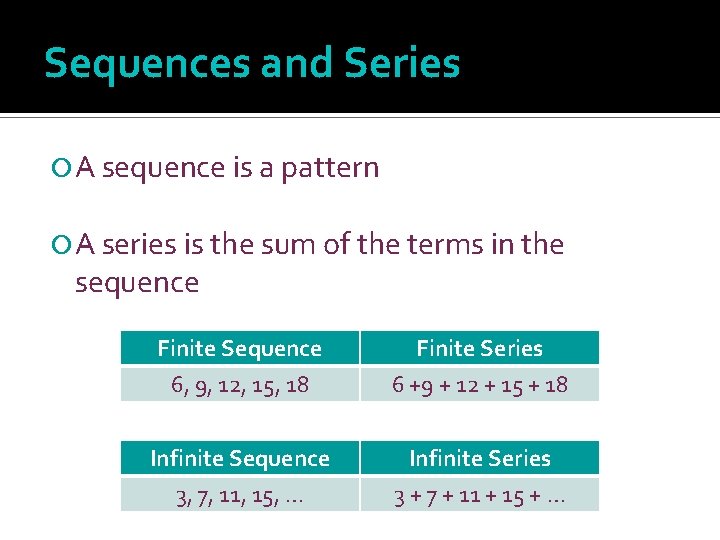
Sequences and Series A sequence is a pattern A series is the sum of the terms in the sequence Finite Sequence 6, 9, 12, 15, 18 Finite Series 6 +9 + 12 + 15 + 18 Infinite Sequence 3, 7, 11, 15, … Infinite Series 3 + 7 + 11 + 15 + …
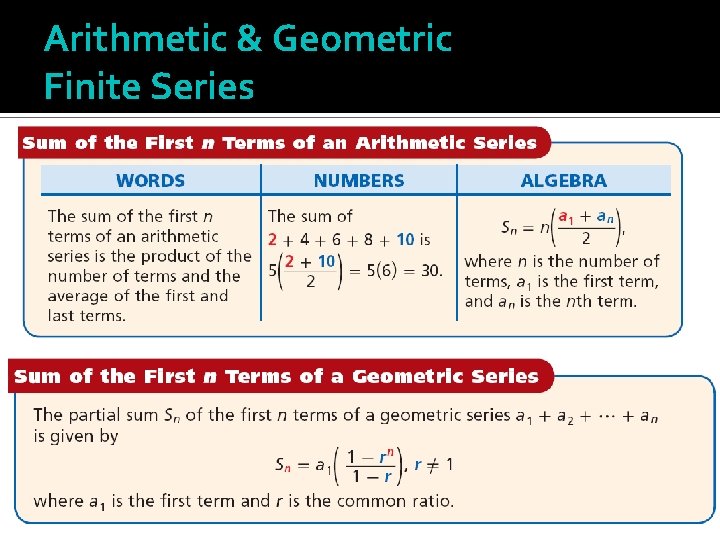
Arithmetic & Geometric Finite Series
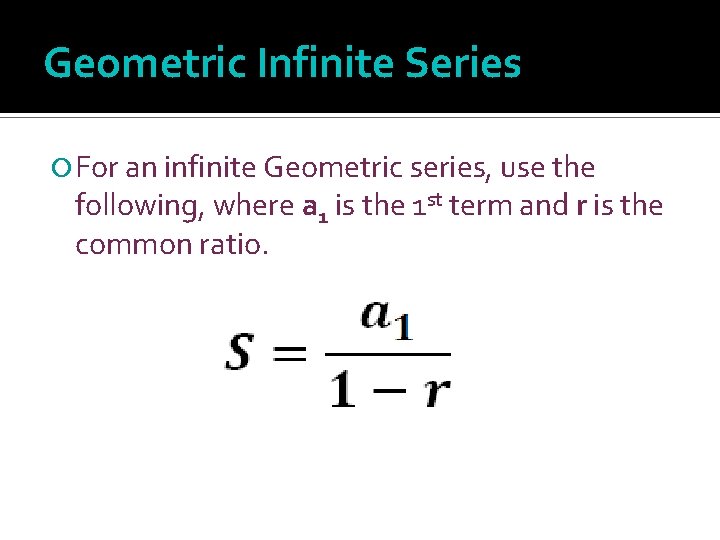
Geometric Infinite Series For an infinite Geometric series, use the following, where a 1 is the 1 st term and r is the common ratio.
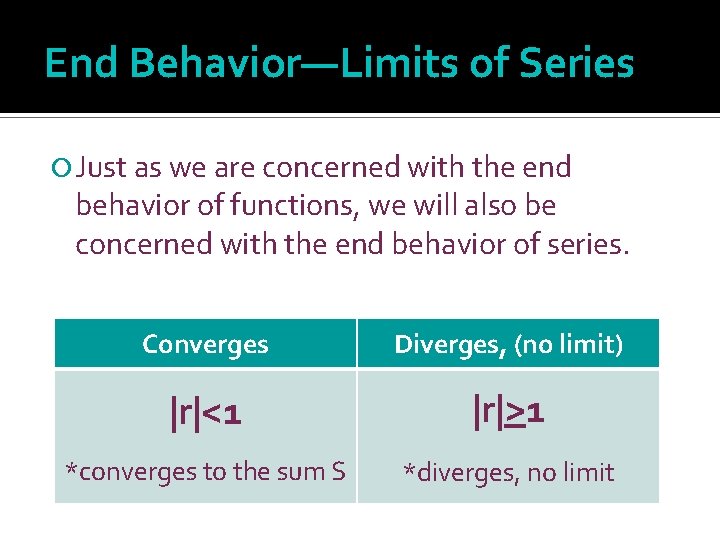
End Behavior—Limits of Series Just as we are concerned with the end behavior of functions, we will also be concerned with the end behavior of series. Converges Diverges, (no limit) |r|<1 |r|>1 *converges to the sum S *diverges, no limit
HW 9. 4 p. 739, 1 -31 odd Project due 5/2 or 5/3 Quiz at the end of next class