
Warm Up Check your understanding on p 705
- Slides: 10
Warm Up Check your understanding on p. 705 -06 You do NOT need to calculate ALL the expected values by hand but you need to do at least 2. You do NOT need to calculate the chi square value by hand but should calculate 2 parts of it by hand. The Practice of Statistics, 5 th Edition 1
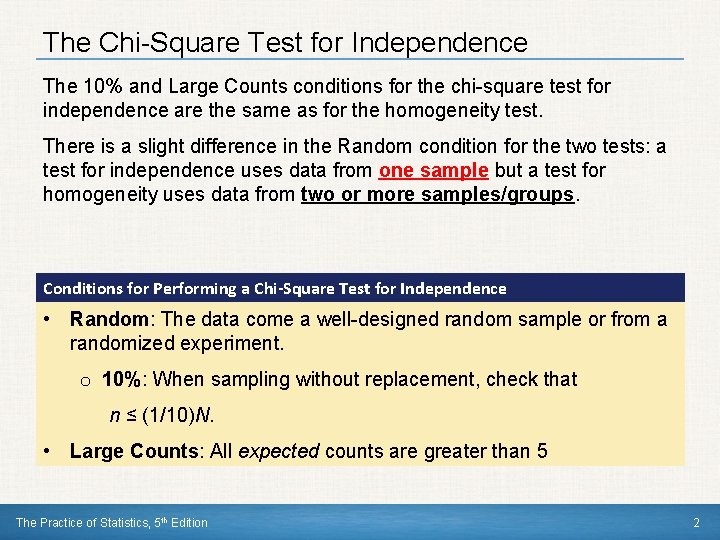
The Chi-Square Test for Independence The 10% and Large Counts conditions for the chi-square test for independence are the same as for the homogeneity test. There is a slight difference in the Random condition for the two tests: a test for independence uses data from one sample but a test for homogeneity uses data from two or more samples/groups. Conditions for Performing a Chi-Square Test for Independence • Random: The data come a well-designed random sample or from a randomized experiment. o 10%: When sampling without replacement, check that n ≤ (1/10)N. • Large Counts: All expected counts are greater than 5 The Practice of Statistics, 5 th Edition 2
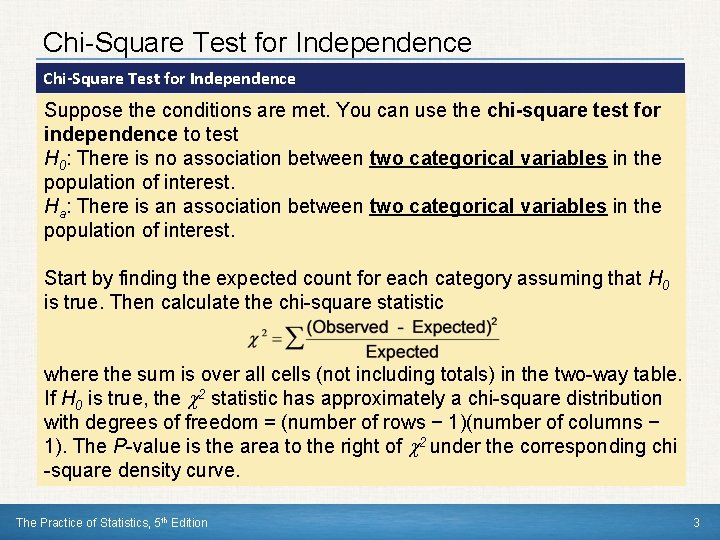
Chi-Square Test for Independence Suppose the conditions are met. You can use the chi-square test for independence to test H 0: There is no association between two categorical variables in the population of interest. Ha: There is an association between two categorical variables in the population of interest. Start by finding the expected count for each category assuming that H 0 is true. Then calculate the chi-square statistic where the sum is over all cells (not including totals) in the two-way table. If H 0 is true, the c 2 statistic has approximately a chi-square distribution with degrees of freedom = (number of rows − 1)(number of columns − 1). The P-value is the area to the right of c 2 under the corresponding chi -square density curve. The Practice of Statistics, 5 th Edition 3
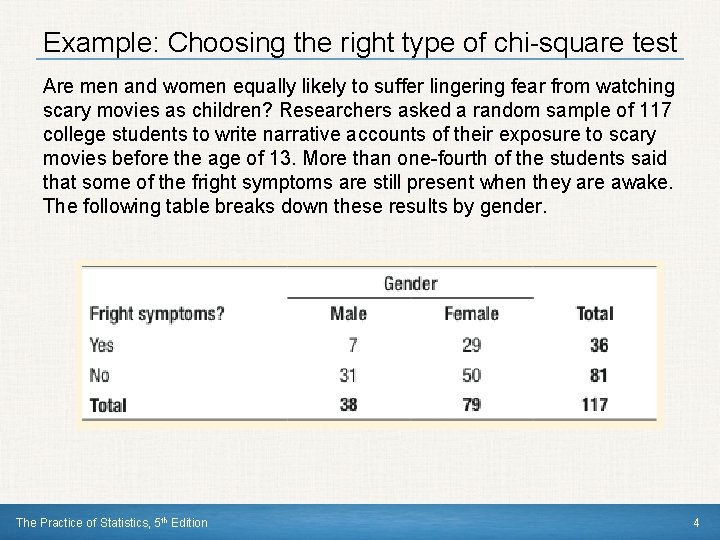
Example: Choosing the right type of chi-square test Are men and women equally likely to suffer lingering fear from watching scary movies as children? Researchers asked a random sample of 117 college students to write narrative accounts of their exposure to scary movies before the age of 13. More than one-fourth of the students said that some of the fright symptoms are still present when they are awake. The following table breaks down these results by gender. The Practice of Statistics, 5 th Edition 4
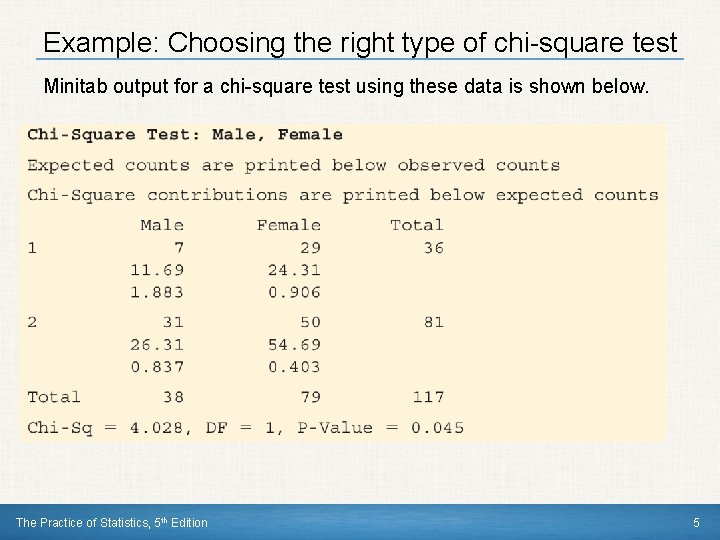
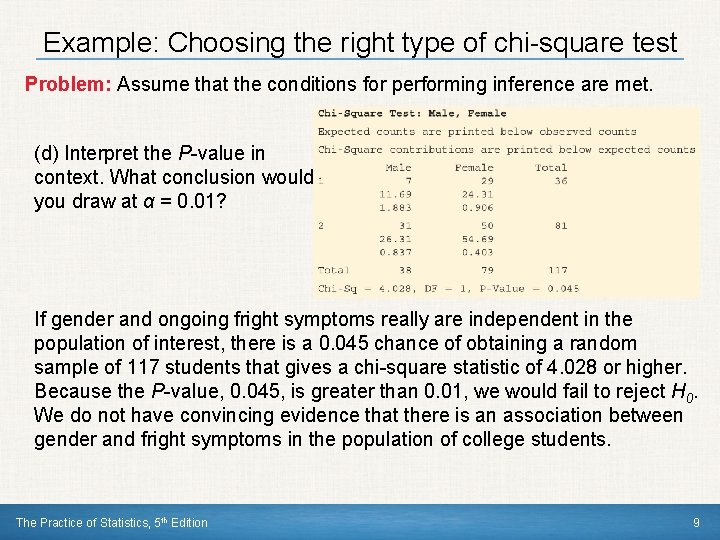
Example: Choosing the right type of chi-square test Minitab output for a chi-square test using these data is shown below. The Practice of Statistics, 5 th Edition 5
Example: Choosing the right type of chi-square test Problem: Assume that the conditions for performing inference are met. (a) Explain why a chi-square test for independence and not a chi-square test for homogeneity should be used in this setting. The data were produced using a single random sample of college students, who were then classified by gender and whether or not they had lingering fright symptoms. The chi-square test for homogeneity requires independent random samples from each population. ***This is how you tell the difference between a test for idenpendence vs. a test of homogeneity. They both use the same test on the calculator but you MUST be able to correctly identify the proper test. The Practice of Statistics, 5 th Edition 6
Example: Choosing the right type of chi-square test Problem: Assume that the conditions for performing inference are met. (b) State an appropriate pair of hypotheses for researchers to test in this setting. The null hypothesis is H 0: There is no association between gender and ongoing fright symptoms in the population of college students. Ha: There is an association between gender and ongoing fright symptoms in the population of college students. The Practice of Statistics, 5 th Edition 7
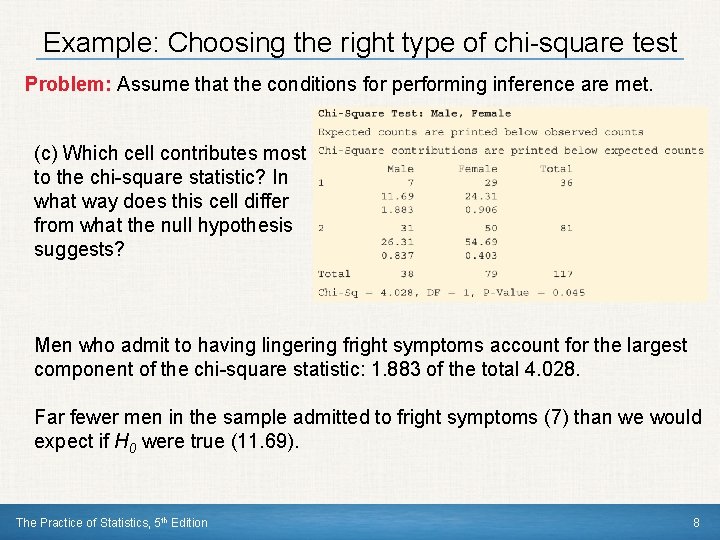
Example: Choosing the right type of chi-square test Problem: Assume that the conditions for performing inference are met. (c) Which cell contributes most to the chi-square statistic? In what way does this cell differ from what the null hypothesis suggests? Men who admit to having lingering fright symptoms account for the largest component of the chi-square statistic: 1. 883 of the total 4. 028. Far fewer men in the sample admitted to fright symptoms (7) than we would expect if H 0 were true (11. 69). The Practice of Statistics, 5 th Edition 8
Example: Choosing the right type of chi-square test Problem: Assume that the conditions for performing inference are met. (d) Interpret the P-value in context. What conclusion would you draw at α = 0. 01? If gender and ongoing fright symptoms really are independent in the population of interest, there is a 0. 045 chance of obtaining a random sample of 117 students that gives a chi-square statistic of 4. 028 or higher. Because the P-value, 0. 045, is greater than 0. 01, we would fail to reject H 0. We do not have convincing evidence that there is an association between gender and fright symptoms in the population of college students. The Practice of Statistics, 5 th Edition 9
Another Example… • Finger Length example on p. 131 in your notes packet. The Practice of Statistics, 5 th Edition 10