
Warm Up 9 9 13 Compare predator adaptations

- Slides: 10
Warm Up 9 -9 -13 Compare predator adaptations to prey adaptations. Give two examples of each.
Answer Predator adaptations help predators catch prey. Ex. Speed, camouflage, heat sensory (snake) Prey adaptations help the prey from being eaten. Ex. Warning coloration, herding, playing dead.
Warm Up 9 -10 -13 What is the difference between a food chain and a food web?
Answer A food web shows the feeding relationships between multiple organisms in an ecosystem. A food chain shows feeding relationships from one organism to the next.
Warm Up 9 -11 -13 A tick sucks blood from a dog. In this relationship, the tick is the _____ and the dog is the _____. a. parasite, prey c. parasite, host b. predator, host d. host, parasite
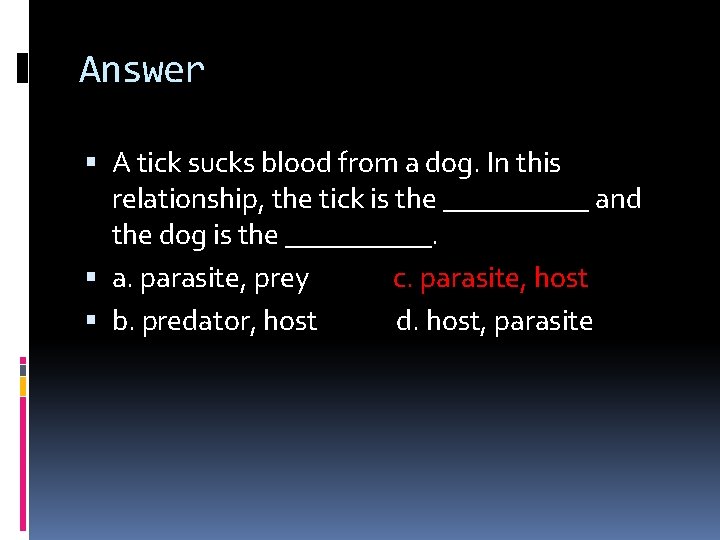
Answer A tick sucks blood from a dog. In this relationship, the tick is the _____ and the dog is the _____. a. parasite, prey c. parasite, host b. predator, host d. host, parasite
Warm Up 9 -12 -13 Resources such as water, food, or sunlight are likely to be limiting factors a. when population size is decreasing. b. when predators eat their prey. c. when the population is small. d. when a population is approaching the carrying capacity.
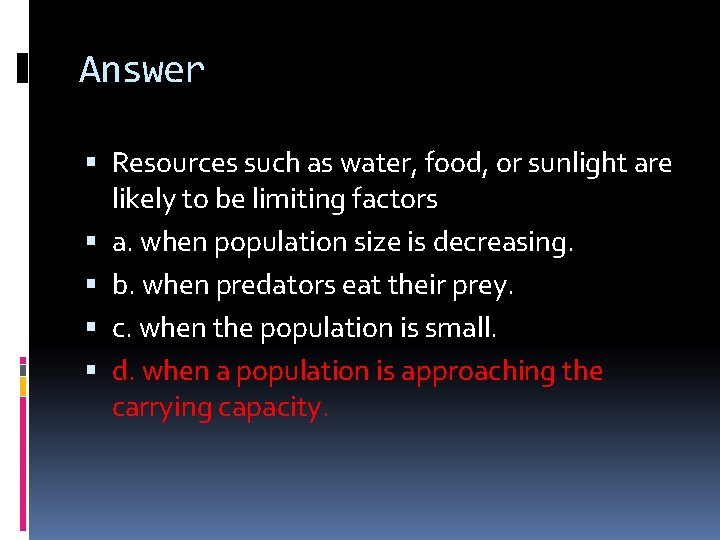
Answer Resources such as water, food, or sunlight are likely to be limiting factors a. when population size is decreasing. b. when predators eat their prey. c. when the population is small. d. when a population is approaching the carrying capacity.
Warm Up 9 -13 -13 Nature’s recyclers are a. predators. c. producers. b. decomposers. d. omnivores.
Answer Nature’s recyclers are a. predators. c. producers. b. decomposers. d. omnivores.