
Warm up 4 min 92018 Thursday Warm Up



- Slides: 12
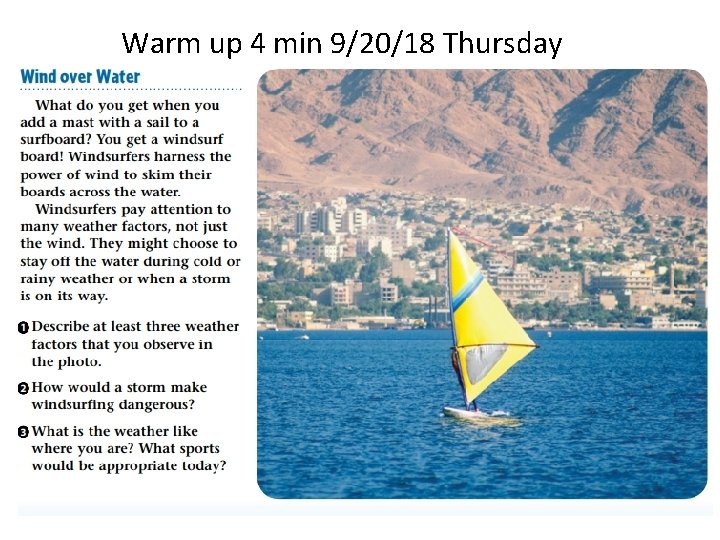
Warm up 4 min 9/20/18 Thursday
Warm Up Answer 1 The weather appears to be warm, sunny, and moderately windy 2 A storm could bring strong winds, heavy rain, and lightning. 3 Answers will vary. Examples: football, baseball, swimming, etc.
Today Agenda • • • 1) Warm Up 4 min 2) Key Concept Builder 15 min 3) Concept Practice 10 min 4) Video 5 min 5) Plicker 10 min
Key Concept Builder (page 16) 1. yes; It is an atmospheric condition that is taking place for a short time at my house. 2. no; It is not short term, but it describes the temperature normally present in the summer. 3. yes; It is a short-term atmospheric condition. 4. yes; This describes a short-term atmospheric change. 5. no; This is not short term, but it describes an annual pattern. 6. yes; I am looking for any possible short-term changes in the atmospheric condition. 7. yes; The rains represent a short-term change in atmospheric conditions. 8. no; This represents annual temperatures that fall below freezing and are not short-term changes. 9. no; This is an annual pattern that is not representative of a short-term atmospheric condition. 10. yes; This represents a short-term atmospheric change. 11. yes; It has changed from a sunny day to rain, representing a short-term atmospheric change.
Key Concept Builder (page 17) 1. dew point 2. barometric pressure 3. air pressure 4. precipitation 5. air temperature 6. humidity 7. relative humidity
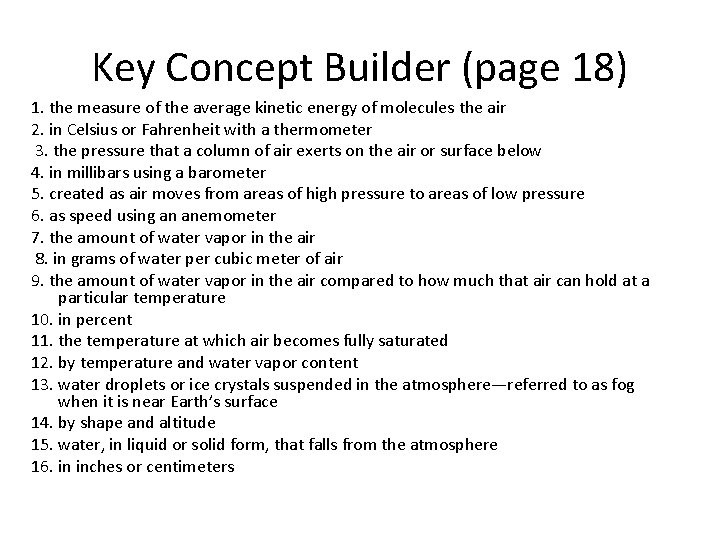
Key Concept Builder (page 18) 1. the measure of the average kinetic energy of molecules the air 2. in Celsius or Fahrenheit with a thermometer 3. the pressure that a column of air exerts on the air or surface below 4. in millibars using a barometer 5. created as air moves from areas of high pressure to areas of low pressure 6. as speed using an anemometer 7. the amount of water vapor in the air 8. in grams of water per cubic meter of air 9. the amount of water vapor in the air compared to how much that air can hold at a particular temperature 10. in percent 11. the temperature at which air becomes fully saturated 12. by temperature and water vapor content 13. water droplets or ice crystals suspended in the atmosphere—referred to as fog when it is near Earth’s surface 14. by shape and altitude 15. water, in liquid or solid form, that falls from the atmosphere 16. in inches or centimeters
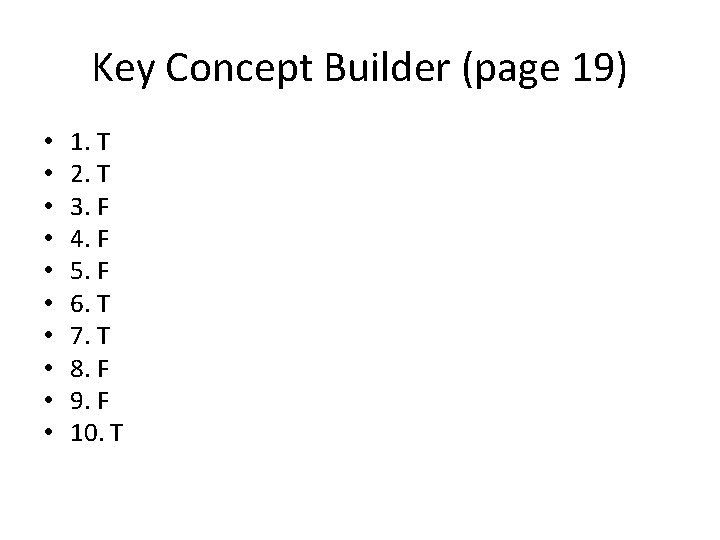
Key Concept Builder (page 19) • • • 1. T 2. T 3. F 4. F 5. F 6. T 7. T 8. F 9. F 10. T
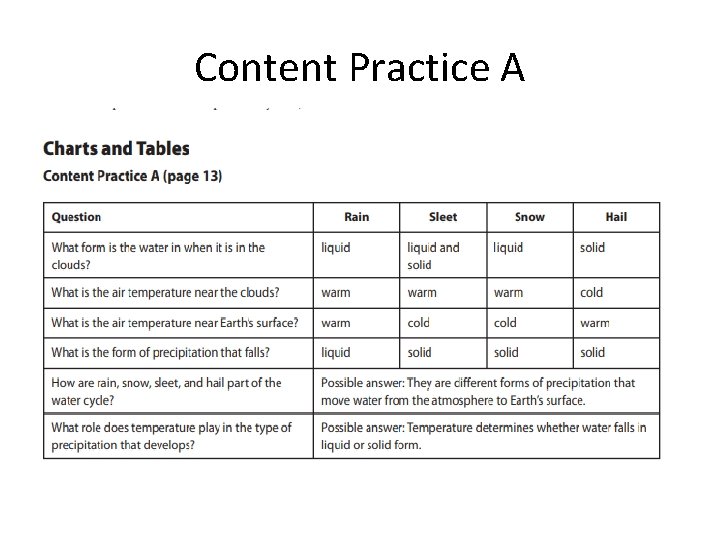
Content Practice A
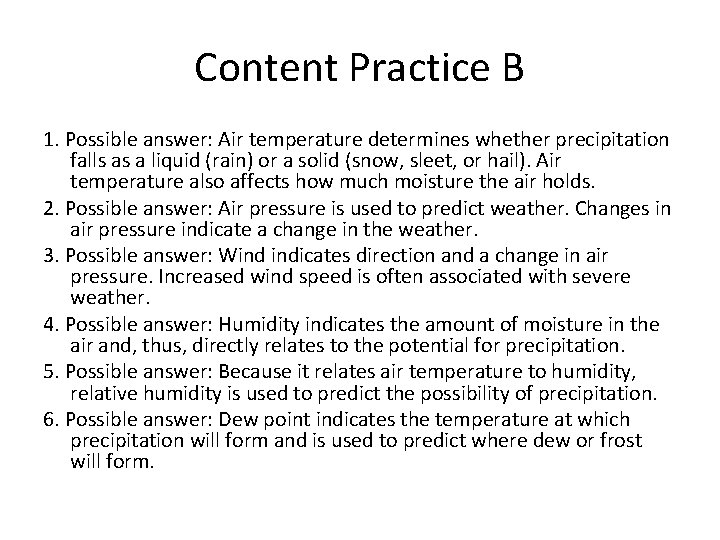
Content Practice B 1. Possible answer: Air temperature determines whether precipitation falls as a liquid (rain) or a solid (snow, sleet, or hail). Air temperature also affects how much moisture the air holds. 2. Possible answer: Air pressure is used to predict weather. Changes in air pressure indicate a change in the weather. 3. Possible answer: Wind indicates direction and a change in air pressure. Increased wind speed is often associated with severe weather. 4. Possible answer: Humidity indicates the amount of moisture in the air and, thus, directly relates to the potential for precipitation. 5. Possible answer: Because it relates air temperature to humidity, relative humidity is used to predict the possibility of precipitation. 6. Possible answer: Dew point indicates the temperature at which precipitation will form and is used to predict where dew or frost will form.
Content Practice B • • • 7. Possible answer. The height and type (shape) of cloud are used to predict the type of weather that is possible, such as light rain, thunderstorms, snow, sleet, or hail. 8. Possible answer: Fog is clouds that form near Earth’s surface, so it reduces visibility. If ice crystals form in the cloud, dangerous surface conditions can exist. 9. Possible answer: Precipitation falls as rain, snow, sleet, or hail. The type of precipitation that falls is predicted based on air temperature and humidity levels. 10. Possible answer: The type of weather that a region experiences depends on what is happening at that place in the water cycle. 11. Possible answer: If water is evaporating and the humidity levels are low, then there is no precipitation. 12. Possible answer: If water vapor condenses and clouds form, then precipitation will fall. The type of precipitation that falls depends on air temperature.
Video-Study Jams • https: //www. youtube. com/watch? v=Xir. AUv. S_ 29 I&t=33 s
Plicker