
Warm Up 31 Who controls how much money


- Slides: 47
Warm Up #31 Who controls how much money is spent on the American people and how to spend it, and explain how they got that power? NEXT
Class Confession We the Senior Class of 2016 will complete ALL of our assignments to best of our abilities and behave appropriately in class. We will respect all faculty, staff, substitutes, classmates, and especially Mr. Wilcox. We will graduate on time May 20, 2016 and become productive citizens in society. NEXT
SSEMA 3 ab The student will explain how the government uses fiscal policy to promote price stability, full employment, and economic growth. Determine and define vocabulary. Identify key terms within the standard. Define each term. ________________________________________ ________________________________________ NEXT
Scaffold understanding of the standard(s) and/or element(s). Paraphrase the standard(s) and/or element(s). Rewrite the standard including synonyms or brief definitions in parentheses and in a different color following the key terms found in step 1. The student will explain (clarify) how the government uses fiscal (financial) policy (strategy) to promote price stability (constancy), full employment, and economic growth. NEXT
Using Fiscal Policy What is Fiscal Policy? SSEMA 3 a Define Fiscal Policy. Explain the government’s taxing and spending decisions. NEXT
Using Fiscal Policy KEY CONCEPT • Fiscal policy uses taxes and government spending in an effort to smooth out the peaks and troughs of the business cycle. WHY THE CONCEPT MATTERS • During the 20 th century, periods of rampant inflation and economic depression caused great hardship for millions of people in different parts of the world. • The federal government uses a combination of spending and taxation to reduce the impact of economic extremes. NEXT
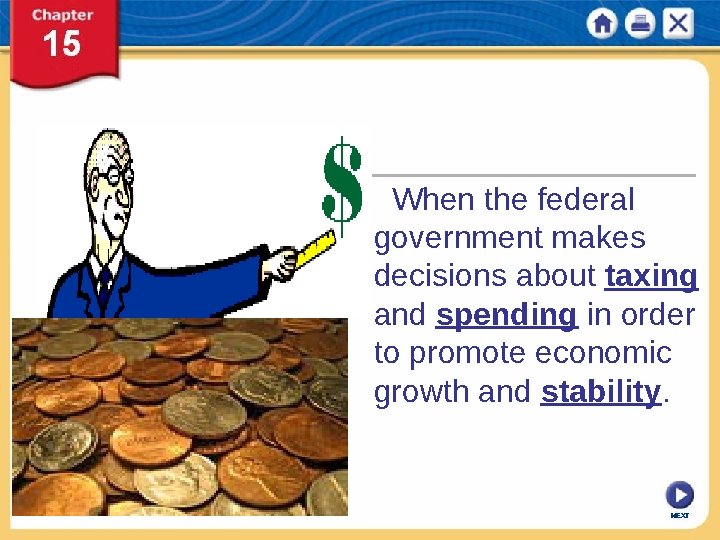
What is Fiscal Policy? When the federal government makes decisions about taxing and spending in order to promote economic growth and stability. NEXT
Fiscal Policy Tools KEY CONCEPTS Fiscal—refers to government revenue, spending, and debt • Fiscal policy—government’s use of taxes, spending to affect economy • Expansionary fiscal policy—raises aggregate demand, stimulates economy • Contractionary fiscal policy—reduces aggregate demand, slows economy • – Federal government’s tools to influence economy is taxation and spending NEXT
Fiscal Policy Tools Discretionary Fiscal Policy p. 446 • Discretionary fiscal policy—actions government takes to stabilize the economy – involve choices government makes about taxes or spending – Congress must enact (authorize) legislation for policies to be implemented NEXT
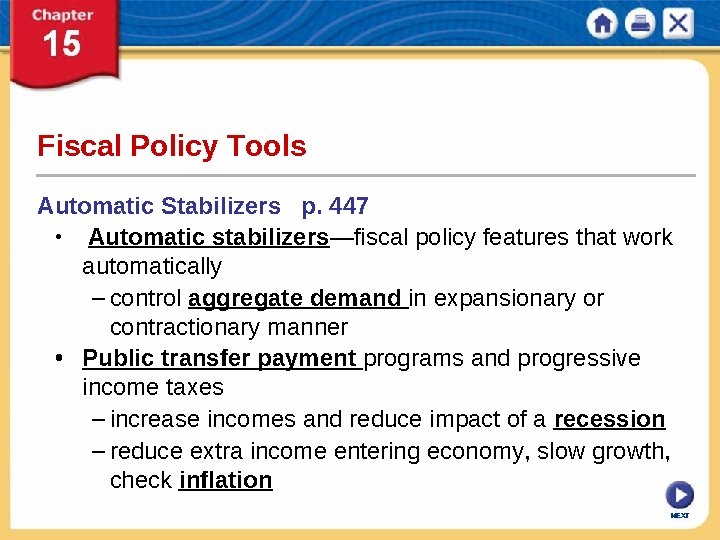
Fiscal Policy Tools Automatic Stabilizers p. 447 • Automatic stabilizers—fiscal policy features that work automatically – control aggregate demand in expansionary or contractionary manner • Public transfer payment programs and progressive income taxes – increase incomes and reduce impact of a recession – reduce extra income entering economy, slow growth, check inflation NEXT
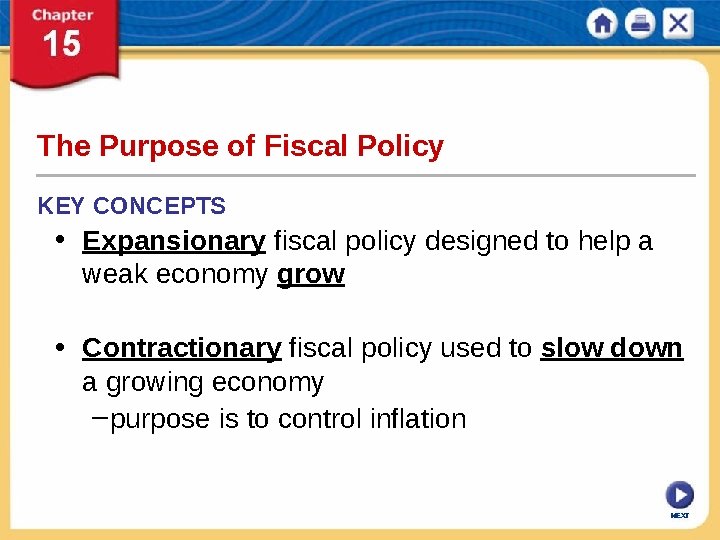
The Purpose of Fiscal Policy KEY CONCEPTS • Expansionary fiscal policy designed to help a weak economy grow • Contractionary fiscal policy used to slow down a growing economy – purpose is to control inflation NEXT
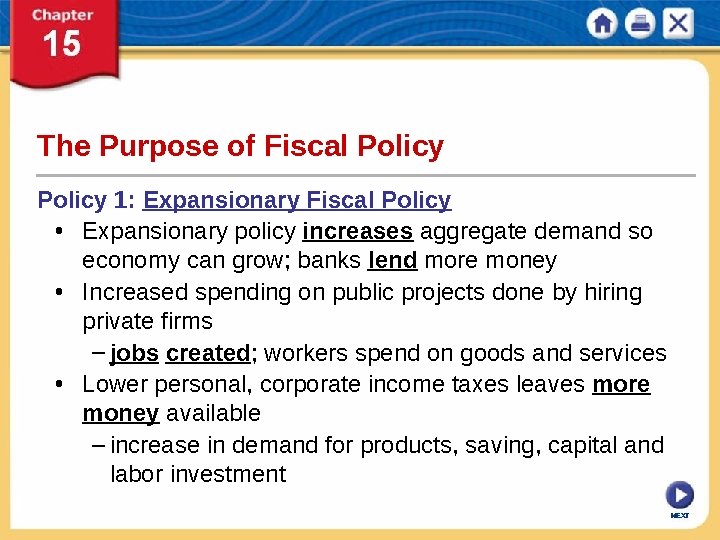
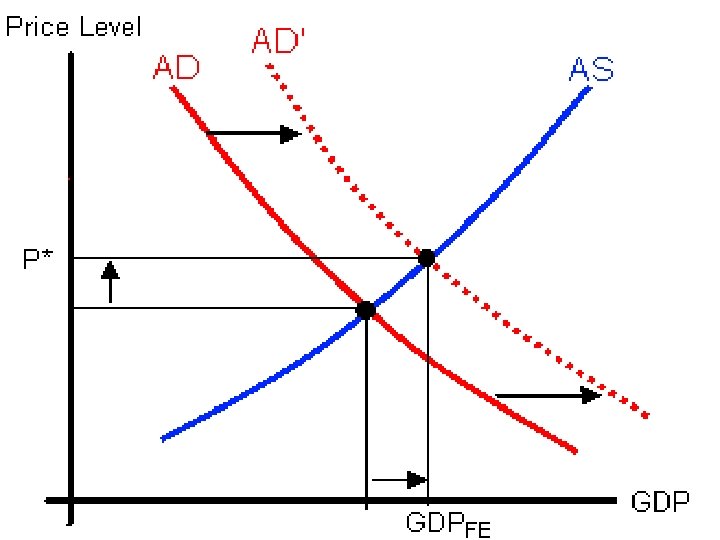
The Purpose of Fiscal Policy 1: Expansionary Fiscal Policy • Expansionary policy increases aggregate demand so economy can grow; banks lend more money • Increased spending on public projects done by hiring private firms – jobs created; workers spend on goods and services • Lower personal, corporate income taxes leaves more money available – increase in demand for products, saving, capital and labor investment NEXT
NEXT
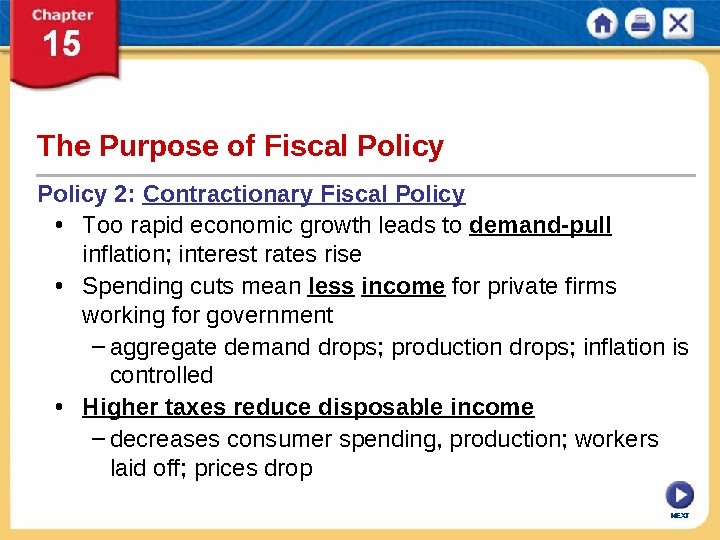
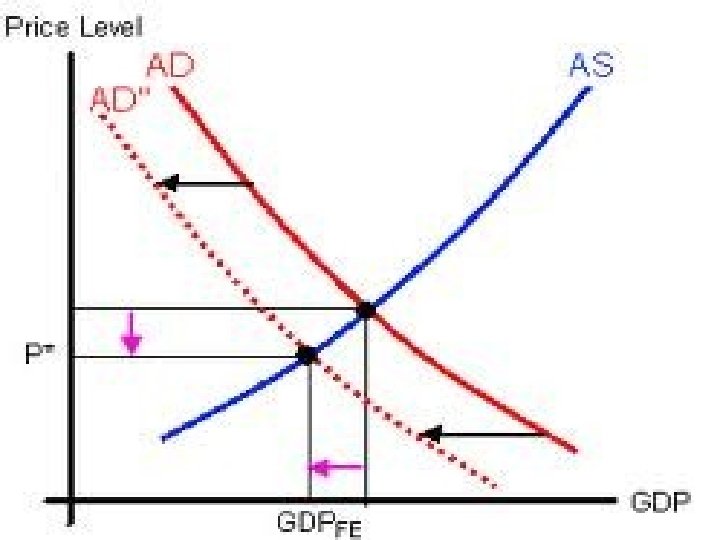
The Purpose of Fiscal Policy 2: Contractionary Fiscal Policy • Too rapid economic growth leads to demand-pull inflation; interest rates rise • Spending cuts mean less income for private firms working for government – aggregate demand drops; production drops; inflation is controlled • Higher taxes reduce disposable income – decreases consumer spending, production; workers laid off; prices drop NEXT
NEXT
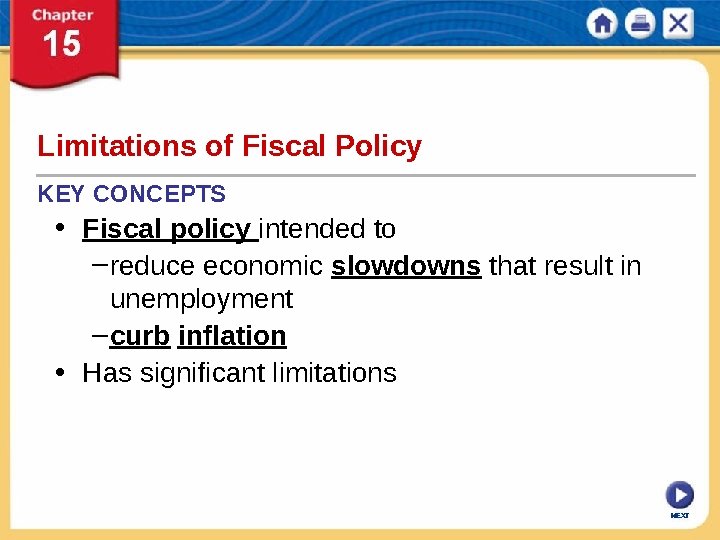
Limitations of Fiscal Policy KEY CONCEPTS • Fiscal policy intended to – reduce economic slowdowns that result in unemployment – curb inflation • Has significant limitations NEXT
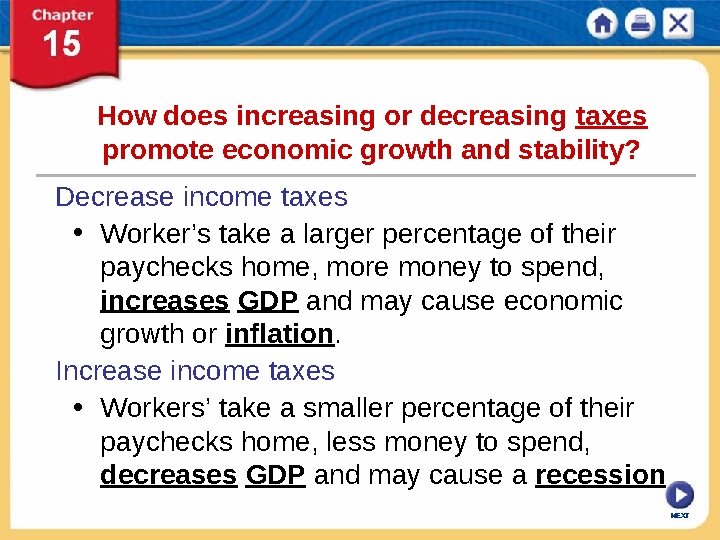
How does increasing or decreasing taxes promote economic growth and stability? Decrease income taxes • Worker’s take a larger percentage of their paychecks home, more money to spend, increases GDP and may cause economic growth or inflation. Increase income taxes • Workers’ take a smaller percentage of their paychecks home, less money to spend, decreases GDP and may cause a recession NEXT
How does the government get money to spend on the American people? Taxes National defense, public education, highway construction, police, fire protection, garbage collection, public facilities, and any welfare programs. More government spending on programs, there will be an increase on taxes! NEXT
Show What You Know! Georgia Milestone Questions What are the two basic tools that the federal government uses to influence the economy? Entitlements and spending Entitlements and wages Taxing and spending Taxation and wages NEXT
Show What You Know! Georgia Milestone Questions How does an aggregate demand graph show the results of expansionary fiscal policy? Aggregate demand curve shifts to the left Aggregate demand curve shifts to the right Aggregate demand curve shifts vertical None of these NEXT
Show What You Know! Georgia Milestone Questions Assume an economy is having high unemployment and low GDP. Which fiscal policy would be most appropriate to correct this situation? Increase the discount rate Decrease government spending Decrease taxes Increase the reserve requirement NEXT
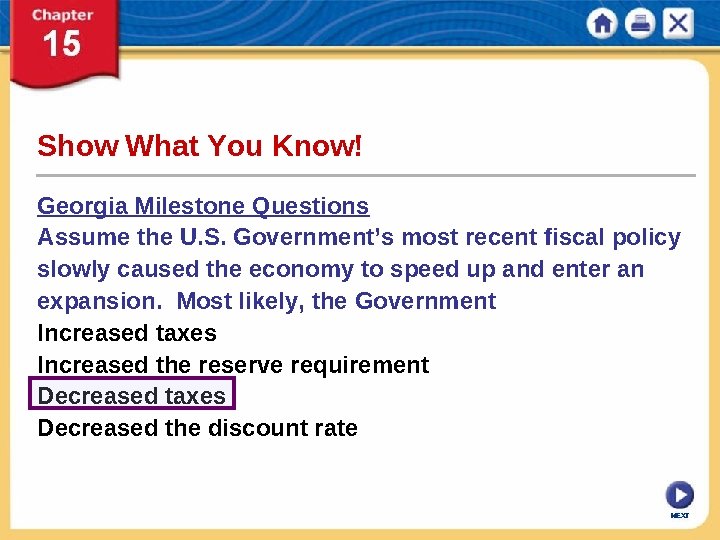
Show What You Know! Georgia Milestone Questions Assume the U. S. Government’s most recent fiscal policy slowly caused the economy to speed up and enter an expansion. Most likely, the Government Increased taxes Increased the reserve requirement Decreased taxes Decreased the discount rate NEXT
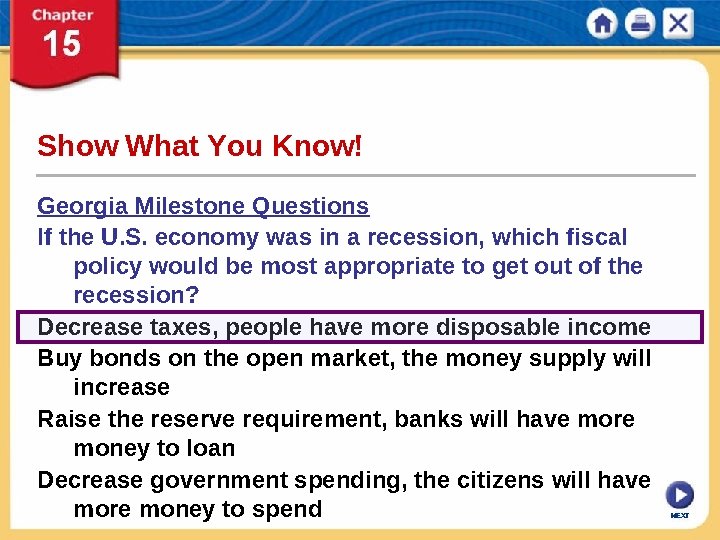
Show What You Know! Georgia Milestone Questions If the U. S. economy was in a recession, which fiscal policy would be most appropriate to get out of the recession? Decrease taxes, people have more disposable income Buy bonds on the open market, the money supply will increase Raise the reserve requirement, banks will have more money to loan Decrease government spending, the citizens will have more money to spend NEXT
The End Any Questions? Any Concerns? Any Comments? NEXT
Warm Up #32 On the projector daily transparencies TT 52. Deficits and the National Debt. NEXT
Class Confession We the Senior Class of 2016 will complete ALL of our assignments to best of our abilities and behave appropriately in class. We will respect all faculty, staff, substitutes, classmates, and especially Mr. Wilcox. We will graduate on time May 20, 2016 and become productive citizens in society. NEXT
SSEMA 1 f The student will be able to describe the difference between the national debt and government deficits. Determine and define vocabulary. Identify key terms within the standard. Define each term. ________________________________________ ________________________________________ NEXT
Scaffold understanding of the standard(s) and/or element(s). Paraphrase the standard(s) and/or element(s). Rewrite the standard including synonyms or brief definitions in parentheses and in a different color following the key terms found in step 1. Describe (Label) the difference between he national debt (obligation) and government deficits(shortfalls). NEXT
Using Fiscal Policy Deficits and the National Debt SSEMA 3 Explain how government budget deficits or surpluses impact national debt. NEXT
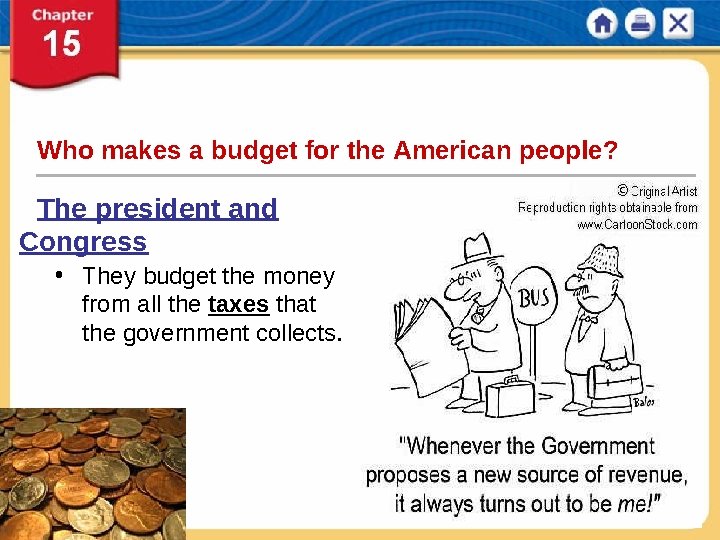
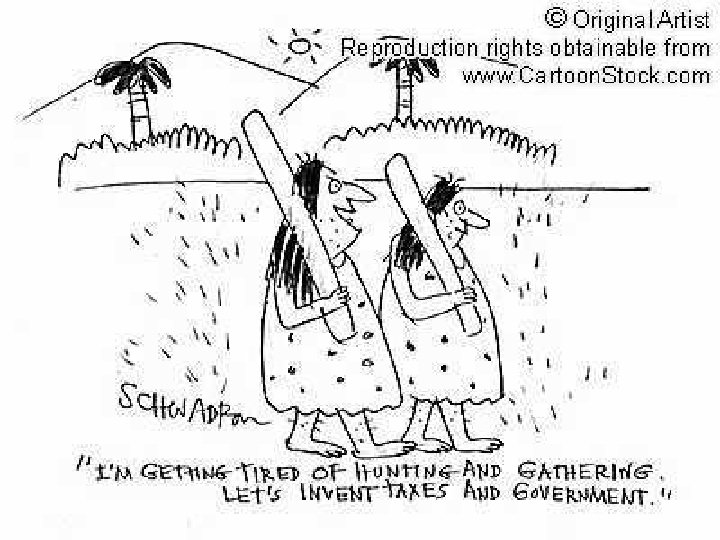
Who makes a budget for the American people? The president and Congress • They budget the money from all the taxes that the government collects. NEXT
Deficits and the National Debt The Federal Deficit and Debt KEY CONCEPTS • All levels of government struggle to achieve balanced budget: – Budget surplus occurs when government takes in more than it spends – Budget deficit occurs when government spends more than it takes in – Deficit spending—spending more than revenues for a specific budgeted year – National debt—the total amount of money the government owes NEXT
Think Pair Share What happens if the government collects more than it spends? Budget Surplus • The government collects more than it spends. NEXT
Budget Deficit When the government spends more than it collects. The government borrows money and adds to the National Debt. NEXT
NEXT
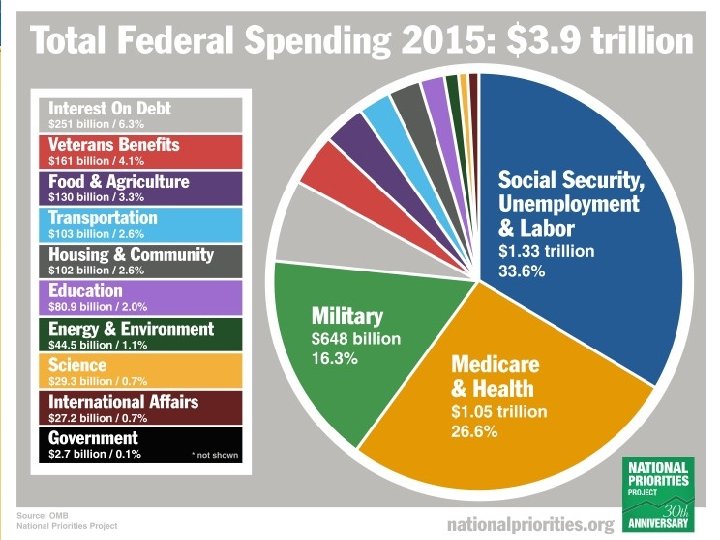
The Federal Deficit and Debt Four main reasons for deficit spending: — 1. National emergencies usually require massive spending beyond normal budget — 2. Building public goods and services is expensive, work takes years — 3. Public projects to stimulate, stabilize weak economy need large sums — 4. Entitlement programs that people depend on are expensive NEXT
NEXT
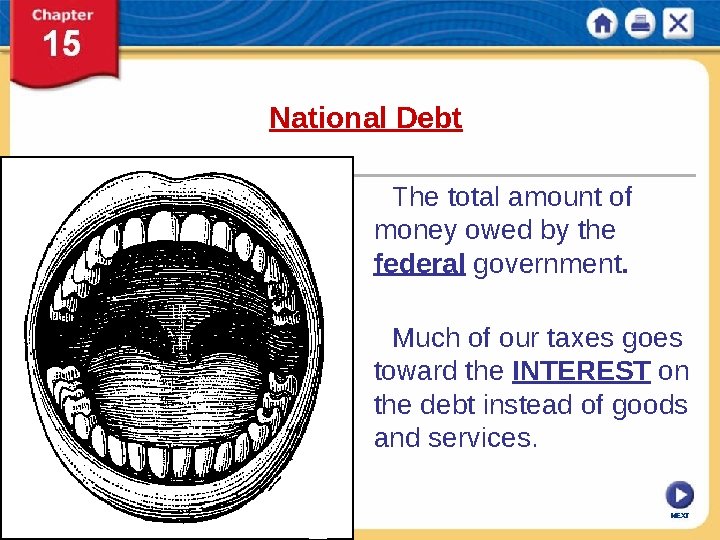
National Debt The total amount of money owed by the federal government. Much of our taxes goes toward the INTEREST on the debt instead of goods and services. NEXT
NEXT
The National Debt KEY CONCEPTS • Government owes bond holders the amount of the bond plus interest • Also borrows from government trust funds—money held for specific future purpose – trust fund surpluses invested in bonds until programs need the funds – some economists do not think moving funds within government is debt – no burden to current economy because current budget does not pay for it NEXT
The National Debt The Effect of the Debt on the Economy • If government spending stimulates economy, jobs and public goods are created • If government outbids private sector, pays higher bond interest rates – crowding-out effect—money leaves private sector, interest rates rise • Constant borrowing increases total interest and taxes to service debt – higher taxes decrease consumer spending and business investment NEXT
Closure Activity #28 Setting Sights on the Deficit p. 469 Thinking Economically. 1. How does the Bush administration plan to cut the deficit by half in three years? 2. What other steps might it take to control the deficit? NEXT
Show What You Know! Georgia Milestone Questions If the government spends more than it takes in, what is that called? Balanced budget Budget deficit Budget surplus Discretionary budget NEXT
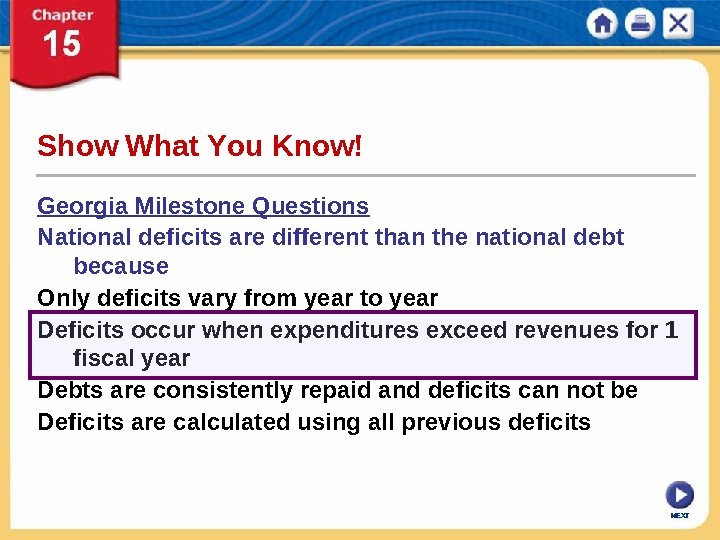
Show What You Know! Georgia Milestone Questions National deficits are different than the national debt because Only deficits vary from year to year Deficits occur when expenditures exceed revenues for 1 fiscal year Debts are consistently repaid and deficits can not be Deficits are calculated using all previous deficits NEXT
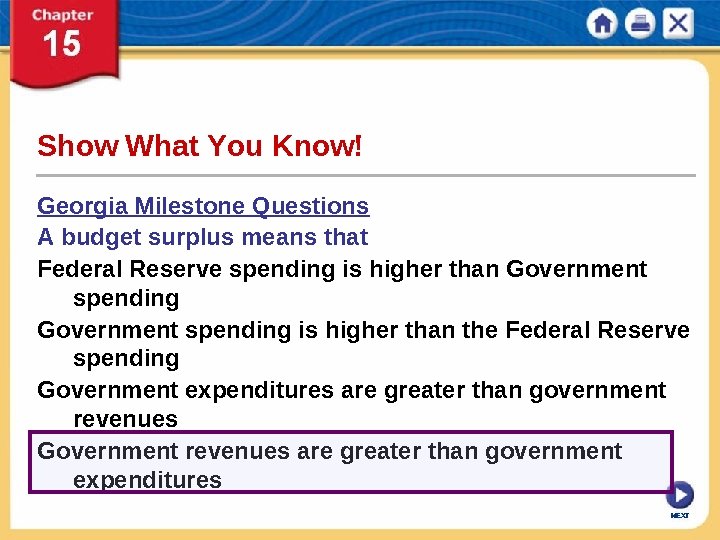
Show What You Know! Georgia Milestone Questions A budget surplus means that Federal Reserve spending is higher than Government spending is higher than the Federal Reserve spending Government expenditures are greater than government revenues Government revenues are greater than government expenditures NEXT
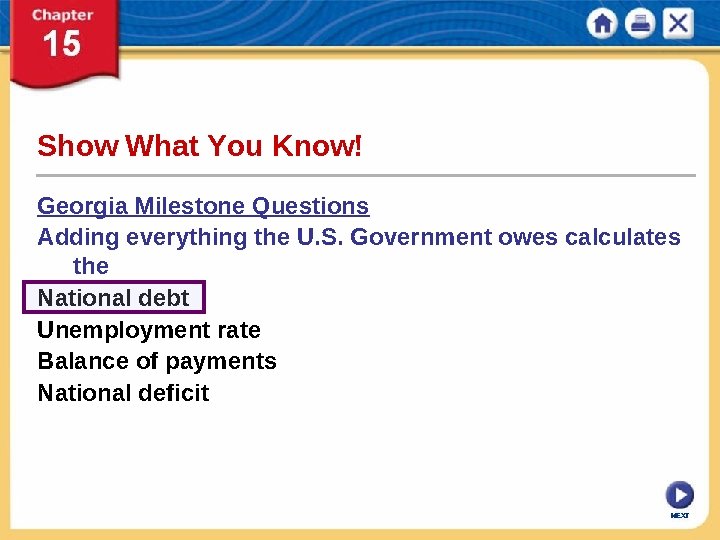
Show What You Know! Georgia Milestone Questions Adding everything the U. S. Government owes calculates the National debt Unemployment rate Balance of payments National deficit NEXT
The End. Any Questions? Any Concerns? Any Comments? NEXT
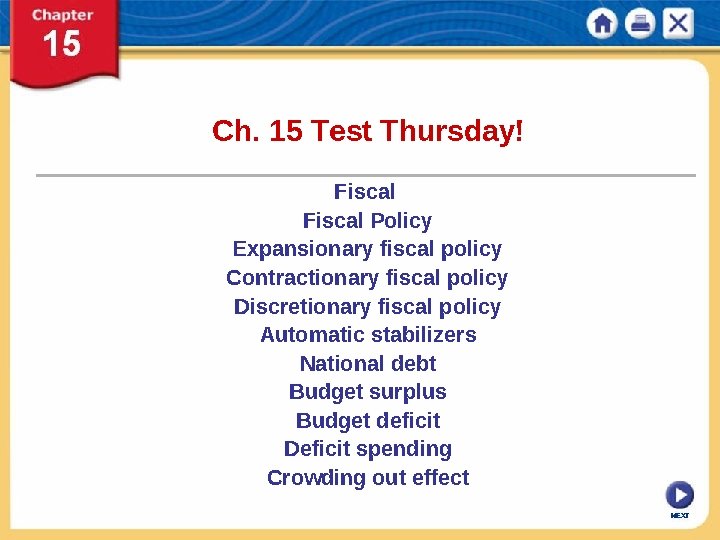
Ch. 15 Test Thursday! Fiscal Policy Expansionary fiscal policy Contractionary fiscal policy Discretionary fiscal policy Automatic stabilizers National debt Budget surplus Budget deficit Deficit spending Crowding out effect NEXT