
Warm Up 3 How does the kinetic energy



- Slides: 10
Warm Up #3 �How does the kinetic energy and number collisions relate to the temperature? With this logic, how could someone die from hypothermia (being in cold temperatures too long)? � 230 k. Pa = ____ atm? … _____ mm. Hg? �How does pressure relate to elevation? Why does this relationship exist? �Name two phase changes (going from one state of matter to another), and describe this phase change.
Chapter 13. 2 PROPERTIES OF LIQUIDS PHASE CHANGES
Review: Gasses �Kinetic Theory – all matter in constant motion Except absolute zero (0 K) �Pressure: # collisions/unit volume mm. Hg, atm, k. Pa Temp. = DIRECT relationship Elevation = INDIRECT relationship
Liquids �Liquids – take shape of container, definite volume �More dense than gas More attractive forces at work �Liquids = condensed Difficult to compress
Liquids and Pressure…a straw �Gases/Liquids prefer moving from HIGH to LOW pressure �Sucking action = DECREASES pressure INSIDE straw/mouth �Pressure of water draws liquid UP straw into mouth To a point (20 meters)
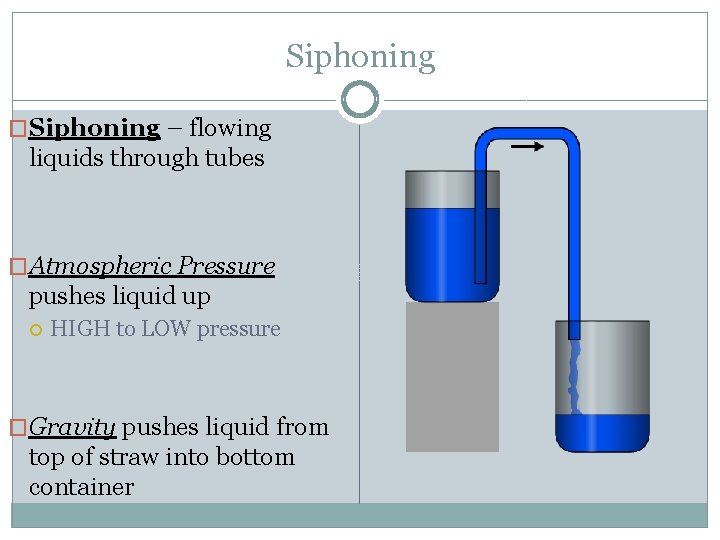
Siphoning �Siphoning – flowing liquids through tubes �Atmospheric Pressure pushes liquid up HIGH to LOW pressure �Gravity pushes liquid from top of straw into bottom container
Phase Change: Vaporization/Evaporation �Vaporization – liquid to a gas/vapor �Evaporation – occurs on surface of liquid not boiling �MINIMUM kinetic energy required to become gas Lower than that = liquid �Evaporation = a cooling process!
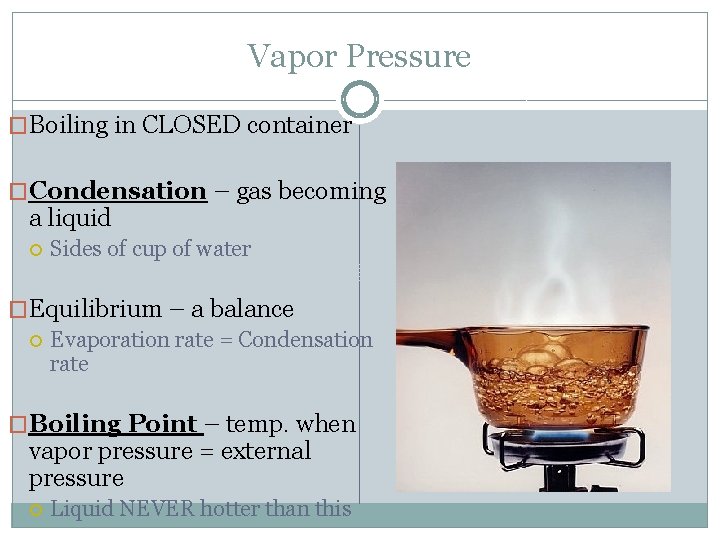
Vapor Pressure �Boiling in CLOSED container �Condensation – gas becoming a liquid Sides of cup of water �Equilibrium – a balance Evaporation rate = Condensation rate �Boiling Point – temp. when vapor pressure = external pressure Liquid NEVER hotter than this
Boiling Point and Elevation �B. P. when vapor pressure = external pressure Normal boiling point = when pressure = 101. 3 k. Pa �As elevation increases, pressure decreases Inverse proportion SO �As elevation increases, boiling point decreases
Quick Quiz #2 �How does the kinetic energy influence the state of matter something will be in? Why are liquids not really compressible? �Review: you transfer water from one container, to another container at the same temperature. How will that effect the kinetic energy of the water? Why? �Why will the boiling point lower as elevation increases?