
Warm Up 1 Determine whether each situation involves

- Slides: 10
Warm Up 1. Determine whether each situation involves permutations or combinations • Arrangement of 10 books on a shelf permutation • Selection of a committee of 3 from 10 people combination • A hand of 6 cards from a deck of 52 cards • Arrangement of 8 people around a circular table • A subset of 12 elements contained in a set of 26 combination permutation combination • A guest list of 3 friends that your family has said you can invite to dinner combination 2. Solve each problem (set up…if you can simplify…you’re great!) • How many ways can 3 books be placed on a shelf if chosen from a selection of 7 different books? • How many tennis teams of 6 players can be formed from 14 players without regard to position played?
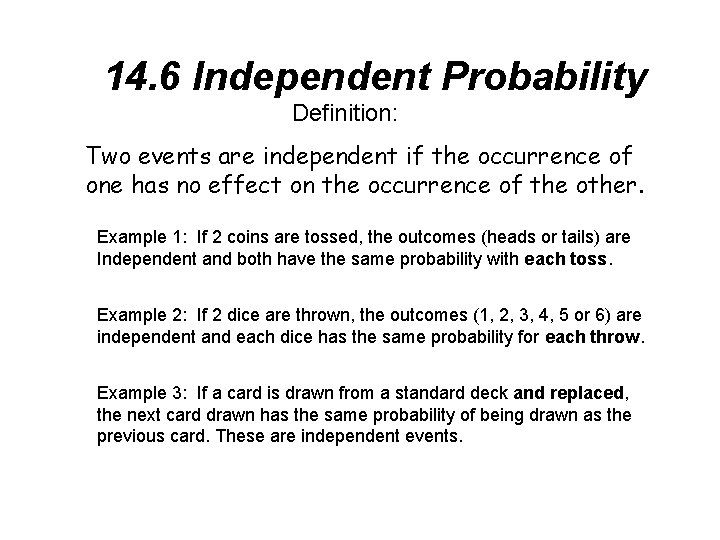
14. 6 Independent Probability Definition: Two events are independent if the occurrence of one has no effect on the occurrence of the other. Example 1: If 2 coins are tossed, the outcomes (heads or tails) are Independent and both have the same probability with each toss. Example 2: If 2 dice are thrown, the outcomes (1, 2, 3, 4, 5 or 6) are independent and each dice has the same probability for each throw. Example 3: If a card is drawn from a standard deck and replaced, the next card drawn has the same probability of being drawn as the previous card. These are independent events.
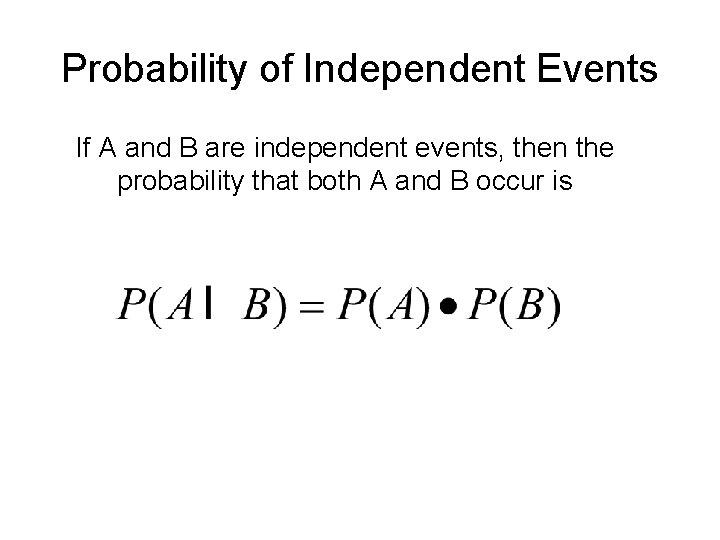
Probability of Independent Events If A and B are independent events, then the probability that both A and B occur is
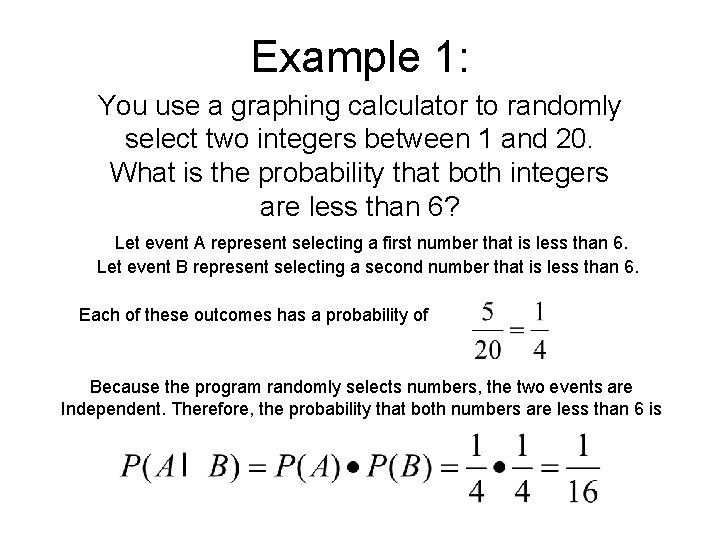
Example 1: You use a graphing calculator to randomly select two integers between 1 and 20. What is the probability that both integers are less than 6? Let event A represent selecting a first number that is less than 6. Let event B represent selecting a second number that is less than 6. Each of these outcomes has a probability of Because the program randomly selects numbers, the two events are Independent. Therefore, the probability that both numbers are less than 6 is
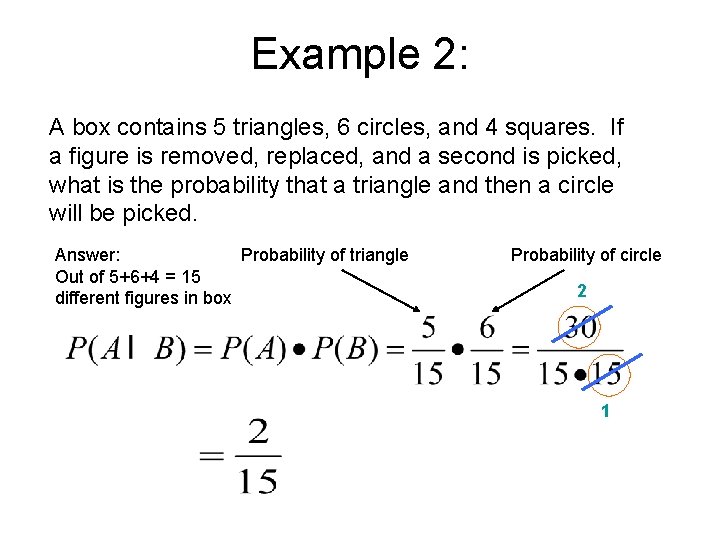
Example 2: A box contains 5 triangles, 6 circles, and 4 squares. If a figure is removed, replaced, and a second is picked, what is the probability that a triangle and then a circle will be picked. Answer: Probability of triangle Out of 5+6+4 = 15 different figures in box Probability of circle 2 1
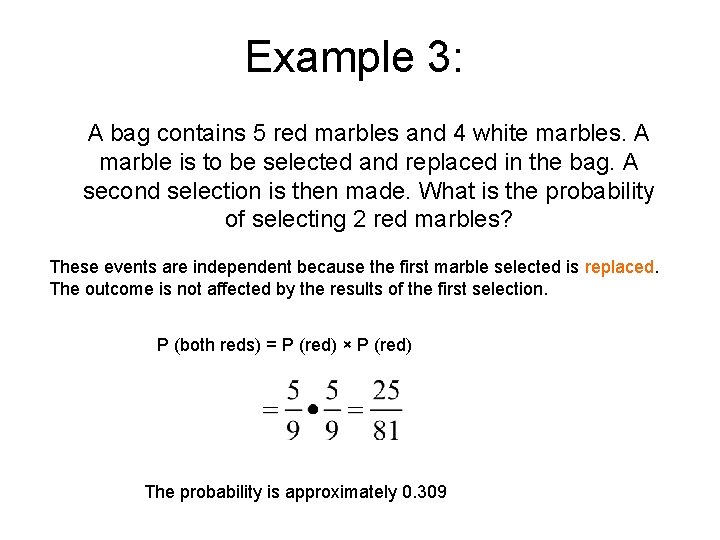
Example 3: A bag contains 5 red marbles and 4 white marbles. A marble is to be selected and replaced in the bag. A second selection is then made. What is the probability of selecting 2 red marbles? These events are independent because the first marble selected is replaced. The outcome is not affected by the results of the first selection. P (both reds) = P (red) × P (red) The probability is approximately 0. 309
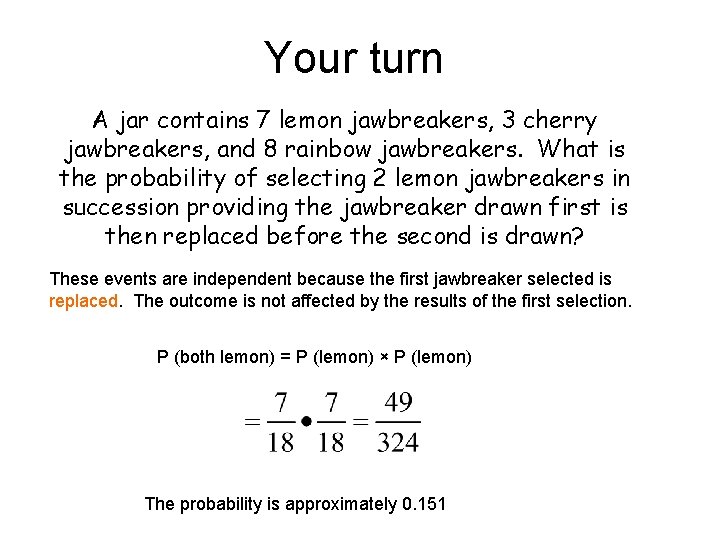
Your turn A jar contains 7 lemon jawbreakers, 3 cherry jawbreakers, and 8 rainbow jawbreakers. What is the probability of selecting 2 lemon jawbreakers in succession providing the jawbreaker drawn first is then replaced before the second is drawn? These events are independent because the first jawbreaker selected is replaced. The outcome is not affected by the results of the first selection. P (both lemon) = P (lemon) × P (lemon) The probability is approximately 0. 151
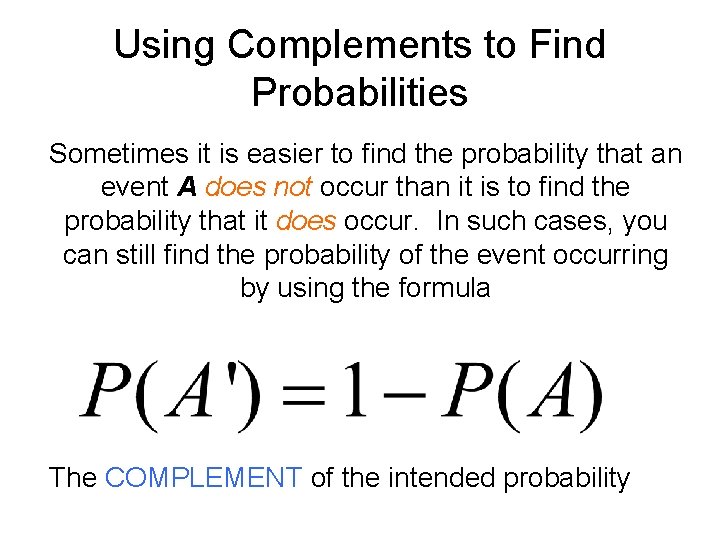
Using Complements to Find Probabilities Sometimes it is easier to find the probability that an event A does not occur than it is to find the probability that it does occur. In such cases, you can still find the probability of the event occurring by using the formula The COMPLEMENT of the intended probability
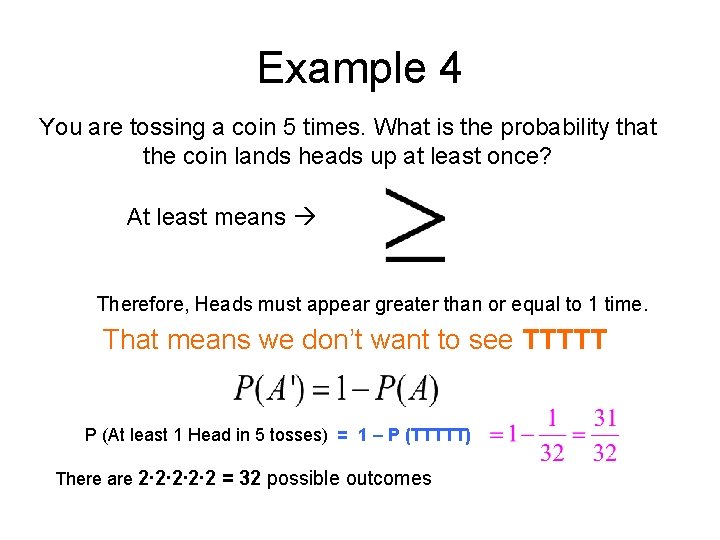
Example 4 You are tossing a coin 5 times. What is the probability that the coin lands heads up at least once? At least means Therefore, Heads must appear greater than or equal to 1 time. That means we don’t want to see TTTTT P (At least 1 Head in 5 tosses) = 1 – P (TTTTT) There are 2∙ 2∙ 2 = 32 possible outcomes
In Summary… • Give an example of an independent event and how to calculate the probability. • Worksheet 14. 6