
Warfare Coalitional Aggression Evolutionary Perspective on Development and

- Slides: 23
Warfare: Coalitional Aggression Evolutionary Perspective on Development and Prejudice Evolutionary Psychology Spring 2021 Dr Chapman 1
Definition of War Merriam-Webster o o o War as coalitional aggression / killing o o o (1)a state of usually open and declared armed hostile conflict between states or nations (2)a period of such armed conflict problematic because most hostile interactions between groups are based on revenge, fights over mates, reputation that are spread out over many years "events in which coalitions of members of a group seek to inflict bodily harm on one or more members of another group" (Bowles, 2009, p. 1294) requires a coalition and aggression toward an outgroup wolves, nonhuman primates, hunter gatherers and modern humans Examples of fission-fusion social systems o o o Chimpanzees form male coalitions to defend territory, Muller and Mitani (2005) Other primates such as Baboons or spider monkeys have intergroup fighting Some other mammals such as wolves have inter-pack fighting to defend territory 2
Warfare Were ancestral humans largely “peaceful” or “warlike” ? o Confused with the potential that human societies have for cooperation (which is mostly in-group altruism) There are some well documented peaceful societies o o They have a set of common characteristics that influence levels of violence However, most of these societies have some competition, aggression and even violence under specific situations see; "Constant Battles" Le. Blanc, Steven A. with Katherine E. Register (2003) New York: St. Martin's Griffin. see: "Did Warfare Among Ancestral Hunter-Gatherers Affect the Evolution of Human Social Behaviors? “Bowles (2009) Evidence from late Pleistocene to early Holocene period (120, 000 to 10, 000 years ago) from 23 hunting gathering societies see Fig 1 and Table 2 3
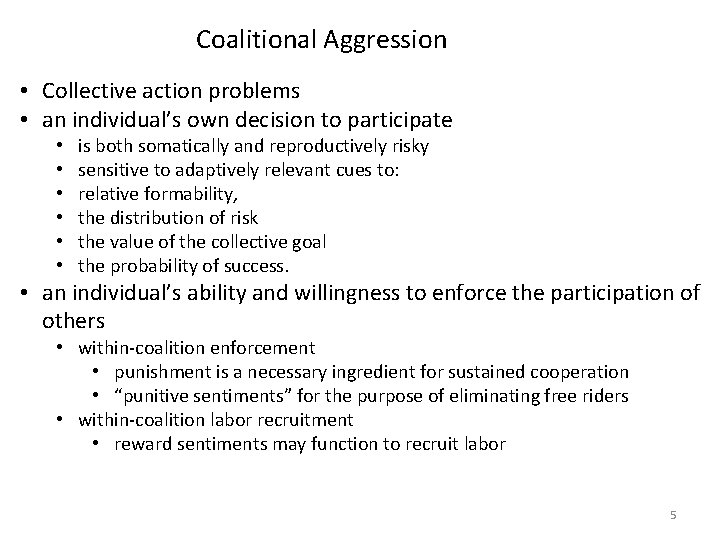
Coalitional Aggression • Two forms of coalitional aggression • Offensive aggression: taking territory or goods • with benefits which asymmetrically accrue to the participants rather than the group as a whole because participants easily privatize the benefits • reward sentiment toward participants will be triggered by one’s willingness to participate • Defensive aggression: holding territory or resources • an out-group initiates aggression • The preexisting bonds of hunter-gatherer bands facilitate a quick defensive response • Punitive sentiment triggered by willingness to participate in defense 4
Coalitional Aggression • Collective action problems • an individual’s own decision to participate • • • is both somatically and reproductively risky sensitive to adaptively relevant cues to: relative formability, the distribution of risk the value of the collective goal the probability of success. • an individual’s ability and willingness to enforce the participation of others • within-coalition enforcement • punishment is a necessary ingredient for sustained cooperation • “punitive sentiments” for the purpose of eliminating free riders • within-coalition labor recruitment • reward sentiments may function to recruit labor 5
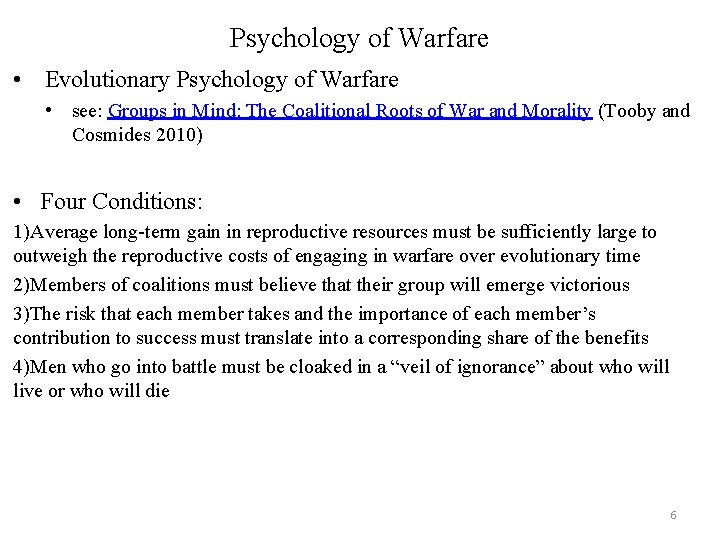
Psychology of Warfare • Evolutionary Psychology of Warfare • see: Groups in Mind: The Coalitional Roots of War and Morality (Tooby and Cosmides 2010) • Four Conditions: 1)Average long-term gain in reproductive resources must be sufficiently large to outweigh the reproductive costs of engaging in warfare over evolutionary time 2)Members of coalitions must believe that their group will emerge victorious 3)The risk that each member takes and the importance of each member’s contribution to success must translate into a corresponding share of the benefits 4)Men who go into battle must be cloaked in a “veil of ignorance” about who will live or who will die 6
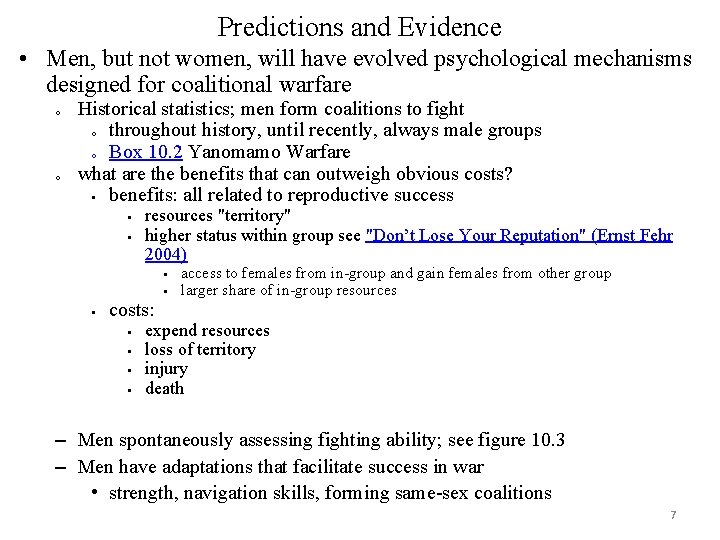
Predictions and Evidence • Men, but not women, will have evolved psychological mechanisms designed for coalitional warfare o o Historical statistics; men form coalitions to fight o throughout history, until recently, always male groups o Box 10. 2 Yanomamo Warfare what are the benefits that can outweigh obvious costs? benefits: all related to reproductive success resources "territory" higher status within group see "Don’t Lose Your Reputation" (Ernst Fehr 2004) costs: access to females from in-group and gain females from other group larger share of in-group resources expend resources loss of territory injury death – Men spontaneously assessing fighting ability; see figure 10. 3 – Men have adaptations that facilitate success in war • strength, navigation skills, forming same-sex coalitions 7
8
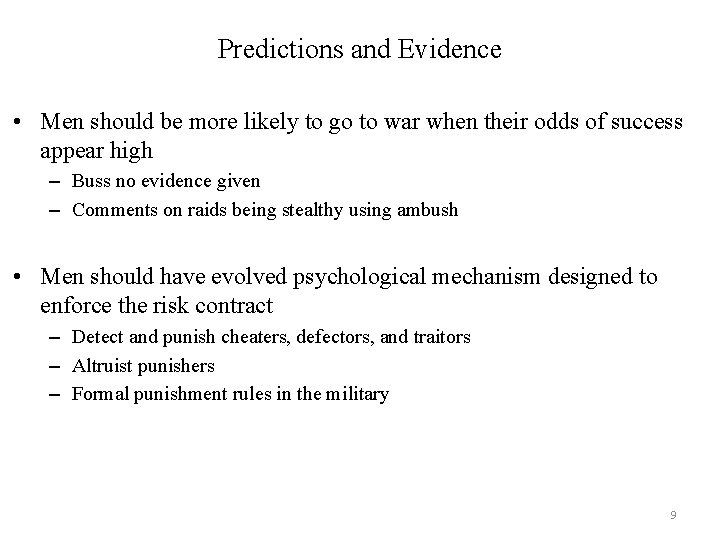
Predictions and Evidence • Men should be more likely to go to war when their odds of success appear high – Buss no evidence given – Comments on raids being stealthy using ambush • Men should have evolved psychological mechanism designed to enforce the risk contract – Detect and punish cheaters, defectors, and traitors – Altruist punishers – Formal punishment rules in the military 9
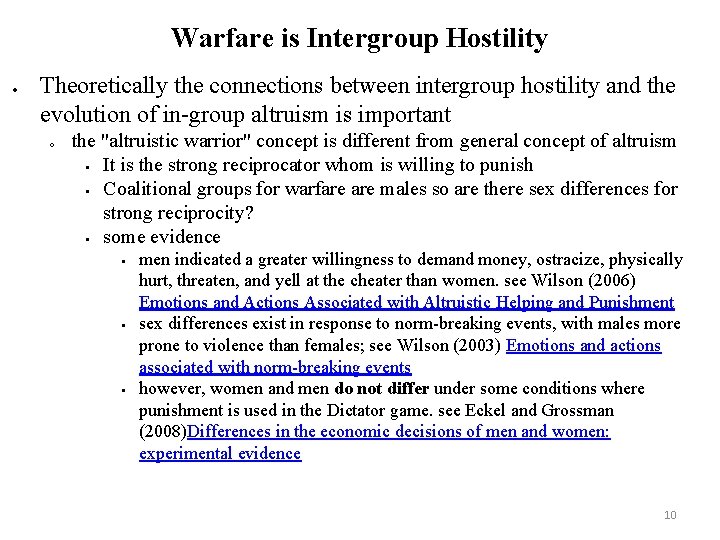
Warfare is Intergroup Hostility Theoretically the connections between intergroup hostility and the evolution of in-group altruism is important o the "altruistic warrior" concept is different from general concept of altruism It is the strong reciprocator whom is willing to punish Coalitional groups for warfare males so are there sex differences for strong reciprocity? some evidence men indicated a greater willingness to demand money, ostracize, physically hurt, threaten, and yell at the cheater than women. see Wilson (2006) Emotions and Actions Associated with Altruistic Helping and Punishment sex differences exist in response to norm-breaking events, with males more prone to violence than females; see Wilson (2003) Emotions and actions associated with norm-breaking events however, women and men do not differ under some conditions where punishment is used in the Dictator game. see Eckel and Grossman (2008)Differences in the economic decisions of men and women: experimental evidence 10
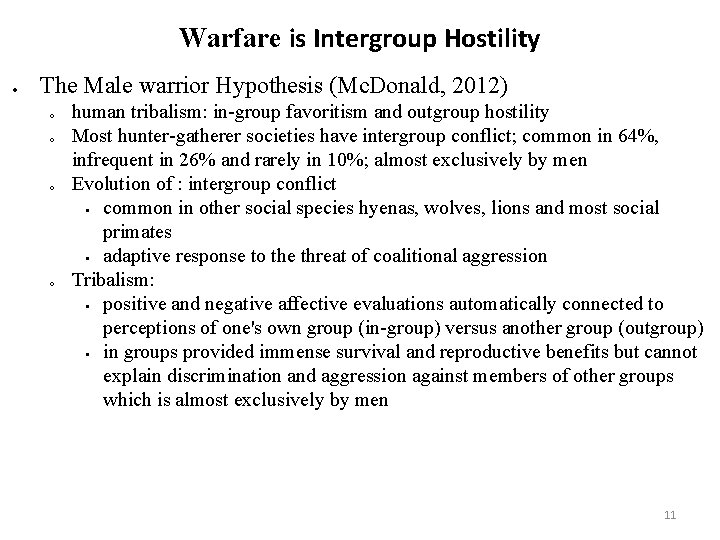
Warfare is Intergroup Hostility The Male warrior Hypothesis (Mc. Donald, 2012) o o human tribalism: in-group favoritism and outgroup hostility Most hunter-gatherer societies have intergroup conflict; common in 64%, infrequent in 26% and rarely in 10%; almost exclusively by men Evolution of : intergroup conflict common in other social species hyenas, wolves, lions and most social primates adaptive response to the threat of coalitional aggression Tribalism: positive and negative affective evaluations automatically connected to perceptions of one's own group (in-group) versus another group (outgroup) in groups provided immense survival and reproductive benefits but cannot explain discrimination and aggression against members of other groups which is almost exclusively by men 11
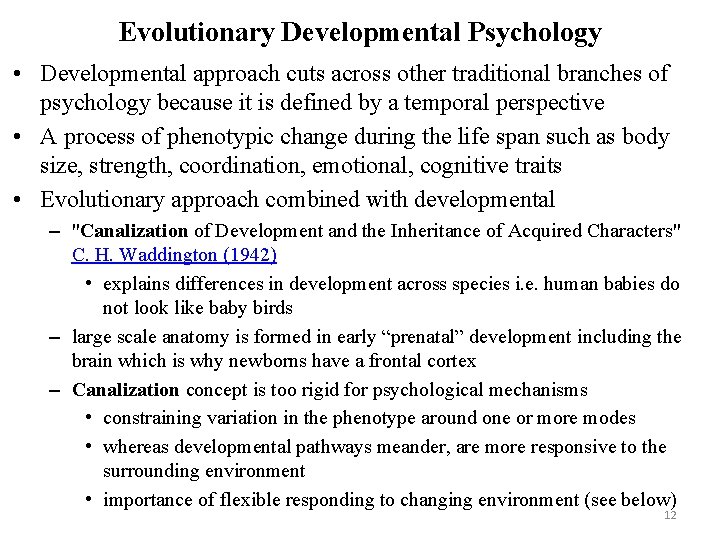
Evolutionary Developmental Psychology • Developmental approach cuts across other traditional branches of psychology because it is defined by a temporal perspective • A process of phenotypic change during the life span such as body size, strength, coordination, emotional, cognitive traits • Evolutionary approach combined with developmental – "Canalization of Development and the Inheritance of Acquired Characters" C. H. Waddington (1942) • explains differences in development across species i. e. human babies do not look like baby birds – large scale anatomy is formed in early “prenatal” development including the brain which is why newborns have a frontal cortex – Canalization concept is too rigid for psychological mechanisms • constraining variation in the phenotype around one or more modes • whereas developmental pathways meander, are more responsive to the surrounding environment • importance of flexible responding to changing environment (see below) 12
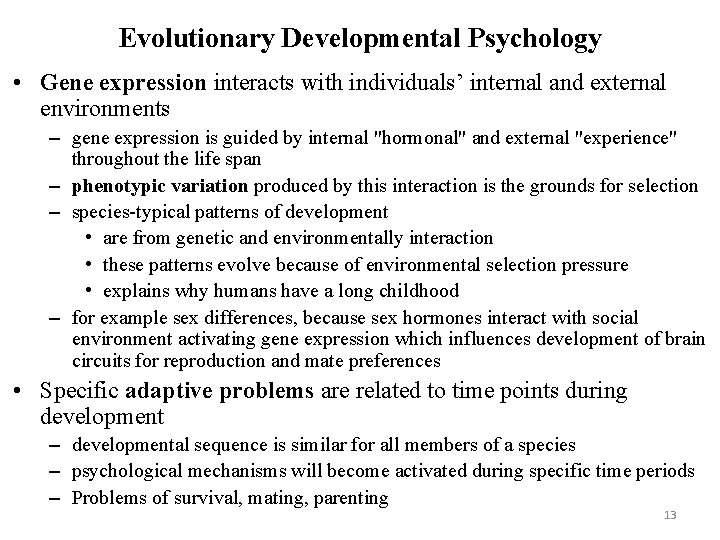
Evolutionary Developmental Psychology • Gene expression interacts with individuals’ internal and external environments – gene expression is guided by internal "hormonal" and external "experience" throughout the life span – phenotypic variation produced by this interaction is the grounds for selection – species-typical patterns of development • are from genetic and environmentally interaction • these patterns evolve because of environmental selection pressure • explains why humans have a long childhood – for example sex differences, because sex hormones interact with social environment activating gene expression which influences development of brain circuits for reproduction and mate preferences • Specific adaptive problems are related to time points during development – developmental sequence is similar for all members of a species – psychological mechanisms will become activated during specific time periods – Problems of survival, mating, parenting 13
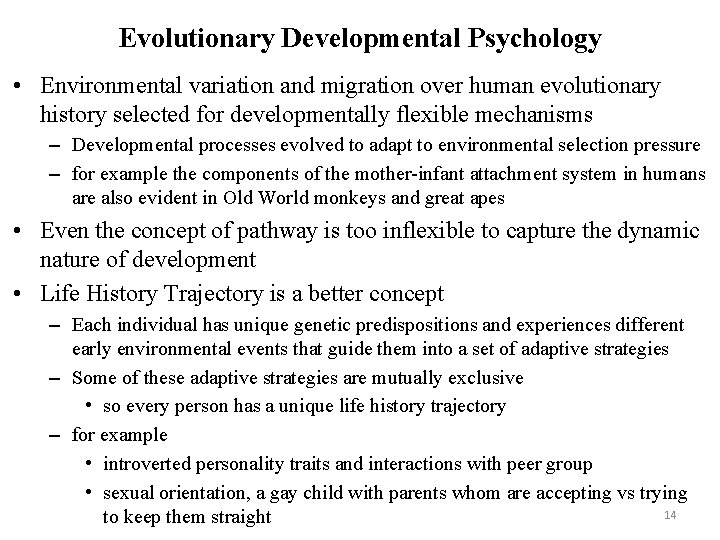
Evolutionary Developmental Psychology • Environmental variation and migration over human evolutionary history selected for developmentally flexible mechanisms – Developmental processes evolved to adapt to environmental selection pressure – for example the components of the mother-infant attachment system in humans are also evident in Old World monkeys and great apes • Even the concept of pathway is too inflexible to capture the dynamic nature of development • Life History Trajectory is a better concept – Each individual has unique genetic predispositions and experiences different early environmental events that guide them into a set of adaptive strategies – Some of these adaptive strategies are mutually exclusive • so every person has a unique life history trajectory – for example • introverted personality traits and interactions with peer group • sexual orientation, a gay child with parents whom are accepting vs trying 14 to keep them straight
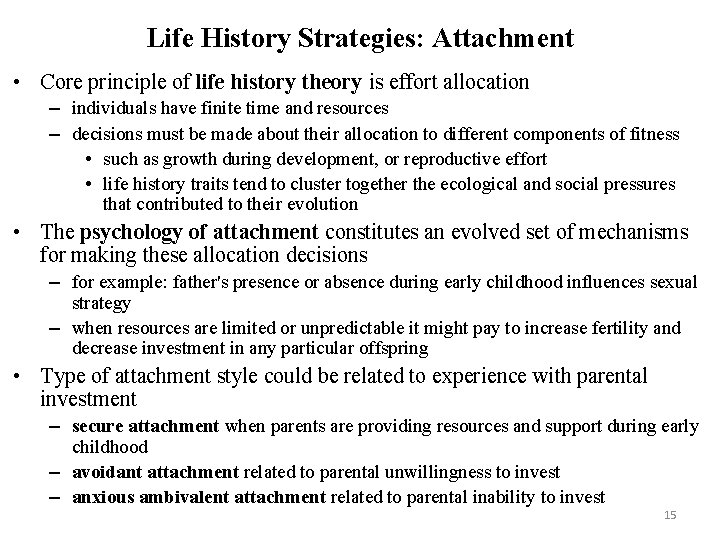
Life History Strategies: Attachment • Core principle of life history theory is effort allocation – individuals have finite time and resources – decisions must be made about their allocation to different components of fitness • such as growth during development, or reproductive effort • life history traits tend to cluster together the ecological and social pressures that contributed to their evolution • The psychology of attachment constitutes an evolved set of mechanisms for making these allocation decisions – for example: father's presence or absence during early childhood influences sexual strategy – when resources are limited or unpredictable it might pay to increase fertility and decrease investment in any particular offspring • Type of attachment style could be related to experience with parental investment – secure attachment when parents are providing resources and support during early childhood – avoidant attachment related to parental unwillingness to invest – anxious ambivalent attachment related to parental inability to invest 15
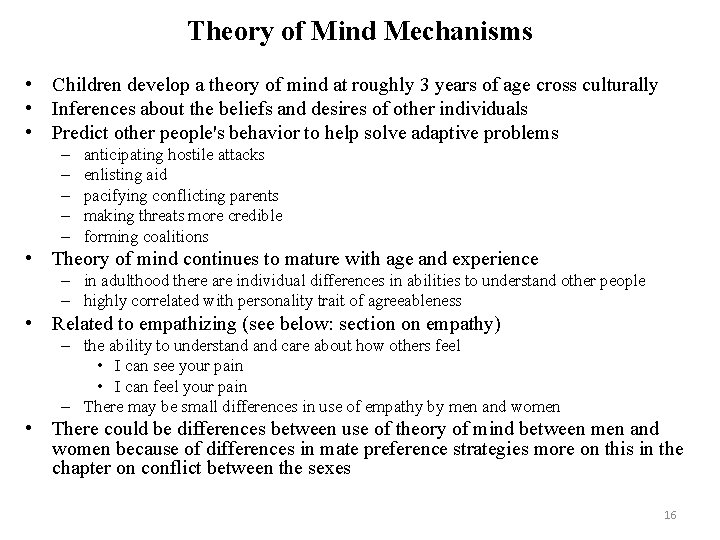
Theory of Mind Mechanisms • Children develop a theory of mind at roughly 3 years of age cross culturally • Inferences about the beliefs and desires of other individuals • Predict other people's behavior to help solve adaptive problems – – – anticipating hostile attacks enlisting aid pacifying conflicting parents making threats more credible forming coalitions • Theory of mind continues to mature with age and experience – in adulthood there are individual differences in abilities to understand other people – highly correlated with personality trait of agreeableness • Related to empathizing (see below: section on empathy) – the ability to understand care about how others feel • I can see your pain • I can feel your pain – There may be small differences in use of empathy by men and women • There could be differences between use of theory of mind between men and women because of differences in mate preference strategies more on this in the chapter on conflict between the sexes 16
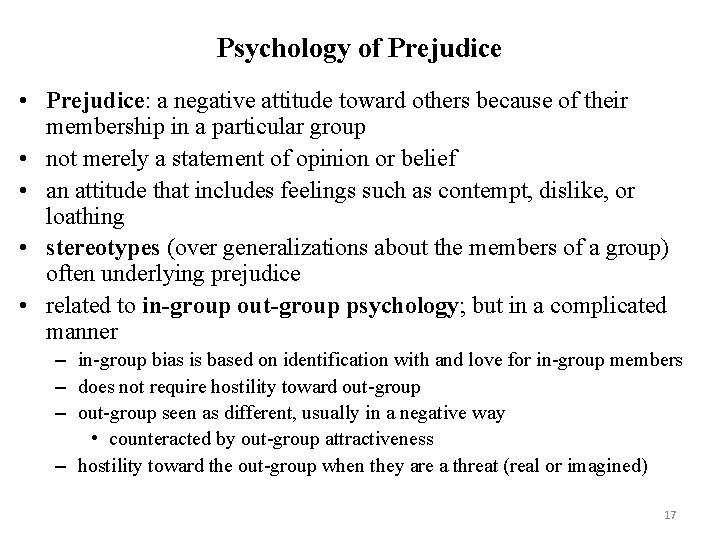
Psychology of Prejudice • Prejudice: a negative attitude toward others because of their membership in a particular group • not merely a statement of opinion or belief • an attitude that includes feelings such as contempt, dislike, or loathing • stereotypes (over generalizations about the members of a group) often underlying prejudice • related to in-group out-group psychology; but in a complicated manner – in-group bias is based on identification with and love for in-group members – does not require hostility toward out-group – out-group seen as different, usually in a negative way • counteracted by out-group attractiveness – hostility toward the out-group when they are a threat (real or imagined) 17
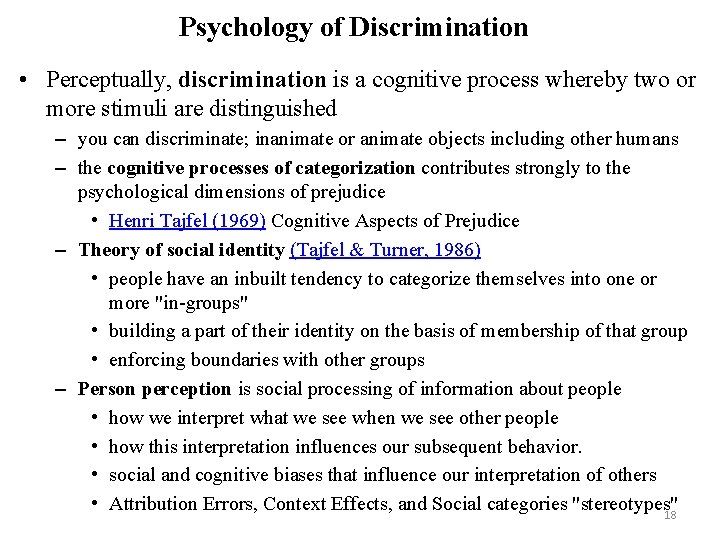
Psychology of Discrimination • Perceptually, discrimination is a cognitive process whereby two or more stimuli are distinguished – you can discriminate; inanimate or animate objects including other humans – the cognitive processes of categorization contributes strongly to the psychological dimensions of prejudice • Henri Tajfel (1969) Cognitive Aspects of Prejudice – Theory of social identity (Tajfel & Turner, 1986) • people have an inbuilt tendency to categorize themselves into one or more "in-groups" • building a part of their identity on the basis of membership of that group • enforcing boundaries with other groups – Person perception is social processing of information about people • how we interpret what we see when we see other people • how this interpretation influences our subsequent behavior. • social and cognitive biases that influence our interpretation of others • Attribution Errors, Context Effects, and Social categories "stereotypes" 18
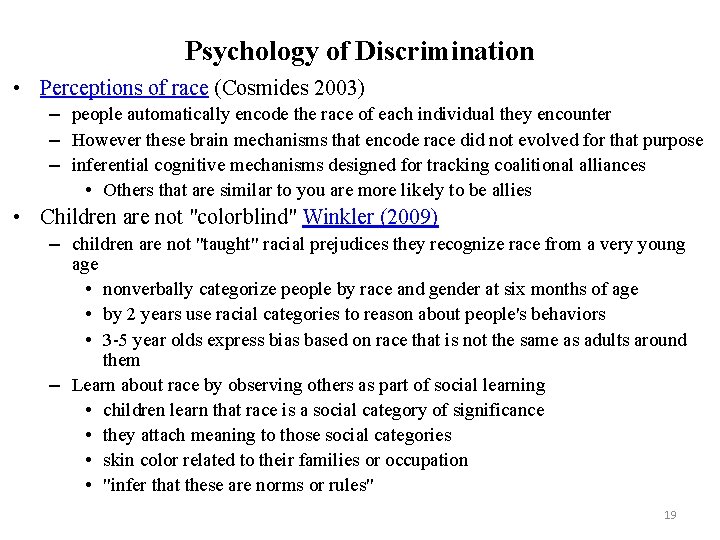
Psychology of Discrimination • Perceptions of race (Cosmides 2003) – people automatically encode the race of each individual they encounter – However these brain mechanisms that encode race did not evolved for that purpose – inferential cognitive mechanisms designed for tracking coalitional alliances • Others that are similar to you are more likely to be allies • Children are not "colorblind" Winkler (2009) – children are not "taught" racial prejudices they recognize race from a very young age • nonverbally categorize people by race and gender at six months of age • by 2 years use racial categories to reason about people's behaviors • 3 -5 year olds express bias based on race that is not the same as adults around them – Learn about race by observing others as part of social learning • children learn that race is a social category of significance • they attach meaning to those social categories • skin color related to their families or occupation • "infer that these are norms or rules" 19
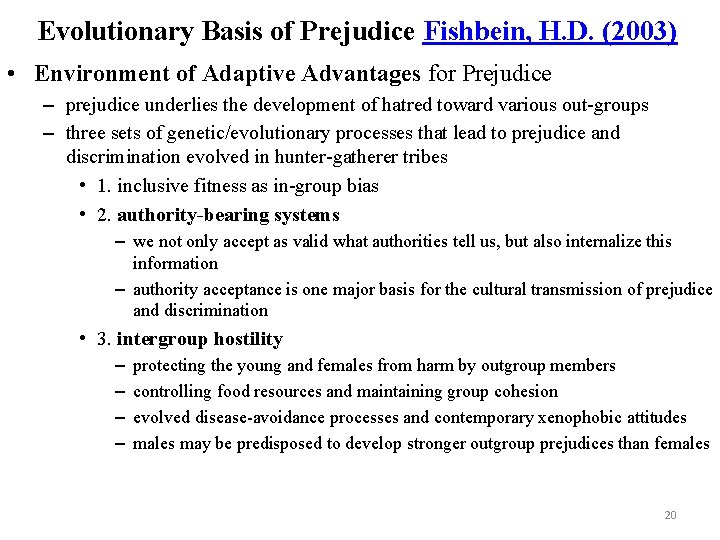
Evolutionary Basis of Prejudice Fishbein, H. D. (2003) • Environment of Adaptive Advantages for Prejudice – prejudice underlies the development of hatred toward various out-groups – three sets of genetic/evolutionary processes that lead to prejudice and discrimination evolved in hunter-gatherer tribes • 1. inclusive fitness as in-group bias • 2. authority-bearing systems – we not only accept as valid what authorities tell us, but also internalize this information – authority acceptance is one major basis for the cultural transmission of prejudice and discrimination • 3. intergroup hostility – – protecting the young and females from harm by outgroup members controlling food resources and maintaining group cohesion evolved disease-avoidance processes and contemporary xenophobic attitudes males may be predisposed to develop stronger outgroup prejudices than females 20
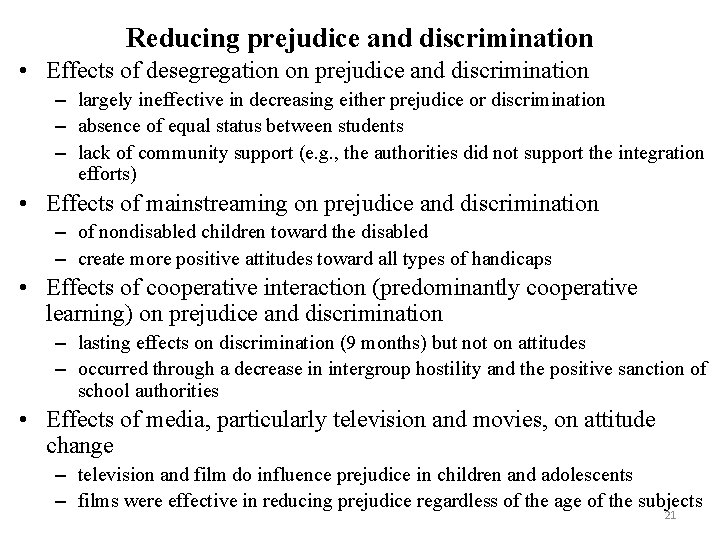
Reducing prejudice and discrimination • Effects of desegregation on prejudice and discrimination – largely ineffective in decreasing either prejudice or discrimination – absence of equal status between students – lack of community support (e. g. , the authorities did not support the integration efforts) • Effects of mainstreaming on prejudice and discrimination – of nondisabled children toward the disabled – create more positive attitudes toward all types of handicaps • Effects of cooperative interaction (predominantly cooperative learning) on prejudice and discrimination – lasting effects on discrimination (9 months) but not on attitudes – occurred through a decrease in intergroup hostility and the positive sanction of school authorities • Effects of media, particularly television and movies, on attitude change – television and film do influence prejudice in children and adolescents – films were effective in reducing prejudice regardless of the age of the subjects 21
Why is it difficult to overcome prejudicial thinking? • Much of the processing of information related to judgements for prejudice occur rapidly in what Kahneman refers to as system one. • This system requires little effort and does not process information deeply hence it is prone to cognitive bias such as stereotyping. • Here are several links to related material from Daniel Kahneman – The Riddle of Experience vs. Memory 2010 TED talk – Introduction to Thinking Fast and Slow – Chapter one from Thinking Fast and Slow 22
What makes good people do bad things? APA Monitor October 2004, Vol 35, No. 9 • Stanford Prison Experiment, by Zimbardo – the situationist explanation for how ordinary people do 'evil' things under the wrong conditions – Missing from Zimbardo's account is any reference to the individual factors that interact with such situational ones – that make one person conform to socially sanctioned group violence – and make another person -- in the very same situation -- resist the conformity bias and stand up for what he or she thinks is right. • The Science of Evil: On Empathy and the Origins of Cruelty Simon Baron-Cohen 2012 – “Evil” is more properly defined as a complete lack of empathy – Empathy is the ability to identify with someone else’s feelings because we have felt that way ourselves. – “Empathy erosion” arises from people turning other people into objects • ignoring their thoughts and feelings as part of corrosive emotions like bitter resentment, desire for revenge, hatred, or the desire to protect • these are transient emotions indicating that empathy erosion is reversible • But empathy erosion can be the result of more permanent psychological characteristics. • Borderline personality disorder, autism, narcissism, psychosis, Asperger's: All of these syndromes have one thing in common--lack of empathy. 23 – See Lack of Empathy notes for more coverage of this topic