
WAREHOUSING 10 1 Warehouse A warehouse is typically


- Slides: 57
WAREHOUSING 10 -1
Warehouse A warehouse is typically viewed as a place to store inventory. However, in many logistical system designs, the role of the warehouse is more properly viewed as a switching facility as contrasted to a storage facility. 10 -2
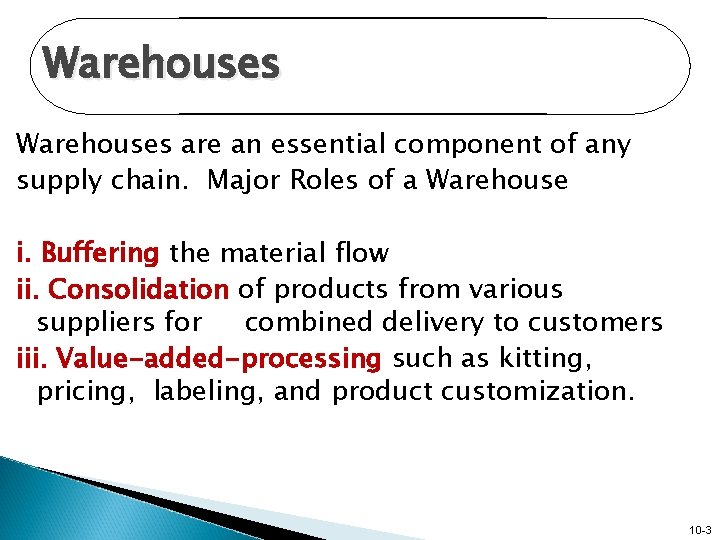
Warehouses are an essential component of any supply chain. Major Roles of a Warehouse i. Buffering the material flow ii. Consolidation of products from various suppliers for combined delivery to customers iii. Value-added-processing such as kitting, pricing, labeling, and product customization. 10 -3
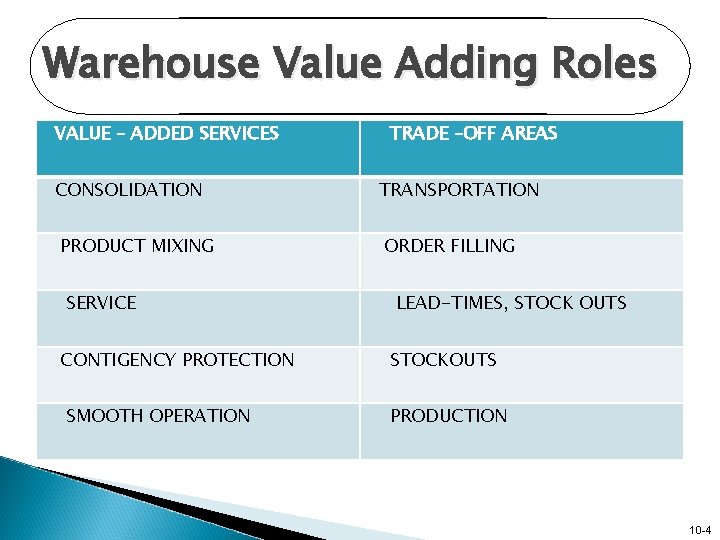
Warehouse Value Adding Roles VALUE – ADDED SERVICES CONSOLIDATION PRODUCT MIXING SERVICE CONTIGENCY PROTECTION SMOOTH OPERATION TRADE –OFF AREAS TRANSPORTATION ORDER FILLING LEAD-TIMES, STOCK OUTS STOCKOUTS PRODUCTION 10 -4
OPPERTUNITIES With the developments in the concepts of JI T , WMS and Radio Frequency identification follow new opportunities have emerged ØInventory control ØShorter response time ØGreater product variety handling ØReal time control ØEasy communication ØHigh automation 10 -5
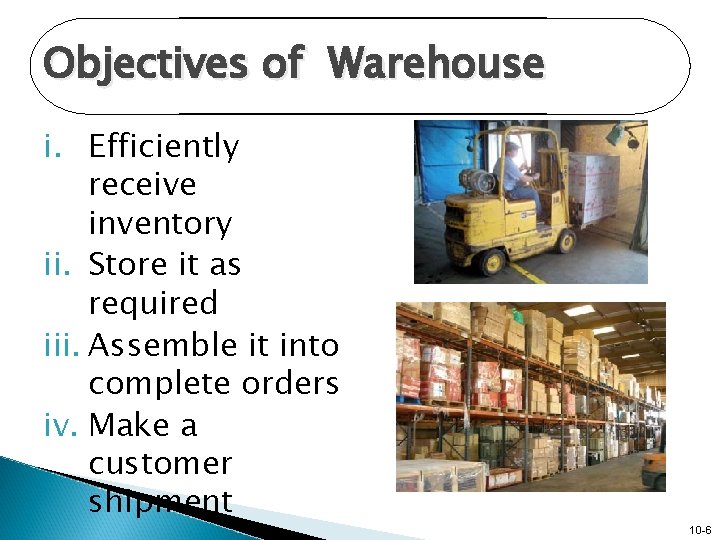
Objectives of Warehouse i. Efficiently receive inventory ii. Store it as required iii. Assemble it into complete orders iv. Make a customer shipment 10 -6
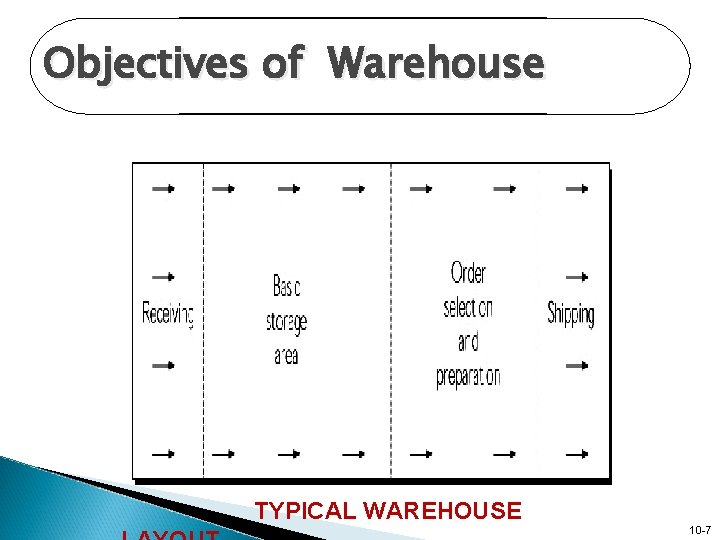
Objectives of Warehouse TYPICAL WAREHOUSE 10 -7
Functions of a Warehouse There are five functions of a Warehouse i. iii. iv. v. Consolidation ( LTL ) Mixing Service Protection against contingencies Smooth operations 10 -8
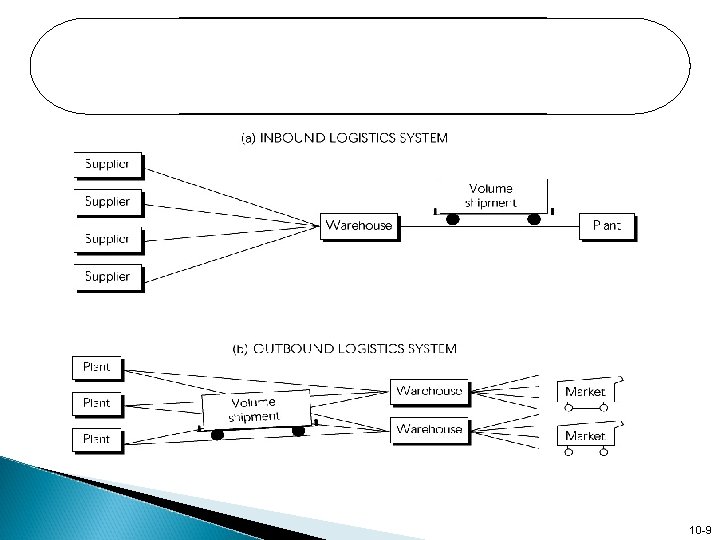
10 -9
History of Warehouse Product development shifted from households to retailers, wholesalers, and manufacturers. Warehouses stored in inventory in the logistics pipeline, serving to coordinate product supply and consumer demand. Labour productivity , material handling efficiency, and inventory turnover was a not a major concern. II. Role of strategic network increased after World war 10 -10
Basic Warehousing Decisions Basic Warehousing decisions are made trade-off framework The trade-off is between service and cost e. g. Increasing the number of warehouses in a geographic area may offer better service to customers but it will increase the inventory and transportation cost. 10 -11
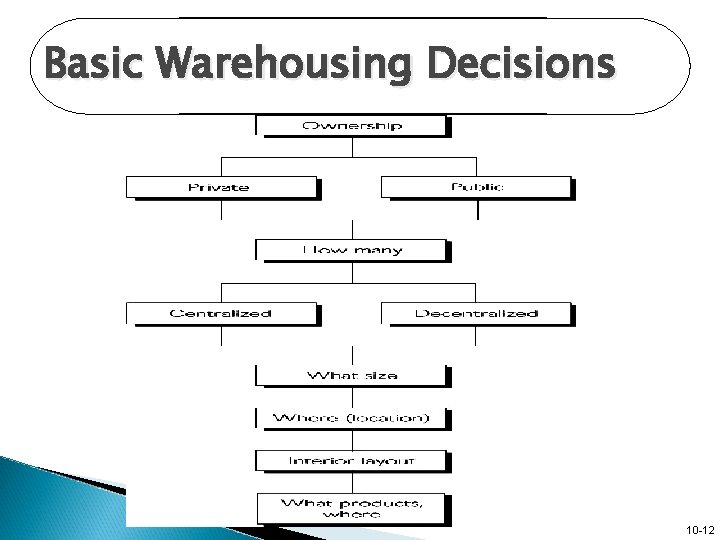
Basic Warehousing Decisions 10 -12
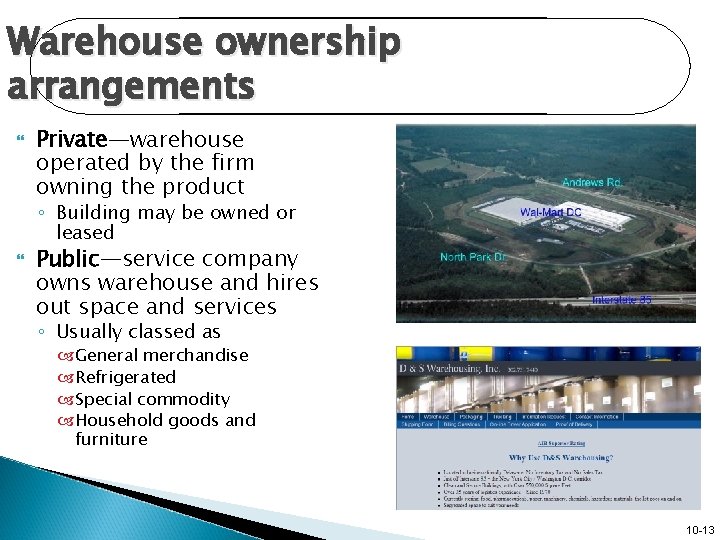
Warehouse ownership arrangements Private—warehouse operated by the firm owning the product ◦ Building may be owned or leased Public—service company owns warehouse and hires out space and services ◦ Usually classed as General merchandise Refrigerated Special commodity Household goods and furniture 10 -13
Contract warehousing combines elements of private and public operations Usually a long-term relationship or contract between a firm and the warehousing owner/operator ◦ Long-term cost savings compared with public warehouse ◦ Often a firm’s employees will work alongside the contract warehouse’s ◦ Example is Kraft Foods who has contracted with Ameri. Cold Logistics since the late 1990’s 10 -14
Public Warehouse ( Advantages ) i. No fixed Capital Investment ii. Lack of Facility risk iii. Marketplace flexibility iv. Transportation economics v. Access to special features vi. Computerization vii. Overflow Warehousing viii. Tax breaks ix. Inventory backup 10 -15
Public Warehouse ( Disadvantages ) i. Lack of timely accurate communication ii. lack of specialized service iii. lack to access to space iv. Limitations in availability 10 -16
Private Warehouse ( ADVANTAGES ) i. Direct Control ii. Less expensive for high storage and large continuous volumes iii. Simplify communication iv. Space can be used for value added services 10 -17
Private Warehouse ( Disadvantages ) i. Burden of fixed cost ii. Risk of damage iii. Presence of skilled workforce is necessary iv. Exposure to labor disputes 10 -18
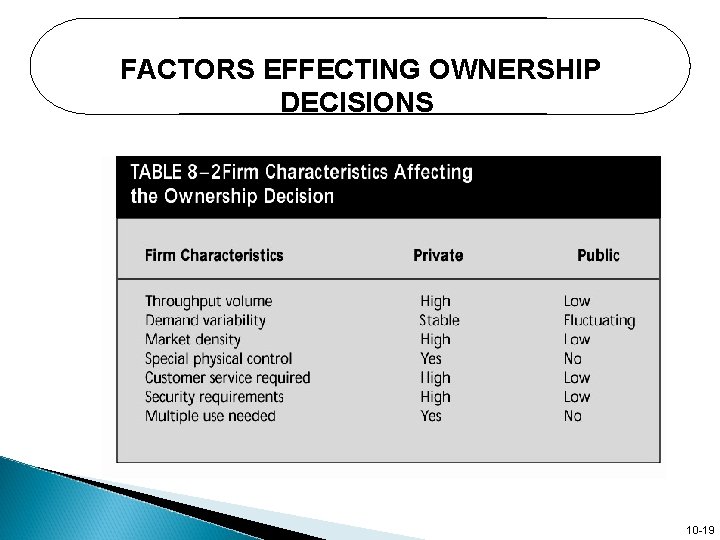
FACTORS EFFECTING OWNERSHIP DECISIONS 10 -19
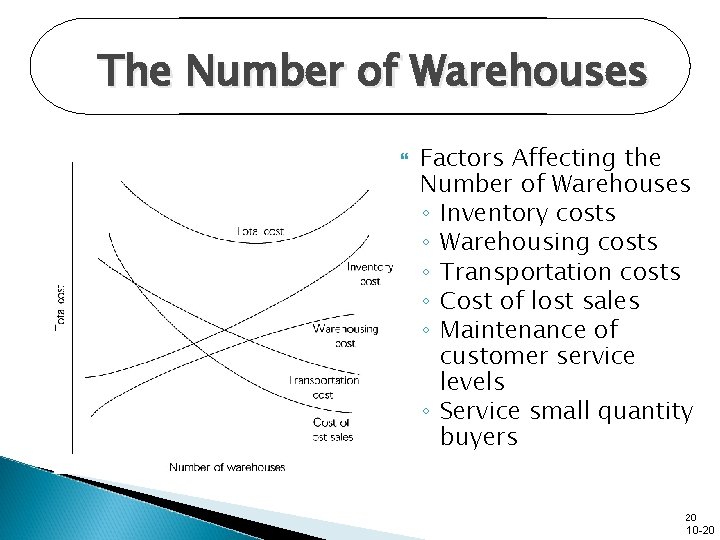
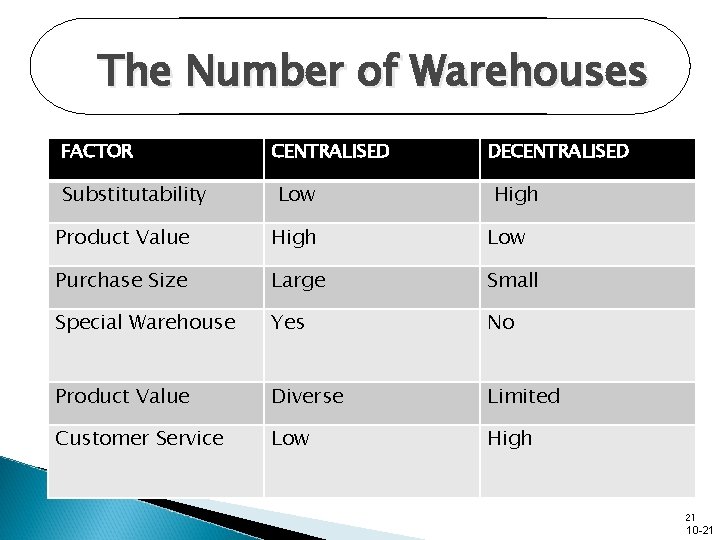
The Number of Warehouses Factors Affecting the Number of Warehouses ◦ Inventory costs ◦ Warehousing costs ◦ Transportation costs ◦ Cost of lost sales ◦ Maintenance of customer service levels ◦ Service small quantity buyers 20 10 -20
The Number of Warehouses FACTOR Substitutability CENTRALISED Low DECENTRALISED High Product Value High Low Purchase Size Large Small Special Warehouse Yes No Product Value Diverse Limited Customer Service Low High 21 10 -21
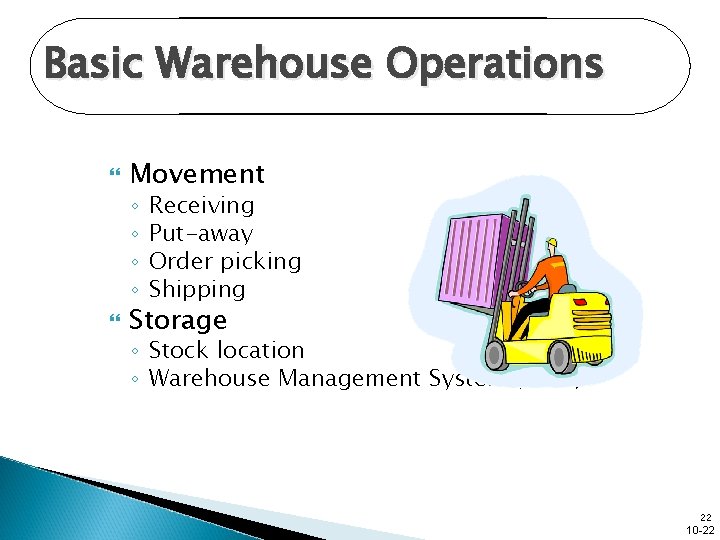
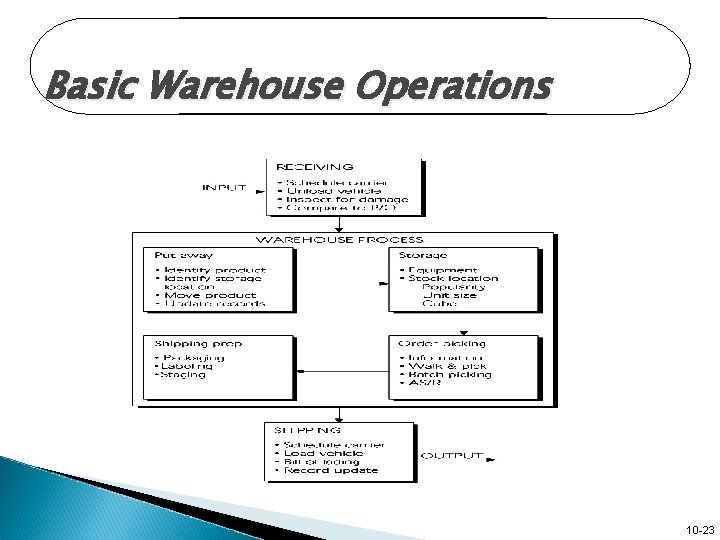
Basic Warehouse Operations Movement ◦ ◦ Receiving Put-away Order picking Shipping Storage ◦ Stock location ◦ Warehouse Management System (WMS) 22 10 -22
Basic Warehouse Operations 10 -23
Warehousing Strategies i. iii. iv. There are four types of warehouse strategies that are generally used Consolidation Warehouse Break Bulk Warehouse Processing/Postponement Stockpiling 10 -24
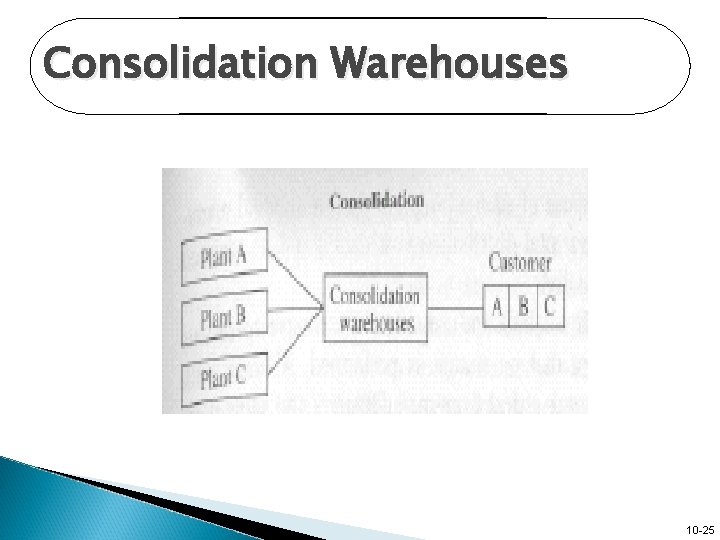
Consolidation Warehouses 10 -25
Consolidation Ø Ø Ø Shipment consolidation is an economic benefit of warehousing. With this arrangement, the consolidating warehouse receives and consolidates materials from a number of manufacturing plants destined to a specific customer on a single transportation shipment. Benefits Realization of lowest possible economic cost Reduced traffic congestion at a customer receiving dock Consolidation warehousing may be used by a single firm, or a number of firms may join together and use a for-hire consolidation service. 10 -26
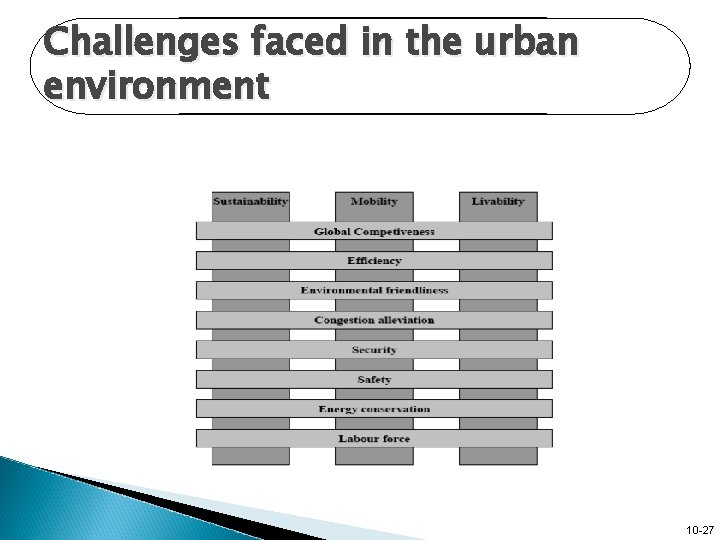
Challenges faced in the urban environment 10 -27
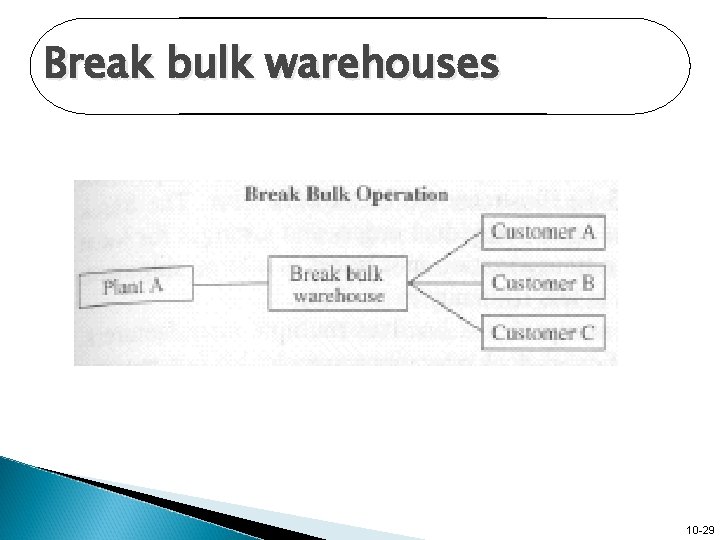
Break bulk warehouses Break bulk warehouse operations are similar to consolidation except that no storage is performed. A break bulk operation receives combined customer orders from manufacturers and ships them to individual customers. The break bulk warehouse sorts or splits individual orders and arranges for local delivery. Because the long-distance transportation movement is a large shipment, transport costs are lower and there is less difficulty in tracking. 10 -28
Break bulk warehouses 10 -29
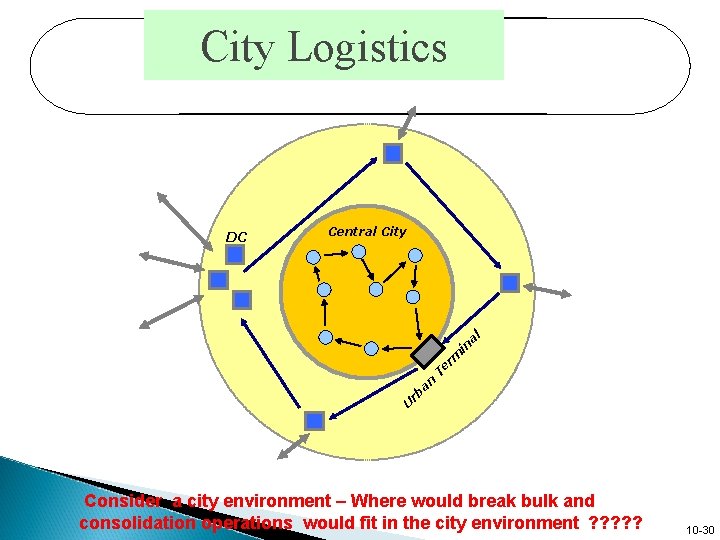
City Logistics Central City U rb an Te rm in al DC Consider a city environment – Where would break bulk and consolidation operations would fit in the city environment ? ? ? 10 -30
Processing/Postponement Warehouses can also be used to postpone, or delay, production by performing processing and light manufacturing activities. A warehouse with packaging or labeling capability allows postponement of final production until actual demand is known. For example, vegetables can be processed and canned in "brights" at the manufacturer. Brights are cans with no pre-attached labels. Impact of postponement on maintenance cost 10 -31
Processing/Postponement… The use of brights for a private label product means that the item does not have to be committed to a specific customer or package configuration at the manufacturer's plant. Once a specific customer order is received, the warehouse can complete final processing by adding the label and finalizing the packaging. 10 -32
Processing/Postponement… Benefits I. First, risk is minimized because final packaging is not completed until an order for a specific label and package has been received. II. Second, the required level of total inventory can be reduced by using the basic product (brights) for a variety of labeling and packaging configurations. 10 -33
Stockpiling The economic benefit of stockpiling comes from the need of seasonal storage. LAWN FURNTIRUE VS AGRICULTURE PRODUCTS 10 -34
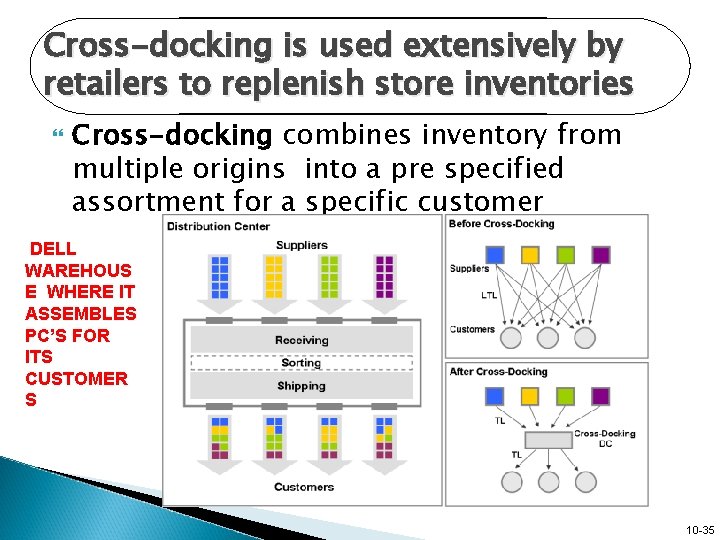
Cross-docking is used extensively by retailers to replenish store inventories Cross-docking combines inventory from multiple origins into a pre specified assortment for a specific customer DELL WAREHOUS E WHERE IT ASSEMBLES PC’S FOR ITS CUSTOMER S 10 -35
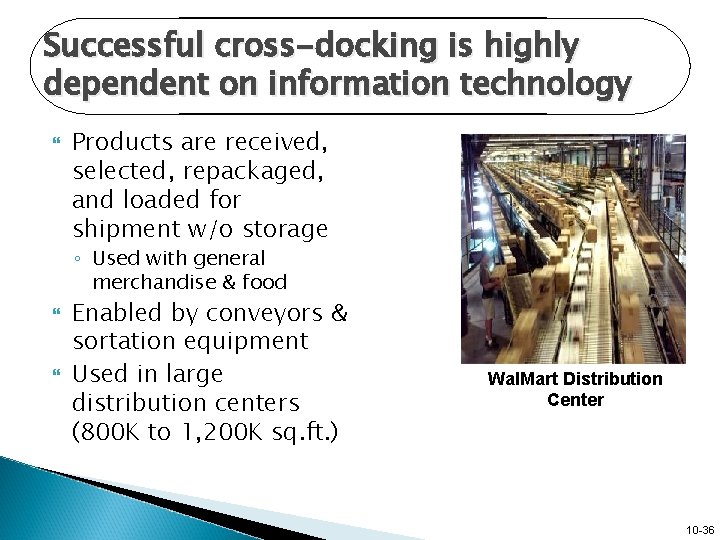
Successful cross-docking is highly dependent on information technology Products are received, selected, repackaged, and loaded for shipment w/o storage ◦ Used with general merchandise & food Enabled by conveyors & sortation equipment Used in large distribution centers (800 K to 1, 200 K sq. ft. ) Wal. Mart Distribution Center 10 -36
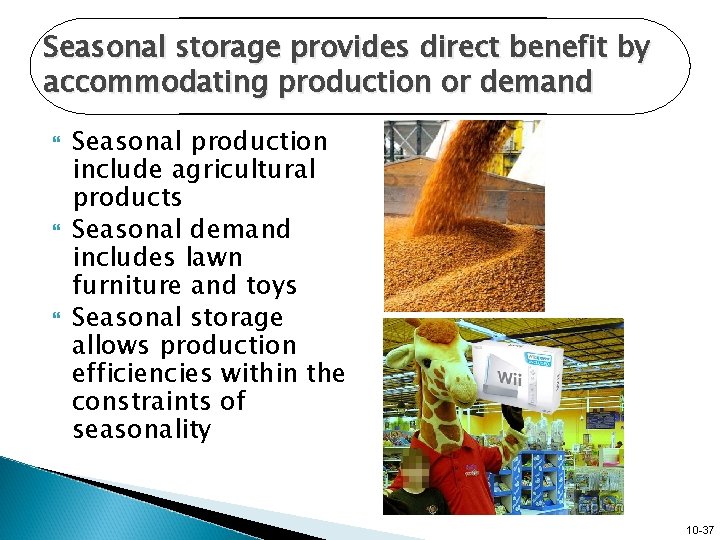
Seasonal storage provides direct benefit by accommodating production or demand Seasonal production include agricultural products Seasonal demand includes lawn furniture and toys Seasonal storage allows production efficiencies within the constraints of seasonality 10 -37
Service Benefits Five basic service benefits are achieved through warehousing: ◦ ◦ ◦ spot stock, assortment, mixing, production support, and market presence. 10 -38
Spot Stock Under spot stocking, a selected amount of a firm's product line is placed or "spot stocked" in a warehouse to fill customer orders during a critical marketing period. In particular, manufacturers with limited or highly seasonal product lines are partial to this service. Rather than placing inventories in warehouse facilities on a year-round basis or shipping directly from manufacturing plants, delivery time can be substantially reduced by advanced inventory commitment to strategic markets. 10 -39
Spot Stock… Utilizing warehouse facilities for stock spotting allows inventories to be placed in a variety of markets adjacent to key customers just prior to a maximum period of seasonal sales. Suppliers of agricultural products to farmers often use spot stocking to position their products closer to a service-sensitive market during the growing season. Following the sales season, the remaining inventory is withdrawn to a central warehouse. 10 -40
Assortment An assortment warehouse stocks product combinations in anticipation of customer orders. The assortments may represent multiple products from different manufacturers or special assortments as specified by customers. In the first case, for example, an athletic wholesaler would stock products from a number of clothing suppliers so that customers can be offered assortments. In the second case, the wholesaler would create a specific team uniform including shirt, pants, and shoes. 10 -41
Assortment vs. Spot Stock The differential between stock spotting and complete line assortment is the degree and duration of warehouse utilization. A firm following a stock spotting would typically warehouse a narrow product assortment and place stocks in a large number of small warehouses dedicated to specific markets for a limited time period. Distribution assortment warehouse usually has a broad product line, is limited to a few strategic locations, and is functional year-round. The combined assortments also allow larger shipment quantities, which in turn reduce transportation cost. 10 -42
Mixing In a typical mixing situation, truckloads of products are shipped from manufacturing plants to warehouses. Each large shipment enjoys the lowest possible transportation rate. Upon arrival at the mixing warehouse, factory shipments are unloaded and the desired combination of each product for each customer or market is selected. When plants are geographically separated, overall transportation charges and warehouse requirements can be reduced by mixing. 10 -43
Production Support Production support warehousing provides a steady supply of components and materials to assembly plants. Safety stocks on items purchased from outside vendors may be justified because of long lead times or significant variations in usage. The operation of a production support warehouse is to supply or "feed" processed materials, components, and subassemblies into the assembly plant in an economic and timely manner. 10 -44
Market Presence While a market presence benefit may not be so obvious, it is often cited by marketing managers as a major advantage of local warehouses. The market presence factor is based on the perception or belief that local warehouses can be more responsive to customer needs and offer quicker delivery than more distant warehouses. As a result, it is also thought that a local warehouse will enhance market share and potentially increase profitability. 10 -45
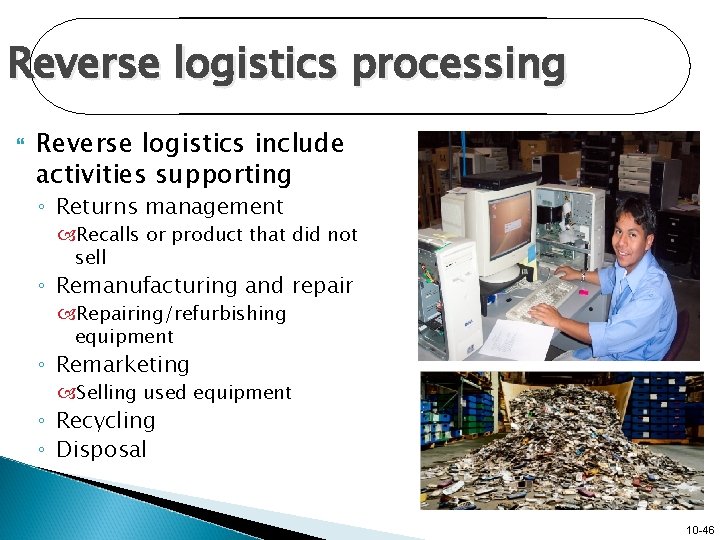
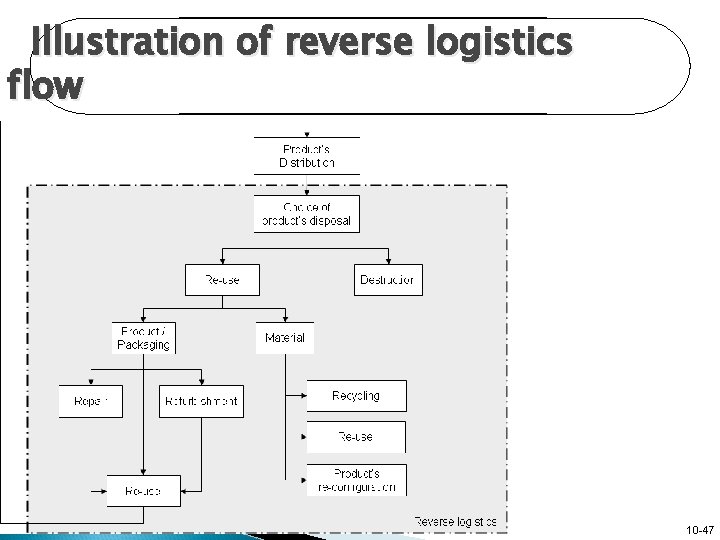
Reverse logistics processing Reverse logistics include activities supporting ◦ Returns management Recalls or product that did not sell ◦ Remanufacturing and repair Repairing/refurbishing equipment ◦ Remarketing Selling used equipment ◦ Recycling ◦ Disposal 10 -46
Illustration of reverse logistics flow 10 -47
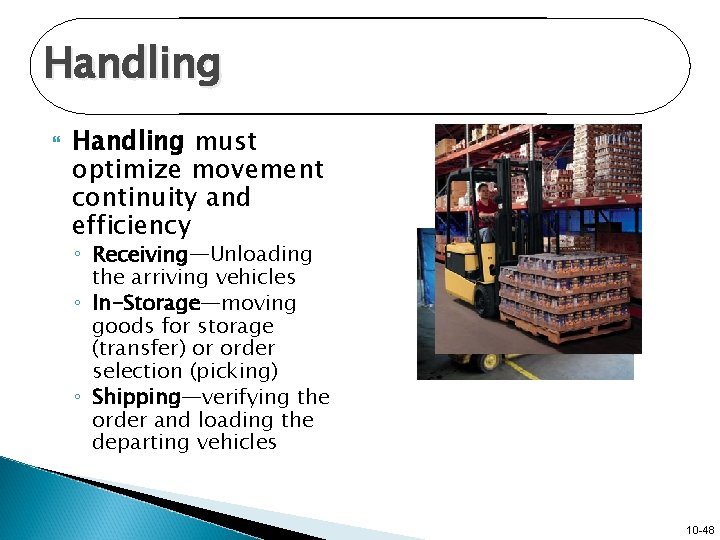
Handling must optimize movement continuity and efficiency ◦ Receiving—Unloading the arriving vehicles ◦ In-Storage—moving goods for storage (transfer) or order selection (picking) ◦ Shipping—verifying the order and loading the departing vehicles 10 -48
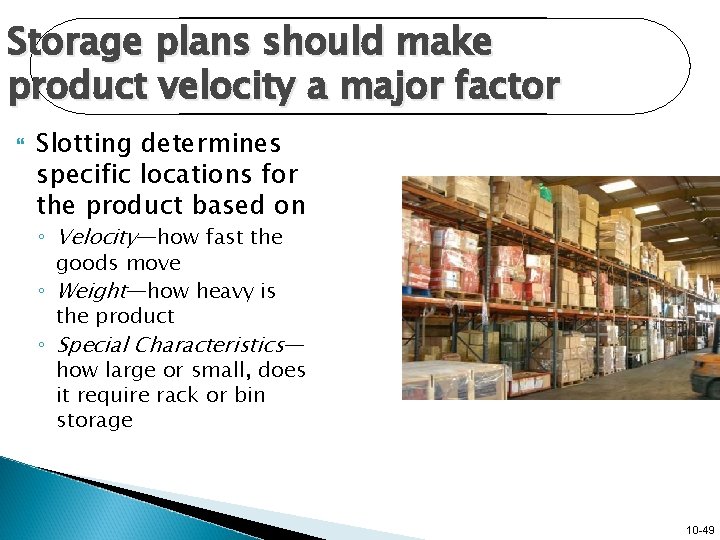
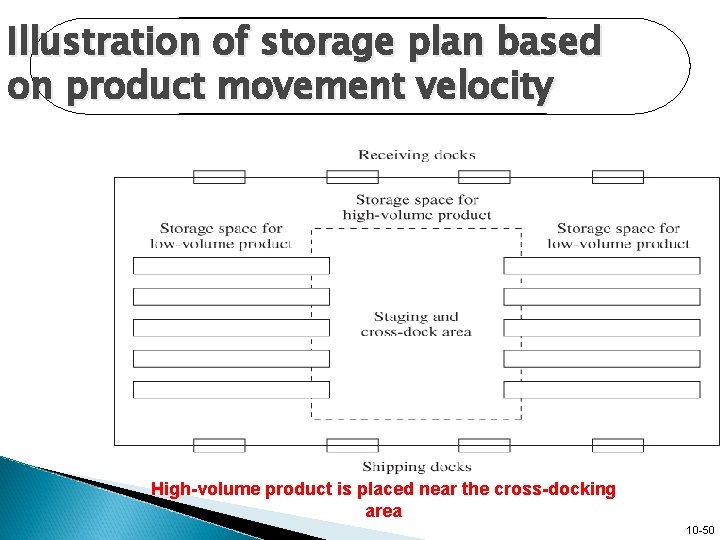
Storage plans should make product velocity a major factor Slotting determines specific locations for the product based on ◦ Velocity—how fast the goods move ◦ Weight—how heavy is the product ◦ Special Characteristics— how large or small, does it require rack or bin storage 10 -49
Illustration of storage plan based on product movement velocity High-volume product is placed near the cross-docking area 10 -50
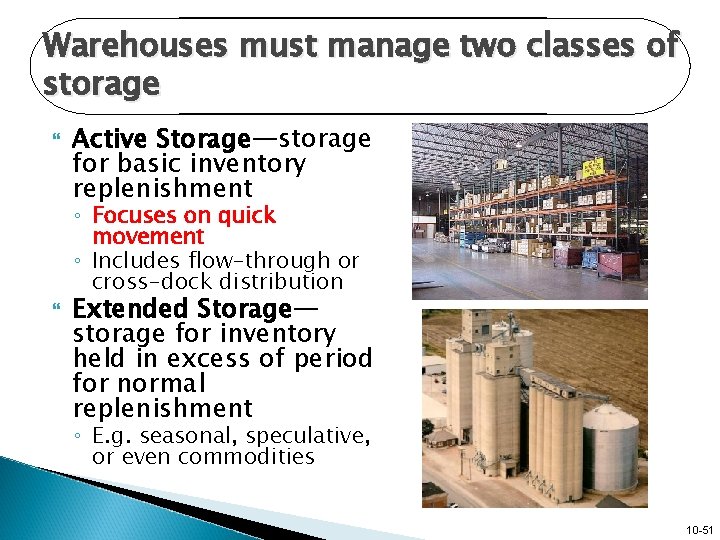
Warehouses must manage two classes of storage Active Storage—storage for basic inventory replenishment ◦ Focuses on quick movement ◦ Includes flow-through or cross-dock distribution Extended Storage— storage for inventory held in excess of period for normal replenishment ◦ E. g. seasonal, speculative, or even commodities 10 -51
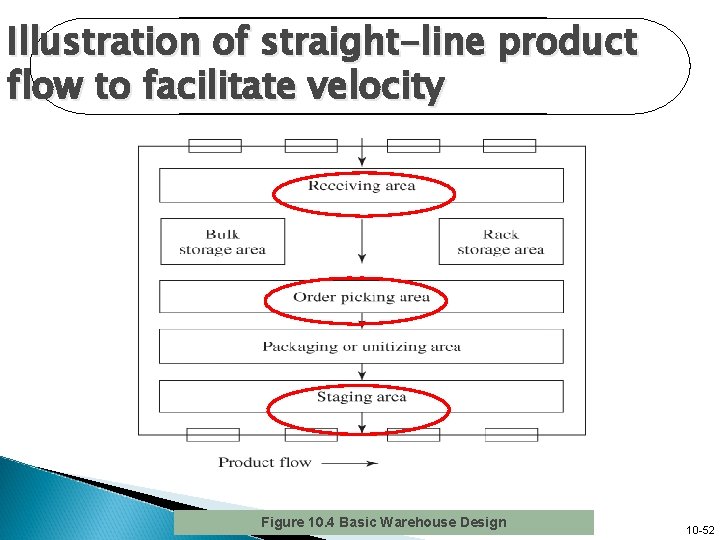
Illustration of straight-line product flow to facilitate velocity Figure 10. 4 Basic Warehouse Design 10 -52
Warehouse management systems encourage best practices Warehouse management systems (WMS) integrate procedures and software support to standardize storage and handling work procedures One main use of WMS is to coordinate order selection ◦ Discrete selection is when a specific customer’s order is selected and prepared for shipment as a single work assignment ◦ Wave or batch selection is when orders are processed through zones of the warehouse assigned to specific employees 10 -53
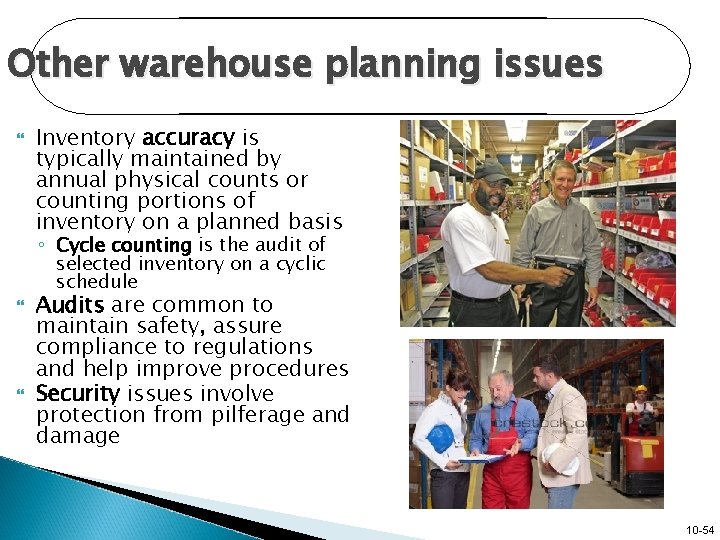
Other warehouse planning issues Inventory accuracy is typically maintained by annual physical counts or counting portions of inventory on a planned basis ◦ Cycle counting is the audit of selected inventory on a cyclic schedule Audits are common to maintain safety, assure compliance to regulations and help improve procedures Security issues involve protection from pilferage and damage 10 -54
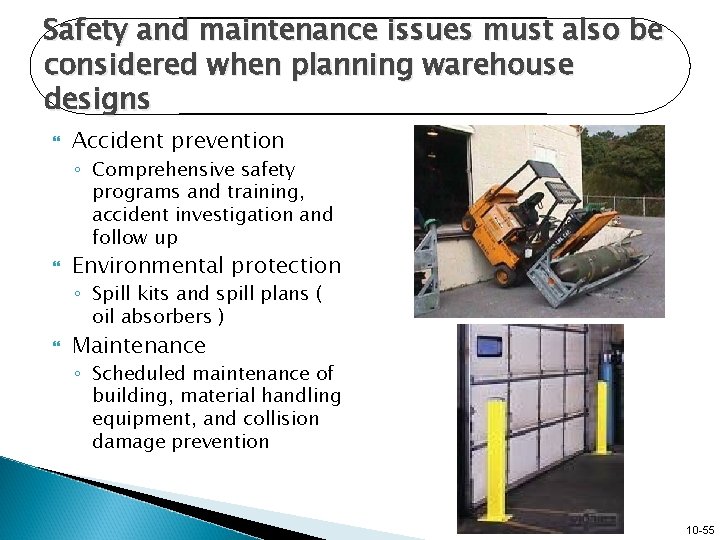
Safety and maintenance issues must also be considered when planning warehouse designs Accident prevention ◦ Comprehensive safety programs and training, accident investigation and follow up Environmental protection ◦ Spill kits and spill plans ( oil absorbers ) Maintenance ◦ Scheduled maintenance of building, material handling equipment, and collision damage prevention 10 -55
ISSUE OF LAST MILE Freight Tonnage Increases by 2020 EU 70% by 2020 USA similar World container traffic 8% p. a. growth All culminate in a “last mile” 10 -56
What is the future of warehouse management? Will warehouses grow smaller in the future? ◦ Offer a wider range of services? ◦ Will final assembly of goods be increasingly done in warehouses? What is your solution to the “challenge of the last mile” posed by Dr. Patrick Dixon? ◦ Video link (7: 45 min. ) https: //www. youtube. com/watch? v=Zb. PMax. Nl 3 J 4 10 -57