
Warehouse Profiling Chapter 2 Activity Profiling Systematic analysis
- Slides: 29
Warehouse Profiling Chapter 2
Activity Profiling • Systematic analysis of item and order activity – Used to quickly identify root causes of material and information flow problems – Pinpoint major opportunities for process improvements – Provide an objective basis for project-team decision making.
Profiling Motivations and Minefields • • • Profiling Pays Drown in a shallow lake – “on average” Data stimulates creative thinking A picture is worth 1, 000 words Paralysis by analysis
Key Profiling Facts • What is the business? Who are the customers? What are the service requirements? What special handling is required? • The area of the warehouse and types of storage, material handling equipment • Average number of SKUs in the warehouse • Average number of pick-lines shipped per day • Average number of units per pick-line • Average number of customer orders shipped in a day • Number of order-pickers and how many shifts devoted to pallet movement, to case-picking, and to broken case picking • Average number of shipments received in a day • Average rate of introduction of new SKUs • Seasonalities
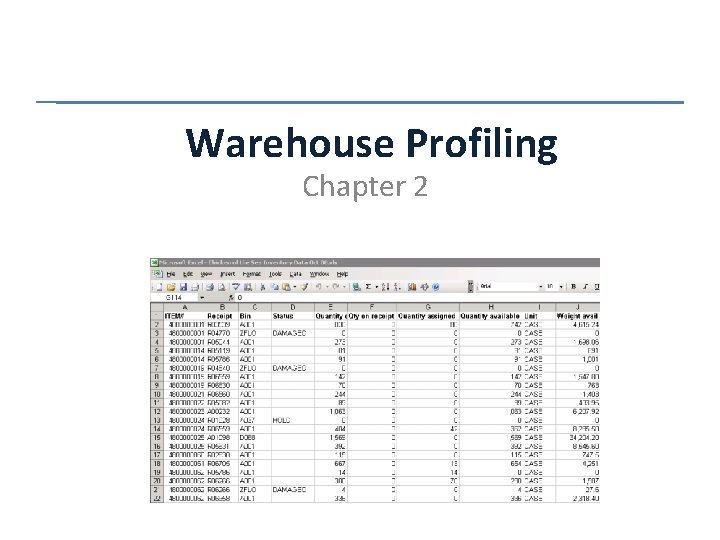
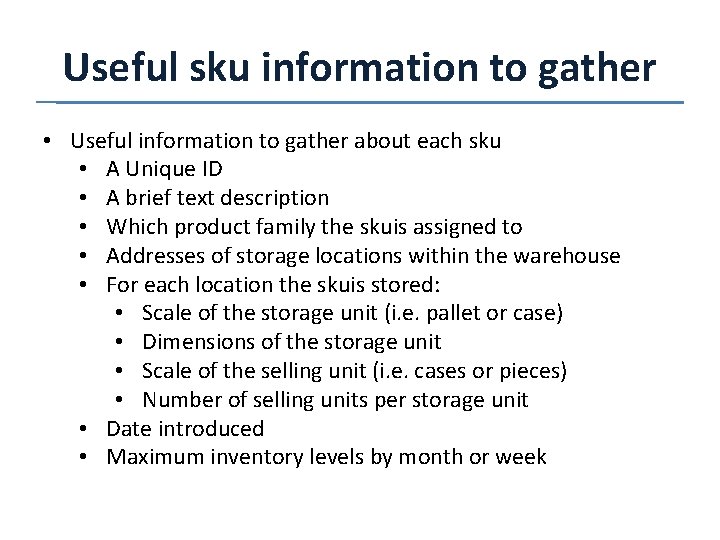
Useful sku information to gather • Useful information to gather about each sku • A Unique ID • A brief text description • Which product family the skuis assigned to • Addresses of storage locations within the warehouse • For each location the skuis stored: • Scale of the storage unit (i. e. pallet or case) • Dimensions of the storage unit • Scale of the selling unit (i. e. cases or pieces) • Number of selling units per storage unit • Date introduced • Maximum inventory levels by month or week
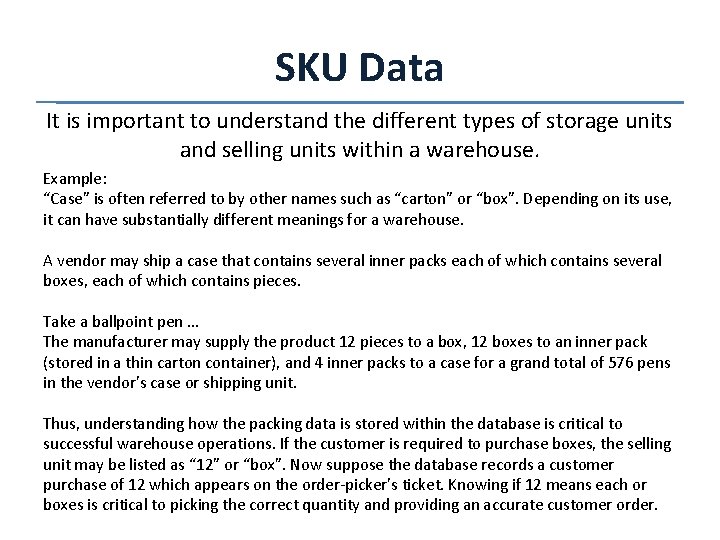
SKU Data It is important to understand the different types of storage units and selling units within a warehouse. Example: “Case” is often referred to by other names such as “carton” or “box”. Depending on its use, it can have substantially different meanings for a warehouse. A vendor may ship a case that contains several inner packs each of which contains several boxes, each of which contains pieces. Take a ballpoint pen … The manufacturer may supply the product 12 pieces to a box, 12 boxes to an inner pack (stored in a thin carton container), and 4 inner packs to a case for a grand total of 576 pens in the vendor’s case or shipping unit. Thus, understanding how the packing data is stored within the database is critical to successful warehouse operations. If the customer is required to purchase boxes, the selling unit may be listed as “ 12” or “box”. Now suppose the database records a customer purchase of 12 which appears on the order-picker’s ticket. Knowing if 12 means each or boxes is critical to picking the correct quantity and providing an accurate customer order.
Warehouse Design Considerations • General considerations – Quantity and character of goods must be known— product profiling – Know the purpose to be served • Storage • Distribution • Cross-docking
Warehouse Design Considerations • Trade-offs – Fixed versus variable slot locations for merchandise – Build out (horizontal) versus build up (vertical) – Order-picking versus stock-replenishing functions – Two-dock versus single-dock layout – Conventional, narrow, or very narrow aisles – Paperless warehousing vs. traditional paper-oriented warehousing operations – Other space needs
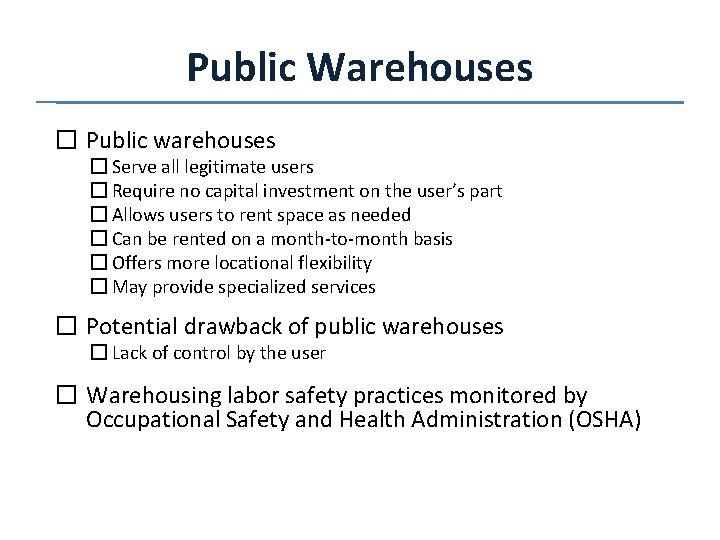
Public Warehouses � Public warehouses � Serve all legitimate users � Require no capital investment on the user’s part � Allows users to rent space as needed � Can be rented on a month-to-month basis � Offers more locational flexibility � May provide specialized services � Potential drawback of public warehouses � Lack of control by the user � Warehousing labor safety practices monitored by Occupational Safety and Health Administration (OSHA)
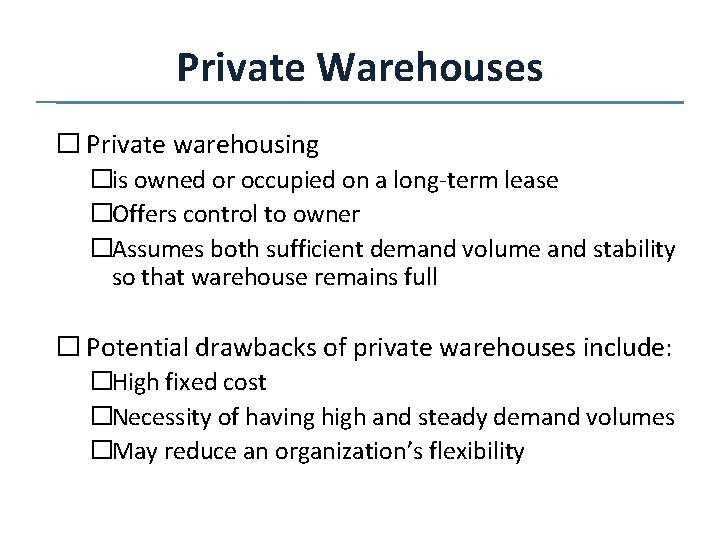
Private Warehouses � Private warehousing �is owned or occupied on a long-term lease �Offers control to owner �Assumes both sufficient demand volume and stability so that warehouse remains full � Potential drawbacks of private warehouses include: �High fixed cost �Necessity of having high and steady demand volumes �May reduce an organization’s flexibility
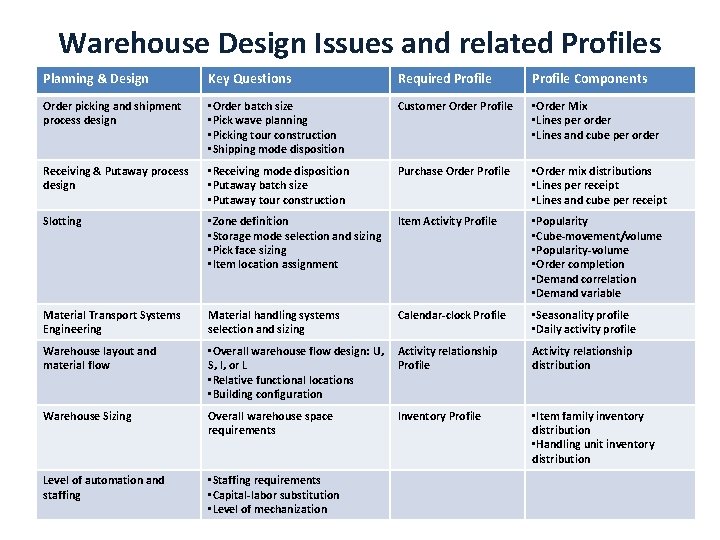
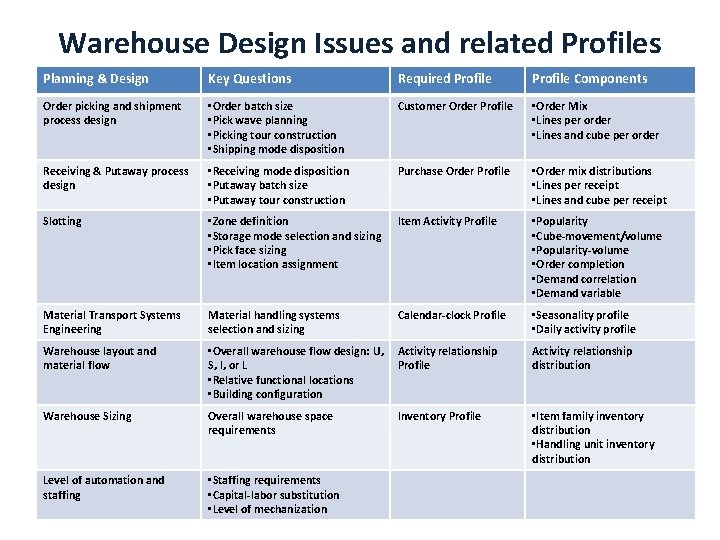
Warehouse Design Issues and related Profiles Planning & Design Key Questions Required Profile Components Order picking and shipment process design • Order batch size • Pick wave planning • Picking tour construction • Shipping mode disposition Customer Order Profile • Order Mix • Lines per order • Lines and cube per order Receiving & Putaway process design • Receiving mode disposition • Putaway batch size • Putaway tour construction Purchase Order Profile • Order mix distributions • Lines per receipt • Lines and cube per receipt Slotting • Zone definition • Storage mode selection and sizing • Pick face sizing • Item location assignment Item Activity Profile • Popularity • Cube-movement/volume • Popularity-volume • Order completion • Demand correlation • Demand variable Material Transport Systems Engineering Material handling systems selection and sizing Calendar-clock Profile • Seasonality profile • Daily activity profile Warehouse layout and material flow • Overall warehouse flow design: U, S, I, or L • Relative functional locations • Building configuration Activity relationship Profile Activity relationship distribution Warehouse Sizing Overall warehouse space requirements Inventory Profile • Item family inventory distribution • Handling unit inventory distribution Level of automation and staffing • Staffing requirements • Capital-labor substitution • Level of mechanization
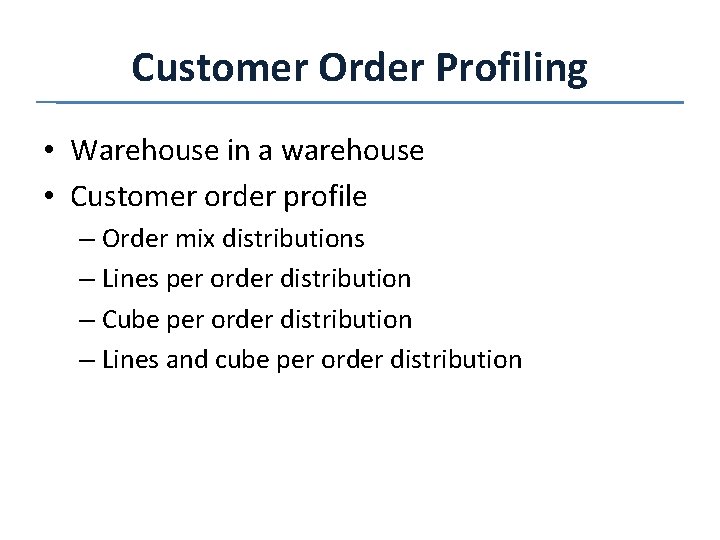
Customer Order Profiling • Warehouse in a warehouse • Customer order profile – Order mix distributions – Lines per order distribution – Cube per order distribution – Lines and cube per order distribution
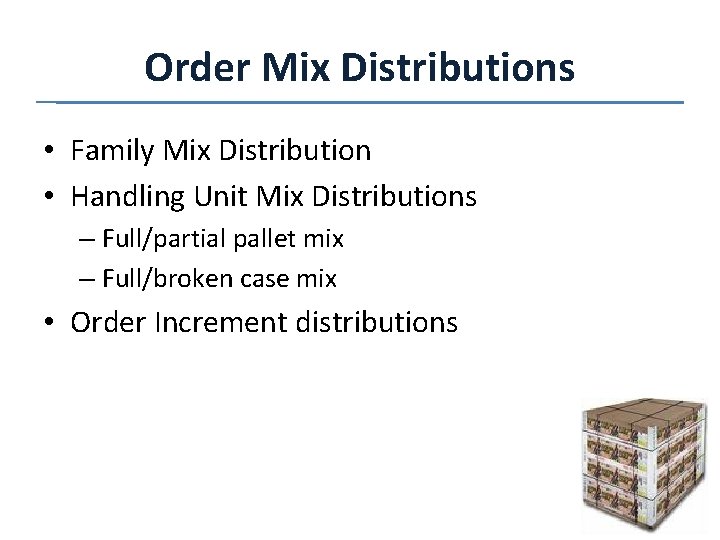
Order Mix Distributions • Family Mix Distribution • Handling Unit Mix Distributions – Full/partial pallet mix – Full/broken case mix • Order Increment distributions
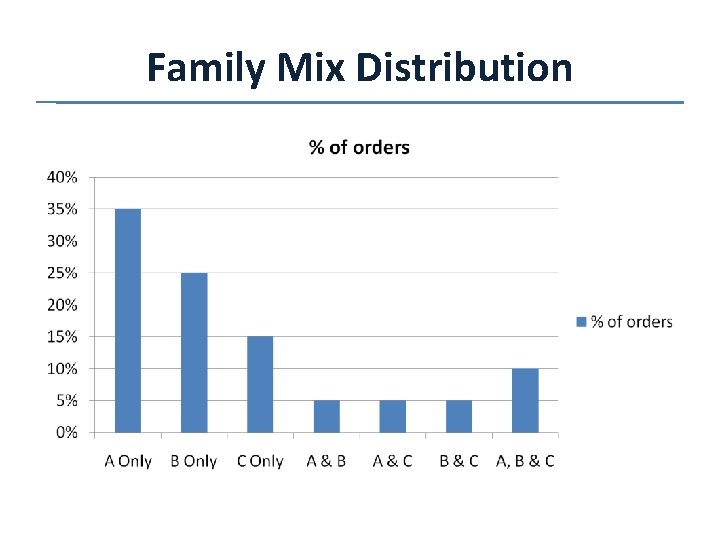
Family Mix Distribution
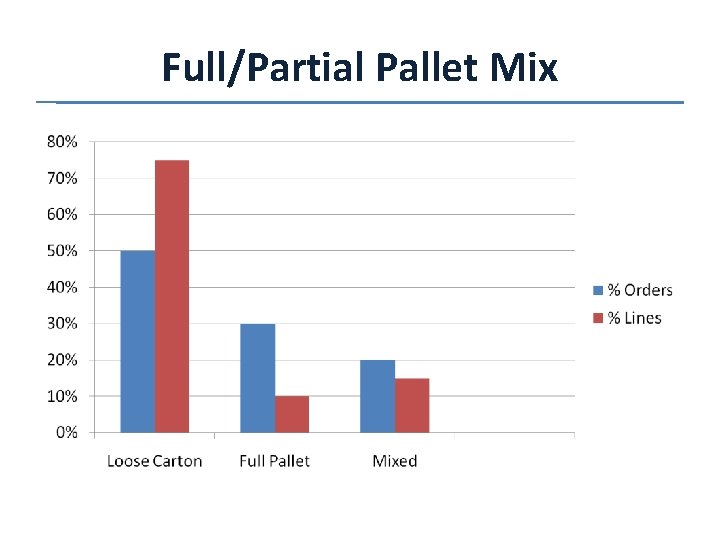
Full/Partial Pallet Mix
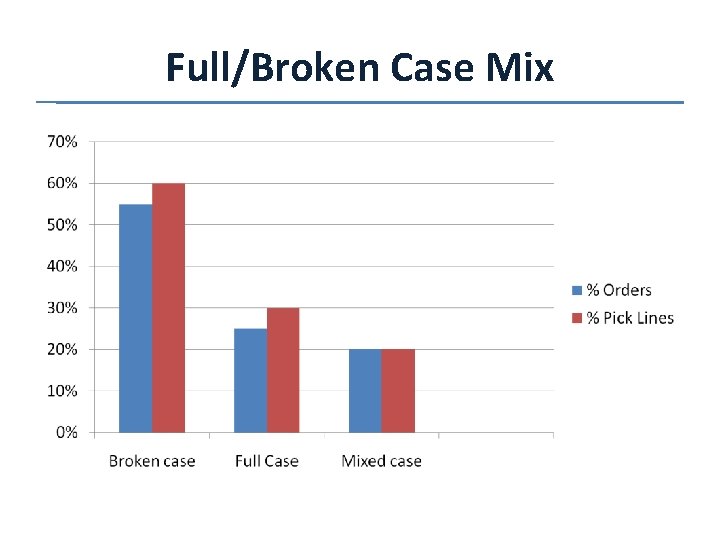
Full/Broken Case Mix
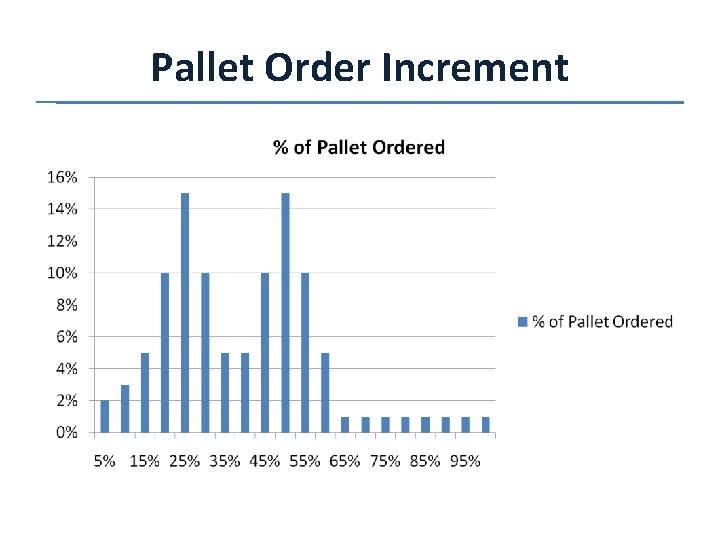
Pallet Order Increment
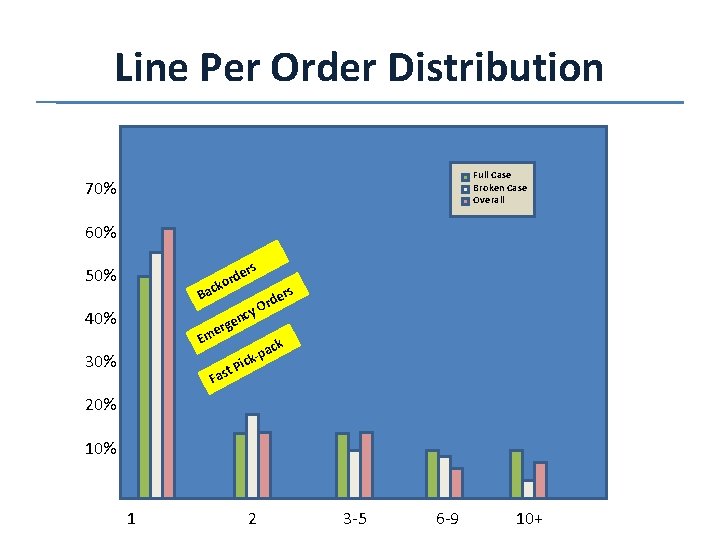
Line Per Order Distribution Full Case Broken Case Overall 70% 60% ers 50% rd cko Ba 40% rs ncy e erg Em 30% t Fas e Ord ack -p ick P 20% 1 2 3 -5 6 -9 10+
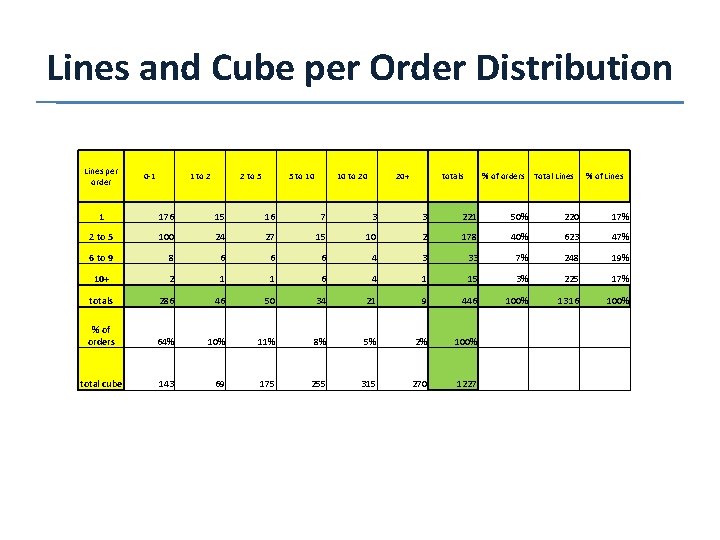
Lines and Cube per Order Distribution Lines per order 0 -1 1 to 2 2 to 5 5 to 10 10 to 20 20+ totals % of orders Total Lines % of Lines 1 176 15 16 7 3 3 221 50% 220 17% 2 to 5 100 24 27 15 10 2 178 40% 623 47% 6 to 9 8 6 6 6 4 3 33 7% 248 19% 10+ 2 1 1 6 4 1 15 3% 225 17% totals 286 46 50 34 21 9 446 100% 1316 100% % of orders 64% 10% 11% 8% 5% 2% 100% total cube 143 69 175 255 315 270 1227
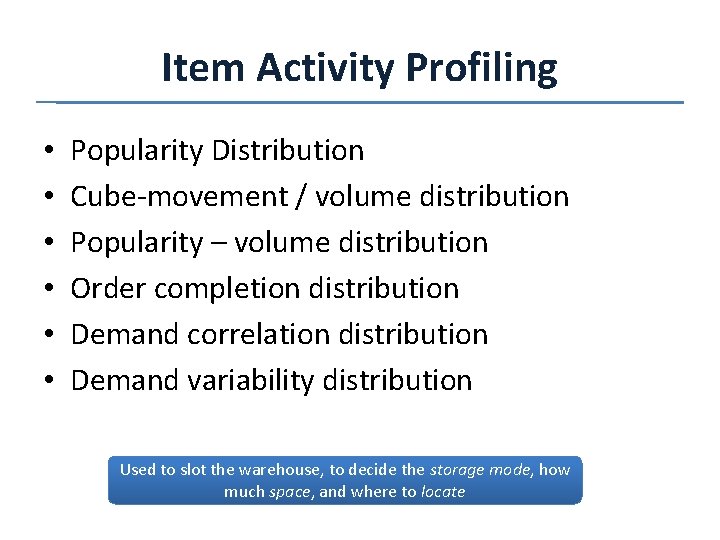
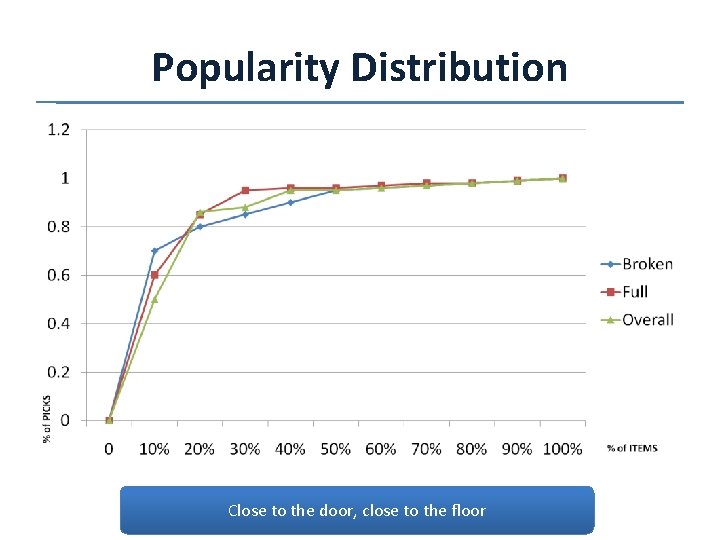
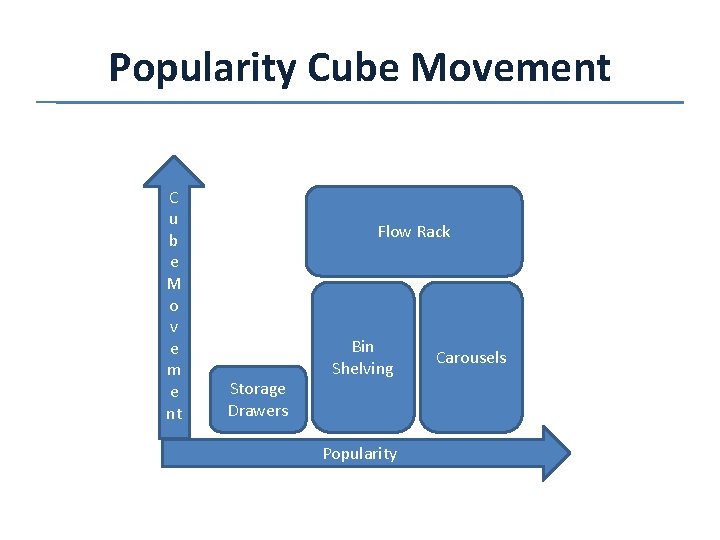
Item Activity Profiling • • • Popularity Distribution Cube-movement / volume distribution Popularity – volume distribution Order completion distribution Demand correlation distribution Demand variability distribution Used to slot the warehouse, to decide the storage mode, how much space, and where to locate
Popularity Distribution Close to the door, close to the floor
Popularity Cube Movement C u b e M o v e m e nt Flow Rack Storage Drawers Bin Shelving Popularity Carousels
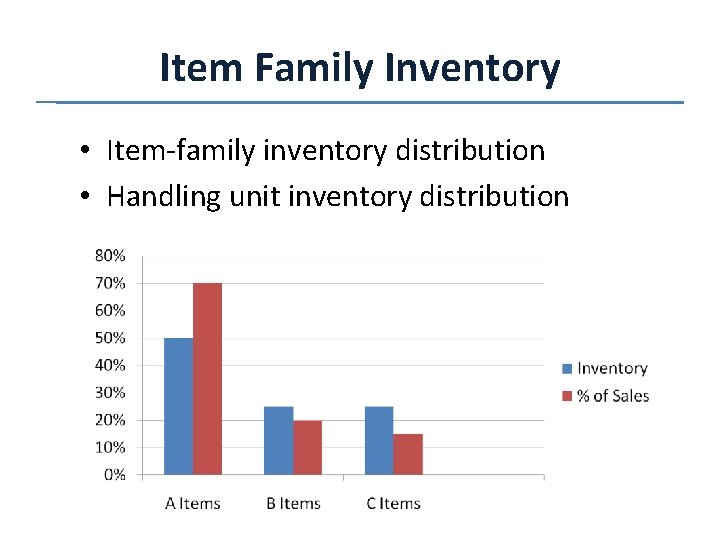
Item Family Inventory • Item-family inventory distribution • Handling unit inventory distribution
Inventory Profile • Item-family inventory distribution • Handling unit inventory distribution
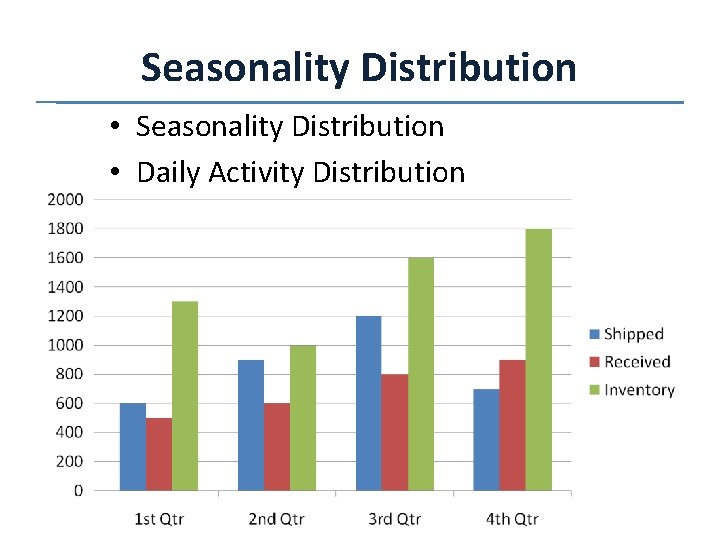
Calendar – Clock Profile • Seasonality Distribution • Daily Activity Distribution
Seasonality Distribution • Daily Activity Distribution
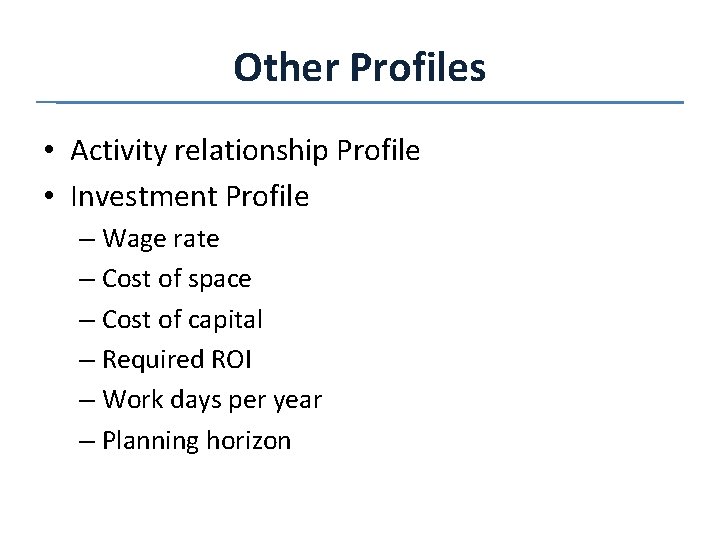
Other Profiles • Activity relationship Profile • Investment Profile – Wage rate – Cost of space – Cost of capital – Required ROI – Work days per year – Planning horizon
Warehouse Design Issues and related Profiles Planning & Design Key Questions Required Profile Components Order picking and shipment process design • Order batch size • Pick wave planning • Picking tour construction • Shipping mode disposition Customer Order Profile • Order Mix • Lines per order • Lines and cube per order Receiving & Putaway process design • Receiving mode disposition • Putaway batch size • Putaway tour construction Purchase Order Profile • Order mix distributions • Lines per receipt • Lines and cube per receipt Slotting • Zone definition • Storage mode selection and sizing • Pick face sizing • Item location assignment Item Activity Profile • Popularity • Cube-movement/volume • Popularity-volume • Order completion • Demand correlation • Demand variable Material Transport Systems Engineering Material handling systems selection and sizing Calendar-clock Profile • Seasonality profile • Daily activity profile Warehouse layout and material flow • Overall warehouse flow design: U, S, I, or L • Relative functional locations • Building configuration Activity relationship Profile Activity relationship distribution Warehouse Sizing Overall warehouse space requirements Inventory Profile • Item family inventory distribution • Handling unit inventory distribution Level of automation and staffing • Staffing requirements • Capital-labor substitution • Level of mechanization
Preparing a Profile • • Suggestions for getting started Prepare the data: Organize it. Perform consistency checks. Identify missing or inconsistent data and develop a plan for handling them (Fix? Ignore? ). Profiling warehouse activity in the zones of interest to us: What are the most popular skus? What are the most popular vendors? How much space is devoted to each sku and to each vendor? What is the distribution of lines-per-order in Zones B and C? How many picks come from each zone? How many picks come from reserve locations and how many from active pick locations? Which sku's have reserve locations and in what zone? Prepare a visualization of which aisles are most visited. For more detail, prepare a visualization of which sections of shelf are most visited. Here is version 0. 1 of a tool to generate such a visualization. (Note: It would be helpful and not hard for you to adapt this tool, make it more general, and provide more adequate documentation. Making this tool more generally useful could be a significant contribution even though it does not directly address the client's issues. ) Has SPR chosen the correct skus to store in the fast-pick area and the correct amounts? Use a spreadsheet to check this via the fluid model. If a fast-pick area seems a promising idea, use commercial software to slot it and the reserve area. Finally, do not work only on slotting. This is a complicated issue at SPR. (It might be valid to conclude that a fast-pick area offers them too little benefit for the complexity of design and maintenance. ) Do not lose sight of the big issue: How can pick-rates be increased?